Paper commentary
Scaling public input on AI policy with pluralistic agents
Pluralistic agents let people shape AI policy without joining every discussion
- Problem Public input on AI safety policy is hard to scale, because people cannot join every discussion or share private information. Earlier AI tools mostly mediated human talk rather than speaking for people who were absent.
- Method Pluralistic agents are AI representatives that interview each person first, then speak for them in group discussion. Unlike a single AI drafter, each person keeps a voice, and a Policy Writer revises one shared draft after every round.
- Results In a 746-person preregistered study, Pluralistic Agents recovered 68% of the satisfaction gap between Direct Discussion and Single AI. Participants also rated the process as fair.
Where AI policy deliberation gets stuck
Most AI safety policy is drafted by a narrow group of specialists and agents that mostly talk among themselves. That closed format may limit the room for pluralistic alignment, which asks for diverse human values to shape AI development. Digital tools have long been proposed as political proxies, under labels such as e-democracy, deliberationware and augmented democracy.
Empirical tests of these agent representatives have been limited, because limited technical capabilities prevented major testing. Recent LLM agents have grown much more capable at conversation and reasoning, and safety researchers have called for agent advocates that represent individuals.
Existing methods use AI as a mediator of human deliberation rather than as a stand-in for people. So the open question is whether an agent can speak for someone who is absent from the room.
Agent-only deliberation adds its own risk, because interacting agents can compound their homogeneity. Agents assigned distinct political positions drift toward the model's priors over the course of a debate. The paper's authors say a substantial gap remains in tools for pluralistic alignment at scale.
One agent per persona, and why it interviews first
Each represented person gets an agent that interviews them first and then speaks for them in the group discussion. The interview captures a person's first views before the group talks, following the Nominal Group Technique and the Delphi method. The authors built this stage to limit groupthink and anchoring to the first views voiced in the group.
Without the interview, an agent would have to improvise a position in the middle of the debate. In the single-AI baseline, the Policy Writer runs the same interview and then writes the policy alone.
Personas come from the backstories method, which samples age, gender, and occupation from U.S.-representative distributions. An LLM then writes a natural-language description for each sampled persona. The authors don't present these simulations as accurate forecasts of human behavior. They argue the method mitigates the bias and homogeneity that come from prompting with explicit demographic characteristics.
Each persona is then interviewed on the AI safety policy topic under discussion.
In the discussion, each agent sends one message per round, which keeps speaking time from concentrating among a few voices. Text-only interaction under aliases strips out the demographic and social status cues that would otherwise carry influence. After each participant speaks, the Policy Writer agent drafts the policy and revises it against the next round of arguments.
This keeps the group working from one concrete draft.
Why a budget task replaces open-ended drafting
Open-ended drafting ended too early, because the personas were readily satisfied with the first natural-language statements. Each deliberation stopped at the earliest possible round, so little real disagreement remained for the authors to study. The authors switched to a budget policy that divides a topic's priorities under a zero-sum constraint.
Agents split 100% of a budget across four priorities, such as AI and Privacy, so disagreement stays alive. Budget outcomes varied more and carried more risk of dissatisfaction, so the authors used this task for two experiments.
Influence is measured as the similarity between the persona's budget before discussion and the final Policy Writer budget. Each similarity score is 100 minus the total variation distance, which equals half the L1 distance between allocations. A score of 100 means the final policy matches the persona's own preference exactly. A score of 0 occurs only when every nonzero priority in the persona's budget is zero in the group budget.
The policy influence experiment used simulated personas across 5,947 deliberations. The authors initiated 6,000 deliberations and dropped 53 after model refusals to discuss biological research. Six inputs were randomized independently, and each budget allocates 100% across the four priorities. These similarity scores feed the comparison of the six factors shown in Figure 2.
Setting up the policy influence experiment
The policy influence experiment tested six inputs, each randomized on its own, to see which ones move the group budget. The design borrows conjoint analysis, a common method in political science. Cooperativeness was chosen because it raises willingness to work with someone who holds opposing views, yet it can lower negotiation performance.
Verbosity asked each persona's agent to write 5–100 words per message, with the length assigned uniformly. Quantitative preferences had three settings: not expressed, expressed, or expressed with instructions to exaggerate them relative to the group's draft. Speaking order was sampled without replacement, and the speaking order placement was assigned once per deliberation.
The representatives were five models: Claude-Opus-5, GPT-5.6-Sol, GLM-5.2, Kimi-K3 and Mistral-Large. Gemini-3.6-Flash ran the Policy Writer and the human–agent representatives, chosen for efficiency and consistency. Every variable was randomized per agent, so the settings followed each agent rather than each run. The authors initiated 6,000 deliberations and dropped 53 after model refusals to discuss biological research, leaving 5,947.
Influence was later measured as the similarity between the persona's budget and the final group budget.
Which settings change a persona's influence
Five of the six inputs changed how closely the final group budget matched a persona's own budget. Verbosity had a clear effect: similarity rose 0.32 points per 10 target words (p < 0.001). Verbosity was assigned uniformly, with each agent instructed to write 5 to 100 words per message.
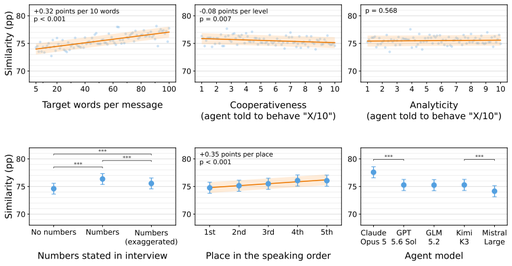
Figure 2 | Personas have more influence over the group policy if they instruct their agent to send long messages, be less cooperative, or state their preferences quantitatively. Instructions to be more or less analytical have no significant effect. Agents who speak later have more influence. We find some differences between the influence of models: Claude has more influence, and Mistral has less than the others. Influence is measured as similarity between the persona’s budget and the final group budget.
Original paper · CC BY 4.0Personas that stated numerical preferences gained influence, whether or not they told their agent to exaggerate them. Influence was higher without exaggeration than with it (p < 0.001). Speaking later in the conversation added 0.35 points per place in the speaking order (p < 0.001). The speaking order was sampled without replacement for each deliberation.
Claude-Opus-5 gave its persona more influence than each of the other four models. Mistral-Large gave less influence than each of the other four models (all p < 0.001). GPT-5.6-Sol, GLM-5.2, and Kimi-K3 didn't differ significantly from one another (all p > 0.5). The five agent models were Claude-Opus-5, GPT-5.6-Sol, GLM-5.2, Kimi-K3, and Mistral-Large.
A sensitivity run used five Gemini models, and it replicated significance for all five prompt and structural factors. The Gemini representatives showed a smaller spread in influence across models. Influence was measured as similarity in percentage points, so 100 means the final policy matched the persona's own budget.
The three processes in the human study
The study compared three processes, and each one changes how much the participant speaks and who writes the draft. In Direct Discussion, the participant skips the interview and talks in the group beside four simulated personas and the Policy Writer. Pluralistic Agents works differently, because an agent interviews the person first and then speaks for them in the discussion.
Single AI removes the group entirely, so the Policy Writer interviews the participant and drafts the policy alone.
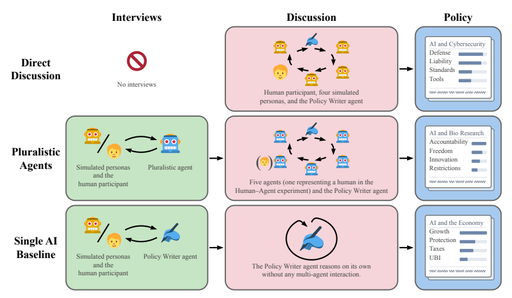
Figure 3 | The three processes compared in the human–agent experiment. InDirect Discussion, there is no interview, and the person speaks in the discussion themselves, alongside four agents emulating other personas and the Policy Writer agent. InPluralistic Agents, an agent interviews the person and then speaks for them in the discussion. InSingle AI, the Policy Writer agent interviews the person and writes the policy on its own, with no multi-agent deliberation.
Original paper · CC BY 4.0 · Jacy Reese Anthis, Ken Burke, David Madras, Crystal Qian, Meredith Ringel Morris, Logan Cross, Caroline Pantofaru, Utsav Prabhu · Scaling public input on AI policy with pluralistic agents · Original paper figure · Extracted the figure area from page 7 of the original PDF.Direct Discussion keeps the participant's own voice in the room, while the other two processes route that voice through an agent or a single AI. The processes all worked on a budget task with four priorities, such as Accountability, Freedom, Innovation and Restrictions. Each participant had to split 100% of the budget across those priorities, which created a zero-sum constraint.
They also ruled out emotional appeals that aggressively claim the other side will deeply regret its choices. Participants rated Direct Discussion and Pluralistic Agents as ethical in procedural justice terms, with both above Single AI. The satisfaction figure shows means of 4.39, 4.84 and 5.06 for the three processes on a 1 to 7 scale. Pluralistic Agents recovered 68% of the gap between Direct Discussion and Single AI in satisfaction.
Participants updated their policy views significantly in each process. They updated more in Direct Discussion than in Pluralistic Agents, so the agent route moved people less than speaking for themselves.
What participants preferred and how they updated
The 746 participants preferred Pluralistic Agents over the Single AI baseline. They preferred Direct Discussion over Pluralistic Agents, so direct participation ranked highest. On satisfaction, Pluralistic Agents recovered 68% of the gap between Direct Discussion and Single AI. That's most of the distance to direct participation, though not all of it.
The authors also rated each process on procedural justice, a fairness judgment about how a decision is made. Direct Discussion and Pluralistic Agents both scored as highly ethical on this measure. Each of those two processes was perceived as more ethical than Single AI. Procedural justice is separate from the fairness of the outcome, so these ratings judge the process itself.
Participants updated their policy views significantly in each process. They updated more in Direct Discussion than in Pluralistic Agents. So when an agent spoke for them, their views moved less than when they spoke themselves. Participants also voiced large amounts of excitement and concern about agent representatives.
These mixed reactions match the opportunities and risks the authors identified in the agent-only experiments. The satisfaction result comes from a simple budget task, which makes collective outcomes hard to measure. The authors suggest that more diverse populations and longer deliberation processes would strengthen these comparisons.
Limits of what was tested
The personas in these experiments are simulations, and the authors don't intend them to be accurate forecasts of human behavior. The backstories method was chosen because it mitigates the bias and homogeneity issues of simulating humans with explicit demographic characteristics. The open-ended drafting condition saturated, because personas were readily satisfied and deliberations ended at the earliest possible round.
The authors therefore moved to a budget policy with a zero-sum constraint, so they could study persistent disagreement.
All influence results come from the budget task, where agents allocated 100% of a budget across four priorities. The influence experiment used 5,947 simulated-persona deliberations, and 53 of 6,000 initiated deliberations were dropped after model refusals to discuss biological research. Because the budget task was the only setting tested, the influence findings don't show how influence varies in open-ended drafting.
The human-agent experiment used one simple allocation task, so it was difficult to identify changes in collective group outcomes. The authors say human-agent experiments would benefit from more diverse populations, including non-Western participants and people who don't join online survey platforms. Group sizes and types of cooperation weren't varied, so the influence findings cover one set of group designs.
The authors also say that more involved deliberation processes, comparable to focus groups and citizens' assemblies, would strengthen future work.
The authors encourage cautious implementation that amplifies human input rather than replacing human participation. Pluralistic agents are meant to extend thoughtful input from diverse populations, so the claims stay within these tested conditions.
Paper info
- Authors
- Jacy Reese Anthis, Ken Burke, David Madras, Crystal Qian, Meredith Ringel Morris, Logan Cross, Caroline Pantofaru, Utsav Prabhu
- Venue
- arXiv · Preprint
- First published
- 2026-11-11
- Added
- 2026-11-13
- Updated
- 2026-11-11
- Version
- v1
- arXiv
- 2611.16028
- Category
- cs.CY · cs.AI · cs.CL · cs.LG
- Original paper terms
- CC BY 4.0
- What we show
- Paper info, commentary and permitted figures from the original paper
AI commentary is a separate explanation from the original paper and may contain errors. The original paper and figures follow each source's terms of use and any rights noted separately.
Abstract
AI is being deployed across a vast range of application domains, cultural environments, and human stakeholders. Safe and responsible AI development requires continuously accounting for diverse perspectives. We develop and test pluralistic agents, AI agent representatives that deliberate on behalf of individuals to align AI systems with diverse human perspectives. Pluralistic agents could help people contribute to many more discussions than they could directly participate in, on technical topics that would require training, and on policy choices that rely on private information that corporations and governments cannot readily share. Our experiments identify opportunities, risks, and perceptions of pluralistic agents. Agents were able to reliably shift policies in the direction of their represented persona's preferences, but the extent of each agent's influence was sensitive to the instructions from its persona, such as having more influence when instructed to be more verbose or less cooperative. This suggests that influence in AI-assisted deliberation could vary based on how participants prompt their agents and how the system is designed. In a preregistered study, 746 humans participated in the pluralistic agents process. Participants viewed pluralistic agents as useful and fair, preferring agents over the baseline of providing input to a single AI reasoning model. Most participants preferred participating themselves over either pluralistic agents or the baseline, but pluralistic agents recovered 68% of the baseline-direct gap in reported satisfaction and 82% in fairness. Because pluralistic agents can be used in many real-world contexts where direct discussion is not, they could be a promising tool to scale AI safety policy development. We encourage cautious exploration of this method, playing to its strengths as an amplifier of human input rather than a replacement.
Quote from the paper
Jacy Reese Anthis, Ken Burke, David Madras, Crystal Qian, Meredith Ringel Morris, Logan Cross, Caroline Pantofaru, Utsav Prabhu (2026). Scaling public input on AI policy with pluralistic agents. arXiv:2611.16028v1. https://arxiv.org/abs/2611.16028v1
BibTeX
@misc{anthis2026scaling,
  title = {{Scaling public input on AI policy with pluralistic agents}},
  author = {Jacy Reese Anthis and Ken Burke and David Madras and Crystal Qian and Meredith Ringel Morris and Logan Cross and Caroline Pantofaru and Utsav Prabhu},
  year = {2026},
  eprint = {2611.16028},
  archivePrefix = {arXiv},
  url = {https://arxiv.org/abs/2611.16028v1}
}