Paper commentary
How Does Chain-of-Thought Supervision Teach Models to Reason? A Theoretical Analysis
Theory explains how training chain-of-thought length causes overthinking at inference
- Problem Models may need to reason past the steps seen in training, and longer reasoning can then hurt performance. Theory had not linked this overthinking to the amount of finite training chain-of-thought.
- Method The authors train an in-context weight-prediction model on finite gradient descent trajectories for linear regression. At inference, the learned update runs recursively past the training steps.
- Results With short contexts, a larger training chain-of-thought budget first worsens long-horizon error, then stabilizes reasoning. The pattern persists in fully trained linear and softmax attention models.
Why extra reasoning steps can hurt
Reasoning past the steps seen in training can make answers worse, a pattern called overthinking. Empirical work describes two ways long runs fail even when short-horizon performance looks similar. Such observations are hard to read for CoT data alone, because training data and model scale also affect performance. So observed performance offers limited guidance on which CoT training data to choose.
Theory has covered part of this ground, since sufficient CoT lets a model approximately implement multi-step GD. Phase transitions between successful inference and overthinking also appear in a setting without training-time CoT. Those analyses study the test-time behavior of trained models. They don't characterize what a finite teacher CoT contributes as training data.
The authors model this by training an in-context weight-prediction model on finite GD trajectories for linear regression. The open question is how far a model keeps reasoning correctly past the teacher steps, and how that generalization breaks down.
Each task provides L labeled examples, with x drawn from a standard Gaussian and the teacher CoT built from K GD steps. The teacher trajectory starts from zero and takes steps of size η on the empirical squared loss. During pre-training, the model predicts the next teacher state from the task context and the current state, without earlier states.
This Markovian setup means the one-step predictor depends only on the current state, which keeps each training transition short.
A learned step that imitates gradient descent
The core idea is to treat gradient descent trajectories on linear regression as the teacher CoT and to train a one-step predictor on them. The model sees the labeled task examples together with the current state, and it learns to output the next state of the trajectory. Because only the state changes from step to step, the predictor is Markovian once the task context is fixed.
Each of the M tasks has L labeled examples, with inputs drawn from a standard Gaussian and labels from a noisy linear teacher. Starting from zero, gradient descent with step size \( \eta \) on the empirical squared loss produces K steps through \( s_{\mu,k+1} = s_{\mu,k} - \frac{\eta}{L} X_\mu (X_\mu^\top s_{\mu,k} - y_\mu) \). Pre-training therefore takes the pair \( (Q_\mu, s_{\mu,k}) \) as input and \( s_{\mu,k+1} \) as the target.
The prompt places the labeled examples in the first L columns and adds a state column, marked by a 1 in the last row. A one-layer linear attention with a residual connection reads the state slot back out as the next-step prediction. To keep the analysis tractable, most blocks of the value and query-key matrices are fixed, so only one D by D matrix A is learned.
The authors justify each fixed block by rotational symmetry, by a no-loss-of-generality argument, or by stopping inference from skipping the context.
With this reduction, the prediction becomes \( \hat s_{\mu,k+1} = s_{\mu,k} + \frac{1}{L} X_\mu (X_\mu^\top A s_{\mu,k} + \eta y_\mu) \), and training adds a Frobenius penalty on A. For a positive regularization strength, this objective is strongly convex, so its minimizer is unique.
At inference the matrix is frozen and the update is applied recursively, starting from a zero estimate of the weight vector. The estimate is scored by its mean squared error against the true test weight, and that error is compared with the error of exact gradient descent on the same test context. When the learned update matches the teacher, the two errors coincide.
Where recovery and divergence separate
The first lever is the training CoT budget, defined as φ = τ(K−1), which counts the total CoT transitions per dimension. For context ratio α above 1 and budget φ below 1, the learned update is projected GD rather than full GD. Outside these cases, evaluating the error at finite depth still requires the two-point functions.
Two-point functions don't close under the training-CoT recursion in general, because the training trajectories couple successive transitions. The authors therefore study the error as t goes to infinity, where the dominant eigenvalues decide whether the error stays bounded, grows polynomially, or diverges exponentially. They obtain the one-point spectral quantities with the cavity method and Marchenko–Pastur averages.
Result 4.2 sorts the long-time behavior into four phases: GD, bounded error, exponential growth and quadratic growth. Bounded error occurs for context ratio below 1 when the budget lies between φ+ and 1/α. Exponential growth occurs for budgets between φ− and φ+, again with context ratio below 1. These statements hold for sufficiently small η and as t goes to infinity.
Figure 1 maps these boundaries in the context ratio and training CoT budget plane and sets them beside simulations. Panel B uses α = 2 and panel C uses α = 0.625. Both panels use D = 96, K = 2, η = 0.15 and σ² = 0.01. The error bars show one standard error across eight independent runs.
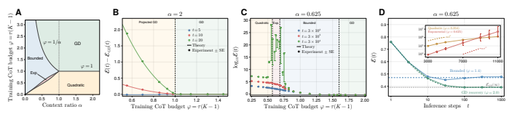
Figure 1 :Training CoT budget and context length control GD recovery and test-time error growth.(A) Theoretical phase diagram in the context ratio α and training CoT budget φ=τ(K−1) . The four regions correspond to GD recovery, bounded error, exponential divergence, and quadratic divergence. (B) Numerical experiments (circles) and theoretical prediction (solid line) on excess generalization error E(t)− EGD(t) at α= 2 . (C) Numerical experiments of the generalization error at α= 0.625 . (D) Typical test-time error dynamics in the four phases; the dotted lines show the theoretical long-time predictions, and the inset highlights the quadratic and exponential regimes at large t. (B,C) The vertical dotted lines show the theoretical phase boundaries. Parameters: (B,C) D= 96 , K= 2 , η= 0.15 and σ2 = 0.01. (B-D) Error bars represent one standard error across eight independent runs.
Original paper · CC BY 4.0 · Kaito Takanami, Cengiz Pehlevan · How Does Chain-of-Thought Supervision Teach Models to Reason? A Theoretical Analysis · Original paper figure · Extracted the figure area from page 6 of the original PDF.In the recovery phase, the learned test-time recursion reproduces the GD update beyond the number of steps in the training trajectories. For α above 1, the paper's counting argument gives the recovery condition M(K−1)D > D², which is equivalent to φ > 1. For α below 1, the budget required for recovery depends on the context length and must exceed 1/α.
A short context constrains the update only on a subspace, so the authors say a larger CoT budget is needed to identify it.
Accumulation versus amplification
The authors rewrite inference as a state transition, with the current estimate carried forward and the context injected at every step. The update takes the form ŵ_{t+1} = J ŵ_t + (η/L) X^in y^in, where J = I + H Â and H = (1/L) X^in (X^in)^⊤. Error evolution is therefore determined by the eigenvalue structure of J.
Projecting the update onto this mode gives z_{t+1} = z_t + η c, with c nonzero for the excited component. The unit coefficient on z_t means the accumulated state persists, so each input adds up instead of being canceled. The authors call this error accumulation, since errors introduced at each step remain uncorrected.
Projecting onto this mode gives z_{t+1} = r z_t + η c, which iterates to z_t = η c (r^t − 1)/(r − 1). This expression grows exponentially with t because |r| > 1. This is why the authors call it error amplification.
Unit or unstable modes cause divergence only when the context input excites them. In that case the input may have zero component along these modes, so c = 0 and neither accumulation nor amplification occurs. The system then lands in the bounded regime. Ainslie et al. (2026) report similar behavior in autoregressive dynamical-system prediction, where eigenvalues outside the unit circle amplified errors and eigenvalues near it accumulated them.
More teacher CoT can first hurt long-horizon error
For a context ratio below 1, the Figure 1C sweep changes regime as the training CoT budget rises. Error moves from quadratic growth to exponential growth, then to bounded error, and finally to GD recovery. So the middle of the sweep is not monotone: at intermediate budgets, more teacher CoT can worsen long-time error growth.
The authors explain the effect by looking at what happens at each budget level. Only with a larger budget does the model learn reliable updates and eventually recover GD.
The non-monotonic pattern resembles an earlier practical report. Ren et al. (2026) saw model performance first decline and then recover during supervised fine-tuning with long teacher CoT. The authors present their theory as a possible explanation: short contexts that fail to identify the update can make extra teacher CoT temporarily hurt performance.
The paper's own experiments are linear-regression simulations, not language-model fine-tuning.
Do the patterns survive trained attention
The authors retrain the same setup with fully trained attention and vary only the architecture. One variant is single-head linear attention with learned query, key and value matrices. The other is two-head softmax attention that also learns an output matrix. Both use a context-only mask, so the current state serves as the query while the labeled examples supply keys and values.
The runs use D equal to 32, alpha equal to 0.75, K equal to 2, eta equal to 0.1, and sigma equal to 0.1. Each point averages 8 independent experiments, and error bars show one standard error. Given enough training CoT, both models keep stable inference beyond the K steps used in training. That suggests end-to-end trained attention can learn from finite-length CoT and keep reasoning past the training horizon.
As the training CoT budget grows, the error stays low at small budgets. It then rises quickly with inference depth at intermediate budgets, and settles into stable inference at larger budgets.
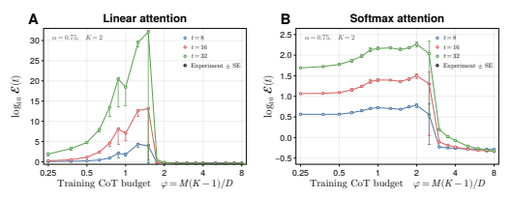
Figure 2 :Training CoT budget produces non-monotonic long-horizon performance in fully trained attention.Numerical experiments of the test-time generalization error for (A) Single-head linear attention with learned Q/K/V and (B) Two-head softmax attention with learned Q/K/V/O. Parameters: (A,B) D= 32 , α= 0.75 , K= 2 , η= 0.1 , and σ= 0.1 . Error bars represent one standard error of the 8 independent experiments per point.
Original paper · CC BY 4.0The authors read this as evidence that the non-monotonicity predicted for the effective model carries over to attention. They say the phase-transition-like behavior from Section 5.3 persists in these more complex attention models. Figure 2A shows a relatively sharp change inside the failure region for linear attention. That fits the split between error accumulation and error amplification found in Section 5.2.
For softmax attention, the change in Figure 2B is more gradual, so its failure region isn't clearly divided into two regimes. The authors attribute this difference to state dependence in the one-step Jacobian. For linear attention the Jacobian is constant for a fixed context, while for softmax it changes along the inference trajectory.
Limits of the analysis
The analysis rests on the effective model, where only A is learned and the other blocks are fixed by design choices. The authors argue that these reductions concentrate the nontrivial inference parameter in the single matrix A. The effective learning problem adds a regularization term with parameter λ > 0, which makes the objective strongly convex so that the minimizer is unique.
The phase results are asymptotic, taken in the high-dimensional limit where D, L and M grow proportionally while K and t stay O(1). Result 4.2 holds only for sufficiently small η as t goes to infinity, so it says nothing about finite inference depth. Finite-depth error in the remaining regime still requires the two-point functions, which the authors don't evaluate in closed form.
In the training-CoT setting, the cavity equations don't close under the same recursion as in the earlier work. The two-point problem reduces to one-point Marchenko-Pastur averages only when the learned matrix takes the form  = −ηP for an orthogonal projector P.
The attention experiments use one context ratio, α = 0.75, and one K = 2, with 8 independent experiments per point. The softmax attention runs don't show whether the failure region splits into error accumulation and error amplification. For softmax attention, the change in Figure 2B is more gradual than in the linear case, so the two regimes aren't clearly separated.
The linearized Jacobian for softmax attention depends on the current state, so error propagation can vary along one trajectory.
Paper info
- Authors
- Kaito Takanami, Cengiz Pehlevan
- Venue
- arXiv · Preprint
- First published
- 2026-11-1
- Added
- 2026-11-3
- Updated
- 2026-11-1
- Version
- v1
- arXiv
- 2611.01740
- Category
- cs.LG · cond-mat.dis-nn · stat.ML
- Original paper terms
- CC BY 4.0
- What we show
- Paper info, commentary and permitted figures from the original paper
AI commentary is a separate explanation from the original paper and may contain errors. The original paper and figures follow each source's terms of use and any rights noted separately.
Abstract
Training with chain-of-thought (CoT) supervision is an effective approach for teaching models multi-step reasoning procedures. At inference time, however, models may need to continue reasoning beyond the finite teacher CoT sequences observed during training, and longer reasoning can instead degrade performance, a phenomenon known as overthinking. How the amount and structure of training-time CoT give rise to such failures remains theoretically poorly understood. To study this problem, we introduce an in-context weight prediction model trained on finite gradient descent trajectories for linear regression. Using high-dimensional asymptotic analysis, we show that the success and failure modes of long-horizon reasoning undergo phase transitions depending on the context length and the total amount of training CoT. We further distinguish two mechanisms of overthinking, error accumulation and error amplification, and show that with short training contexts, increasing the training CoT budget can worsen long-horizon error before eventually stabilizing reasoning. Experiments with fully trained linear and multi-head softmax attention further show that these qualitative behaviors persist. Our results provide a theoretical account linking properties of training-time CoT to inference-time failures and offer guidance for designing teacher CoT that supports stable reasoning.
Quote from the paper
Kaito Takanami, Cengiz Pehlevan (2026). How Does Chain-of-Thought Supervision Teach Models to Reason? A Theoretical Analysis. arXiv:2611.01740v1. https://arxiv.org/abs/2611.01740v1
BibTeX
@misc{takanami2026does,
  title = {{How Does Chain-of-Thought Supervision Teach Models to Reason? A Theoretical Analysis}},
  author = {Kaito Takanami and Cengiz Pehlevan},
  year = {2026},
  eprint = {2611.01740},
  archivePrefix = {arXiv},
  url = {https://arxiv.org/abs/2611.01740v1}
}