Paper commentary
Feature Completion for Occluded Person Re-Identification
RFC block fills in occluded body regions to improve person re-identification
- Problem Occluded person reID methods usually discard hidden body parts, so matching relies on incomplete evidence and can confuse similar-looking visible parts.
- Method RFC block recovers occluded body-region features in feature space instead of discarding them. It splits the feature map into a few regions and predicts occluded ones from visible ones.
- Results RFCnet scores 46.1 mAP on Occluded-DukeMTMC with key-points, against 37.3 mAP for PGFA.
Why discarding hidden parts falls short
Most occluded person reID methods handle hidden body parts by discarding them, so the matching relies only on what stays visible. Some of these methods detect non-occluded body parts with body part detectors and consider only the shared visible parts for matching. This degrades the reliability of retrieval results, since the visible parts may share a similar appearance.
The method fails when the occluded body parts are key discriminative cues that would separate two people. The authors argue that discarding leaves the matching with incomplete evidence about the target person.
A second route recovers the appearance of hidden parts with an image completion network, as the authors' earlier VRSTC method does. Image completion gives a fuller picture of the target person, and it is superior at interpreting and visualizing what is recovered. The completion network is large, so it is usually a post-hoc addition to the reID network.
Because of that arrangement, the reID task cannot give direct feedback to the completion task. Image completion is built on U-Net, an encoder-decoder pipeline of convolutional layers. Long-range context is a further problem, since a convolution only sees a local spatial neighbourhood. Information must be stacked across many layers to travel far, which is computationally inefficient.
Expensive image completion also tends to use only two adjacent frames, which limits the temporal context it can draw on.
The RFC block recovers the features of occluded body regions in feature space instead of discarding those regions. By representing each body region as one feature, a single spatial completion module can propagate information between any two positions. Feature completion predicts only a few region features, so it can use more adjacent frames for temporal context.
The key idea: complete a few region features
The RFC block completes occluded regions in feature space instead of discarding them, so the network keeps a full description of the target person. The image feature map is split into a few region features through region division, so each body region becomes one feature node. With a few feature nodes, one completion module can propagate spatial information between any two positions.
Image completion networks built on U-Net reach distant positions only by stacking convolutional layers, which the authors call computationally inefficient and hard to optimize. Wang et al. report that repeated convolution operations cause optimization difficulties, which is the reason the authors give for avoiding that route.
Because the completion step predicts only a few region features, it costs little, so the temporal step can use more adjacent frames. Image completion usually considers only two adjacent frames because of its cost, which limits the temporal context it can use. The Adaptive Partition Unit divides the feature map into regions, and each region corresponds to a specific body part.
The SRFC module uses a region-encoder to gather occluded and correlated non-occluded regions into an intermediate node, and a region-decoder predicts the occluded region from that node. The TRFC module computes temporal relations among the same region across all input frames and uses them to refine the SRFC prediction. Because RFC is lightweight, it adds only a slight increase in model complexity and can be readily inserted into any network.
The authors insert the completion block at any depth of the ReID backbone, so the ReID loss can supervise the completion directly. Image completion, by contrast, is usually a post-hoc addition, so the ReID task cannot give it direct feedback. Feature completion therefore enables end-to-end training, which the authors present as the main advantage over the image route.
How the RFC block runs, step by step
The APU first divides each frame's feature map into body regions. It predicts only four coarse keypoints, which the authors found more robust to pose-detection noise than predicting every keypoint. The foreground-guided extractor then predicts a foreground probability map with a 1x1 convolution and a Sigmoid, using body masks from a human parsing model as guidance.
Each region feature is a weighted sum over the frame features, with weights taken from the masked foreground map of that region, normalised by its L1 norm. \[ f_t^i = \frac{M_t^i \odot I_t}{\|M_t^i \odot I_t\|_1} \ast F_t \]
SRFC then runs on each frame separately, with a region-encoder that groups regions into a few clusters and a region-decoder that spreads the clusters back to the regions. The encoder builds an assignment matrix \(S \in \mathbb{R}^{N\times K}\), where \(S_{ik}\) is the probability of assigning region \(R_i\) to cluster \(c_k\). The appearance branch computes \(S^A = \mathrm{softmax}(W^a \ast f)\) with a 1x1 convolution, so each row sums to one.
An appearance regularizer \(L_a\) makes the similarity between two appearance assignment vectors follow the cosine similarity of the two region features. The position branch encodes each region's centre and size as \((y, x, h, w)\), passes it through two convolutions and a row-wise softmax to get \(S^P\). A position similarity \[ ps(R_i,R_j) = 1 - 2\sqrt{\left(\frac{y_i-y_j}{H}\right)^2 + \left(\frac{x_i-x_j}{W}\right)^2} \] is the target for a position regularizer \(L_p\) on the assignment vectors.
For a fully occluded region with no appearance cue, the position branch links it to its nearest visible neighbour, so information can flow from that neighbour.
The final assignment averages the two branches as \(S=(S^A+S^P)/2\), and each column is normalised over regions to give the encoding matrix \(A\). Each cluster is then \[ c_k = \sum_{i=1}^{N} A_{ik} f_i, \quad A_{ik} = \frac{S_{ik}}{\sum_{j=1}^{N} S_{jk}} \] A 1x1 channel transformer refines each cluster, because a linear sum alone may not give the clusters enough representational power.
The decoder forms each output region as a sum of the clusters weighted by that region's row of \(S\), and a residual connection eases the completion.
TRFC takes the SRFC output and works on the same region across all frames of the clip. It computes temporal relations between those regions, aggregates temporal contexts with them, and uses the result to refine the occluded region features. The authors describe this as a memory over other frames, and the gating weight it learns is lower for occluded regions.
Finally, a reverse projection maps the completed regions back to the feature map, so the block fits an ordinary CNN.
Building the video occluded benchmark
The authors built Occluded-DukeMTMC-VideoReID by reorganising DukeMTMC-VideoReID, so that video-based occluded reID could be studied. They list it as their third contribution, a large-scale video occluded reID dataset meant to support research on occluded reID. The authors use it to test RFCnet in a setting where video frames can recover information that a single image cannot.
Because the authors care about test-set performance, they analysed the test set of the dataset statistically. All query tracklets contain occlusion, so 100% of the query set has occlusion. The authors count that above 70% of gallery tracklets also contain occlusion. Above 60% of query tracklets have more than 80% occluded frames, and above 30% of gallery tracklets do.
The authors read this as evidence that the dataset contains serious occlusion, which suits evaluating models on occluded scenes. They also annotate each frame with an occlusion label from 0 to 10, where 0 means no occlusion and 1 means 0 to 10% of the frame is occluded.
The image benchmark Occluded-DukeMTMC is built from DukeMTMC-reID by keeping occluded images as queries. The authors filter out training images that share the same occlusion mode as the queries. Occluded-DukeMTMC is the largest occluded image reID dataset in the paper, and its obstacles vary widely, which makes it harder.
Image occluded reID against matched baselines
When the key points are not used, RFCnet replaces APU with a fixed partition into 6 regions. When the foreground information is not used, RFCnet removes the foreground-guided region feature extractor from its RFC blocks. Under these matched conditions, RFCnet consistently achieves the best performance in Tab. 4. With key-points added, RFCnet scores 46.1 mAP, compared to 37.3 mAP for PGFA, which discards the occluded parts.
The authors argue that the completion strategy helps distinguish identities whose visible parts look alike.
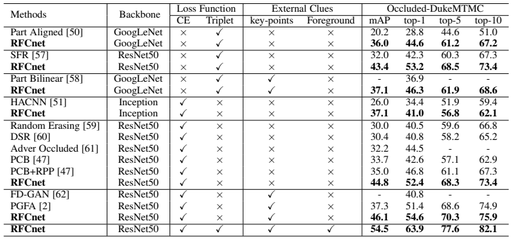
TABLE 4 . Comparison with state-of-the-arts on on image occluded reID dataset, Occluded-DukeMTMC. The “CE” and “Triplet” indicate whether the methods use the cross-entropy loss and triplet loss to train. The “Key-points” and “Foreground” indicate whether the methods rely on extra supervision information from human pose model and human parsing model.
Original paper · CC BY 4.0 · Ruibing Hou, Bingpeng Ma, Hong Chang, Xinqian Gu, Shiguang Shan, Xilin Chen · Feature Completion for Occluded Person Re-Identification · Original paper figure · Extracted the figure area from page 10 of the original PDF.Against holistic reID methods, the gap is about 10% in mAP, which the authors attribute to occlusion hurting holistic feature extraction. Compared with PCB+RPP, the paper's occluded reID comparison also shows RFCnet at 44.8 mAP without key-points and foreground information. With both key-points and foreground information, RFCnet reaches 54.5 mAP on Occluded-DukeMTMC.
Against methods that add occluded images as data augmentation, such as Random Erasing and Adver Occluded, RFCnet gains about 10% mAP. The authors note that these augmentation works are compatible with RFCnet and could lift its performance further. Against the occluded reID methods that only extract non-occluded parts, RFCnet improves mAP by up to 8.8%.
Overall, the authors report that RFCnet outperforms state-of-the-art methods on the occluded datasets by about 10% mAP.
Video occluded reID against holistic and occlusion methods
Under the ResNet50 protocol with cross-entropy and triplet loss and no extra clues, RFCnet scores 90.1 mAP on Occluded-DukeMTMC-VideoReID. In the same table, the completion-based VRSTC scores 76.7 mAP, so the gap is the comparison that matters most here. The authors credit the gain of about 13.4% mAP over VRSTC to feature completion, where the reID task gives direct feedback to the completion step.
RFCnet adds much less overhead, because it completes a few region features instead of whole images.
The holistic video methods RCN and TriNet score 62.4 and 64.1 mAP in this table. Both methods treat every frame of a video equally, so occluded frames corrupt the video representation. RFCnet surpasses these holistic methods by up to 29.6% in top-1 accuracy and 27.7% in mAP.
The frame-selection methods QAN, STAN and RQEN use a temporal attention network to pick non-occluded frames. Those methods still lose spatial information, and their temporal information gets interrupted. RFCnet is up to 15.2% ahead of them in mAP, because feature completion restores spatial and temporal information inside the RFC blocks.
When key-points and foreground information are added, RFCnet reaches 92.0 mAP and 93.0 top-1 accuracy. The authors used these extra clues only in that final row, so the plain 90.1 mAP row remains the fair comparison with the baselines.
Which parts of the design carry the gains
APU beats a fixed partition at each region number, and its best result comes at six regions. The authors argue that too few regions cannot accurately locate the occluded body parts. Eight regions split the head and upper-body parts into two regions each, which damages their semantics. Replacing APU with STN in the RFC block gives 49.1% mAP and 53.9% top-1, so APU outperforms STN by 6.4% mAP.
Removing the key-points constraint Lk lowers the results of RFCnet on both the image and the video occluded benchmarks. Without Lk, the divided regions tend to be disorganized and lack specific semantics. RFCnet clearly outperforms the variant trained without Lf, which the authors take as evidence for the foreground map constraint. RFCnet outperforms the variants trained without La, without Lp, and without both, indicating that the assignment regularizations help.
Without both regularizers, RFCnet-wo-Lap may produce a degenerate assignment matrix for severely occluded images.
The spatial-first order of SRFC and TRFC performs slightly better than the temporal-first order. The authors argue that SRFC can use position information to roughly recover fully occluded regions, which TRFC can then refine. Adding a second RFC block at stage 3 improves a single block at stage 2 by about 2.7% mAP and 3.0% top-1 accuracy. TRFC brings a further 10.3% top-1, so the temporal step carries weight in the video setting.
Cost of the RFC block
The RFC block adds only a small overhead to the reID model, according to the authors' complexity comparison. On the image reID task, RFCnet requires 4.34 GFLOPs, which is a 6.8% relative increase over the original model. RFCnet introduces 2.1M parameters, a 8.9% relative increase over the baseline. The parameter count stays fixed because the RFC block's parameters don't depend on the length of the input sequence.
Training RFCnet takes 78 minutes, and inference takes 119 seconds. Those times are 8.3% and 8.2% above the baseline, so the authors treat the extra time as modest. The authors argue that this overhead is justified by the gains in model performance.
Limits under severe occlusion
RFCnet still fails when occlusion is severe, and the paper reports two failure cases. In the first case, a person is severely occluded by another person, so the model can mistake the disturbed person for the target. The model then retrieves wrong person images that look similar to the disturbed person. The paper illustrates this case with a probe image in Fig.
17 (a).
In the second case, a person is extremely occluded by a static object, so most body parts are completely invisible. Little appearance information remains, so the model may fail to retrieve the true person images. Fig. 17 (b) shows examples of this failure.
Video training samples 4 frames with a stride of 8 frames, because GPU memory limits the input clip length. A longer clip would force a smaller batch size, and the authors note that a small batch may hurt optimization of RFCnet. At test time, each tracklet is split into 64-frame clips, and the video feature is the average over all clips.
The authors leave open the best way to combine spatial and temporal completion. They plan to explore a better combination mode, such as collaborative integration. They also suggest that feature level completion should be prioritised for occluded reID.
Paper info
- Authors
- Ruibing Hou, Bingpeng Ma, Hong Chang, Xinqian Gu, Shiguang Shan, Xilin Chen
- Venue
- arXiv · Preprint
- First published
- 2021-6-24
- Added
- 2026-11-6
- Updated
- 2021-6-24
- Version
- v1
- arXiv
- 2106.12733
- Category
- cs.CV
- Original paper terms
- CC BY 4.0
- What we show
- Paper info, commentary and permitted figures from the original paper
AI commentary is a separate explanation from the original paper and may contain errors. The original paper and figures follow each source's terms of use and any rights noted separately.
Abstract
Person re-identification (reID) plays an important role in computer vision. However, existing methods suffer from performance degradation in occluded scenes. In this work, we propose an occlusion-robust block, Region Feature Completion (RFC), for occluded reID. Different from most previous works that discard the occluded regions, RFC block can recover the semantics of occluded regions in feature space. Firstly, a Spatial RFC (SRFC) module is developed. SRFC exploits the long-range spatial contexts from non-occluded regions to predict the features of occluded regions. The unit-wise prediction task leads to an encoder/decoder architecture, where the region-encoder models the correlation between non-occluded and occluded region, and the region-decoder utilizes the spatial correlation to recover occluded region features. Secondly, we introduce Temporal RFC (TRFC) module which captures the long-term temporal contexts to refine the prediction of SRFC. RFC block is lightweight, end-to-end trainable and can be easily plugged into existing CNNs to form RFCnet. Extensive experiments are conducted on occluded and commonly holistic reID benchmarks. Our method significantly outperforms existing methods on the occlusion datasets, while remains top even superior performance on holistic datasets. The source code is available at https://github.com/blue-blue272/OccludedReID-RFCnet.
Quote from the paper
Ruibing Hou, Bingpeng Ma, Hong Chang, Xinqian Gu, Shiguang Shan, Xilin Chen (2021). Feature Completion for Occluded Person Re-Identification. arXiv:2106.12733v1. https://arxiv.org/abs/2106.12733v1
BibTeX
@misc{hou2021feature,
  title = {{Feature Completion for Occluded Person Re-Identification}},
  author = {Ruibing Hou and Bingpeng Ma and Hong Chang and Xinqian Gu and Shiguang Shan and Xilin Chen},
  year = {2021},
  eprint = {2106.12733},
  archivePrefix = {arXiv},
  url = {https://arxiv.org/abs/2106.12733v1}
}