Paper commentary
SpaceAct: Benchmarking 3D Spatial and Temporal Reasoning via Closed-Loop Action and Active Perception
SpaceAct tests whether MLLMs can reason about space by acting in a scene
- Problem Most 3D benchmarks ask multiple-choice questions about images, so models never move the camera or collide with anything. Interactive suites often hand models exact coordinates and a motion planner.
- Method SpaceAct is a benchmark with SAPA, an agent that rotates the camera, reads in-scene rulers, and outputs 6-DoF poses. Each step must pass collision and statics checks or it rolls back.
- Results Adding exact 3D state to a plan lets the top three models close 90% of the gap, and cuts collisions to 0.5 per episode.
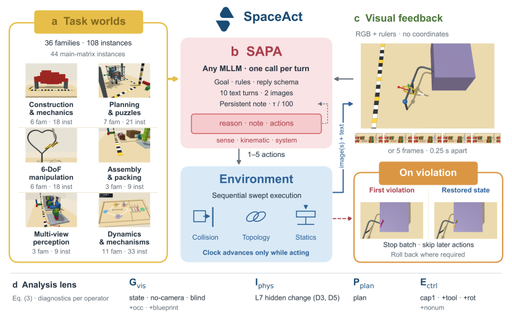
Figure 4 : The SpaceAct task suite and the SAPA active-perception agent. (a) The six task categories contain 36 task families and 108 verified instances in total (44 in the main matrix). (b) At each turn, the input comprises actively acquired RGB observations with rulers, task rules, the available tools, and a dynamic memory (a bounded history window plus a persistent note). A single MLLM call per turn jointly performs 3D localization (𝒢vis), physics identification (ℐphys), multi-step planning (𝒫plan), and frame-aware control (ℰctrl), returning a JSON response with a rationale, a memory update (note), and 1–5 tool calls; the four capabilities are a diagnostic decomposition, not four separate calls. The tool calls execute sequentially in swept substeps of at most 0.05 stud or 0.5°, without a motion planner, under collision/topology and static-equilibrium checks, and the simulation clock is frozen while the model deliberates. (c) Observations are RGB images with rulers and no coordinates; dynamic tasks provide five frames from the same viewpoint at 0.25-s intervals. The first violation truncates execution and skips the remaining calls, returning a 1280 × 640 split-screen rollback view (left: the violating contact; right: the last valid state). (d) The diagnostic conditions grouped by the operator of Eq. (3) that they replace or stress.
Original paper · CC BY 4.0 · Chenglong Shi, Zekai Yuan, Yue Song, Jon Pu, Will Wu · SpaceAct: Benchmarking 3D Spatial and Temporal Reasoning via Closed-Loop Action and Active Perception · Original paper figure · Extracted the figure area from page 10 of the original PDF.Why 3D action is hard to test
An agent that moves objects in 3D has to infer hidden structure from partial, overlapping views and judge whether a part will jam or a support will hold. Many MLLMs now act as planners that emit displacements, rotation angles or assembly steps directly. In that setup, a support misplaced by one stud or a gate timed wrong leaves no low-level controller able to recover.
Most existing benchmarks never test this loop, and they fall into two families. Static 3D question answering poses multiple-choice questions over images or videos, so the model never moves the camera or suffers a collision. Interactive embodied suites are closer, but they often reduce household tasks to commonsense language and feed manipulation models privileged coordinates and a motion planner.
Newer closed-loop benchmarks go further, yet their actions stay discrete, or they hand collision checking to a fixed layer. Time is also absent: in almost every interactive evaluation nothing moves on its own, so timing never decides success.
A benchmark where the model must act and look
SpaceAct changes the test from answering questions about a picture to acting in a scene and seeing what happens. The agent must rotate the camera to clear occlusion and read positions from in-scene rulers, because no numerical coordinates appear in the text. It then outputs 6-DoF poses one step at a time, and each step must pass swept-collision and statics checks.
When a batch collides or loses stability, the environment cuts it short and returns a 1280 × 640 split-screen rollback view.
The simulated clock stays frozen while the model deliberates, so API latency doesn't change the physical world. Dynamic tasks give five strobe frames, spaced 0.25 s apart, rendered from the current camera view. With these frames, the model can estimate velocity, angular velocity and period from pixels instead of from text. Hidden parameters, such as the angular velocity of rotating gates, can't be read from a single frame.
A persistent note records ruler readings and intermediate plans across up to 100 turns. Each turn carries 1 to 5 tool calls, which cuts model API calls by 23% to 60%, with a median of 50%. Because SAPA is model-agnostic, every MLLM runs through the same perceive-and-act loop.
In SpaceAct, the policy outputs a note and a batch of actions, aiming to maximize the expected score.
One turn, from model output to physical check
Each turn, the agent receives a rendered image with rulers, the task rules, the available tools, and its memory. The memory keeps the last 10 text turns, the last 2 images, and a persistent note that the agent rewrites itself. The model answers with one JSON object holding a reason, a note that overwrites the old one, and actions. Each reply carries 1 to 5 tool calls, so the agent can batch several moves in a single turn.
Perception calls and manipulation calls sit in the same reply, so grounding, timing and planning all happen within one call.
The payload doesn't teleport to a target; it moves along a continuous path γ(u) in SE(3). SAPA splits each sweep into substeps of at most 0.05 stud or 0.5°, with no motion planner involved. The stopping point u⋆ is the supremum of fractions u where both Φfree and Φstatic hold along the whole path. Φfree checks geometric collision and topological limits such as gripper clearance and rope length.
Φstatic checks rigid-body equilibrium, the in-construction overhang limit, and the admissible center-of-mass range.
When a violation occurs at u⋆ below 1, execution stops and the remaining calls in the batch are skipped. The state is rolled back when needed, and the next frame is a 1280 × 640 split screen. The left half shows the violation moment, with the offending part in magenta and the obstacle in bright blue. The right half shows the restored valid state, and text feedback reports the result of every call.
The outcome then feeds the score, which gives solved episodes 40 to 100 and unsolved episodes 0 to 35. Surplus actions, collisions and turns all lower the score of a solved episode. Construction tasks B1, B2 and B3 end in a load test, so they are graded pass or fail and only count toward success rate.
Do the scores separate the models?
On the 44-instance main matrix, tiered scores run from 4.8 to 79.1 across the ten frontier models, with a median of 23.1. Claude Opus 5.5 leads at 79.1 with a 93.2% success rate, ahead of GPT-6 Astra at 65.0 and Gemini 4 Argon at 42.1. The remaining seven models average 16.6 with a 25.6% success rate, so the paper splits the field into three tiers rather than one smooth gradient.
Ranks four to seven score 19.5 to 29.0, and the last three fall between 4.8 and 10.4.
Tiered scores penalize surplus actions, collisions and turns in solved episodes, so Claude Opus 5.5 still has room to improve at 79.1. Claude Opus 5.5 solves 86.4% of its instances within 30 turns, while GPT-6 Astra solves 59.1% in the same budget. The gap is widest on continuous 6-DoF manipulation, where seven of ten models solve at most 27.3% of those tasks.
Seven models solve no multi-view perception task, so both hardest categories depend on recovering metric 3D geometry from pixels. Rankings still shift by category, with a mean pairwise Kendall tau of 0.53 and a minimum of 0.38. Claude Opus 5.5 and GPT-6 Astra stay in the top two in every category, while the middle of the field reorders.
The random valid agent scores 3.2 with a 6.8% success rate, and every frontier model scores above that baseline. The two weakest models only match that success rate, so the floor sits low for them.
Plan and 3D state as diagnostics
The authors ask whether the bottleneck is planning or perceiving once a plan is available. The +plan condition supplies a reference high-level plan, and +state adds exact 3D state on top of that plan, so the two conditions are nested. Both run on the three strongest models over eight shared L5 instances, giving 22 paired episodes. The plan bypasses the multi-step planning operator, while +state also bypasses 3D visual grounding.
The plan raises the top-three mean from 65.1 to 80.3, closing 44% of the remaining gap to 100. Collisions stay at 5.2 per episode, so the plan helps search without making contacts safer. Across these pairs the plan's effect is mixed, with 10 pairs up and 8 down.
Eighteen pairs go up and none go down, and the success rate reaches 100.0%. Episodes shorten from 36.7 to 5.3 turns, and collisions fall to 0.5 per episode. The authors read the remaining gap as 3D visual grounding, because the plan is the same in both conditions.
For four further models ranked 5th to 8th, the plan lifts the mean score from 10.9 to 35.3. Adding 3D state lifts them to 81.8, with the success rate moving from 18.8% to 90.6%. Much of the plan gain comes from two discrete-search instances, P4 and D8, so the gain rests on a narrow set.
Images, camera and difficulty levers
Without images, the model loses its visual feedback and relies mainly on collisions to learn the scene. Across the frontier models, the mean score falls from 73.9 to 17.7 when images are removed. Collisions per episode surge from 3.6 to 33.5, about ninefold, with 12 pairs down and none up. On the thin-pier gorge, shape-through-wall and C-ring tasks, blocked actions and rollbacks still reveal obstacle boundaries.
The blind SR stays at 77.8%, compared with 88.9% when images are shown. On Klotski and the dynamic counterweight balance, SR drops from 83.3% to 16.7%, because single collisions cannot reveal the global state.
The no-camera mode locks the camera at its initial pose, so the model cannot move it to resolve occlusion. On occlusion-heavy instances, the mean score drops from 58.3 to 37.8 when the camera is locked.
Removing the magenta and blue contact snapshot from rollback images leaves the mean score almost unchanged, at 30.3 against 31.8. Collisions per episode rise by 59%, from 14.6 to 23.2, with 20 pairs declining and 9 improving. The authors read this as the snapshot mainly preventing repeated blind collisions.
In the six spatial families, L7 adds perception and coordinate-frame levers that lower the mean score from 26.2 to 13.7. For the three strongest models, the largest single-lever drops come from +rot at −12.5, +blueprint at −10.3, and +occ at −10.2. The temporal families D3 and D5 stay level, at 46.5 at L5 and 46.6 at L7. Because L7 keeps the plan fixed, the spatial loss isolates perception and coordinate-frame transformation.
Where unsolved episodes stall
Collision loops cover 24% of these episodes, and observation loops cover 22%. Under other threshold combinations, the loop share ranges from 26% to 62%. The loop share climbs to 60% in 6-DoF manipulation, where an agent that can't localize accurately hits the same obstacle or keeps rotating the camera.
The split screen marks the contact location, yet models struggle to turn that marking into an accurate metric correction. GPT-6 Astra repeats the collision 44% of the time, the lowest rate among all models. Mechanism synthesis fails in a different way, since another 30% of unsolved episodes stall without a loop. In that category the difficulty lies in design and planning rather than in localization.
The D7 case shows how a wrong hypothesis can persist across turns. Qwen 3.8 Max records 93 collisions inside the helix and stops at progress 0.46. With identical strategies, the paper concludes that success depends on the precision of 3D visual grounding.
Limitations and the evidence gaps behind the SpaceAct results
The authors count abandoned main-matrix runs as unsolved with score 0, so these failures lower the Claude result in Table 3.
Seven of the ten models ran once per instance, so the seed reruns cover only the three diagnostic models. For those three models, seeds 101 and 102 gave a standard error of at most 2.0 points on the mean score. The seed reruns used only the four L5 families on which every run completed, which narrows what the robustness check can show.
The rule-perturbation checks, with P2 solved by 7 of 10 models and P3 by 6 of 10, fit solutions that are planned rather than recalled. They can't rule out memorization, because a classic puzzle and a Tower of Hanoi check are both widely known. The main claims about planning and grounding therefore rest on the controlled diagnostics rather than on rule perturbations.
The authors leave transfer to real robots as future work. They argue that the rigid-body simulation with calibrated statics gives a controlled foundation for that research, but they don't test transfer.
Paper info
- Authors
- Chenglong Shi, Zekai Yuan, Yue Song, Jon Pu, Will Wu
- Venue
- arXiv · Preprint
- First published
- 2026-10-28
- Added
- 2026-11-1
- Updated
- 2026-10-28
- Version
- v1
- arXiv
- 2610.38405
- Category
- cs.RO · cs.AI
- Original paper terms
- CC BY 4.0
- What we show
- Paper info, commentary and permitted figures from the original paper
AI commentary is a separate explanation from the original paper and may contain errors. The original paper and figures follow each source's terms of use and any rights noted separately.
Abstract
To solve problems in 3D space rather than merely describe images, multimodal large language models (MLLMs) need 3D spatiotemporal reasoning: reconstructing 3D geometry from occluded 2D views, anticipating physical dynamics, and executing precise, closed-loop actions. Prior studies test passive VQA on static images or symbolic planning, requiring no execution or supplying privileged coordinates while ignoring collision, statics, and timing. We introduce SpaceAct, an interactive benchmark evaluating 3D spatiotemporal reasoning via closed-loop physical action and active perception, with SAPA, a Spatiotemporal Active-Probing Agent framework. Built on interlocking bricks and mechanical puzzles, it has 108 verified instances across 36 task families in six categories, without privileged coordinates, and diagnostic modes (+plan, +state, no-camera, blind, L7 levers). In brick-bridging or aperture-threading, models rotate the camera to resolve occlusion, read in-scene rulers, output 6-DoF poses under swept-collision and statics checks, and self-correct via split-screen rollback feedback (dynamic tasks freeze time during deliberation and give five strobe frames). Across 10 frontier MLLMs on the 44 hardest instances, scores span 4.8-79.1 (seven solve at most 27.3% of 6-DoF tasks); for the top three, a reference plan (+plan) closes 44% of the gap while leaving collisions at 5.2 per episode, whereas adding exact 3D state (+state) closes 90% and cuts collisions to 0.5; for four others, +plan lifts the mean score from 10.9 to 35.3 and +state to 81.8; and 46% of failures are collision or observation loops. SpaceAct and SAPA advance evaluation to closed-loop physical interaction, showing that even with a valid plan, MLLMs remain bottlenecked by 3D visual grounding and action refinement, while offering a testbed for active multi-view exploration and explicit 3D grounding.
Figures from the paper
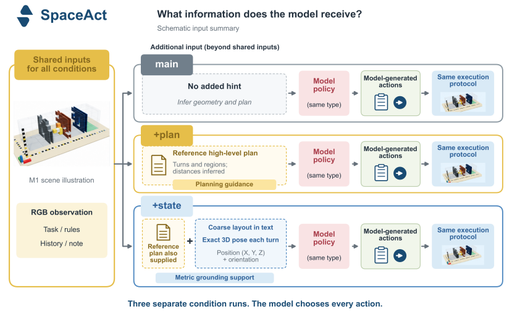
Figure 3 : Inputs of the three controlled-diagnostic conditions (schematic), each run separately on the same instances. All conditions share the RGB observation, task and rules, history, and note; the model generates every action, and all actions run under the same execution protocol. +plan adds a reference high-level plan (turns and regions; distances are left to the model). +state supplies the reference plan as well, plus the coarse layout as text and the exact 3D pose of the payload at every turn.
Original paper · CC BY 4.0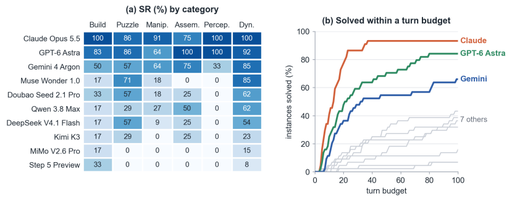
Figure 5 : Category profiles and solving speed. (a) Success rate (%) of each model by task category on the main matrix. (b) Cumulative fraction of main-matrix instances solved within a given turn budget; the three strongest models are highlighted and the remaining seven are shown in gray.
Original paper · CC BY 4.0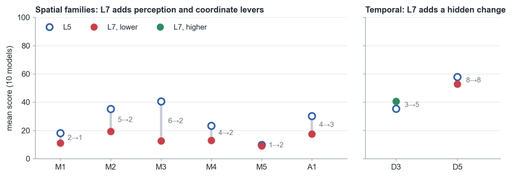
Figure 6 : Difficulty levers. Mean score over the 10 models at L5 (open circles) and L7 (filled; red if lower, green if higher) for the eight families that include both tiers; annotations give the number of solved episodes at L5 → L7. Left: spatial families , where L7 adds perception and coordinate-frame levers. Right: temporal families, where L7 adds an undisclosed physical change.
Original paper · CC BY 4.0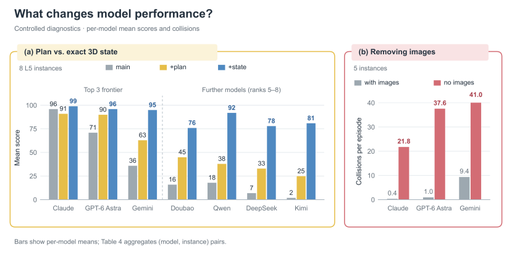
Figure 7 : Controlled diagnostics per model. (a) Mean score under main, +plan, and +state on the eight shared L5 instances for the top-3 frontier models and the four further models; Claude Opus 5.5 is averaged over its six pairs with complete runs. (b) Collisions per episode with and without image input on the five blind-test instances (top-3 models).
Original paper · CC BY 4.0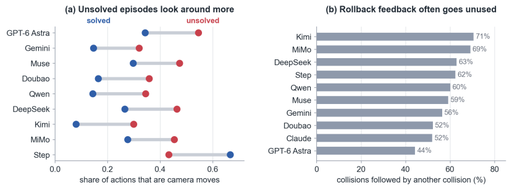
Figure 8 : Behavioral signatures. (a) Share of actions that are camera moves in solved vs. unsolved episodes, for the nine models with both solved and unsolved trajectories. (b) Percentage of collisions that are immediately followed by another collision on the next turn.
Original paper · CC BY 4.0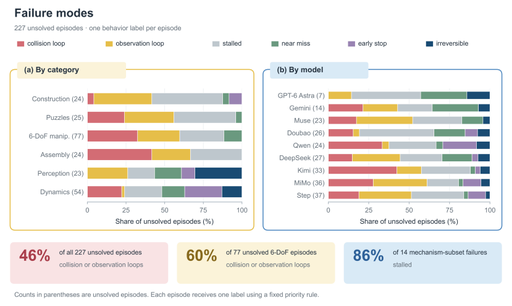
Figure 9 : Failure modes of the 227 unsolved batched-protocol episodes with complete trajectories, broken down (a) by category and (b) by model (number of unsolved episodes in parentheses). Each episode receives a single signature in the priority order defined in Section 6.6.
Original paper · CC BY 4.0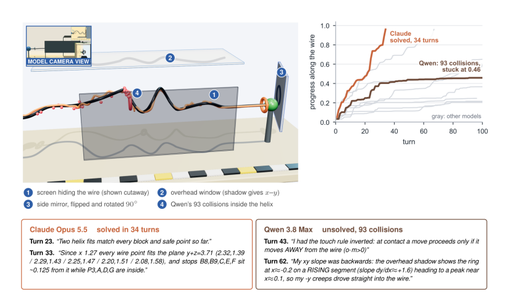
Figure 10 : Case study on the occluded helical wire task (D7-L5). Left: replay of the scene. The ring must follow a wire hidden behind a screen (①, shown cutaway), whose course can be inferred only from the overhead shadow window (②, giving x–y), a flipped and rotated side mirror (③), and collision rollbacks; markers (④) show Qwen 3.8 Max's 93 collisions inside the helix. Top right: progress along the wire per turn (gray: other models). Bottom: excerpts of the models' reasoning. Claude Opus 5.5 turns contact measurements into a consistent geometric hypothesis and solves the instance in 34 turns; Qwen 3.8 Max's hypothesis does not converge after a reversed contact rule and a sign error in the overhead slope; it stops at progress 0.46.
Original paper · CC BY 4.0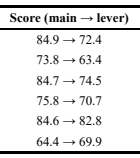
Table C.1 : Single-factor L7 difficulty lever ablations on L5 instances (Claude Opus 5.5, GPT-6 Astra, Gemini 4 Argon).
Original paper · CC BY 4.0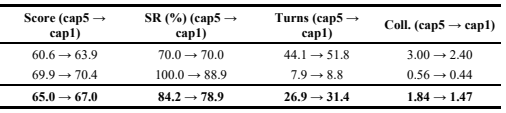
Table C.2 : Batched open-loop (cap5) vs. single-action closed-loop (cap1) control across L5 spatial and temporal tasks.
Original paper · CC BY 4.0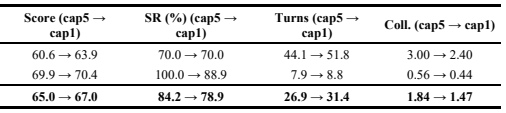
Table C.3 : Per-model breakdown of +plan, +state, nonote, and nosplit diagnostics across the 7 diagnostic models (score / SR). Pairs with an abandoned run are excluded (Section 5). †Claude Opus 5.5: six tasks for main, +plan, and +state, and two tasks for nonote and nosplit.
Original paper · CC BY 4.0
Table D.1 reports per-model trajectory signatures across the 38 main-matrix instances that use the batched protocol: mean actions per response (k), percentage of model calls saved by batching, share of actions that are camera moves in solved vs. unsolved episodes, percentage of collision turns immediately followed by another collision on the next turn, percentage of collision turns followed by a camera inspection, mean batch size before vs. after a collision, and share of turns that update the persistent note.
Original paper · CC BY 4.0Quote from the paper
Chenglong Shi, Zekai Yuan, Yue Song, Jon Pu, Will Wu (2026). SpaceAct: Benchmarking 3D Spatial and Temporal Reasoning via Closed-Loop Action and Active Perception. arXiv:2610.38405v1. https://arxiv.org/abs/2610.38405v1
BibTeX
@misc{shi2026spaceact,
  title = {{SpaceAct: Benchmarking 3D Spatial and Temporal Reasoning via Closed-Loop Action and Active Perception}},
  author = {Chenglong Shi and Zekai Yuan and Yue Song and Jon Pu and Will Wu},
  year = {2026},
  eprint = {2610.38405},
  archivePrefix = {arXiv},
  url = {https://arxiv.org/abs/2610.38405v1}
}