Paper commentary
Seeing Through the Illusion: Test-Time Scaling for World Action Models
WISE picks the best of several imagined rollouts before the robot acts
- Problem World action models generate an action and an imagined future together, but selectors judge only one side, so a plausible future can be paired with an action that does not realize it. Existing selectors miss this mismatch.
- Method WISE scores candidates with an inverse-dynamics check of action against imagined motion and executes the best.
- Results On RoboLab with Cosmos 3 Edge, WISE raises closed-loop success from 6.0% to 24.0%. On LIBERO with DreamZero, mean success rises from 75.1% to 78.3%.
Why a plausible future is not enough
A world action model (WAM) generates an action chunk and an imagined future in one pass, so each sample is a paired proposal. Drawing several such proposals and executing the best one is a natural route to test-time scaling. Sampling and verification have already improved action-only policies, but those methods never see an imagined future.
Recent WAM selectors rank candidates with predicted value, future consensus, geometric consistency, action-distribution consistency, or action-conditioned simulation. Most of these criteria look at one side of a proposal, either the imagined future alone or the action alone.
Some criteria instead depend on an external simulator, so they don't judge the candidate the WAM itself produced. Table 1 lists the two quantities that each decision-time criterion compares. Future consensus compares one predicted future with alternative futures, while cross-view geometry compares multiple views of one predicted future. Conditioning fidelity, as used by ACID, compares an input action with the action an inverse dynamics model recovers from its rollout.
WISE targets a relation that native WAMs expose: the action and future co-generated within one candidate.
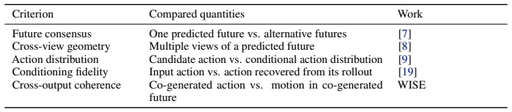
Table 1 : Decision-time consistency criteria compare different quantities.
Original paper · CC BY 4.0In the yogurt case, the imagined object moves substantially while the execution shows little corresponding motion. Figure 1 shows both divergences for Cosmos 3 Edge on RoboLab, with the imagined future on the left of each pair.
One score per candidate, one choice per step
WISE turns each sampled rollout into one number by adding three bounded scores, then executes the highest-scoring candidate. Each candidate pairs an imagined future with the action chunk the WAM co-generated, both drawn from the frozen policy given the observation, state and instruction. The frozen WAM draws B such candidates per decision, and the paper's evaluations set B to 4.
The selector takes the arg max over the candidates, then executes that full action chunk before the robot replans. The WAM is never updated, so test-time scaling acts only through generating candidates and choosing among them.
Each of the three scores lies in [0, 1], and the three answer different failure modes. A smooth action may make no task progress, so the progress score checks what the imagined future achieves. An appealing future can also be incompatible with the action proposed alongside it, which the consistency score targets. The execution score checks the action chunk against validity rules set by the control interface, such as range limits and temporal smoothness.
Each check maps its worst violation to a soft score, so a violation lowers the score smoothly instead of rejecting the candidate.
The execution score is a weighted average of the soft check scores over the checks that the control interface supports. For the consistency score, an inverse dynamics model maps the imagined future back to normalized actions, which are rescaled with the IDM training-set statistics. Continuous channels are compared in standardized training-set units and converted to an exponential consistency score.
Discrete gripper commands are thresholded and compared as discrete states, and the two consistency parts are averaged equally. The task evaluator receives the current observation, the imagined rollout and the instruction, and in both settings the paper uses a frozen Robometer scoring the final imagined frame.
Action validity as a soft score
The execution score asks whether a candidate's commands are physically plausible to run, and it judges the action chunk alone. Each candidate is first checked against validity rules defined by its own control interface, since a desirable future can still hide bad commands. For each applicable check k, the score takes the severity δk of the worst violation in the chunk, measured in that check's own units.
A satisfied constraint gets a score of 1, so the soft score doesn't reject a candidate outright. Larger violations shrink the score smoothly toward zero, which means a near-miss still counts for something.
The first check is simple: commanded values should stay within their admissible ranges. When the control representation has a physical meaning over time, the authors derive further checks from consecutive commands. For a position-like command sampled at interval Δt, velocity, acceleration, and jerk come from differences of neighbouring commands.
A chunk can stay inside every position limit yet still imply excessive velocity or acceleration. So position, velocity, acceleration, and jerk act as complementary checks of the same property.
The execution score r_exec combines the applicable checks as a weighted average of their soft scores, with weights w_k. Dividing by the total weight of the checks in K keeps the score in [0, 1] whatever subset the control interface supports. Higher values mean the chunk respects the robot's physical and control constraints more closely. The next component, world-action consistency, then compares this proposed action with the motion the IDM recovers from the imagined future.
Matching the action to the imagined motion
The IDM is trained on demonstration trajectories for each embodiment, and WISE applies it to the imagined future rather than to a real observation. It predicts normalized continuous actions and gripper states, and WISE maps the continuous part back to WAM units. The mapping multiplies the normalized output by the training standard deviation and adds the training mean: \[ \tilde a^{(i)}_{c,t+h} = z^{(i)}_{\mathrm{idm},t+h} \odot \sigma_{\mathrm{train}} + \mu_{\mathrm{train}} \]
The continuous discrepancy is the mean absolute gap between the IDM action and the WAM action, with each channel divided by its training-set standard deviation: \[ L^{\mathrm{cont}}_{t,i} = \frac{1}{H_a d_c}\sum_{h=0}^{H_a-1}\sum_{j=1}^{d_c} \frac{\bigl|\tilde a^{(i)}_{c,t+h,j} - a^{(i)}_{c,t+h,j}\bigr|}{\sigma^{(j)}_{\mathrm{train}}} \] A soft score converts that discrepancy: \(r^{\mathrm{cont}}_{t,i} = \exp(-L^{\mathrm{cont}}_{t,i})\), so zero discrepancy gives 1 and larger gaps give lower values.
For the gripper, both the IDM output and the WAM proposal are thresholded into discrete states. The discrete score is the fraction of horizon steps where those two states agree.
A high value means the co-generated action and the imagined future describe compatible motion inside the same candidate. The authors point out that this checks the rollout against itself, so whether the imagined future matches what the environment later produces is a separate question. ACID uses a related idea, but there the IDM checks an action supplied to an action-conditioned model, whereas WISE checks an action generated together with its future.
Task progress and the final selection
The task evaluator q_ψ reads the current observation, the imagined rollout, and the instruction, then returns a progress score for each candidate. In both settings it is a frozen Robometer model: Robometer-4B on RoboLab and Robometer-LIBERO on LIBERO. The score comes from the final imagined frame, so the evaluator judges where the imagined future ends rather than each intermediate step.
Its output lies in [0, 1], the same bounded range as the execution and consistency scores. Because the progress term is model-agnostic, a different task evaluator can replace Robometer.
Progress covers a gap the other two scores leave open, since a smooth action may make no task progress. Task progress agrees with the fused WISE choice more often than the other two scores, at 67.2% on RoboLab and 65.5% on LIBERO. Removing the progress score from the sum changes 47.1% of RoboLab selections and 48.5% of LIBERO selections. Used alone as Prog-only, Robometer reaches 20.0% on RoboLab, compared to 24.0% for the full WISE sum.
The authors didn't run pairwise component ablations, so how progress combines with one other score stays open.
After the three scores are summed, WISE picks the rollout with the largest total using Equation 2. The selected candidate's full action chunk runs on the robot, and the robot then observes its new state. The WAM stays frozen, so test-time scaling changes only which candidate is generated and selected. WISE then replans from the next observation, repeating the sample, score, and select loop at every control step.
Two WAM and embodiment pairs at one budget
Cosmos 3 Edge ran on 10 manipulation tasks from RoboLab, with five closed-loop episodes per task. That setup gives 50 episodes in total for the RoboLab benchmark. DreamZero, using the RLinf WAN2.2-5B LIBERO SFT checkpoint at training step 26,000, ran on the four standard LIBERO suites. Each LIBERO suite received 500 closed-loop episodes, so each method got 2,000 episodes overall.
For consistency, the authors trained embodiment-specific, vision-only IDMs on DROID real-robot trajectories for RoboLab. The RoboLab IDM used 21,000 training episodes and 1,000 scene-disjoint validation episodes. For LIBERO, the IDM learned from the physical-intelligence/libero demonstration release, using all four standard suites. That release supplied 1,693 episodes, with 5% held out for validation.
The horizons match each WAM, so a 33-frame RoboLab rollout maps to a 32-step Cosmos 3 Edge chunk. On LIBERO, the IDM reads a 9-frame two-view decoded clip and predicts DreamZero's 16-step action chunk.
Direct execution samples a single rollout per decision, so B equals 1. WISE and all test-time selectors use B equals 4 candidates per decision. Future Consensus [7], GeoBoN [8], and Robometer [20] serve as the comparison selectors at that same budget. Selectors that pick different chunks produce diverging observations, so their later decisions aren't shared.
The authors report closed-loop task success rate as the metric.
Success rate on RoboLab and LIBERO
On RoboLab, Cosmos 3 Edge with direct execution succeeds in 6.0% of episodes, sampling one rollout per decision. WISE, scoring four candidates per decision, raises that success rate to 24.0%. Future Consensus, GeoBoN, and Robometer reach 18.0%, 20.0%, and 20.0% at the same budget. The RoboLab evaluation uses only 50 episodes per method, so a few points of margin can reflect sampling variation.

Table 2 : Success Rate (%) on RoboLab.
Original paper · CC BY 4.0 · Cheikh Ahmed, Mahdi Mostajabdaveh, Milad Yazdani, Zirui Zhou · Seeing Through the Illusion: Test-Time Scaling for World Action Models · Original paper figure · Extracted the figure area from page 7 of the original PDF.On LIBERO, DreamZero's single-rollout mean success across the four suites is 75.1%. WISE lifts that mean to 78.3% and scores above single-rollout execution on all four suites. The largest gains come on LIBERO-Object at +4.8 points and LIBERO-Spatial at +3.2 points, where WISE is also the top selector. GeoBoN leads on LIBERO-Goal and Robometer leads on LIBERO-Long, so the aggregate lead rests on two suites.
Relative to single-rollout execution, WISE raises average episode runtime 3.4 times on RoboLab. On LIBERO, WISE raises average episode runtime 3.5 times over single-rollout execution. On RoboLab, WISE has the highest runtime among the four-candidate selectors. On LIBERO, its cost is comparable to Robometer's and lower than GeoBoN's.
The authors didn't run seeded evaluation at larger episode counts, which they leave as future work.
What each score contributes to the choice
The authors isolated each score by letting it alone choose the candidate in RoboLab closed-loop runs. Exec-only reached 10.0% and Cons-only 16.0%, both below the fused WISE rule at 24.0%. Prog-only, which uses Robometer, reached 20.0%, the closest of the single scores to WISE. These runs don't show what each score adds beside the other two, because each one runs alone.
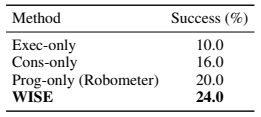
Table 5 : RoboLab single-component selector ablation.
Original paper · CC BY 4.0Next, the authors compared each score's top pick with the candidate WISE chose, using logged per-candidate scores. Task progress agreed with WISE most often, at 67.2% on RoboLab and 65.5% on LIBERO. Execution agreed in 44.4% of RoboLab decisions and 34.5% of LIBERO decisions. Consistency agreed in 36.9% of RoboLab decisions and 48.4% of LIBERO decisions.
All three scores favored the same candidate in only 7.8% of RoboLab and 7.0% of LIBERO decisions.
The authors also recomputed the WISE choice with one component removed at a time, using the same logs. Removing task progress changed the selection in 47.1% of RoboLab and 48.5% of LIBERO decisions, the largest effect. Removing execution changed 24.7% of RoboLab decisions and 12.4% of LIBERO decisions. Removing consistency changed 16.8% of RoboLab decisions and 30.4% of LIBERO decisions.
Execution moves the choice more on RoboLab, whereas consistency moves it more on LIBERO. The authors tie that split to the candidate distribution and the evaluation setting.
Limitations of the WISE evaluation
The evaluation covers only two WAM and embodiment pairs, Cosmos 3 Edge on RoboLab and DreamZero on LIBERO. Both headline comparisons use a matched budget of four candidates, set against single-rollout execution with B equal to 1. WISE depends on two auxiliary models, the IDM and the progress model, so errors in either can mislead the choice.
The IDMs were trained on DROID and LIBERO demonstration data, and the authors didn't test them on other embodiments.
The single-component runs measure each score alone, so they can't show how much each score adds beside the other two. On RoboLab, the 4.0-point lead over the strongest competing selector equals two additional successes in 50 episodes. The LIBERO runs use 2,000 episodes per method, and the 0.9-point lead over Robometer is about one standard error.
WISE adds IDM and progress-model evaluations on top of that sampling cost. Average episode runtime rises 3.4× on RoboLab and 3.5× on LIBERO relative to single-rollout execution.
The authors didn't test adaptive replanning or post-training with the WISE score, and they leave both to future work. They plan seeded evaluation at larger episode counts and pairwise component ablations. These planned runs target the sample-size and component-interaction gaps noted above.
Paper info
- Authors
- Cheikh Ahmed, Mahdi Mostajabdaveh, Milad Yazdani, Zirui Zhou
- Venue
- arXiv · Preprint
- First published
- 2026-11-2
- Added
- 2026-11-4
- Updated
- 2026-11-2
- Version
- v1
- arXiv
- 2611.03585
- Category
- cs.RO
- Original paper terms
- CC BY 4.0
- What we show
- Paper info, commentary and permitted figures from the original paper
AI commentary is a separate explanation from the original paper and may contain errors. The original paper and figures follow each source's terms of use and any rights noted separately.
Abstract
World action models (WAMs) jointly generate actions and imagined futures, but a plausible prediction need not be realized by its co-generated action. We introduce WISE (\emph{World Action Inference Scaling through Evaluation}), a pre-execution selector that scores each sampled rollout on action validity and temporal regularity, inverse-dynamics consistency between the proposed action and the imagined motion, and instruction-conditioned task progress, and executes the highest-scoring candidate while keeping the WAM frozen. With four candidates per decision, WISE raises closed-loop success from 6.0\% to 24.0\% on RoboLab with Cosmos~3 Edge and from 75.1\% to 78.3\% mean success on LIBERO with DreamZero, and exceeds the best existing selector in aggregate by 4.0 and 0.9 points. Component ablations and agreement analyses show that the three scores rank candidates differently and that task progress carries the largest weight in the fused decision.
Quote from the paper
Cheikh Ahmed, Mahdi Mostajabdaveh, Milad Yazdani, Zirui Zhou (2026). Seeing Through the Illusion: Test-Time Scaling for World Action Models. arXiv:2611.03585v1. https://arxiv.org/abs/2611.03585v1
BibTeX
@misc{ahmed2026seeing,
  title = {{Seeing Through the Illusion: Test-Time Scaling for World Action Models}},
  author = {Cheikh Ahmed and Mahdi Mostajabdaveh and Milad Yazdani and Zirui Zhou},
  year = {2026},
  eprint = {2611.03585},
  archivePrefix = {arXiv},
  url = {https://arxiv.org/abs/2611.03585v1}
}