Paper commentary
VLAN: Vision-Language Accessible Navigation
- Problem Goal-reaching benchmarks assume one generic agent, so they cannot show whether a route is accessible to a particular user.
- Method Builds 1,000 editable Gaussian-splat scenes in Unity, derives user-specific routes, accessibility labels and expert actions for five user types, and scores vision-language models on rollout and guidance tasks.
- Results InternVL3.5-8B reached an AccSR of 0.426 on the VLAN test split, the highest of the seven models evaluated.
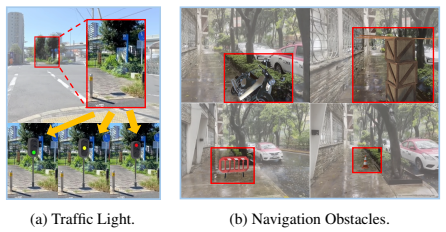
Figure 3 :Editable scenes of VLAN.The same reconstructed scene can be modified with arbitrary traffic-light states, obstacle layouts, and route conditions. It can systematically construct accessibility-aware navigation scenarios.
Original paper · CC BY 4.0 · Jie Hu, Yu Zheng, Wenzhi Wu, Weixing Feng, Cunlei Cheng, Jiaming Zhang · VLAN: Vision-Language Accessible Navigation · Original paper figure · Extracted the figure area from page 4 of the original PDF.Why user-agnostic navigation evaluation falls short
Navigation benchmarks usually count a trajectory as successful when it reaches the target and avoids collisions, judged for a generic agent. That criterion breaks down once the same obstacle must be read differently depending on the body, perception and mobility of the user.
Reaching the target is therefore not sufficient evidence that a trajectory is safe or appropriate for the intended user.
Building editable scenes from reconstructed videos
Each scene starts from egocentric videos that are reconstructed into a Gaussian-splat representation and then imported into Unity for controlled editing. Because the reconstructed scene is editable rather than a fixed set of observations, obstacles, traffic-light states and routes can be changed while the visual appearance stays realistic.
The dataset grows along two axes. More reconstructed scenes widen the variety of appearance, layout, lighting and environmental conditions. More edited routes within a scene widen navigation-level variety over the same geometry. Scene-level variety is also reflected in the taxonomy: of the 1,000 classified scenes, 474 are daytime, 251 nighttime, 131 dusk and 144 low vision, and 563 are sunny.
The release contains 1,000 scenes, 20K navigation trajectories and 160K keyframes. Each scene holds about 20 trajectories, and each trajectory is stored as eight keyframes. Figure 3 shows one reconstructed scene with different traffic-light states and obstacle layouts, which is the kind of edit that lets one base environment yield several navigation instances with different accessibility implications.
Accessibility labels and user-specific routes
A user-conditioned route is written as the output of a generation step G that takes the edited scene S, the obstacle configuration o, the start state, the goal state and the user type. In the formula, the route is a sequence of states indexed from 1 to T for that user.
For action-prediction users, each pose is stored as a position together with a yaw angle. Consecutive poses are converted into local actions made of a lateral displacement, a forward displacement and a yaw change, computed in the frame of the current heading. \[ \begin{bmatrix}\Delta x_t\\ \Delta z_t\end{bmatrix}=R(\psi_t)^{\top}\left(\begin{bmatrix}p^x_{t+1}\\ p^z_{t+1}\end{bmatrix}-\begin{bmatrix}p^x_t\\ p^z_t\end{bmatrix}\right),\qquad \Delta\theta_t=\psi_{t+1}-\psi_t \] Here R(psi_t) is the planar rotation matrix for the current yaw.
Only the ground-plane components enter the action, so vertical motion is excluded from the action representation.
Two task families and how they are scored
For humanoid, BVI and wheelchair users, the model writes natural-language guidance instead of control actions. Each user type has its own conventions: distance and side for humanoids, steps and clock directions with explicit risk for BVI users, and feasibility, clearance and surface stability for wheelchair users.
Rollout metrics use indicator terms. The action success rate counts a rollout only when it both reaches the goal and stays collision-free, and it is written as the average over N rollouts of the indicator that g(i)=1 and c(i)=1. \[ \mathrm{SR}_{\mathrm{act}}=\frac{1}{N}\sum_{i=1}^{N}\mathbb{I}\left[g(i)=1\wedge c(i)=1\right],\qquad \mathrm{SPL}=\frac{1}{N}\sum_{i=1}^{N}g(i)\frac{l^*_i}{\max(l^*_i,\hat l_i)} \] GR and CF are the plain averages of g(i) and c(i).
SPL compares the reference path length l*_i with the predicted rollout length l-hat_i, and it counts only goal-reaching rollouts.
For language-guided users, SRlan is strict: a prediction counts only when every required user-specific semantic constraint is met. IAS is a weighted sum of continuous similarity terms, with weights that add up to one over the constraints of that user type.
Action prediction results for drone and quadruped users
Qwen2.5-VL-7B-Instruct also scores well for drones, with SRact 0.571, which the authors link to explicit, geometric output spaces.
Language-guided guidance results for humanoid, BVI and wheelchair users
For humanoid users, Llama-3.2-11B-Vision-Instruct has the highest SRlan at 0.558 and the highest IAS at 0.846, with Molmo2-8B close behind at SRlan 0.523 and IAS 0.840. Qwen2.5-VL-7B-Instruct reaches an IAS of 0.781 but an SRlan of only 0.275, which the authors take to mean that partial semantic overlap does not secure fully correct user-conditioned guidance.
Idefics3-8B-Llama3 is weak on this user type, with SRlan 0.118 and IAS 0.576.
The authors read the gap between strict success and alignment as a sign that plausible guidance is easier to produce than precise feasibility reasoning.
Balancing the two task families with AccSR
Per-user success rates cannot be compared directly across the two task families, so each family is averaged first. The language family averages the humanoid, BVI and wheelchair SRlan values, and the action family averages the drone and quadruped SRact values. \[ \mathrm{AccSR}=\frac{2\,\mathrm{SR}^{\mathrm{avg}}_{\mathrm{lan}}\,\mathrm{SR}^{\mathrm{avg}}_{\mathrm{act}}}{\mathrm{SR}^{\mathrm{avg}}_{\mathrm{lan}}+\mathrm{SR}^{\mathrm{avg}}_{\mathrm{act}}} \] AccSR is the harmonic mean of the two family averages, so it is high only when both families score well.
Qwen2.5-VL-7B-Instruct ranks third with an AccSR of 0.331.
Idefics3-8B-Llama3 does better on action users, with an action average of 0.431, while Molmo2-8B is stronger for language users, with a language average of 0.315. Llama-3.2-11B-Vision-Instruct reaches an AccSR of 0.191 and Qwen2.5-VL-3B-Instruct 0.147.
Separating perception errors from planning errors
Each trajectory is classed by two signals: whether the language output names the correct obstacle category, labelled P+ or P-, and whether the predicted rollout succeeds under SRact, labelled A+ or A-. The four cells are reported as percentages for each model.
For Qwen2.5-VL-3B-Instruct, 63.4% of trajectories fall in the P-A- cell, and 23.3% have a correct obstacle name with a failed action. Molmo2-8B has 61.4% in P-A-. Qwen3-VL-8B-Instruct and InternVL3.5-8B have the largest shares in P+A+, at 28.9% and 26.5%.
Idefics3-8B-Llama3 has the largest P-A+ share at 40.4%, which means it reaches the goal while naming the obstacle incorrectly. The authors do not attribute those successes to accessibility reasoning.
A correct obstacle name followed by a failed action does not isolate action generation alone, because spatial grounding and user conditioning can both contribute to that cell.
Sim-to-real check on 30 real trajectories
InternVL3.5-8B has the highest AccSR at 0.302, followed by Qwen3-VL-8B-Instruct at 0.283 and Qwen2.5-VL-7B-Instruct at 0.269.
Limitations
The sim-to-real check covers only 30 real-world trajectories, so it cannot serve as a definitive real-world evaluation.
The baselines are general-purpose vision-language models rather than embodiment-specialised navigation agents, which the authors leave as a next step. The main evaluation uses a 100-scene test split with 1,931 trajectories per user setting.
The perception and planning split does not fully separate the two causes, so the four cells describe outcomes rather than a causal decomposition.
Paper info
- Authors
- Jie Hu, Yu Zheng, Wenzhi Wu, Weixing Feng, Cunlei Cheng, Jiaming Zhang
- Venue
- arXiv · Preprint
- First published
- 2026-11-13
- Added
- 2026-11-20
- Updated
- 2026-11-13
- Version
- v1
- arXiv
- 2611.18346
- Category
- cs.AI · cs.CV
- Original paper terms
- CC BY 4.0
- What we show
- Paper info, commentary and permitted figures from the original paper
AI commentary is a separate explanation from the original paper and may contain errors. The original paper and figures follow each source's terms of use and any rights noted separately.
Abstract
Accessible mobility is user-conditioned rather than scene-intrinsic, as walkable paths for one embodiment are inaccessible to another. Yet, existing benchmarks evaluate traversability under a fixed and limited embodiment. We present Vision-Language Accessible Navigation (VLAN), containing 1,000 scenes, 20K navigation trajectories, and 160K keyframes across diverse lighting, environmental conditions, scene semantics, and path geometries. For each trajectory, VLAN provides embodiment-specific actions and accessibility features for legged and wheeled agents, including humanoid and quadruped robots and people with visual or mobility impairments, while everyday obstacles and accessibility labels are categorized as Passable, Bypass, HighRisk, and Blocked. Unlike goal-only evaluation, our benchmark measures physical safety and alignment with user-specific constraints via goal-reaching, collision-aware, and accessibility-aligned metrics. We benchmark modern vision-language models and find they often fail to consistently adapt obstacle relevance, path selection, and safety criteria across user profiles, suggesting accessibility-aware navigation requires dedicated datasets, tasks, and metrics beyond conventional embodied navigation evaluation. All data and code open-source at https://github.com/InSAI-Lab/VLAN.
Quote from the paper
Jie Hu, Yu Zheng, Wenzhi Wu, Weixing Feng, Cunlei Cheng, Jiaming Zhang (2026). VLAN: Vision-Language Accessible Navigation. arXiv:2611.18346v1. https://arxiv.org/abs/2611.18346v1
BibTeX
@misc{hu2026vlan,
  title = {{VLAN: Vision-Language Accessible Navigation}},
  author = {Jie Hu and Yu Zheng and Wenzhi Wu and Weixing Feng and Cunlei Cheng and Jiaming Zhang},
  year = {2026},
  eprint = {2611.18346},
  archivePrefix = {arXiv},
  url = {https://arxiv.org/abs/2611.18346v1}
}