Paper commentary
Counting Under Disagreement: Dollar-Weighted Measurement, Selective Machine Labelling and Budgeted Human Review from Disagreeing AI Readers of Administrative Text
Human-checked corrections make disagreeing AI readers agree on dollar totals
- Problem A total built from one AI reader inherits that reader's bias, and the readers disagree. Their research totals run from $12.5B to $15.0B.
- Method The authors correct each predictor's total with the error it makes on a human-labelled sample. Each human-read text is weighted by its dollars divided by its inclusion probability.
- Results Once rectified, eight predictors with plug-in totals of $11.2-15.0B agree within $0.4B.
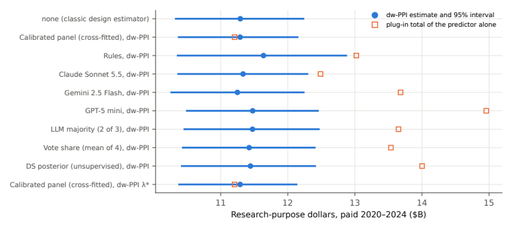
Figure 3 :Each predictor’s plug-in total (open squares) and its dw-PPI estimate with 95% interval (filled). The readers disagree by $12.5–15.0B; rectified on the same human sample they agree.
Original paper · CC BY 4.0 · George Koomullil · Counting Under Disagreement: Dollar-Weighted Measurement, Selective Machine Labelling and Budgeted Human Review from Disagreeing AI Readers of Administrative Text · Original paper figure · Extracted the figure area from page 18 of the original PDF.Why one machine reading of grant purposes can't give the total
The testbed covers US private grants for tax years 2020 to 2024, with 799,675 grant rows worth $126.4B. Those rows carry 121,070 distinct purpose texts, and many rows repeat the same text word for word. So a label given to one text is a decision that spreads to every record carrying it. In the testbed one text covers 45,082 rows and $13.9B, so one label's error reaches a large share of the dollars.
The machine readers disagree, and the dollars each one calls research run from $12.5B to $15.0B. A total built from any one reading therefore inherits that reading's bias. The companion report could only give a spread between $11B and $15B, which an office can't act on.
The estimand is a dollar sum, so an error on one large text counts for more than errors on many small ones. Eight predictors whose plug-in totals span $11.2–15.0B agree to within $0.4B once rectified. That agreement is the result the section sets up, because the rectifier corrects each reading's bias against a human sample.
Correcting a predictor's total with a human sample
The estimator starts from the predictor's own total and corrects it with the error the predictor makes on the human sample. This is prediction-powered inference, specialised here to text-level labels that carry record-level dollars. Its predictor is cross-fitted on folds fixed over the whole frame before sampling, so no unit's own label enters the score that corrects it.
Each human-labelled text enters the correction with its dollars divided by its inclusion probability, written m_i = d_i/π_i. The mi weights let the sampled texts stand for the whole frame, so the correction does not need the sample to be uniform. The rectifier therefore removes the predictor's bias on the dollar scale rather than the count scale.
The committed design uses fixed-size systematic sampling, so unbiasedness there is an approximation rather than an exact result. For that design the authors use the Hájek form of the estimator instead of the Horvitz–Thompson form. The Hájek form is checked by simulation, not proved, under the committed design.
The calibrated panel combines the readers' outputs and the text cues into one calibrated probability of research. The paper shows that the cross-fitting construction, not only the exclusion of a unit's own label, decides exactness. Across the 8 predictors, the rectified estimates land within $0.4B of one another, as the full section below reports.
Do the rectified predictors agree once corrected
The question is whether predictors that disagree on the plug-in total still agree after each one is rectified with the human sample. Eight predictors have plug-in totals that span $11.2–15.0B, and the four readers alone span $12.5–15.0B. After rectification, the dw-PPI estimates span $11.2–11.6B, and every one falls inside the classic interval of $11.29B [10.3, 12.2].
The rectifier therefore removes most of the disagreement in the plug-in totals. The substantive number was already given by the human sample alone, so the agreement is the real result here.
The rules classifier has a plug-in total of $13.0B, which is the largest gap from the human reference among the readers. Tuning λ* settles near zero for the rules classifier, which pulls its weight back out of the estimate.
The regime analysis asks how much of this gain the design itself already delivers. Under a simple random sample of texts, the calibrated panel's variance ratio is 3.6 at n = 651 under truth A. Under the committed design, the same ratio drops to 1.3, because the vote-pattern strata already absorb much of what the predictor knows. At λ = 1 the ratio falls below one for the rules classifier, so the rectifier adds the predictor's noise.
Tuning can reduce the loss from an unhelpful predictor, which is why the tuned estimator stays useful there.
Accepting machine labels at a stated dollar error
It sets the sample size to the Kish effective size of the design, because the weights of the PPS draws are unequal. That substitution is where the guarantee breaks, since the Hoeffding–Bentkus bound is exact only for independent equal-weight draws. The authors therefore report the rule as evaluated rather than certified, and they measure its error on the sample instead of relying on the bound.
On nested held-out folds, the Hoeffding–Bentkus version accepts 80% of the unsampled dollars at α = 0.05. Its realised held-out dollar error is 0.003 [0.000, 0.016], and it sits above α in 0% of the 100 folds. The maximum fold error is 0.024, so no fold came close to a violation at that level. Its error was above α in 0% of the 100 folds, which is the check the held-out evaluation gives.
At α = 0.10 the rule accepts 92% with error 0.025 [0.004, 0.066], and it still sits above α in no fold.
The weighted conformal rule behaves differently, and it has no power at α ≤ 0.05. On held-out folds, where each split's rule is fitted on four fifths of the sample, it accepts 34% of held-out dollars. That held-out acceptance comes with a realised dollar error of 0.005 [0.000, 0.021].
The authors also test the rule on re-draws of the design, where the synthetic truths are fixed and the committed design is redrawn 200 times. That bound holds per cell under that cell's simulation law, and it says nothing about other data-generating mechanisms. The authors judge the rule by these measured violation probabilities on this design, not by a bound.
Spending a limited human reading budget
The replay fits the calibrator on two thirds of the sample and runs the policies on the other third, so the policies see labels the model has not seen. Every label is charged to the budget, so the replay counts the cost of each human reading, not only the cost of the final wave.
After a separate pilot, the active design cuts the RMSE of the total by 2.6 times at 100 texts, relative to dollar-proportional sampling with a calibrated predictor. That active design is worse than dollar sampling when the predictor is uncalibrated, and it under-covers when inclusion probabilities approach zero.
The authors therefore fit the calibrator on the design's own first phase, which charges every label to the budget. That two-phase design, with conditional inclusion probabilities fixed before each wave's labels are revealed, has an RMSE 28% below dollar sampling's at a common total budget of 100 texts, a ratio of 1.38. A hybrid that accepts labels at a stated error and reads the rest by the active design stays a negative result, because accepting labels can invalidate an otherwise useful interval.
The figure below plots RMSE against texts read, with every label charged, for the classic design and the two-phase variants. The figure also shows the batch-sequential variants and a reference with the in-pool calibrator whose labels are not charged.
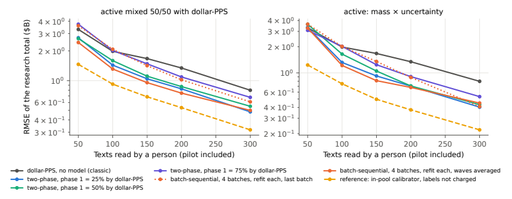
Figure 7 :RMSE of the research total against the budget for the designs with every label charged, with the classic design and the free-pilot reference; left with the mixed measure in the later phases, right with the pure active measure.
Original paper · CC BY 4.0How much the choice of reader moves the answer
The estimated total depends on which person is treated as the reference, and the paper measures that shift directly. Reader 1 labelled the frozen codebook and saw no machine label while doing so, but one reading is still one measurement of the codebook. Two further readers then labelled the whole sample blind, and their first labels were kept and released without adjudication.
The readers give the same research-or-not answer on 77% of texts and 91% of dollars. That shift is 2.2 times the sampling interval, so the choice of reader matters more than the sampling error here.
The methods' conclusions held under each reader, so the rectified total moved with the labels rather than with the calibrator. The regime, with little gain from the predictor under this design, held under every reader. The active review design beat dollar sampling under each reader as well. The composite estimator's institution-level dispersion also depends on the reader: κ̂ is 1.85 under reader 1, and 0.63 and 0.77 under reader 2 and the majority.
Under reader 3, κ̂ is zero, so the round does not settle which reading is right.
The unclear share is 19%, 25% and 16% of texts across the three readers, so the spread partly reflects the codebook.
Agreement among the readers doesn't show that any one of them is correct. The gold-free Dawid–Skene total misses the rectified interval, so the simplest member of that family doesn't recover the reference total here. Reader 1 is not the latent label, so the independence assumption of a gold-free estimator isn't tested by this comparison.
Limitations: what the proofs, checks and experiments leave open
The proofs cover an idealised draw model for the conformal p-values, and the paper doesn't prove the weighted Benjamini–Hochberg step under dollar weights. That step is checked on the committed design, so its error control rests on simulation rather than a theorem. Learn-then-Test is measured on re-draws rather than bounded, because its p-values substitute an effective sample size with no finite-sample justification under unequal weights.
The Hoeffding–Bentkus bound is exact only for independent equal-weight draws, so the authors call the rule evaluated, not certified.
The validity claims also depend on Assumption 1 and on the reference labels, which the paper doesn't test independently. The active design's optimality holds for a Horvitz–Thompson rectifier under Poisson sampling with a calibrated predictor, not for the fixed-size draws used in the replay. The reference is one reader, and two further readers gave a $3.93B shift in the estimated total, 2.2 times the sampling interval.
Its shared texts make institutions dependent, and the composite's κ̂ is a boundary estimate under reader 3. Its simulation holds the calibrator fixed, so calibration error is left out of those intervals. The protected replay's uncertainty covers splits of one sample, not fresh frames, and the forecast is retrospective.
The totals count reported amounts by stated purpose, not research expenditure. The growth test compares two series with different accounting, and its interval admits both no growth and parity. The authors suggest an adjudication of the 152 split texts and a year-stratified top-up as next steps.
Paper info
- Authors
- George Koomullil
- Venue
- arXiv · Preprint
- First published
- 2026-11-9
- Added
- 2026-11-11
- Updated
- 2026-11-9
- Version
- v1
- arXiv
- 2611.13215
- Category
- cs.AI · cs.LG · stat.ME
- Original paper terms
- CC BY 4.0
- What we show
- Paper info, commentary and permitted figures from the original paper
AI commentary is a separate explanation from the original paper and may contain errors. The original paper and figures follow each source's terms of use and any rights noted separately.
Abstract
We study AI-assisted measurement when one text label applies to many administrative records, the target is a monetary total, and the human readings that anchor the machines disagree. The testbed is 121,070 grant-purpose texts from US tax filings (799,675 records, \$126.4B), labelled by a rule-based classifier and three language models, with a designed sample of 651 texts read independently by three people under one codebook. We state exact conditions for a fixed-predictor difference estimator and for a cross-fitted predictor whose folds are assigned to the whole frame before sampling, under Poisson sampling, and assess the implemented fixed-size procedures by simulation: 8 predictors whose own totals span \$11.2-15.0B agree to within \$0.4B once rectified. Two rules that accept machine labels at a stated dollar-weighted error, weighted conformal p-values under a dollar measure and Learn-then-Test on the design estimate of the error, are evaluated on nested held-out folds and on re-draws of the design with synthetic truths; their error control in deployment is not established, and the count-based rule accepts no text under a dollar-drawn sample. In a replay that charges every human label, a two-phase review policy whose calibrator is fitted on its own first phase reduces the RMSE of the total by 28% at a budget of 100 texts relative to dollar-proportional sampling, while pure Neyman allocation fails with an uncalibrated predictor. Independent readers shift the estimated total by \$3.93B, 2.2 times the within-reader sampling interval, and institution-level intervals under-cover at every size. Every headline result is re-run under each reader. The results identify both the benefits and the limits of using learned predictions to decide what a person should verify.
Quote from the paper
George Koomullil (2026). Counting Under Disagreement: Dollar-Weighted Measurement, Selective Machine Labelling and Budgeted Human Review from Disagreeing AI Readers of Administrative Text. arXiv:2611.13215v1. https://arxiv.org/abs/2611.13215v1
BibTeX
@misc{koomullil2026counting,
  title = {{Counting Under Disagreement: Dollar-Weighted Measurement, Selective Machine Labelling and Budgeted Human Review from Disagreeing AI Readers of Administrative Text}},
  author = {George Koomullil},
  year = {2026},
  eprint = {2611.13215},
  archivePrefix = {arXiv},
  url = {https://arxiv.org/abs/2611.13215v1}
}