Paper commentary
Grasping the Future: Joint 3D Hand-Object Forecasting From Internet Videos
Grasping-the-Future jointly forecasts 3D hand and object motion from partial observations
- Problem Forecasting hand-object interactions in 3D has lacked training data, because internet videos show grasps but contain no 3D hand or object labels. Pixels alone do not record hand and object poses, so supervision is missing.
- Method Grasping-the-Future is one generative model that fills in hidden parts of hand-object trajectories. It reconstructs 3D trajectories from internet videos, then trains a flow-matching transformer on masked cells, so one network handles forecasting and cross-entity prediction.
- Results The model outperforms released forecasters on OakInk2 and HOT3D, which have 3D annotations. Retargeted trajectories reproduce 73.8% of forecasts in simulation on a robot hand.
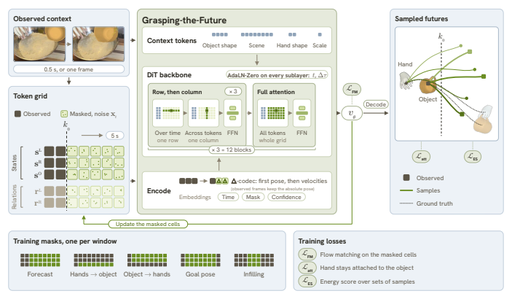
Figure 2 :Model overview.An interaction is represented as a grid of tokens, with rows indicat- ing statessand relationsr, and one column per frame. Observed cells are given, and unobserved cells are initialized to noise. A transformer attends to rows, columns and across the grid to predict the flow velocity of the noise cells (with the context tokens (blue) as additional keys/values). The noise is decoded into a sample by ten Euler steps, producing hand and object trajectories. Multiple samples for the same input vs. ground truth (dashed). The bottom row is used for training. An observation mask is sampled per window during training so the same model trains on all tasks (but with a different set of observed cells). Flow matching is used for velocity supervision and auxiliary losses are applied to decoded trajectories.
Original paper · CC BY 4.0 · Rustin Soraki, Matthew Wallingford, Ryan Aby, Brandon Chee, Jason Ren, Ali Farhadi, Homanga Bharadhwaj, Roozbeh Mottaghi · Grasping the Future: Joint 3D Hand-Object Forecasting From Internet Videos · Original paper figure · Extracted the figure area from page 4 of the original PDF.Why 3D forecasting is hard to supervise
Anticipating a grasp means predicting the hand and the object together, and keeping them in firm contact as the object moves. A mug that is lifted, carried and set on a shelf needs the fingers and the mug to stay coordinated the whole way. Human videos show these motions across many everyday situations, which makes them a natural place to learn from.
Predicting in 3D makes the spatial relationships between hands, objects and scene explicit, and it gives an unambiguous reference for retargeting to a robot. The raw video itself doesn't supply these 3D targets, because the pixels alone don't record hand and object poses. Learning the predictive model therefore requires 3D hand-object supervision that large-scale internet videos don't directly provide.
The pipeline separates camera motion from object motion, refines the hand-object alignment with contact and temporal constraints, and filters unreliable reconstructions.
The extracted trajectories are noisier than annotations, so the model receives a confidence input that lets it rely less on noisy labels. From third-person viewpoints, the hand error is about nine times lower and the object pose error about a quarter lower.
One masked model for every prediction task
The key idea is to treat every prediction task as one problem: some cells of a hand-object trajectory are shown, and the rest are generated. The authors' key insight is that a single model can learn these different forms of prediction, from forecasting to cross-entity prediction. Each window is a grid with one row per entity, meaning each hand and the object, and one column per frame.
A mask marks each cell as observed with a 1, and its complement marks the cells the model has to generate.
Which cells are shown decides the task. Temporal infilling hides the middle third of the window for every entity and generates it from the frames before and after.
Because the same weights see every observation pattern, one network can replace several separate forecasters.
How the masked grid is encoded and sampled
The network reads a grid of tokens, with one column per frame and one row for each hand, the object, and each hand-object relation. Each frame carries five tokens: three states and two relation tokens, where the relation token holds the wrist pose in the object's coordinates. Each relation token holds 14 values: the wrist position and rotation in object coordinates, plus five fingertip-to-surface distances.
Before encoding, every pose is re-expressed in the camera frame of the present frame and centred on the wrists and object. If a hand or the object is hidden in a frame, its relation token is hidden too, so the model doesn't receive a pose it must generate.
Motion is stored with the ∆-codec, which encodes each state as a change per unit time instead of an absolute pose. Each value subtracts the previous state and divides by the elapsed time and a per-channel velocity scale σv estimated from training data. Dividing by elapsed time lets windows with different frame rates share one scale. A stationary state becomes a run of zero difference tokens, and a difference is observed only when both neighbouring states are observed.
The masked tokens are trained with flow matching, which mixes clean encoded values with Gaussian noise at a random flow time t. The network vθ regresses the velocity x1 minus ε on the masked tokens, and the observed tokens enter without noise. The confidence embedding lets the model rely less on trajectories extracted from video, which contain more noise.
Each attention layer also reads the context as extra key-value tokens: the object mesh from Uni3D and the scene point cloud from LitePT.
The transformer repeats a group of four blocks, where the first three attend over the five tokens across time and per frame. At inference, Grasping-the-Future starts the masked tokens from Gaussian noise and integrates the predicted velocity over 10 Euler steps.
Keeping the hand attached after decoding
Small errors under framewise flow matching can build up in decoded trajectories, and the hand can drift away from the object. So the authors decode a clean trajectory from one flow-velocity prediction and supervise it directly with an attachment loss. Flow matching alone scores each velocity against its target, so a small per-frame error never becomes a direct penalty on hand-object distance.
The attachment loss runs only over reference contact frames, where at least one fingertip lies within 5 mm of the object surface. For each hand, the loss compares the predicted object-frame wrist position and fingertip positions with their reference values. It also adds a chordal rotation distance on the wrist orientation and a relative wrist velocity term with weight λv.
Because the loss matches the reference relative motion, it still allows changes such as regrasping.
For scoring, the model generates M = 3 trajectories from the same observation on a quarter of the optimizer steps. Each sample uses six Euler steps, and gradients flow back through all six. The energy score compares these samples with the reference trajectory, balancing accuracy against diversity among samples.
Scoring sets of samples targets the final positions and rotations, instead of a single trajectory's error. Section 3.4 then describes how the training trajectories are extracted from internet video.
Recovering trajectories from monocular internet video
The pipeline starts by picking usable clips, since most internet footage doesn't show a clear manipulation. Molmo 2 identifies manipulation clips from Action100M and locates the manipulated object, then SAM 3 tracks its mask. WiLoR estimates the MANO hand poses, SAM 3D the object meshes and poses, MoGe the metric depth, and MegaSaM the camera motion.
Each per-frame estimate lives in its own camera frame, so the MegaSaM camera poses bring them into one world coordinate system.
CoTracker3 object tracks are lifted into 3D with depth, and a rigid object trajectory is fitted by robust bundle adjustment. A transformer trained on corrupted motion-capture trajectories estimates each clip's depth bias, which is then corrected along the viewing direction.
From third-person viewpoints, the hand error is about nine times lower and the object pose error about a quarter lower. Training on these trajectories with annotated data lowers the forecasting error, which the authors measure against the annotated benchmarks.
Forecasting against non-learned baselines
Stay-put holds the last observed pose, constant velocity extrapolates observed motion, and interpolation connects the observed endpoint poses.
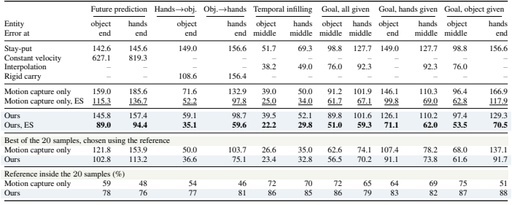
Table 1 :Prediction across seven tasks.Position errors are in millimeters, and hand errors average the left and right wrists. The row “Error at” shows whether a column scores the last frame or, when the final pose is given as input, the middle of the generated frames. “Motion capture only” is our model trained without the trajectories extracted from internet videos. For both models, we report the error of a single sample, the energy score of the20samples, and the error of the best of the20 samples (Section 4.1). Because the energy score subtracts the distance between samples, it is not the error of any one trajectory and can be lower than the best-of-20error. The best of20is chosen using the reference, so it has its own block and is left out when marking the best (bold) and second-best (underlined) results. The last block shows the percentage of windows in which the reference lies within the20samples, ideally95%.
Original paper · CC BY 4.0A sample commits to one plausible motion, so its error can exceed that of not moving when that motion differs from the reference. A single sample also trails interpolation at the middle of gaps with both endpoints given, by 3–28%.
A single prediction has no spread, so part of that energy-score gap could come from spread alone. To test this, the authors gave stay-put and interpolation the spread of the model's samples, using Gaussian noise with the same covariance.
Table 1 reports these comparisons across all seven tasks under the same single-sample, energy-score and best-of-20 protocol.
Against released forecasting methods
Table 2 pits the model against released forecasters, and each released model runs on its own required inputs. For the object, the energy-score ADE is 55.5 mm compared to 77.0 for ObjectForesight.
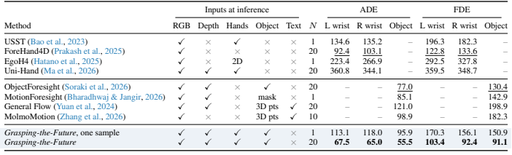
Table 2 :Comparison with different forecasting approaches.ADE and FDE in millimeters with the listed inputs. Methods withNsamples are scored with the energy score of all samples, which equals the error whenN=1. Our model uses estimated depth here. Bold and underline mark the best and second-best results.
Original paper · CC BY 4.0MotionForesight, by contrast, gets a lower object ADE than the single sample but barely moves the object. Its FDE sits within 1 mm of stay-put, so the low error comes from staying still rather than from following the motion.
The released models take different inputs, so the shared element is the scoring code rather than the inputs.
Retargeting forecasts to a simulated robot hand
Retargeting maps the predicted hand poses onto a simulated robot hand, either kinematically or with SPIDER's dynamic control. Dynamic retargeting with SPIDER further optimizes robot controls in simulation so the robot follows the predicted object motion. The authors also test kinematic retargeting with SPIDER's grasp preparation, which runs without trajectory optimization.
Once the forecast hand holds the object, the robot wrist moves with the predicted object while the grip stays unchanged.
Grasp preparation raises success to 43.7%, so many kinematic failures come from a grasp that doesn't hold the object. When SPIDER also optimizes the robot controls, 73.8% of the forecasts are reproduced in simulation. The authors read this as evidence that most forecast hand-object motions can be carried out through physical interaction once adapted to the robot hand.
They conclude that these forecasts are physically plausible.
The conclusion connects this result to the wider goal of moving predictions from human videos into robot execution. The retargeting test is the paper's only check of physical plausibility on the robot side.
Where the evidence stops: pseudo-ground truth and sampling choices
The internet-video references are less accurate than the annotations, so scores on those clips are measured against noisier pseudo-ground truth. The authors point to Appendix C for the full accuracy comparison between extracted and annotated references.
The annotated evaluation covers OakInk2 and HOT3D, the two datasets with 3D annotations that the authors name.
The best-of-20 numbers are chosen with the ground-truth reference, which the model doesn't have at inference time. Rates below 95% mean the samples are too concentrated, while rates above 95% mean they are too dispersed.
Paper info
- Authors
- Rustin Soraki, Matthew Wallingford, Ryan Aby, Brandon Chee, Jason Ren, Ali Farhadi, Homanga Bharadhwaj, Roozbeh Mottaghi
- Venue
- arXiv · Preprint
- First published
- 2026-11-9
- Added
- 2026-11-11
- Updated
- 2026-11-9
- Version
- v1
- arXiv
- 2611.12879
- Category
- cs.CV
- Original paper terms
- CC BY 4.0
- What we show
- Paper info, commentary and permitted figures from the original paper
AI commentary is a separate explanation from the original paper and may contain errors. The original paper and figures follow each source's terms of use and any rights noted separately.
Abstract
To interact with an object, we need to anticipate both how it will move and how our hands should move with it. Human videos capture these relationships across everyday activities, offering a natural source for learning to predict future interactions. Learning from them requires recovering motion from completed interactions and using it to anticipate what could happen next. We present $\textit{Grasping-the-Future}$, a unified generative model of joint 3D hand-object motion, including wrist motion, finger articulation, and object position and orientation. Through masked spatiotemporal completion and flow matching, we train a single model for several prediction tasks: forecasting future interactions, predicting hand motion given object motion or vice versa, generating both trajectories toward a desired final object pose, and completing partially observed interactions. We explicitly model hand-object relations and incorporate contact constraints to help preserve grasp relationships during motion. To obtain 3D supervision from internet videos, we develop a scalable pipeline that combines pretrained perception models with joint geometric optimization to reconstruct completed interactions. We combine these recovered trajectories with annotated interaction datasets as training data for all tasks. We demonstrate strong performance across all tasks, outperforming released forecasters on datasets with 3D annotations. Moreover, we show geometric and physical plausibility of the predicted trajectories by retargeting them to a robotic embodiment. Videos are available at https://grasping-the-future.github.io.
Quote from the paper
Rustin Soraki, Matthew Wallingford, Ryan Aby, Brandon Chee, Jason Ren, Ali Farhadi, Homanga Bharadhwaj, Roozbeh Mottaghi (2026). Grasping the Future: Joint 3D Hand-Object Forecasting From Internet Videos. arXiv:2611.12879v1. https://arxiv.org/abs/2611.12879v1
BibTeX
@misc{soraki2026grasping,
  title = {{Grasping the Future: Joint 3D Hand-Object Forecasting From Internet Videos}},
  author = {Rustin Soraki and Matthew Wallingford and Ryan Aby and Brandon Chee and Jason Ren and Ali Farhadi and Homanga Bharadhwaj and Roozbeh Mottaghi},
  year = {2026},
  eprint = {2611.12879},
  archivePrefix = {arXiv},
  url = {https://arxiv.org/abs/2611.12879v1}
}