Paper commentary
Evaluating the Ripple Effects of Knowledge Editing in Language Models
RIPPLE EDITS tests whether a factual edit spreads to the facts it implies
- Problem Editing methods are checked on the edited fact and unrelated facts, but not on facts that should change too. A model can pass these checks and still be inconsistent, for example keeping old siblings after its mother fact changes.
- Method RippleEdits is a benchmark of 5K factual edits, built with six criteria for facts implied by an edit. Each criterion tests whether a related fact changes or stays put.
- Results Parametric editors averaged only 38 to 66 accuracy across models and subsets. In-context editing with GPT-3 scored 90.3 on the RANDOM subset, the highest average among the listed rows.
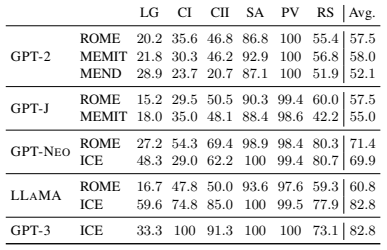
Table 3 : Accuracy on the RECENT subset, by MEND , ROME , MEMIT , and the ICE baseline, on GPT-2 , GPT-J, GPT-N EO, LL AMA, and GPT-3.
Original paper · CC BY 4.0 · Roi Cohen, Eden Biran, Ori Yoran, Amir Globerson, Mor Geva · Evaluating the Ripple Effects of Knowledge Editing in Language Models · Original paper figure · Extracted the figure area from page 9 of the original PDF.Why an edit's own test isn't enough
Knowledge editing changes the belief a model stores behind one fact, such as the team a player plays for. The standard protocol checks whether the model completes the edited query with the new object, plus paraphrases of that query. It also checks that unrelated facts have not changed, so it focuses on two aspects of the new fact and the rest of the knowledge.
zsRE and CounterFact measure efficacy, paraphrasing and specificity in this way. CounterFact adds checks on the generation quality of the edited model, such as consistency and fluency.
The authors argue that this scope is too narrow, because one edit usually implies other facts the model should also change. Take a mother z of e; if the mother changes to z′, the children of z′ become the siblings of e. A model that keeps the old siblings of e is therefore inconsistent, even when the edited fact itself is correct. The authors call such implied changes ripple effects.
This matters because outdated or wrong beliefs can hurt downstream tasks, the model's reliability and its usability.
Existing benchmarks don't check these implied facts, so they can pass a model that is locally right but globally inconsistent. Hase et al. (2023) examined whether updating beliefs propagates to entailed facts, but only to test editing specificity. MQUAKE tests multi-hop reasoning after edits, yet each of these benchmarks covers a single consequence of editing.
RIPPLE EDITS instead provides a general framework for several types of edit ripple effects.
Six criteria for checking ripple effects
The core idea is to check the facts an edit should move, not only the fact it edits. Editing one fact in a model can leave other facts that logically follow from it stale. The authors define six criteria for testing which facts beyond the edit should change or stay put. Each criterion covers facts within a 2-hop distance from the subject or the object of the edit.
Logical Generalization checks logical constraints of the knowledge graph after an edit. For Sibling, the relation is symmetric, so an edited (e, Sibling, o) also implies (o, Sibling, e). For Location, the relation is transitive, so two Location facts imply a third one.
Compositionality I composes the edited fact with facts about the new object o*. For example, after a new sibling is injected, the professions of the siblings of Prince can change. Compositionality II starts from a different subject e' whose fact points at the edited subject e. Subject Aliasing expects the same edit for aliases e' of the subject, such as Prince Roger Nelson.
Preservation applies to one-to-many relations, where existing objects o' must remain after adding o*. Relation Specificity expects relations whose objects o does not influence, such as Mother, to stay unchanged.
Figure 2 walks through one edit that adds a sibling to Prince and shows one test per criterion. In the Preservation example, Tyka Nelson should remain a sibling after Nicholas Carminowe is inserted. Relation Specificity complements Logical Generalization, since it covers relations that the edit should not touch. Related methods such as ROME and MEMIT update MLP weights, but these criteria go beyond the edited fact.
Building RIPPLE EDITS from WIKI DATA
The RIPPLE EDITS pipeline starts from WIKI DATA triplets, which the authors split into three groups: RECENT, RANDOM and POPULAR. RECENT triplets were modified during a range of 250 days after July 2022, so they can drive injection edits for models trained earlier. RANDOM triplets come from 10 uniform buckets based on how many triplets each entity has, which works as a popularity measure.
POPULAR subjects are entities whose Wikipedia pages were among the top-1000 most viewed in at least one month during 2020 to 2022. The authors use POPULAR triplets to control ripple effect severity, since models often don't capture tail entities.
For RANDOM and POPULAR, the pipeline samples Ncand triplets per relation and takes their objects as candidates, with Ncand set to 100, 000. It then picks a target object o′ different from the original object, so the edit keeps the object type. A France capital edit might become London, which is a wrong fact with a type-consistent object.
For each relation, the authors manually define a set Dr of dependent relations and write a logical rule for each one. Logical Generalization and Relation Specificity use those rules and the subject's triplets, so the test queries follow from the edit. Compositionality I walks from the edited object o* through its triplets S(o*), and Compositionality II walks through the triplets T(e) that point at the subject.
Subject Aliasing uses the aliases that WIKI DATA stores for the subject, and Preservation keeps the other original objects.
Each relation gets one manually written natural language template, which converts all of its triplets into queries. The authors sampled 200 test queries and found all of them sound, with 98.5% grammatically correct. Table 1 lists the average number of queries per edit and per criterion for each subset. The data has 5K entries overall, with 2,000 RECENT, 1,000 RANDOM and 1,000 POPULAR edits.
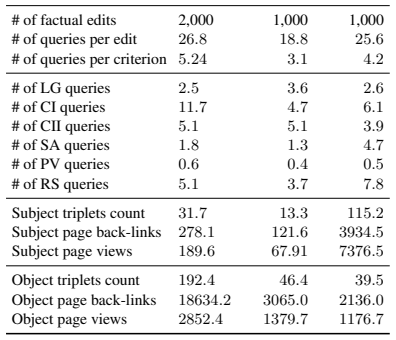
Table 1 : Statistics per subset of RIPPLE EDITS , showing the average of different metrics. Breakdown by evalua- tion criteria shows the number of queries of each crite- rion per edit. For a given subject/object entity, triplets count is the number of WIKI DATA facts it is associated with, page back-links is the number of Wikipedia pages with a link to the entity’s page, and page views is the recent average daily view count of the entity’s page.
Original paper · CC BY 4.0Running parametric editors and the ICE baseline
Each edit is run through the same pipeline, so the editors and the in-context baseline face identical test queries. An edit request is kept only if the model first produces the original objects for the test queries, and then produces the new object o′ when queried about e and r. This filter means the evaluation measures ripple effects, not failures in the initial edit or in the pre-edit knowledge.
Table 2 reports how many edits survive per model and subset, and what share of queries were usable.
MEMIT extends ROME so that it can edit many facts at once. For every model-method pair except ROME with LLAMA, the authors use the official implementation and hyperparameters from Meng et al. (2022).
The ICE baseline leaves every parameter untouched and conditions generation on the new fact instead. For an edit (e, r, o) → (e, r, o*), it prompts the model with "Imagine that <o*> would have been <Pr>", where Pr is a hand-written proposition of r. The prefix "Imagine that" is there because counterfactuals can contradict knowledge stored in the parameters.
They didn't include GPT-2 or GPT-J for ICE, since at most 20% of edits were testable for these models in each subset.
For each test query, the model generates at most 20 tokens. When a test has several gold objects, as in Preservation, each object is scored separately and a match with any one counts. Per criterion, accuracy is averaged over the test queries of each example, and then over all examples.
Parametric editors versus in-context editing
Across all models and subsets, the parametric editors averaged only 38 to 66 accuracy, which the authors read as edits that stay at the surface. The authors argue that KE methods make local updates well, but those changes don't propagate to other related facts. Subject Aliasing is the exception, with accuracy at 86.8 or higher in every setting.
So the ripple checks separate the editors mainly on criteria other than aliasing.
The ICE baseline came out on top, more than 10 points above ROME on GPT-NeoX and 29 points above ROME on LLaMA, averaged across subsets. ICE doesn't change any weights, so it conditions generation on the new fact in an "Imagine that" prompt. On the RANDOM subset, GPT-3 with ICE scored 90.3, the highest average among the listed rows. The 7B LLaMA with ICE performed better than or similar to GPT-3 on the RECENT and POPULAR subsets.
Scores vary a lot by criterion, so the averages hide large gaps between subsets and criteria. ROME on GPT-J reached 53.8 on Logical Generalization for RANDOM and only 5.5 for POPULAR. Because ICE leaves the weights untouched, its scores reflect how the model uses the new fact in its prompt. They didn't test whether ICE changes stored knowledge, so the ICE gains don't show an edit to the weights.
Model size, methods and data splits
Averaged over the three subsets, editing accuracy increases with the number of parameters, with ROME reaching substantially higher accuracy on larger models. The authors also compared against ICE, and the 7B LLaMA stays competitive with the much larger GPT-3. That suggests that simply scaling the model may not be enough to fix the drawbacks of current editing methods.
On GPT-2, Table 6 averages each method over the three RIPPLE EDITS splits. The authors conclude that different methods may capture different types of ripple effects.
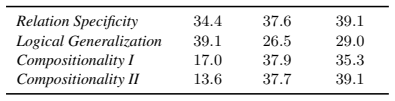
Table 6 : Accuracy of MEND , ROME and MEMIT , using GPT-2 , averaged over the three RIPPLE EDITS splits - RECENT , RANDOM and POPULAR .
Original paper · CC BY 4.0The subsets differ in whether the edited facts are counterfeit or real, and in how popular the edited entities are. Logical Generalization accuracy is substantially higher on RANDOM than on POPULAR. Preservation accuracy is higher on POPULAR than on RANDOM. The authors explain this gap through edit severity: popular entities have more semantically related facts, so editing them can cause more changes.
To study failures, the authors sampled 200 failed test queries for ROME and ICE on GPT-2, GPT-NeoX and LLaMA. Each failure was labeled as no effect, abstaining, or noise, which covers an incorrect or unrelated generation.
Limitations of the benchmark
RIPPLE EDITS covers only a small fraction of all possible ripple edits, so its scope is deliberately narrow. The criteria themselves focus on modified facts within a 2-hop distance from the subject or object of the edit. The benchmark evaluates single edits, and the authors leave the effect of editing multiple facts in one batch to future work.
The data generation pipeline relies on WIKI DATA, which could be incomplete or outdated. Domain-specific knowledge bases often tend to be incomplete, so this concern can matter more there. The authors suggest using the LM's internal knowledge instead of an external knowledge base as one possible solution. They don't test that alternative in this work.
RIPPLE EDITS doesn't include tests of the edit itself, such as paraphrasing of the edit and subject specificity. Those tests are covered by existing benchmarks such as CounterFact. For example, the authors expect that editing the capital of France wouldn't affect the population of Poland, yet they don't check this. Building such an evaluation is hard, because many facts must be considered and it is unclear how to decide automatically which triplets should be affected.
Paper info
- Authors
- Roi Cohen, Eden Biran, Ori Yoran, Amir Globerson, Mor Geva
- Venue
- arXiv · Preprint
- First published
- 2023-7-24
- Added
- 2026-11-6
- Updated
- 2023-12-20
- Version
- v2
- arXiv
- 2307.12976
- Category
- cs.CL
- Original paper terms
- CC BY 4.0
- What we show
- Paper info, commentary and permitted figures from the original paper
AI commentary is a separate explanation from the original paper and may contain errors. The original paper and figures follow each source's terms of use and any rights noted separately.
Abstract
Modern language models capture a large body of factual knowledge. However, some facts can be incorrectly induced or become obsolete over time, resulting in factually incorrect generations. This has led to the development of various editing methods that allow updating facts encoded by the model. Evaluation of these methods has primarily focused on testing whether an individual fact has been successfully injected, and if similar predictions for other subjects have not changed. Here we argue that such evaluation is limited, since injecting one fact (e.g. ``Jack Depp is the son of Johnny Depp'') introduces a ``ripple effect'' in the form of additional facts that the model needs to update (e.g.``Jack Depp is the sibling of Lily-Rose Depp''). To address this issue, we propose a novel set of evaluation criteria that consider the implications of an edit on related facts. Using these criteria, we then construct RippleEdits, a diagnostic benchmark of 5K factual edits, capturing a variety of types of ripple effects. We evaluate prominent editing methods on RippleEdits, showing that current methods fail to introduce consistent changes in the model's knowledge. In addition, we find that a simple in-context editing baseline obtains the best scores on our benchmark, suggesting a promising research direction for model editing.
Quote from the paper
Roi Cohen, Eden Biran, Ori Yoran, Amir Globerson, Mor Geva (2023). Evaluating the Ripple Effects of Knowledge Editing in Language Models. arXiv:2307.12976v2. https://arxiv.org/abs/2307.12976v2
BibTeX
@misc{cohen2023evaluating,
  title = {{Evaluating the Ripple Effects of Knowledge Editing in Language Models}},
  author = {Roi Cohen and Eden Biran and Ori Yoran and Amir Globerson and Mor Geva},
  year = {2023},
  eprint = {2307.12976},
  archivePrefix = {arXiv},
  url = {https://arxiv.org/abs/2307.12976v2}
}