Paper commentary
Who Counts as Exposed? Measurement Choices in an Open, Re-estimable Index of Occupational AI Exposure
- Problem Occupational AI exposure labels feed policy discussion, but the dominant 2023 benchmark rests on one proprietary model's zero-shot judgments, with no inspectable evidence behind them.
- Method Not stated in the paper.
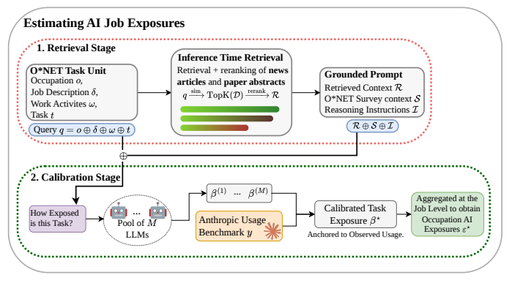
Fig. 2 . The evidence-grounded exposure pipeline, from an O*NET occupation–task pair through corpus construction, hybrid retrieval and reranking, grounded multi-model inference, behavioral calibration, and task-share-weighted aggregation to an occupation-level score.
Original paper · CC BY 4.0 · Mouchel, Luca, Bouquet, Pierre, Sheffi, Yossi · Who Counts as Exposed? Measurement Choices in an Open, Re-estimable Index of Occupational AI Exposure · Original paper figure · Extracted the figure area from page 24 of the original PDF.Why exposure labels need inspectable design
The benchmark that most of this work builds on is the E0 to E3 classification of Eloundou et al., produced by GPT-4 in 2023.
The authors therefore treat exposure as a measurement whose validity has to be argued, not assumed.
Observed usage measures track which tasks are performed on a deployed platform, but low usage on one platform does not show that AI cannot help with the task through another model, product or enterprise workflow.
How one task receives a score
Dense similarity first selects 40 candidate passages, a hybrid of dense and sparse lexical scores rescores them, and a cross-encoder reranks them before up to five passages above a relevance threshold are kept. The passages come from a news collection of more than 32,000 articles from January 2025 to June 2026 and an academic collection of roughly 21,000 abstracts, 53,526 documents in total, and passages are indexed with BGE-M3 into more than 176,000 chunks.
Task scores are aggregated to an occupation with survey-based within-occupation time shares \(\pi_{k,i}\) that sum to one over the task set \(T_k\), so an occupation score weights each task by its share of work time.
Calibrating the ensemble to observed usage
The calibration target is task-level penetration from the Anthropic Economic Index, which is nonzero only when the task has at least 100 observations and the benchmark does not rate it E0. Only 7.6% of matched tasks have positive penetration, and 92% of the target is zero.
The authors do not treat every zero as a reliable negative, because a zero can mean slow adoption or a platform gap as well as no use. Positive-penetration tasks receive weight one, and zeros receive a weight that falls with the mean model exposure, \[\omega_i=\begin{cases}1 & \text{if } y_i>0\\ 1-\frac{1}{M}\sum_{m=1}^{M}\beta_i^{(m)} & \text{if } y_i=0\end{cases}\] where \(y_i\) is penetration and \(M=7\).
This makes the calibration partly circular, because the reliability of each zero depends on the ensemble's own prediction, and the paper refits with every zero at full weight as a check.
The optimization uses SLSQP, and the non-negativity and sum-to-one constraints mean that the calibrated score is a convex combination of the model scores and stays in the range from 0 to 1. With no intercept, a task rated unexposed by every model keeps a calibrated score of zero, and the calibrated mean must lie between the lowest and highest model means, 0.205 and 0.369 on the calibration sample.
The uncalibrated ensemble takes the equal-weight mean, which the paper reports alongside the calibrated index.
Design of the comparison arms
The no-context arms remove the retrieved passages, the descriptor panel and the subtask instructions together, so the contrast tests the whole context block and does not isolate retrieval. The contrast between Au0 and A1 is the cleanest test of context, because neither arm is fitted to Anthropic data. Comparisons with B0 mix several differences at once, since the ensemble arms use the 2026 rubric and different models while B0 uses GPT-4 and the 2023 rubric.
Ranking tasks and aligning occupations with usage
On all 3,391 held-out tasks the benchmark reaches an AUC of 0.766, and the ensemble arms reach 0.791 to 0.821, with the difference significant for four of the five arms. Because only the benchmark's feasible tasks can carry positive penetration, the feasible subset is the harder test. Within the 1,863 feasible held-out tasks the benchmark reaches an AUC of 0.543, while the ensemble arms reach 0.642 to 0.670.
Part of the all-task advantage comes from score resolution, because the benchmark takes three values, and when the ensemble is rounded to the benchmark grid its all-task AUCs fall to 0.748 to 0.788, which is no longer distinguishable from 0.766.
So for task ranking the ensemble advantage comes from the ensemble itself, not from the context.
Adding context raises the Pearson correlation by +0.059 without calibration and by +0.051 with it, while calibration adds +0.032 and +0.024, so context matters more than calibration for this occupation-level alignment. Fitting weights for each fifth of occupations without their own tasks gives the same correlation of 0.686, so the gain is not an artifact of leakage, and Spearman correlations stay between 0.688 and 0.702 for all arms.
The arms split on level and ranking. The mean task score is 0.348 for the benchmark, 0.465 for Au0, 0.377 for A0, 0.311 for A1 and 0.257 for A2, so context lowers the level, while calibration lowers it further because of the conservative fit.
Checking the ranking against a target that does not use usage data
The independent target is the physical versus non-physical classification of Tomlinson et al. applied to 18,183 pairs, and it does not use Anthropic data.
Who is counted as exposed
Above the 0.5 threshold, 0.5% of bottom-quintile workers fall in occupations under A2, against 4.7% under the benchmark, while the top-quintile share rises from 34.2% to 38.4%.
The count depends on the weight δ for integration-dependent exposure. At δ = 0 the calibrated index places 8.6 million workers above 0.5 against 5.5 million for the benchmark, and at δ = 0.5 it places 30.1 million against 36.2 million. The authors argue that the level comparison therefore reflects a choice about unrealized integration rather than a fact about AI capability.
Limitations
The behavioral anchor is one platform, and penetration reflects adoption on Claude in one period rather than what present systems can do.
The context is tested only as a whole, so the design does not show which of the passages, the descriptors or the protocol moves the labels. The ensemble is small, the models have 14 to 32 billion parameters, and each model is sampled once.
The labels have no external human validation, and the development adjudications used curated item sets, so they do not show which labels are correct.
Paper info
- Authors
- Mouchel, Luca, Bouquet, Pierre, Sheffi, Yossi
- Venue
- arXiv · Preprint
- First published
- 2026-11-13
- Added
- 2026-11-16
- Updated
- 2026-11-13
- Version
- v1
- arXiv
- 2611.18168
- Category
- cs.IR
- Original paper terms
- CC BY 4.0
- What we show
- Paper info, commentary and permitted figures from the original paper
AI commentary is a separate explanation from the original paper and may contain errors. The original paper and figures follow each source's terms of use and any rights noted separately.
Abstract
Occupational AI exposure indices are used as inputs to economic analysis, workforce planning, and policy, and the choices built into them decide which workers are described as exposed. We build an open, re-estimable task-level index and vary its two main design decisions, context and calibration, to show how much the answer depends on them. For each of the 18,796 occupation--task pairs in \onet, seven open-weight reasoning models rate exposure under a common rubric. Each model rates with or without a context of retrieved news and research passages, workplace descriptors, and a bottleneck-based reasoning protocol, and the ensemble is combined with or without simplex-constrained calibration to observed Claude usage. The largest difference from the dominant 2023 benchmark is not a disagreement about what AI can do but about how much credit to give exposure that depends on software integrations not yet built, a choice that no data can settle. At the benchmark's own weight, the calibrated index counts fewer exposed workers than the benchmark, and when only direct exposure counts it counts more. At full score resolution, the ensemble ranks tasks better than the benchmark against observed usage and an independent physical-task classification. Adding context mainly shifts the level of exposure rather than improving the ranking. Context and calibration both relocate exposure toward higher-wage occupations, and calibration, which anchors the index to one platform's users, does more of it, so we also release the uncalibrated arm. Exposure indices used as policy inputs should state such choices, report their numbers under the alternatives, and be re-estimated as systems change.
Quote from the paper
Mouchel, Luca, Bouquet, Pierre, Sheffi, Yossi (2026). Who Counts as Exposed? Measurement Choices in an Open, Re-estimable Index of Occupational AI Exposure. arXiv:2611.18168v1. https://arxiv.org/abs/2611.18168v1
BibTeX
@misc{luca2026counts,
  title = {{Who Counts as Exposed? Measurement Choices in an Open, Re-estimable Index of Occupational AI Exposure}},
  author = {Mouchel, Luca and Bouquet, Pierre and Sheffi, Yossi},
  year = {2026},
  eprint = {2611.18168},
  archivePrefix = {arXiv},
  url = {https://arxiv.org/abs/2611.18168v1}
}