Paper commentary
RadRef: A Reference-Free Metric for Radiology Report Generation
RadRef scores radiology reports against the radiograph without needing a reference
- Problem Radiology report metrics compare a generated report with a radiologist-written reference, so they cannot score a report before that reference exists. Text-to-text comparison also misses findings that both texts omit.
- Method RadRef scores each report claim against finding-level beliefs that a vision-language model forms from the radiograph. Unmentioned findings earn exactly zero, so omissions lower the score.
- Results On omissions in a reader study, RadRef reached a Kendall's tau-b of 0.295, against 0.386 between the two radiologists.
Where reference-based scoring stops working
Most radiology report metrics judge a generated report by how closely it matches a radiologist-written reference. In clinical use the radiologist's report is the very thing the system is asked to draft, so the reference is missing exactly when draft quality counts. The paper treats this as a structural gap, not a temporary one, because the reference only comes into being after the draft has been written.
A second weakness sits inside the comparison itself. If the candidate and the reference both omit the same finding, a text-to-text comparison has no evidence that the finding was missed. Reference-based metrics can't catch a shared blind spot, because both texts carry the same gap into the comparison. The authors therefore want a score that checks the report against the radiograph rather than against another text.
It then scores how well the report's claims agree with image-derived beliefs from a vision–language model (VLM), weighted by clinical relevance. Because the check runs against the image, an omission can show up as a gap in the report against what the radiograph supports.
The key idea: check claims against the image
RadRef puts the radiograph and the candidate report over one shared finding vocabulary, then asks whether the report's claims agree with the image. The vocabulary is the 69-finding Chest ImaGenome list, and synonyms collapse during report parsing so differently worded reports map to the same entries. Figure 1 shows these steps on one case, mapping the radiograph, report and indication to finding-level beliefs and claims.
Each report claim is scored against its image-derived belief, and an unmentioned finding is the neutral action that contributes exactly 0.
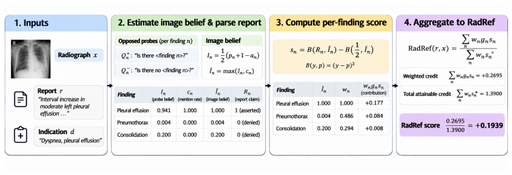
Figure 1 : RadRef worked example. The radiograph, report, and indication are mapped to finding-level
Original paper · CC BY 4.0 · Shelly Schwartz, Alan Ropp, Michael B. Sneider, Nur Yildirim, Cree M. Gaskin, Chirag Agarwal · RadRef: A Reference-Free Metric for Radiology Report Generation · Original paper figure · Extracted the figure area from page 4 of the original PDF.The score is signed, so a report that agrees with the image on net scores above zero and a contradicted one scores below zero. A report with no finding claims scores exactly 0, because nothing in it can be checked against the image. The unmentioned state gets a forecast value of one half, and the Brier-based score is measured against that baseline.
Contradicted claims are negative, and the baseline is a fixed constant of the method rather than a value estimated from data. Because omission forgoes the credit a supported assertion would earn, RadRef doesn't need a separate omission penalty. The image beliefs come from opposed yes/no probes averaged into one belief, which counters a model that tends to answer yes to everything.
Image beliefs, report labels and the finding list
RadRef turns each radiograph into a belief for every finding in the Chest ImaGenome list, with MedGemma-27B answering two opposed yes/no questions per finding. The probe question asks whether the finding is present, and a second question asks whether the chest is free of it. The two "yes" probabilities are averaged, so a belief of one half means maximal uncertainty.
Opposed questions matter because a model that answers yes to both questions gives a belief near one half rather than a confident error. The same probe step also decides which hierarchy terms get scored, so a finding is supported when its belief is at least one half. If a specific finding and its broader parent are both supported, only the specific one is kept, so one abnormality isn't counted twice.
Free-form descriptions add a second source of image evidence, because RadVLM-7B writes five descriptions without being asked about any finding. The mention rate c_n is the fraction of those five descriptions that name finding n, so it takes values from 0 to 1 in steps of 0.2. The descriptions are shared between the MedGemma-27B and Lingshu-32B configurations, so swapping the probe model doesn't also swap this channel.
On the report side, GPT-4o-mini at temperature 0 maps the report onto the same finding list and labels each finding as asserted, denied or unmentioned. Hedged mentions count as assertions, so a possible effusion is treated as present. Normality statements such as clear lungs are expanded into denials of the findings they exclude, so the parser doesn't leave those findings unmentioned.
The parser can be replaced by another structured extractor without changing the scoring rule, which keeps the parsing step separate from the metric. The parser turns each unmentioned finding into the neutral forecast of one half, which the later score treats as zero credit.
From one claim to one score
Each claim is scored with the negative Brier score, using the unmentioned state as the neutral baseline it is measured against. An unmentioned finding contributes exactly zero, so it earns nothing. An omitted finding still forgoes the credit a correct, radiograph-supported assertion would earn, and the denominator keeps that attainable credit.
That is why omission lowers the normalized score even though no separate omission penalty exists.
An assertion earns credit only when its belief exceeds 3/4, while a denial earns credit only when the belief falls below 1/4. Contradicted claims give negative scores, so the sign of each contribution follows the image evidence. Each finding gets a weight from its clinical relevance tier and the confidence of its belief, with the tier squared to emphasize directly relevant findings.
The confidence term is the distance of the belief from maximal uncertainty, and the mention rate c_n preserves weight for consistently described findings. The gate g_n equals the absolute distance of the belief from one half raised to lambda, with lambda set to 1/2 in the primary configuration. The gate shrinks the contribution of findings where the radiograph is near a coin flip, so near-coin-flip beliefs don't move the score strongly.
Each finding contributes its weight, gate and score, so the score combines direction of credit, clinical importance and uncertainty. The gate is left out of the denominator, and Appendix C.1 discusses that choice.
The primary configuration uses MedGemma-27B beliefs without cohort-level calibration, so each radiograph-report pair is scored on its own. RadRef +calibration centers finding-specific belief offsets, and RadRef +robust puts less weight on uncertain image evidence.
Agreement with ReXVal radiologist rankings
ReXVal gives four candidate reports for each radiograph, so the comparison only pairs reports that share the same image. Holding the image fixed keeps case difficulty constant, which pooled comparisons across studies can't do. Tied pairs are dropped from the agreement figure, and Kendall's τb serves as the tie-aware companion statistic.
With MedGemma-27B probes, RadRef reaches 73.1% non-tied combined agreement, against 73.9% for GREEN and 76.9% for CRIMSON. Only 61.8% of pairs receive distinct RadRef scores, so the tie-inclusive agreement falls to 64.3%. The paired intervals for the three leading baselines all contain zero on the combined target, so the gaps aren't significant.
RadRef is therefore comparable to the strongest reference-based metrics overall, not clearly better than them. On omissions RadRef scores 70.2%, and its paired intervals exclude zero against RadFact, RadGraph-F1 and BLEU-4. Its false-finding readout RadRef-FF reaches τb of .32, compared with .29 for the general RadRef score.
Dependence on the image, the report and the indication
RadRef's permutation test asks whether the score depends on the radiograph or only on regularities within the report. Each report is re-scored against another patient's radiograph, so the report stays fixed while the image changes. A metric that ignored the image would give the same score after this swap, so any change shows image dependence.
Reference-based metrics can't be tested this way, because they take no radiograph as input. Only RadRef can be tested for radiograph dependence, so the table marks reference-based metrics with a dash.
Against the report-permuted distribution, the margin runs from 2.3 to 4.5σ across all six configurations. The +4.1σ margin for the primary MedGemma-27B configuration on the radiograph permutation is the largest of the RadRef rows in the radiograph column besides calibration's equal value.
The indication only reweights which findings matter and never changes the image-derived beliefs. A report with no stated indication, as the generated reports are, is scored under a generic chest evaluation. Swapping in a different indication while holding the radiograph, report and beliefs fixed changes RadRef's rankings. So the relevance weights do affect the score, which is what the indication test was designed to check.
The full perturbation results sit in Appendix E.9, which is where the random and far indication comparisons appear.
Why an empty report is the right baseline
An empty report makes no finding claims, so RadRef gives it exactly zero by construction and uses it as the reference point. For a reference-based metric, the empty-report diagnostic compares the generated report against the empty report using the radiologist reference. For RadRef, the same diagnostic needs no reference, because the score of the empty report is zero and only the generated report's score against the radiograph is needed.
Across metrics, the share of studies where the empty report outscores MAIRA-2 ranges from 1.0% to 90.7%, even though their ReXVal agreement is similar.
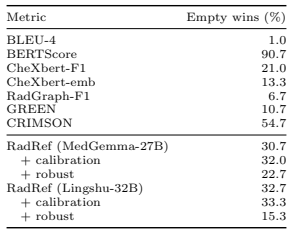
Table 6 : Empty-report diagnostic. Percentage of evaluation studies in which an empty report outscores
Original paper · CC BY 4.0The radiologist-authored reports have a median contrast of +0.070 against the empty report, with a 95% confidence interval from +0.060 to +0.083. The LLaVA-Rad reports have a median contrast of +0.043 against the empty report, and the MAIRA-2 reports have +0.037. All of these confidence intervals exclude zero, so both generated-report distributions stay above the empty-report baseline.
Radiologist reports also score higher than both generators, with a median gap of +0.029 over LLaVA-Rad and +0.037 over MAIRA-2.
The ordering describes the overall tendency, not every study. Such scores show that a report with more contradicted than supported content can rank below silence. The authors also note that below-zero scores reflect the probe beliefs, not clinical judgment.
The gate handling for the numerator and denominator is a separate design choice from this baseline. Applying the same gate to the denominator gave identical same-radiograph rankings in every tested configuration.
Radiologist reader study on generated reports
The reader study asks whether the omission signal seen on ReXVal still holds for text that a generator actually produced. Reference-based metrics can't enter this comparison, because the radiologist report would have to act as their reference.
For omissions, RadRef's Kendall τb is .295 (.10 to .47), while the two readers reach .386 (.20 to .55) against each other. No compared metric differs significantly from RadRef on omissions, so the omission signal is competitive rather than clearly superior.
For false findings, RadRef-FF targets unsupported assertions and reaches τb of .29 (.15 to .42) on same-image pairs. Assertion count alone reaches only .15 on the same comparison, so the image-grounded readout adds information beyond counting claims. On ReXVal, RadRef-FF reached τb of .32, compared with .29 for the general RadRef score.
Where RadRef's evidence can't be stretched
Findings outside the Chest ImaGenome vocabulary can't be scored directly, which limits what a report can contribute to the score. The paper's sensitivity runs show that the probe model drives much of the result, so a new probe needs its own validation.
Image beliefs come from a VLM, and RadRef doesn't claim they are calibrated. Calibration in the +calibration variant is an unsupervised centering of the VLM's own beliefs, not calibration against labeled outcomes. The primary configuration omits that centering, so its scores inherit whatever bias the probe model carries.
The reader study covers 100 studies, and each reader's ranking is only one noisy view of error counts. Inter-reader agreement for omissions is .386 against RadRef's .295, and for false findings the readers agree only imperfectly. The ICC of the combined error count is .21 for a single reader, so the reader labels themselves are noisy. Don't read the omission result as proof that RadRef matches readers; the pairwise intervals are exploratory.
Validation stays inside MIMIC-CXR, and the models may have seen that data in training. The authors say independent image-level labels and external cohorts are still needed before generalizability can be claimed.
Paper info
- Authors
- Shelly Schwartz, Alan Ropp, Michael B. Sneider, Nur Yildirim, Cree M. Gaskin, Chirag Agarwal
- Venue
- arXiv · Preprint
- First published
- 2026-11-9
- Added
- 2026-11-11
- Updated
- 2026-11-9
- Version
- v1
- arXiv
- 2611.13168
- Category
- cs.LG
- Original paper terms
- CC BY 4.0
- What we show
- Paper info, commentary and permitted figures from the original paper
AI commentary is a separate explanation from the original paper and may contain errors. The original paper and figures follow each source's terms of use and any rights noted separately.
Abstract
AI-generated radiology reports are usually evaluated by comparison with a radiologist-authored reference, leaving no way to score them when no reference exists. We introduce RadRef, a reference-free metric that scores report claims against image-derived beliefs over a clinical finding vocabulary, weighted by relevance to the clinical indication. On ReXVal, RadRef achieves 73.1% agreement on non-tied same-radiograph report pairs with radiologist rankings, comparable to leading reference-based metrics overall. It is also competitive on false findings and has its clearest relative result on omissions (missed findings). We further evaluate 100 model-generated and 100 radiologist-authored reports from 100 MIMIC-CXR studies, all independently annotated by two board-certified radiologists. On omissions, RadRef attains Kendall's tau-b = 0.295, against 0.386 between the two readers themselves, and no compared metric differs significantly from RadRef on this target. The same image-grounded representation provides a false-finding readout, RadRef-FF, with tau-b = 0.32 on ReXVal and 0.29 in the reader study, without requiring a reference. Controlled perturbations confirm that RadRef depends on the radiograph, report, and clinical indication. RadRef enables image-grounded evaluation before a radiologist-authored reference exists, supporting quality monitoring of report-generation systems in clinical settings, and complements reference-based metrics when one is available.
Quote from the paper
Shelly Schwartz, Alan Ropp, Michael B. Sneider, Nur Yildirim, Cree M. Gaskin, Chirag Agarwal (2026). RadRef: A Reference-Free Metric for Radiology Report Generation. arXiv:2611.13168v1. https://arxiv.org/abs/2611.13168v1
BibTeX
@misc{schwartz2026radref,
  title = {{RadRef: A Reference-Free Metric for Radiology Report Generation}},
  author = {Shelly Schwartz and Alan Ropp and Michael B. Sneider and Nur Yildirim and Cree M. Gaskin and Chirag Agarwal},
  year = {2026},
  eprint = {2611.13168},
  archivePrefix = {arXiv},
  url = {https://arxiv.org/abs/2611.13168v1}
}