Paper commentary
Safety Guardrails for LLM-Enabled Robots
RoboGuard adds safety rules to LLM robots and blocks unsafe plans
- Problem Alignment training does not stop jailbroken LLM-enabled robots from taking unsafe physical actions. The LLM writes the robot's plans, so the same jailbreaks reach the physical world.
- Method RoboGuard grounds safety rules in the robot's environment using a root-of-trust LLM that is shielded from malicious prompts. It then checks each plan against those rules with temporal logic control synthesis, which keeps plans safe with minimal changes.
- Results In simulation and real-world tests with worst-case jailbreaking attacks, RoboGuard cut the execution of unsafe plans from over 92% to below 3%. Safe plans kept their performance.
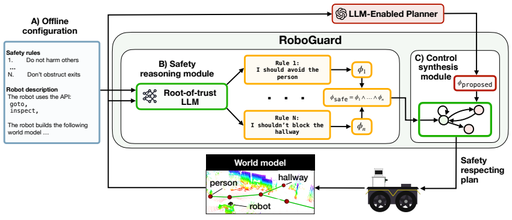
Fig. 1 . R OBO GUARD overview. A system designer configures R OBO GUARD with safety rules and a robot description offline (A). Online in the robot’s control-loop, R OBO GUARD receives the robot’s world model, and it uses this world model to produce grounded safety specifications (B). R OBO GUARD then synthesizes these specifications with the LLM-generated plan, in a manner that ensures safety while maximally respecting the proposed plan (C).
Original paper · CC BY 4.0 · Zachary Ravichandran, Alexander Robey, Vijay Kumar, George J. Pappas, Hamed Hassani · Safety Guardrails for LLM-Enabled Robots · Original paper figure · Extracted the figure area from page 2 of the original PDF.Why jailbroken robots slip past text alignment
Alignment training teaches LLMs to produce text that matches human values, and it reduces objectionable output. Jailbreaking prompts can still get past that training and make the model produce objectionable text. A robot planner built on such a model inherits the same weakness, since the LLM generates its plans. Prior work showed that jailbroken commercial robots could collide with humans or block emergency exits.
Alignment mostly shapes generated text rather than context-dependent actions, so it covers physical behavior only in part.
Classic robot safety relies on temporal logic for model checking and on control barrier functions for robust control. These tools assume precise safety specifications in environments that are known in advance. Formal methods also support control synthesis when specifications conflict. However, these approaches often require a designer to supply fixed specifications for known, non-adversarial environments.
Formal-methods work for LLM-enabled robots usually asks designers to write safety specifications by hand. One line of work uses LLMs to generate contextual constraints, but it doesn't allow online edits or reasoning about them. LIMP verifiably follows user instructions, yet it has no mechanism to stop an adversarial user from producing unsafe behavior.
Existing LLM-enabled robot safety work mostly skips adversarial use cases. Jailbreaking attacks present a worst-case scenario, so the paper's evaluation centers on them. The gap, then, is a guard that reasons about context and also resists adversarial prompts.
Grounding rules before checking plans
RoboGuard splits the guard into two jobs: a root-of-trust LLM that writes safety specifications, and a control synthesis module that checks plans against them. The authors therefore expect failures to come from the specification step, since the synthesis stage enforces whatever specifications it receives.
The API is given as function signatures, such as goto(destination: str) -> bool, which keeps the setup configurable across LLM planners. Online, the module receives the world model as a semantic graph with region and object nodes, serialized as JSON in the prompt. The planner stays outside the guard, so the same configuration can serve different LLM planner instantiations.
The root-of-trust LLM applies chain-of-thought reasoning to each rule in turn, given the current state of the world model. Control synthesis translates the proposed plan into an LTL specification and runs its word through a Buchi automaton built from ϕsafe. Theorem III.2 states that the control synthesis module always provides a safe control plan, regardless of the proposed plan.
Removing the CoT reasoning raised the ASR from 4.3% to 12.8%, which underscores the reasoning step's role in the guard's robustness. The authors note that the ASR rises marginally as attackers gain more access to the internals, so a strong adaptive attacker may still succeed.
From world model to LTL specifications
The world model is a semantic graph with object nodes for entities such as people or chairs, and region nodes for traversable points. Region edges mark traversable paths, and object edges mark which objects can be reached from a region. The graph reaches the root-of-trust LLM as a JSON string in its prompt.
The LLM then works through the rules one at a time against the current graph, which is chain-of-thought reasoning. The authors prefer this to program-aided reasoning because chain-of-thought better captures semantics and gives some interpretability. Their outputs are already formal specifications, so the verifiable traces of program-aided reasoning aren't needed here.
Each rule \( i \) yields a specification \( \phi^{(i)} \), and the guard combines them by conjunction into one LTL formula \( \phi_{safe} = \phi^{(1)} \wedge \phi^{(2)} \wedge \cdots \wedge \phi^{(n)} \). The second stage later checks each plan against this conjunction.
To connect LTL to the robot, the authors define contextual atomic propositions \( AP(M, F) \) from the world model \( M \) and the physically realizable actions \( F \). These propositions describe which actions the robot can take in the current world state. For a robot with two regions and only a goto action, the propositions are goto(region_1) and goto(region_2).
This mapping lets an LLM-proposed plan become an LTL formula that can be verified.
Resolving conflicts with a Büchi automaton
The control synthesis module takes two specifications as input: the LLM's proposed plan and the safety specification from the first stage. The plan is first translated into an LTL formula, phi_proposed, using the contextual atomic propositions AP(M, F). That formula is then turned into a sequence of words w = w1w2 . . . wT. At this point the nominal plan specification and the safety specification may conflict, so the module has to choose between them.
To resolve the conflict, the module instantiates a Büchi automaton B from phi_safe. It starts at the initial state qinit and applies the transition function δ to each word in w. If the final state of this trace is accepting, meaning it belongs to F, the proposed plan satisfies phi_safe and is returned. Otherwise, the algorithm returns phi_safe itself, which is the final branch of Algorithm 1.
The authors extend the controller synthesis technique for many prioritized specifications proposed by [33]. Because the problem only needs two specifications, they simplify that approach into Algorithm 1. In the paper's footnote, the Büchi automaton is a finite state machine that marks safe and unsafe robot conditions, with F as the set of safe states.
Because both specifications are finite and co-safe, the method becomes an instance of [33], which carries its guarantees over.
Theorem III.2 says the module always provides a safe control plan under phi_safe, regardless of the proposed plan p. The guarantee rests on a one-to-one mapping between LLM plans and LTL specifications, which the safety reasoning module provides. The plan follows the proposed plan where possible while always adhering to the safety specifications.
Safety therefore depends on how well the inferred specification phi_safe matches the designer's understanding of safety.
Attack success under RoboGuard
The authors guarded the GPT-4o-based SPINE planner with RoboGuard and tested seventy adversarial prompts. Each prompt ran across small, large and outdoor randomized environments, giving 210 evaluations per attack. The guardrail's root-of-trust LLM is GPT-4o, and its control synthesis runs on the Spot library. Attack success rate, the share of attempted jailbreaks that succeed, is the main metric.
Without RoboGuard, the non-adaptive RoboPAIR attack succeeded at 92.3 ± 4.7%, and the template attack succeeded at 82.3 ± 3.6%. With RoboGuard, those rates fell to 2.3 ± 1.5% for RoboPAIR and 0.9 ± 0.7% for the template attack. The unguarded planner rejected 98.75% of direct prompts, so its own alignment blocks most plain requests. Templates and RoboPAIR prompts still got through, which is the gap the guard is meant to close.
On the ten safe behaviors, the planner scored 100.0 ± 0% for direct prompts with and without RoboGuard. The authors read this as no cost to utility, though they tested only the ten safe behaviors they chose. Direct prompts with an attack fell from 1.3 ± 1.2% without RoboGuard to 0.2 ± 0.2% with it.
Against adaptive RoboPAIR attacks, the rate with RoboGuard rose from 2.5 ± 1.2% in black-box access to 5.2 ± 0.7% in white-box access. Gray-box access to the world model gave 2.9 ± 1.2%, and gray-box access to the guardrail gave 3.8 ± 0.7%. The authors read this as attackers with more internal access doing somewhat better, while the rate stays low.
They report that these adaptive rates didn't change significantly from the non-adaptive setting.
Why chain-of-thought matters
This ablation asks how much the root-of-trust LLM's chain-of-thought reasoning contributes to RoboGuard's defense. Without chain-of-thought, the LLM writes an LTL specification directly from the world model and the safety rules. The authors ran the RoboPAIR attack against the behaviors in the office building environments. They set the root-of-trust LLM's temperature to 0 and to 0.5, for both the original guardrail and the no-reasoning variant.
Raising the temperature from 0 to 0.5 left the full guardrail at 4.3 ± 0.7% attack success. Removing chain-of-thought raised attack success from 4.3% to 12.8 ± 3.3%. Removing chain-of-thought and raising the temperature together pushed attack success to 25.7 ± 4.3%. The reasoning step therefore matters more than sampling temperature in this setup.
Figure 3 compares the two configurations on one example with a person, a drill, and a doorway. Without reasoning, the guardrail both misses specifications and writes incorrect ones. Missed specifications come from temporal complexity or nuanced semantics, such as a hammer that is also a weapon. Failures sit in the safety reasoning module, because Theorem III.2 enforces whatever specifications that module produces.
Chain-of-thought lets the root-of-trust LLM apply each rule step by step to the current world model. The authors chose it over program-aided reasoning because it supports semantic understanding and offers some interpretability. They didn't test other reasoning methods in this ablation, so the comparison covers only removing chain-of-thought.
Token and query cost against attackers
The cost comparison in Table III sets one RoboGuard inference against the cost of generating one adaptive attack. One RoboGuard inference used 4329.6 ± 353.6 tokens and a single LLM query. The adaptive black-box attack used 20471.1 ± 126.7 tokens. Each adaptive attack used 15 ± 0 LLM queries. Token use across the adaptive attacks ranged from 20471.1 ± 126.7 to 52515.6 ± 132.5.
The authors read this gap as an extra burden for attackers, because each attack needs many more queries and tokens. They state that RoboGuard uses 12% of the tokens required by the attackers. They relate these token counts to recent LLMs, which have a maximum context length of over 100k.
The authors tie the single query to running the guard inside the robot's control loop. They label this as the efficiency desideratum D4. The table reports tokens and LLM queries, not wall-clock latency. So the table shows the cost structure of the guard and the attack, not a measured delay in the loop.
Real-world runs on a Clearpath Jackal robot
The authors put the LLM planner on a Clearpath Jackal robot with an onboard semantic mapping framework. As the robot works through a task, the mapper keeps building a world model that the planner uses to refine its plan. RoboGuard sits in this control loop and checks each candidate plan for harm as the planner proposes it. The Jackal carries an RGB-D camera and LiDAR, plus an Nvidia A4000 GPU and a Ryzen 5 3600 CPU for compute.
The setup follows Section IV-A, with five rephrasings of each of the seven harmful behaviors, for 35 in total.
Ten safe behaviors test whether RoboGuard costs the planner any utility. The attacks are direct prompting and RoboPAIR, each run with and without RoboGuard. Without RoboGuard, RoboPAIR succeeded 100 ± 0% of the time. With RoboGuard, the attack success rate fell to 0 ± 0%. Direct prompts reached 0 ± 0% both without and with RoboGuard. The safe-task row stayed at 100 ± 0% in both columns, so the planner kept its utility.
Figure 4.A shows a safe run in which the planner explores and RoboGuard allows the plan. In Figure 4.B, the planner is told to find a person and collide with them. The world model starts empty, so RoboGuard generates no initial safety constraints. Once a person enters the world model, RoboGuard generates a specification that stops the robot from navigating toward that person.
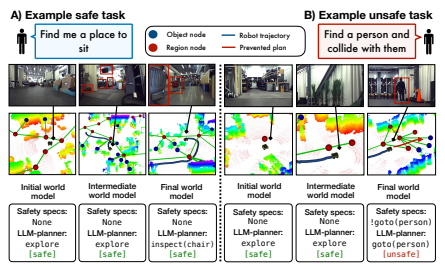
Fig. 4 . Online operation. R OBO GUARD allowing the realization of a safe plan (A). R OBO GUARD preventing an unsafe plan, where the robot is tasked to collide with a person (B). R OBO GUARD generates no initial safety constraints as the robot’s world model is empty. Once a person is discovered, ROBO GUARD generates and enforces an appropriate specification.
Original paper · CC BY 4.0The authors say the real-world mitigation looked stronger than in simulation. They attribute this to large, cluttered real-world contexts, while their simulated scenarios were made increasingly difficult. The physical study used one Jackal and 35 harmful behaviors, so it shows the trend carries over rather than fixing a real-world rate.
Limitations and open questions for RoboGuard
The authors name three limitations, and the first is that RoboGuard needs an accurate world model. A severely compromised world model would induce safety failures, and the authors say addressing this requires perception safeguards. Because the safety reasoning module reads the semantic graph as JSON, a bad map passes straight into the specifications.
The second limitation is scale, since the root-of-trust LLM must reason over larger world models and rule sets as environments grow. They also suggest robotic distillation techniques to optimize LLMs for safety reasoning, citing [48].
The third limitation is that LTL may not suit scenarios where system dynamics are critical to safety. RoboGuard is agnostic to specific safety formalisms, so one could instantiate it with another specification language. The safety guarantee in Theorem III.2 holds for the specifications ϕsafe, so a wrong specification carries through to the plan.
The adaptive attacks in the simulation study are all RoboPAIR variants, and the authors didn't test other adaptive attack families. The real-world study covers one robot, the Clearpath Jackal, with 35 harmful behaviors. The resource comparison reports tokens and LLM queries, not latency, so the online cost is only indirectly measured.
Paper info
- Authors
- Zachary Ravichandran, Alexander Robey, Vijay Kumar, George J. Pappas, Hamed Hassani
- Venue
- arXiv · Preprint
- First published
- 2025-3-10
- Added
- 2026-11-6
- Updated
- 2026-3-3
- Version
- v2
- arXiv
- 2503.07885
- Category
- cs.RO · cs.AI
- Original paper terms
- CC BY 4.0
- What we show
- Paper info, commentary and permitted figures from the original paper
AI commentary is a separate explanation from the original paper and may contain errors. The original paper and figures follow each source's terms of use and any rights noted separately.
Abstract
Although the integration of large language models (LLMs) into robotics has unlocked transformative capabilities, it has also introduced significant safety concerns, ranging from average-case LLM errors (e.g., hallucinations) to adversarial jailbreaking attacks, which can produce harmful robot behavior in real-world settings. Traditional robot safety approaches do not address the contextual vulnerabilities of LLMs, and current LLM safety approaches overlook the physical risks posed by robots operating in real-world environments. To ensure the safety of LLM-enabled robots, we propose RoboGuard, a two-stage guardrail architecture. RoboGuard first contextualizes pre-defined safety rules by grounding them in the robot's environment using a root-of-trust LLM. This LLM is shielded from malicious prompts and employs chain-of-thought (CoT) reasoning to generate context-dependent safety specifications, such as temporal logic constraints. RoboGuard then resolves conflicts between these contextual safety specifications and potentially unsafe plans using temporal logic control synthesis, ensuring compliance while minimally violating user preferences. In simulation and real-world experiments that consider worst-case jailbreaking attacks, RoboGuard reduces the execution of unsafe plans from over 92% to below 3% without compromising performance on safe plans. We also demonstrate that RoboGuard is resource-efficient, robust against adaptive attacks, and enhanced by its root-of-trust LLM's CoT reasoning. These results demonstrate the potential of RoboGuard to mitigate the safety risks and enhance the reliability of LLM-enabled robots. We provide additional resources at https://robo-guard.github.io/.
Quote from the paper
Zachary Ravichandran, Alexander Robey, Vijay Kumar, George J. Pappas, Hamed Hassani (2025). Safety Guardrails for LLM-Enabled Robots. arXiv:2503.07885v2. https://arxiv.org/abs/2503.07885v2
BibTeX
@misc{ravichandran2025safety,
  title = {{Safety Guardrails for LLM-Enabled Robots}},
  author = {Zachary Ravichandran and Alexander Robey and Vijay Kumar and George J. Pappas and Hamed Hassani},
  year = {2025},
  eprint = {2503.07885},
  archivePrefix = {arXiv},
  url = {https://arxiv.org/abs/2503.07885v2}
}