Paper commentary
Pretty Linear Liars: Unregularized Probes Favor Intervention-Unfaithful Features
Ridge regularization makes linear probes track features the network actually uses
- Problem Linear probes are often read as evidence that a network uses a feature, but decodable features can sit in directions the network never uses. Unregularized OLS probes amplify low-variance noise directions, so they often fail intervention tests.
- Method Ridge regression adds a penalty that shrinks the weight on low-variance directions, and the authors tune that penalty by intervention loss instead of decodability. Unlike OLS, the ridge probe ignores the spurious low-variance directions that the least-squares fit magnifies.
- Results On Llama-2-7B, the OLS probe's intervention loss was 13.7, compared to 7.1 for the intervention-tuned ridge probe. The ridge direction sits 26.3 degrees from the DAS direction, while the OLS direction sits 84.7 degrees away.
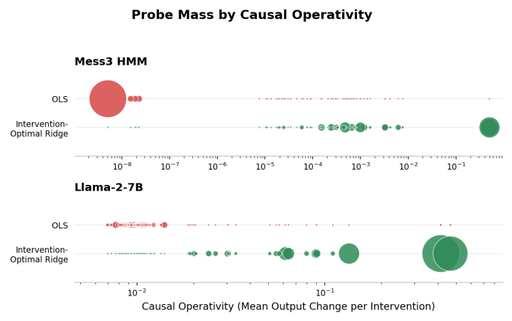
Figure 5 : Probe mass by causal operativity. Each bubble is a principal component, area proportional to its probe massm i, position its operativity under in-range swaps. OLS mass (red) concentrates at low operativity on both testbeds; intervention-selected ridge mass (green) concentrates at high operativity. The Llama frame shows the heaviest-mass PCs, covering95%of the ridge probe’s mass but only∼31%of the OLS probe’s, whose remainder spreads over a long tail of small bubbles piling onto the same low-operativity side.
Original paper · CC BY 4.0 · Karl Vilhelmsson Emneby, Julian Yocum, Cameron Allen · Pretty Linear Liars: Unregularized Probes Favor Intervention-Unfaithful Features · Original paper figure · Extracted the figure area from page 9 of the original PDF.Why decodable probes can mislead
Linear probes fit a map from activations to a target, and decoding accuracy is often read as evidence that the network represents it. That reading is weak, because a variable can be decodable even when the probe's direction plays no role in the network's computation. Causal interventions give a stronger test, asking whether moving along the probe's direction changes the output the way the variable should.
The fitting procedure itself, and regularization in particular, has received little attention in this test. Gurnee & Tegmark (2024) pick a ridge penalty by held-out decodability, while Heinzerling & Inui (2024) use partial least squares, which selects components by covariance with the target. That neuroimaging setting doesn't let those weights be tested by intervention.
The authors compare three ways of extracting a feature vector: OLS probes, ridge regression probes, and Distributed Alignment Search (DAS). OLS and ridge probes fit the direction by decodability and differ only in the ridge penalty λ. DAS instead fits the direction by gradient descent on intervention outcomes, so it serves as a causal reference point.
Running the three on identical activations and targets makes the fitting procedure the only thing that changes.
The authors argue that OLS amplifies noise most strongly along directions where activations vary least. Sampling noise can give even an unused direction a small nonzero covariance with the target, and OLS magnifies that covariance. The authors test whether such directions are intervention-faithful on a toy transformer and on Llama-2-7B.
Why unregularized weights blow up on quiet directions
The authors work in the principal-component basis, where activation coordinates are uncorrelated across the dataset. Because the cross terms vanish, the full objective splits into d separate one-dimensional problems, one per direction. For one direction v, they write the sample variance as σ_v² and the sample covariance with the target as cov_vf.
They then minimize the one-dimensional ridge objective for the weight w on that fixed direction.
The minimizer is w equal to the sum of z_j f_j over the sum of z_j squared plus λ, which equals cov_vf over σ_v² plus λ/n. Setting λ to zero recovers the OLS probe, so one expression covers both methods. The penalty enters only through the variance term, so it changes the denominator and leaves the covariance untouched.
For a target-uncorrelated direction on sampled data, the sample covariance has a typical size set by sampling noise, σ_v σ_f over √n. Plugging that scale into the formula, the OLS weight grows without bound as the direction's variance σ_v shrinks toward zero. Ridge regression changes only the divisor, and that divisor can't fall below λ/n.
The authors also check the opposite limit, where λ grows toward infinity. In that limit, the ridge weight points along the covariance with the target, not along the direction of maximum variance.
Two testbeds and how each direction is tested
The first testbed is the Mess3 HMM, a three-state hidden Markov model with mixing parameter 0.05 and emission concentration 0.85. Its belief state and the correct next-token output are exactly computable, so the true output after any intervention is known. The authors take the pre-trained 4-layer transformer of width 64 from Shai et al. (2024), enumerate all sequences of length 1 to 8, and cache activations at the final LayerNorm.
The second testbed probes Llama-2-7B at layer 8, using 4096-dimensional residual-stream activations at the last token of a name over 8000 prompts. The target is the birth year, shifted and scaled to mean zero and variance one, and the output is read as an expected decade over the digit tokens. This setting is a deliberate anchor, because a causally operative direction is already known to exist, so a probe that fails to steer points at the probe itself.
On the HMM, probe-mediated steering maps a desired belief shift through the pseudoinverse of the transposed probe, in 20 smooth steps per target. \[ \Delta a = (W^\top)^{+}\,\delta f \] On Llama-2-7B, the interchange takes a base prompt from someone born in the 1920s and a source prompt from someone born in the 1980s, and swaps one component along a candidate direction v.
\[ \Delta a = (v^\top a_{src} - v^\top a_{base})\, v \] A faithful direction moves the predicted decade from the base's toward the source's, and the intervention loss is the MSE to the source's decade. DAS learns one unit direction on Llama-2-7B from a random start, minimizing the MSE of the differentiable expected decade against the source's decade.
OLS probes decode well but steer nothing
On Llama-2-7B, the OLS probe's intervention loss of 13.7 matches the loss from not intervening at all. The intervention-selected ridge regression probe reaches 7.1, and DAS reaches 6.4. Both of those probes roughly halve the loss that the OLS probe leaves in place.
The angle to DAS separates the probes in the same way on both testbeds. On the Mess3 HMM, the intervention-optimal ridge probe sits 28.9 degrees from DAS, while the OLS probe sits 89.8 degrees away. On Llama-2-7B, the ridge probe sits 26.3 degrees from DAS, while the OLS probe sits 84.7 degrees away.
The ridge probe, by contrast, steers the output mostly faithfully.
The authors fit and evaluate every probe on the full datasets, with no train/test split.
Ridge directions move toward DAS and high variance
The ridge probe is fit on decodability alone, and DAS is trained on causation alone, yet the two directions end up close together. On birth year, the intervention-selected ridge direction sits 26.3 degrees from DAS, while the OLS direction is 84.7 degrees from DAS. The OLS direction is nearly orthogonal to DAS, so the two fitting procedures pick very different directions.
On the HMM, the ridge probe sits 28.9 degrees from DAS, and the OLS probe sits 89.8 degrees away.
The authors sweep the ridge penalty λ on Llama-2-7B and track the angle to DAS and to OLS. As λ grows, the ridge direction turns steadily from the OLS direction toward the DAS direction. Once λ gets too large, the ridge direction degrades again and drifts away from DAS.
A natural objection is that ridge regression only favors high-variance directions, so variance alone might pick the right λ. The authors reject this, because variance is monotone in λ, so maximizing it would over-regularize the probe.
Limitations of the causal and theoretical claims
Causal control is only partial, and the paper says so directly. Even the most intervention-faithful ridge probe directions leave intervention loss well above zero. That loss is still far below the loss of the OLS probes, as Figure 1 shows. The LLM results come from a single model, so the birth-year findings aren't tested on other models.
Corollary 3.3 proves the negative claim about OLS and nothing more. It doesn't prove that ridge regression finds the directions the network uses. It also doesn't show that intervention-faithful directions are necessarily high-variance. The case for ridge rests on the two testbeds, where the intervention-optimal ridge direction is faithful and similar to DAS.
The recommendation to regularize therefore rests on those experiments, plus a theoretical result about one failure mode of OLS. Held-out decodability doesn't apply when fitting on the exhaustive HMM dataset.
Paper info
- Authors
- Karl Vilhelmsson Emneby, Julian Yocum, Cameron Allen
- Venue
- arXiv · Preprint
- First published
- 2026-11-16
- Added
- 2026-11-17
- Updated
- 2026-11-16
- Version
- v1
- arXiv
- 2611.20371
- Category
- cs.LG · cs.AI
- Original paper terms
- CC BY 4.0
- What we show
- Paper info, commentary and permitted figures from the original paper
AI commentary is a separate explanation from the original paper and may contain errors. The original paper and figures follow each source's terms of use and any rights noted separately.
Abstract
Linear probing is a common technique in mechanistic interpretability despite the fact that the decodability of a given feature does not necessarily imply the network uses that feature. Intervention faithfulness, not merely decodability, is the appropriate criterion for whether a feature serves a defined active role in the model. Meanwhile, probe regularization has been used for feature discovery, but the impact of regularization on feature causality remains unclear. We study probe regularization systematically, starting with unregularized ordinary least squares (OLS) regression and considering increasing amounts of regularization via ridge regression. We show theoretically that OLS probes amplify low-variance directions in activation space that have spurious correlations with the target feature, whereas regularization reduces influence from these directions. Empirically, we find in a toy transformer and Llama-2-7B that intervention faithfulness increases up to a point, and then decreases again, and that the optimal regularization strength leads to features bearing striking similarity (in both direction and variance) to those learned by optimizing for intervention outcomes directly. Together, these results provide mechanistic justification for regularizing regression probes.
Figures from the paper
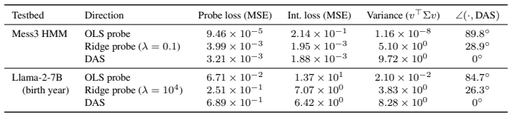
Table 1 : The two testbeds tell similar stories. The OLS probes achieve the lowest probe loss (sam- pled, not exhaustive, on Llama-2-7B), yet their directions carry orders of magnitude less variance, are near-orthogonal to DAS, and interventions along them barely move network outputs. By con- trast, intervention-optimal ridge regression probes are similar to the DAS directions in probe loss, intervention loss, variance, and direction. DAS is technically not a probe as it does not optimize for decodability, but its reported “probe loss” is nevertheless that of a linear readout fit on its subspace. Also, the intervention loss of 13.7 for the OLS probe on Llama-2-7B is the same as what one gets from not intervening at all, whereas the ridge regression probe (7.1) and DAS (6.4) roughly halve it.
Original paper · CC BY 4.0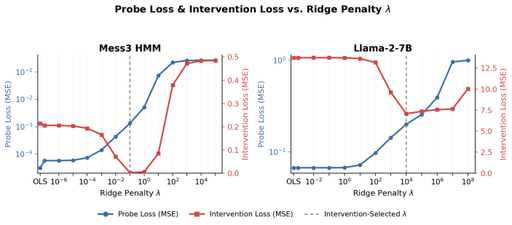
Figure 2 : Probe loss (blue, log scale) and intervention loss (red) as a function of the ridge penaltyλ. Probe loss rises monotonically withλwhile intervention loss has an interior minimum.
Original paper · CC BY 4.0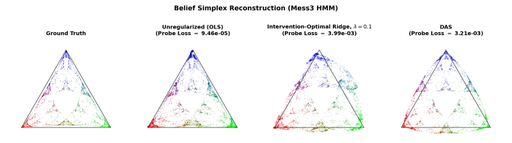
Figure 3 : Belief simplex reconstructions for ground truth, the OLS probe, intervention-optimal ridge regression probe and DAS. The OLS probe recovers the simplex near-perfectly yet is causally inert. Although the specific distortion shapes differ, the two intervention-faithful methods both produce visibly distorted reconstructions with similar probe loss (more than a magnitude higher than the OLS probe).
Original paper · CC BY 4.0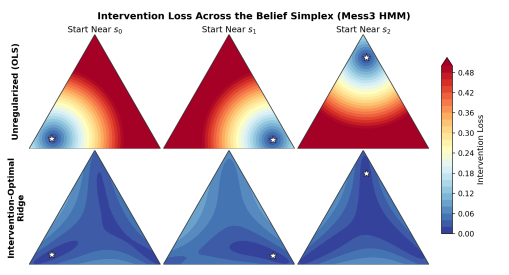
Figure 4 : Intervention loss across the belief simplex for the OLS probe (top) vs. the intervention- optimal ridge regression probe (bottom). From each of the three start states (stars), OLS probe interventions have substantially higher loss than intervention-optimal ridge probe interventions.
Original paper · CC BY 4.0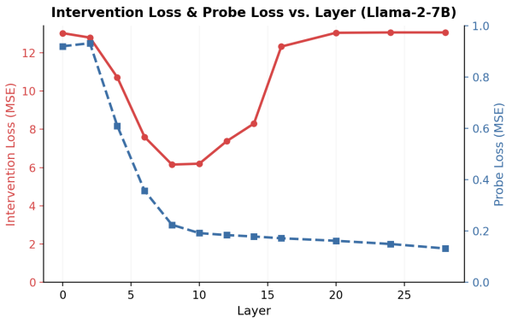
Figure 6 : Intervention loss (red, MSE) and probe loss (blue, MSE) of the birth-year interchange by layer, based on 200 base–source pairs. Each layer has its own intervention-optimized ridge regression probe. Interventions work best at layer 8, the site used for our Llama-2-7B experiments.
Original paper · CC BY 4.0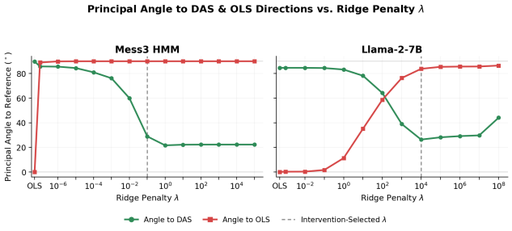
Figure 7 : Angle from the ridge probe to DAS (green) and to OLS (red) asλgrows. On the HMM study, we report the larger of the two principal angles between the steering subspaces. On the Llama-2-7B study, the angle is between single directions. The intervention-selectedλis dashed. The sweep’s positive case for ridge regression is clearest on the Llama-2-7B experiment, where the principal angle to DAS is minimized at the intervention-optimalλ. The case against OLS is clear on both testbeds.
Original paper · CC BY 4.0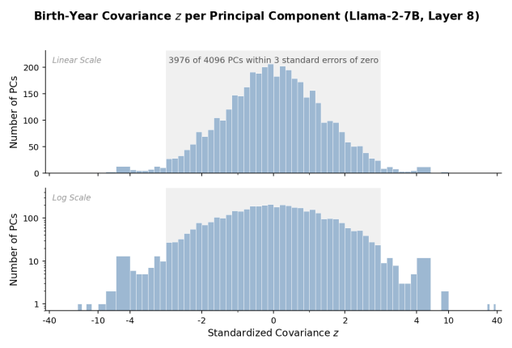
Figure 8 : Standardized birth-year covariancez i = √ncov i/(σiσf )for all4096PCs of Llama-2-7B layer 8, computed split-half (one half of the prompts fixes the PC directions, the other suppliesσ andcov).3976of4096PCs lie within3standard errors of zero (shaded), the sampling-noise scale of Section 3.2.
Original paper · CC BY 4.0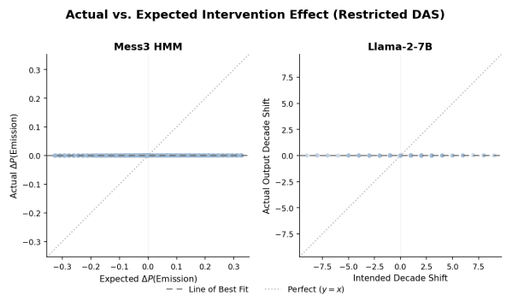
Figure 9 : Per-sample intervention effect for DAS confined to the heaviest-OLS-weight principal components:100on Llama-2-7B and7on the HMM transformer (over99.9%of OLS probe mass). No causally operative direction is found in either.
Original paper · CC BY 4.0Quote from the paper
Karl Vilhelmsson Emneby, Julian Yocum, Cameron Allen (2026). Pretty Linear Liars: Unregularized Probes Favor Intervention-Unfaithful Features. arXiv:2611.20371v1. https://arxiv.org/abs/2611.20371v1
BibTeX
@misc{emneby2026pretty,
  title = {{Pretty Linear Liars: Unregularized Probes Favor Intervention-Unfaithful Features}},
  author = {Karl Vilhelmsson Emneby and Julian Yocum and Cameron Allen},
  year = {2026},
  eprint = {2611.20371},
  archivePrefix = {arXiv},
  url = {https://arxiv.org/abs/2611.20371v1}
}