Paper commentary
Learning Minimum-Time Flight in Cluttered Environments
Neural policies learn minimum-time quadrotor flight through obstacles by combining RL with guiding paths
- Problem Minimum-time planners ignore obstacles in control, and simplified models or polynomial trajectories miss the full actuator limits. Tracking such plans is prone to crashes from disturbances and model mismatch.
- Method The authors train a neural policy with deep reinforcement learning on topological guiding paths. The policy flies along a collision-free route and adjusts speed and control online.
- Results The learned policy reaches a 100% success rate without collision, while traditional planning and control approaches achieve only 40%.
Why minimum-time flight in clutter is hard
Minimum-time flight pushes the quadrotor to the boundary of its physical envelope, and obstacles make the planning problem nonconvex. A slight disturbance or model mismatch can then end in a catastrophic crash, so the planning and control method has to be robust and adapt the trajectory online. Earlier work solved only a subset of these problems, and each family fails on a different part of them.
Some methods ignore obstacles in time-optimal planning, and others cannot exploit the full actuation of the platform because of a simplified quadrotor model. Polynomial trajectories are inherently smooth, so they cannot represent time-optimal maneuvers. Polynomial representations only reach the input limits for infinitesimally short durations.
Search-based planners suffer from the curse of dimensionality, and they use simplified point-mass models instead of the full quadrotor dynamics.
The sampling-based method can plan minimum-time trajectories in clutter, but it plans offline. Its planned trajectory is tracked by an MPC that does not account for the obstacles, so flying it is vulnerable to disturbances and model mismatches. At the actuation limit, even a slight deviation from the pre-planned trajectory can lead to a catastrophic crash.
Optimization-based planners can need hours of computation, or they rely on solver approximations that yield suboptimal performance. Neither of the optimization approaches in [4] and [32] solves the problem for environments that contain obstacles.
Learning avoids this split between planning and control, because reinforcement learning tunes a parametric controller by trial and error. RL also handles highly nonlinear dynamics and nonconvex objectives that conventional robotics methods cannot solve. Prior RL successes were largely limited to video games, ground robots, and simple hovering of a quadrotor.
Learning-based methods also map high-dimensional observations directly to control commands, which avoids a hand-designed tracking pipeline.
Topological paths as the guide
The topological guiding path gives the learner a collision-free route, so RL only has to learn how to fly that route at speed. The guiding paths come from a variant of the Probabilistic Roadmap described in [19], which searches for several distinct paths in different homotopy classes. The planner samples ellipsoids between individual waypoints and enlarges them until at least one path between waypoints is found.
Repeating the shortest-path search yields further distinct paths, such as going around an obstacle from different sides.
The multi-waypoint task minimizes the total time T equal to the sum of the segment durations t_i over the trajectories through the waypoints. Reaching the last waypoint gives a very sparse signal that is difficult to optimize. The method therefore computes progress along the guiding path instead of along straight segments between gates. The reached distance term with weight k_s counteracts the singularities that arise at sharp corners of the guide, which could otherwise block learning a policy that flies through all waypoints.
The guide also shapes the observation, because the farthest collision-free point gamma on the guiding path tells the policy where to fly. Gamma indicates the flight direction of the quadrotor, which maximizes progress. The planner supplies the geometry, and the policy supplies speed and control along it.
What the policy sees and commands
The network takes in three parts: the quadrotor state, the next waypoint, and a point on the guiding path. The state holds position, rotation matrix and velocity, so the policy knows where the vehicle is and how fast it moves. The waypoint enters as a matrix W with four corner positions, forming a box with edge size 2rtol around the gate.
The third input, γ(t), marks the farthest point on the guiding path that a collision-free straight segment can reach. The policy reads γ(t) as a cue for flight direction, which pushes the quadrotor to make progress. The authors removed observation components in ablations and found that every part was needed in all tested scenarios.
The action has two parts: a(t) = [fT, w], a collective thrust and a set of commanded body rates. The thrust fT acts along the body z axis, while w holds the commanded body rates. A low-level controller tracks these two commands and turns them into speed commands for each rotor. The network is a 2-layer MLP with 2 x 256 units and ReLU activations.
The authors chose this action form because the work in [37] found it to be the best performing for learning-based control policies.
Because the network outputs thrust and body rates, the low-level controller handles the conversion to rotor speeds. Together, the observation and the action let the policy map high-dimensional observations straight to control commands.
Progress reward and two-stage training
The progress term is computed along the topological guiding path, not in straight space between waypoints. The closest point on the guide is found by minimizing the distance from the quadrotor position, together with its segment index. Reached distance s(p) sums the segment lengths up to that closest point, and the progress reward is its change between steps.
Progress alone has singularities at the sharp corners of the guide, which can block learning a policy that flies through all waypoints. The reached distance term with weight k_s counteracts these singularities, so the total reward adds it to the progress term.
A waypoint passed within d_w ≤ r_tol adds a positive reward that decays with distance from the waypoint center. A collision adds a terminal reward of −10, and the body-rate term discourages high rates. Naive optimization of this reward gets stuck in local minima and collides more often at high speed. The authors trace this to the decoupling of topological path planning from reinforcement learning of the dynamic quadrotor model.
A slow first stage trains a policy to fly close to the guiding path under scaled rewards. The factor s multiplies the progress and reached distance weights, and it drops when speed leaves the band or the distance grows. The speed band uses v_min of 1 m s−1 and v_max of 2 m s−1, with d_max of 0.3 m. The initial k_s comes from the speed limit and the summed segment lengths, so reached distance roughly matches progress early on.
Once the slow policy passes all waypoints, the speed limits and distance constraint are removed for minimum-time training.
PPO trains the policy with 100 parallel agents in simulation, with the dynamics integrated by a fourth-order Runge-Kutta scheme. The linear drag coefficients are redrawn from normal distributions for each agent after a restart, which builds robustness to aerodynamic effects. Agents restart from valid states stored along the guide, which is discretized into 1 m parts.
Lap times in simple simulation
The lap time test compares planned trajectory durations in a simple simulation that leaves out motor dynamics and aerodynamic drag. The authors chose this setup for a fair comparison, since most baselines ignore both effects. The polynomial method [18] minimizes snap and time, with a time penalty kT of 105000 and a polynomial order Npoly of 10.
The search-based method [30] plans over a discretized point-mass state with an acceleration limit of 31.4 m s−2. The authors call that limit optimistic yet infeasible, while the sampling-based method [19] layers model complexity hierarchically.
Table II lists the best-found duration Tb for each method, plus an average Ta over 30 runs for randomized methods. The polynomial method has the longest trajectories but the lowest computation time. The search-based method flies substantially faster trajectories, but it needs longer computation times. Its state discretization blocks truly time-optimal continuous trajectories, and it returns valid solutions only in the 2D Forest and Office environments.
The optimization method solves only the three simple Forest cases, because its non-convex collision constraints break down elsewhere. The sampling-based method finds high-quality solutions in all cases, with computation time comparable to [4] and [30].
In Office case 0, the learned policy reaches a best duration of 1.62 s, compared to 1.93 s for the sampling-based method. The authors trace this gap to the sampling method's point-mass guide, which yields bang-bang body rates. Racing case 2 is the one case where the learned policy is slower, at 1.38 s against 1.37 s. In simple Forest case 0, the sampling-based method reaches 0.96 s against 0.98 s for the learned policy.
The authors attribute the simpler-environment losses to a trade-off between flying safe and flying fast. The policy slows down when a time-optimal trajectory almost touches the obstacles. The remaining gaps lie within, or close to, the time precision dt of 0.02 s. On inference, the policy averages less than one millisecond, which the authors say allows fast online adaptation.
Each scenario needed about 45 minutes of training on a standard laptop.
Success rate with a high-fidelity model
The high-fidelity test uses Bade-Element-Momentum (BEM) theory, which models lift and drag from each rotor's ego-motion and rotor speeds. The BEM simulation also adds motor dynamics and aerodynamics, which the simple simulation leaves out. The sampling-based trajectories are tracked at 100 Hz by an MPC that outputs the same thrust and body-rate commands as the RL policy.
The MPC gets a thrust limit of 8.5 N, while planning and learning used 7 N, which leaves it control margin.
The authors tune the MPC to maximize position tracking, so the quadrotor sticks to the planned collision-free positions. Each test case uses 30 runs, and a run succeeds only when the quadrotor passes every waypoint within tolerance. A successful run also has to avoid all obstacles. The obstacle tolerance is decreased by the ESDF precision, which removes the effect of the discretized map.
The learned policy's best duration isn't always shorter: Forest case 0 gives 1.21 s for RL versus 1.13 s for the sampling-based method with MPC.
The authors explain the gap by the MPC struggling with disturbances at high speed, where small deviations from the plan lead to crashes. They state that the learned policy transfers to a different simulator without fine-tuning. So the advantage shown here is collision-free flight under model mismatch, not uniformly shorter trajectories.
Real-world Slalom flight
The policy runs on a real quadrotor flying the Slalom track, as Figure 1 shows. The platform comes from the open-hardware Agilicious framework, and BetaFlight tracks the commanded collective thrust and body rates. The flights took place in a 30 × 30 × 8 m3 indoor arena with a motion capture system running at 400 Hz. The authors tested two thrust limits, 4 N and 7 N, in the same arena.
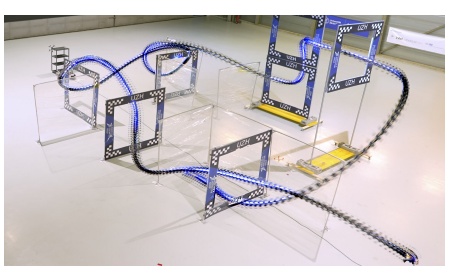
Fig. 1 : Our quadrotor races through a complex race track in the real world while avoiding a set of obstacles made from transparent foil. While racing, the quadrotor reaches speeds of up to 42 km h−1 and accelerates with up to 3.6g.
Original paper · CC BY 4.0 · Robert Penicka, Yunlong Song, Elia Kaufmann, Davide Scaramuzza · Learning Minimum-Time Flight in Cluttered Environments · Original paper figure · Extracted the figure area from page 1 of the original PDF.With the 7 N limit, the quadrotor's maximal velocity reached 42 km h−1. The same racing flight accelerates with up to 3.6g, according to the Figure 1 caption. The policy's simulated flight duration was 7.68 s. The real flight with the 7 N limit took 7.90 s, against 7.68 s in simulation.
Both durations refer to the Slalom environment, so the comparison is direct. The authors report one real flight on one track, so this is a single data point. The paper reports no other real-world track for this policy.
Where the claims stop
The lap-time comparison leaves out motor dynamics and aerodynamic drag, so it can't show how each planner copes with those effects. Among the baselines, only the method from [4] can include a simple linear drag model. In Forest case 0 of Table II, the learned policy reaches 0.98 s, while the sampling-based method reaches 0.96 s. The authors attribute this gap to a trade-off between flying safe and flying fast, since the policy slows down near obstacles.
Table III lists the best-found duration of the learned policy as 1.21 s in Forest case 0, against 1.13 s for the sampling-based method with MPC. The text's claim of faster flight doesn't hold for Forest case 0 in Table III. The 19% improvement in the abstract isn't tied to one named comparison in the body text. The simulated evaluation covers four environments, and each test case in Table III uses 30 runs.
The search-based method returns valid solutions only in the 2D Forest and Office environments. The optimization-based method solves only the three simple Forest test cases. The real-world check is a single Slalom flight, with a 7.68 s simulated duration and a 7.90 s real flight at fmax = 7 N.
They didn't test other motor, drag or disturbance models beyond the randomized drag coefficients and the BEM simulator. Each scenario needs its own policy, trained for about 45 minutes on a standard laptop.
Paper info
- Authors
- Robert Penicka, Yunlong Song, Elia Kaufmann, Davide Scaramuzza
- Venue
- arXiv · Preprint
- First published
- 2022-3-28
- Added
- 2026-11-6
- Updated
- 2022-6-17
- Version
- v2
- arXiv
- 2203.15052
- DOI
- 10.1109/lra.2022.3181755
- Category
- cs.RO
- Original paper terms
- CC BY 4.0
- What we show
- Paper info, commentary and permitted figures from the original paper
AI commentary is a separate explanation from the original paper and may contain errors. The original paper and figures follow each source's terms of use and any rights noted separately.
Abstract
We tackle the problem of minimum-time flight for a quadrotor through a sequence of waypoints in the presence of obstacles while exploiting the full quadrotor dynamics. Early works relied on simplified dynamics or polynomial trajectory representations that did not exploit the full actuator potential of the quadrotor, and, thus, resulted in suboptimal solutions. Recent works can plan minimum-time trajectories; yet, the trajectories are executed with control methods that do not account for obstacles. Thus, a successful execution of such trajectories is prone to errors due to model mismatch and in-flight disturbances. To this end, we leverage deep reinforcement learning and classical topological path planning to train robust neural-network controllers for minimum-time quadrotor flight in cluttered environments. The resulting neural network controller demonstrates substantially better performance of up to 19\% over state-of-the-art methods. More importantly, the learned policy solves the planning and control problem simultaneously online to account for disturbances, thus achieving much higher robustness. As such, the presented method achieves 100% success rate of flying minimum-time policies without collision, while traditional planning and control approaches achieve only 40%. The proposed method is validated in both simulation and the real world, with quadrotor speeds of up to 42km/h and accelerations of 3.6g.
Quote from the paper
Robert Penicka, Yunlong Song, Elia Kaufmann, Davide Scaramuzza (2022). Learning Minimum-Time Flight in Cluttered Environments. arXiv:2203.15052v2. https://doi.org/10.1109/lra.2022.3181755
BibTeX
@article{penicka2022learning,
  title = {{Learning Minimum-Time Flight in Cluttered Environments}},
  author = {Robert Penicka and Yunlong Song and Elia Kaufmann and Davide Scaramuzza},
  year = {2022},
  eprint = {2203.15052},
  archivePrefix = {arXiv},
  doi = {10.1109/lra.2022.3181755},
  url = {https://arxiv.org/abs/2203.15052v2}
}