Paper commentary
TriGen: A Generative Paradigm for Trigger-Induced Recommendation
TriGen repeats the trigger item inside the history to steer generative recommendation
- Problem Generative recommenders assume the user's history is steady, so a trigger click's sudden new intent goes unmodeled. Pushing the model fully toward the trigger narrows candidates and loses lasting tastes.
- Method TriGen repeats the trigger embedding at the history tail, so attention can use it next to recent behaviours. A gating router then mixes trigger and history paths per request, and separate MLPs add guidance at each Semantic ID level.
- Results On the industrial dataset, TriGen scored 5.58 Recall@5, compared to 4.35 for GR plus trigger append.
Why trigger clicks break generative recommenders
Generative recommenders predict an item by generating its Semantic ID one token at a time, conditioned on the user's history. Trigger-Induced Recommendation (TIR) adds a case where a click on one item opens a follow-up feed built around that item. The clicked item then carries the user's immediate intent, so it should steer what comes next instead of sitting as one more past interaction.
The paper's standard generative model conditions the target's tokens only on the history, while the TIR formulation adds the trigger item as a second condition.
The authors argue that existing generative frameworks presume behavioral continuity, so they lack dedicated mechanisms for sudden shifts in user intent.
Pushing the model fully toward the trigger causes the opposite failure, because candidates narrow to an overly narrow semantic space and lasting tastes get lost. The authors see three places where this tension bites: the encoder, the fusion step, and the decoder. In the encoder, standard self-attention lets a long history dilute a single trigger token.
In the fusion step, the right balance between persistent preferences and immediate intent changes from request to request, so static fusion schemes fall short. In the decoder, conditioning only at the initial step weakens over successive generation steps as the Semantic ID unfolds from broad categories to fine-grained attributes.
The key idea: give the trigger a role at each stage
TriGen keeps the trigger present at every stage instead of feeding it in once as a global input. Calibrated Tail Injection works in the encoder, where repeated trigger representations are placed at the history tail. RoPE models the relative positions of the trigger and recent behaviors, and the repetition count N regulates the trigger's influence.
A larger N lets the trigger steer the context toward immediate intent, while a smaller N keeps it from overriding historical preferences. The encoder output then feeds both the fusion module and the decoder cross-attention.
Adaptive Dual-Path Fusion takes the raw historical sequence, not the coupled encoder output, as its input. The trigger path projects the trigger item into step-specific queries to retrieve behaviors relevant to the immediate intent. The history path uses learnable default queries to summarize the user's preference prototypes without the trigger.
A per-request gating router then mixes the two condition paths with step-wise weights, so the balance changes with each request. The authors chose this because a static fusion scheme cannot handle both casual exploration and a decisive shift in interest.
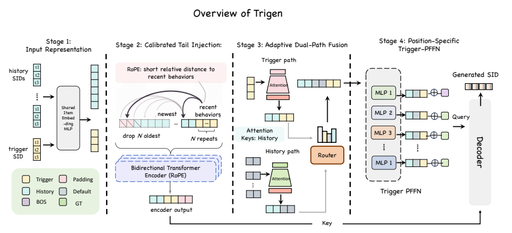
Figure 2 : Overall architecture of TriGen. (a) Calibrated Tail Injection: The trigger is appended to the sequence tail with 𝑁 repetitions, placing it adjacent to recent behaviors. RoPE models relative positions, while 𝑁 controls the repetition count to regulate trigger influence. (b) Adaptive Dual-Path Fusion: Parallel pathways decouple trigger-conditioned steering from history-preserved preference, dynamically balanced by an input-dependent gating router. (c) Position-Specific Trigger-PFFN: Step-specific feed-forward networks project the fused representation into level-aware condition signals, maintaining persistent, coarse-to-fine guidance throughout autoregressive decoding.
Original paper · CC BY 4.0 · Muyu Zou, Haibo Xing, Shunye Tang, Liyan Tie, Lingyu Mu, Yandong Wang, Jinxin Hu · TriGen: A Generative Paradigm for Trigger-Induced Recommendation · Original paper figure · Extracted the figure area from page 4 of the original PDF.Position-Specific Trigger-PFFN sits in the decoder and passes the fused condition sequence through one MLP per Semantic ID level. The authors used separate MLPs because early tokens carry broad categories and later tokens carry fine-grained attributes. Each modulated condition vector is added to the decoder input at its position, so the guidance accompanies every decoding step.
The three parts form a chain, because the decoder-side conditioning takes the fused condition sequence as its input.
Calibrated tail injection and the repeat count
Calibrated Tail Injection starts from the idea that a click reshapes only a local part of the history. Standard self-attention lets a long history dilute a single trigger token, so the trigger needs a position attention can use. TriGen therefore places the trigger inside the sequence at the tail, beside the newest behaviours. Left padding keeps the most recent behaviour at the right end, so the tail sits next to it in RoPE terms.
The authors write the rewritten history as H-tilde, built from the window of length M and N copies of the trigger embedding. The first M minus N history representations stay in place, and the trigger embedding fills the last N positions. RoPE encodes relative distance, so the trigger copies relate to recent behaviours in self-attention. N sets how much query-key capacity the trigger occupies, so a larger N pushes the context toward immediate intent.
A bidirectional Transformer encoder turns H-tilde into the trigger-aware sequence O, which feeds the dual-path fusion and the decoder cross-attention.
The repeat count depends on the dataset: the industrial setup repeats the trigger three times. The public dataset inserts the trigger only once, because its histories are short. Removing the tail injection lowers Recall@5 from 5.58 to 4.16 on the industrial dataset. The same ablation lowers Recall@10 from 15.50 to 11.04.
Placing the trigger at the sequence head gives Recall@5 of 5.31 and Recall@10 of 14.58, below the full model. Dropping RoPE gives Recall@5 of 4.96 and Recall@10 of 14.24. Dropping repetition gives Recall@5 of 5.20 and Recall@10 of 14.83. Figure 3 shows the metrics rising and then falling as the repeat number grows from 1 to 5.
Adaptive dual-path fusion and the per-step gate
A trigger can mislead when the model over-trusts it, and it can be ignored when the model clings to history. TriGen therefore builds two condition paths and lets an input-dependent gating router decide their mix for each request. Both paths read the unperturbed historical representations, so this branch bypasses the coupled encoder sequence.
The trigger path projects the trigger item into a distinct step-specific query for each decoding level. That query attends over the raw history H to retrieve behaviors relevant to the immediate intent. The history path uses a learnable default query, marked as Default in Figure 2, that attends over the same history without the trigger. For decoding level l, the trigger vector t_l and the history vector h_l are both softmax attention outputs over H W^V, with W^K and W^V shared across the two paths.
Stacking these vectors over the L levels yields the trigger condition sequence T and the history condition sequence H_cond.
The router mean-pools each pathway over the levels, which gives a global profile for each path. It concatenates the two pooled profiles and applies a linear map W_r with a sigmoid to produce one weight w_l per level. Each fused vector is a convex mix c_l = w_l t_l + (1 - w_l) h_l, so w_l sets how much trigger enters level l. The weights come from each request's own pooled profiles, so the balance between trigger and history shifts from request to request.
On the industrial dataset, replacing the adaptive gate with uniform path averaging lowers Recall@5 from 5.58 to 4.15. The authors read this drop as evidence that different requests need different balances between instant redirection and historical continuity.
The fused sequence C then feeds Stage 4, the Position-Specific Trigger-PFFN, which steers the decoder at each step. The method description has an unclear point: the encoder section says the trigger-aware sequence O also feeds the fusion module. Yet the fusion section bypasses the encoder sequence and Eq. (5) uses the raw H, so the paper does not settle which input the fusion uses.
Position-specific trigger-PFFN for each Semantic ID level
Semantic IDs come from residual quantization, so early tokens give a coarse approximation and later tokens encode refinements. The authors argue that each decoding step therefore needs its own kind of trigger modulation rather than one uniform signal across all positions. Trigger-PFFN takes the calibrated condition sequence C from Stage 3 as input and maps each vector c_l through a dedicated feed-forward layer.
Each MLP_l is an independent multi-layer perceptron learned for the l-th Semantic ID level, so every level has its own projection parameters. Early levels can learn broad categorical guidance, while later levels can learn detailed attribute control.
The modulated vectors are added to the decoder input, so the trigger guidance travels with the target prefix at every step. Under teacher forcing with the ground-truth sequence (y_1, ..., y_L), the first decoder input adds the BOS embedding to the first modulated condition. Each later decoder input adds the embedding of the previous ground-truth token to the modulated condition at its own level.
At inference, the trigger and the history change for each request, but the level networks and projections stay fixed.
Data: an industrial trigger log and a simulated public trigger
The industrial dataset comes from a real Trigger-Induced Recommendation scenario on a major e-commerce platform. It covers real exposure, click, and follow-up feedback signals, and it holds 49,277,990 users, 158,533,241 items and 1,492,770,272 samples. The authors use this log as the setting where the trigger is a genuine field of the data.
The public benchmark is the Industrial_and_Scientific category of Amazon Reviews 2018, in its 5-core version. Because this dataset has no native TIR annotations, the authors simulate the trigger from the user history.
Trigger models read the shortened history plus the trigger, while trigger-free baselines read the full sequence, so both see the same items. Across the three splits, the public data contain 3,686 items, 7,694 users and 49,371 interactions.
The simulated trigger is an ordinary past interaction, not a click that just happened, so its intent signal is weaker than in deployment. The authors read the public-dataset margin as a lower bound, because TriGen gets a degraded trigger there.
Offline results: where TriGen leads and where it trails
Table 1 compares TriGen with TIR-specific, sequential, trigger-free generative and simple TIR-GR baselines on both datasets. Each number in Table 1 is the mean over five seeds. On the industrial dataset, TriGen reaches 5.58 Recall@5, compared to 2.58 for HSTU, the best trigger-free generative baseline in that column. The sequential GRU4Rec scores 1.66 and SASRec scores 2.16 on the same column.
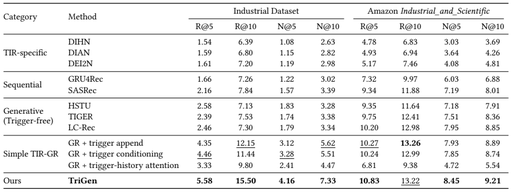
Table 1 : Overall performance comparison on the industrial dataset and the AmazonIndustrial_and_Scientificbenchmark. Results report the mean performance over 5 seeds (corresponding standard deviations are detailed in Appendix E, Table 7). R@𝐾 and N@𝐾 denote Recall@𝐾 and NDCG@𝐾, respectively. The best performance in each column is highlighted in bold, and the second-best is underlined .
Original paper · CC BY 4.0The closest test is GR + trigger append, which already uses the trigger, and it reaches 4.35 on that column. TriGen's margin over this naive version, the authors argue, reflects their tailored designs rather than the mere presence of the trigger. On the industrial dataset, every simple TIR-GR variant trails TriGen on all four metrics.
The picture is less uniform on Amazon, where TriGen leads on Recall@5 and both NDCG columns but not on Recall@10.
On the industrial dataset, the five-seed standard deviations run from 0.01 to 0.03. The authors attribute the wider public spread to the smaller sample size of the Amazon benchmark.
Which components carry the offline gain?
The ablation study removes one piece of TriGen at a time while the backbone configuration stays the same. Removing the trigger entirely drops Recall@5 from 5.58 to 2.88, the largest fall in the ablation table. The authors read this as evidence that historical interaction data alone can't yield accurate recommendations in this setting.
Dropping tail injection gives 4.16 Recall@5, and the authors say that relying on downstream trigger conditioning alone is insufficient. Dropping Position-Specific Trigger-PFFN gives 4.28 Recall@5, so decoder-side conditioning matters about as much as encoder-side injection. Dropping Adaptive Dual-Path Fusion gives 5.11 Recall@5, closer to the full model but below it on every metric.
Table 3 tests the gate directly by replacing the learned router with uniform averaging of the two paths. Uniform averaging gives 4.15 Recall@5, against 5.58 for the learned gate. The authors argue that different requests need different balances between instant redirection and historical continuity, which a uniform mix can't provide.
Figure 3 sweeps the trigger repeat number on the industrial dataset, and every metric first improves and then declines. Inserting the trigger only once gives 5.20 Recall@5 in the Table 3 variant without repeats. The authors call this bell-shaped trend calibration: too few copies leave the trigger overshadowed, and too many overwhelm history.
Table 3 also covers a trigger placed at the sequence head, which scores 5.31 Recall@5. Removing RoPE gives 4.96 Recall@5, and start-only decoder injection gives 4.62. A single shared projection layer gives 4.90 Recall@5, below the full model's 5.58 in each of these variants. The ablation text doesn't state a seed count, while the main comparison uses 5 seeds.
Two real-world users clicked the same quilted shoulder bag, but their histories differ. With an informative travel-outfit history, TriGen returns tops, shorts, a bag and a skincare set, so the trigger reads as part of a trip. With unrelated digital and desk items, TriGen concentrates its slots on bags and varies style instead of category.
The authors take these two cases as evidence that the fusion is adaptive, though they rest on two qualitative examples.
Online A/B test across six markets
The authors ran the online A/B test inside the trigger-induced feed on product detail pages, across six markets. The control was the production model, GR + trigger append, which is itself a simple trigger-aware generative baseline. The treatment was TriGen, and each bucket received 10% of randomly sampled production traffic. Because the control already uses the trigger, the test measures TriGen against an existing trigger-aware system rather than against a trigger-free one.
TriGen raised Revenue in all six markets, with relative lifts from +1.64% to +8.16%. GMV rose in four of the six markets, and TriGen reached +20.54% in the best one. Revenue therefore improved more consistently across the markets than GMV did.
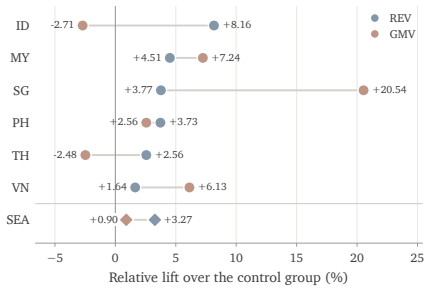
Figure 4 : Online A/B test results across six international mar- kets. REV (Revenue) and GMV (Gross Merchandise Value) denote the relative lifts of TriGen over the deployed produc- tion baseline. SEA represents the traffic-weighted aggregate.
Original paper · CC BY 4.0On the traffic-weighted Southeast Asia aggregate, TriGen delivers +3.27% in Revenue and +0.90% in GMV. The authors report statistical significance at p<0.05 in a two-sided test for these aggregate figures. The aggregate GMV lift is much smaller than the revenue lift, so the commercial gain shows up more clearly in revenue.
The authors report an inference latency of approximately 10.5 ms, which they judge virtually indistinguishable from the control model. Since July 2026, TriGen has been fully deployed and serves primary online traffic across the platform.
Limitations
The public trigger is simulated, so the public-dataset margin may be conservative. On Amazon, TriGen sees only the last history item as its trigger, so its trigger signal is capped.
TriGen assumes exactly one trigger per request, which matches product detail pages but not feeds where several recent signals arrive together. How several triggers should be injected and fused is left to future work.
The offline industrial results come from one e-commerce platform, and the online test covers six markets on that platform. The 5-seed protocol is stated for the main comparison only.
Paper info
- Authors
- Muyu Zou, Haibo Xing, Shunye Tang, Liyan Tie, Lingyu Mu, Yandong Wang, Jinxin Hu
- Venue
- arXiv · Preprint
- First published
- 2026-11-12
- Added
- 2026-11-13
- Updated
- 2026-11-12
- Version
- v1
- arXiv
- 2611.16395
- Category
- cs.IR
- Original paper terms
- CC BY 4.0
- What we show
- Paper info, commentary and permitted figures from the original paper
AI commentary is a separate explanation from the original paper and may contain errors. The original paper and figures follow each source's terms of use and any rights noted separately.
Abstract
Generative recommendation typically operates under the User-Induced Recommendation (UIR) setting, predicting target items by autoregressively generating semantic IDs as a passive continuation of long-term user history. However, this paradigm overlooks Trigger-Induced Recommendation (TIR), an essential industrial scenario where a user click triggers an immediate follow-up feed. In TIR, recommendations must dynamically align with the instant trigger intent without compromising historical preference continuity. Traditional TIR methods rely on discriminative scoring and cannot guide token-level generation, while existing generative models lack mechanisms to reconcile this structural tension. To address this challenge, we propose TriGen, establishing a tailored generative paradigm for trigger-induced recommendation. TriGen introduces calibrated tail injection to re-encode local history, adaptively arbitrates between persistent tastes and immediate impulses via dynamic gating, and applies position-specific transformations to sustain level-aware trigger guidance across decoding steps. Extensive offline evaluations confirm consistent gains over competitive baselines. Furthermore, online A/B tests across six country markets demonstrate significant revenue and GMV improvements, leading to the full production deployment of TriGen.
Quote from the paper
Muyu Zou, Haibo Xing, Shunye Tang, Liyan Tie, Lingyu Mu, Yandong Wang, Jinxin Hu (2026). TriGen: A Generative Paradigm for Trigger-Induced Recommendation. arXiv:2611.16395v1. https://arxiv.org/abs/2611.16395v1
BibTeX
@misc{zou2026trigen,
  title = {{TriGen: A Generative Paradigm for Trigger-Induced Recommendation}},
  author = {Muyu Zou and Haibo Xing and Shunye Tang and Liyan Tie and Lingyu Mu and Yandong Wang and Jinxin Hu},
  year = {2026},
  eprint = {2611.16395},
  archivePrefix = {arXiv},
  url = {https://arxiv.org/abs/2611.16395v1}
}