Paper commentary
Scout Before You Route: Predicting Task Success and Token Count from a Small LLM Prefill
Scout models predict per-query output length to price reasoning models more accurately
- Problem Routers price every model at one fixed cost, but reasoning models' output length varies by an order of magnitude across queries. That constant misprices expensive queries, so routers choose poorly on reasoning candidates.
- Method The Scout router reads a frozen 4B Qwen3 model's prompt activations, without running any candidate. For each candidate, a ridge probe predicts log output length, which is converted to a dollar cost and traded against predicted success.
- Results On eight of nine datasets, the cost probe saves 9.4 to 33.0% against median pricing at matched accuracy. It reaches up to 69% of the saving that perfect per-query cost knowledge would give.
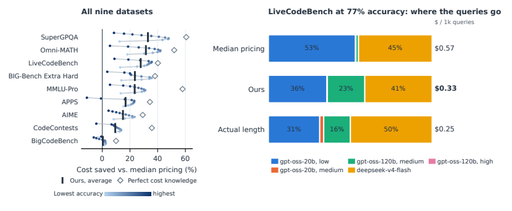
Figure 1 :What predicting cost saves, and where the queries go.Left: cost saved relative to median pricing on all nine datasets at each of 12 matched accuracies, from the lowest (light, low in the row) to the highest (dark, high in the row) in the range both routers reach, averaged over ten training sets. Ticks mark our average over the range and diamonds the same average for perfect per-query cost knowledge (Table 3 gives 95% intervals). Right: share of LiveCodeBench test queries sent to each candidate at 77% accuracy by three routers that price a query by median length, by our cost probes, or by its actual length (perfect knowledge), with the spend per 1,000 queries (one training set). Ours moves queries from gpt-oss-20b at low effort to gpt-oss-120b at medium effort.
Original paper · CC BY 4.0 · Aristides Milios, Christopher Pal · Scout Before You Route: Predicting Task Success and Token Count from a Small LLM Prefill · Original paper figure · Extracted the figure area from page 2 of the original PDF.Why a fixed price per model wastes money
Most routers choose one model per query by weighing expected correctness against cost, but they price each model at a single constant. That constant assumes every query produces about the same number of output tokens, and reasoning models break that assumption. On LiveCodeBench, one model's output length differs 11 to 121 times between its 10th- and 90th-percentile problems.
The prefill router of Varshney et al. explicitly prices outputs at the median training length, which is the reference this paper uses.
Some routers do predict cost per query, but few isolate that cost term from the rest of the system. Those pools contain almost no reasoning models, so whether per-query cost matters for reasoning candidates stayed open. The paper compares cost estimators directly, giving every estimator the same success predictions. It measures each estimator against both constant pricing and perfect per-query cost knowledge, not against a single pool.
Reading length from a cheap prompt pass
The scout is a frozen Qwen3-4B that reads only the prompt and generates nothing, so no candidate model runs before routing. The authors call it an actuarial scout, because it prices each query from that query's own features rather than charging every query the average premium. The probe reuses the mean- and last-token activations from eight layers that the success probe already reads.
A router therefore adds one linear probe per candidate instead of a second encoder pass.
For each candidate, the cost probe is a ridge regression of log mean output length, bias-corrected with Duan's smearing. The predicted length is priced at the candidate's input and output token rates, so the estimate becomes a dollar cost per query. Routing then picks the candidate that maximizes V times predicted success minus predicted cost, where V is the value of a correct answer.
The one router that isolates the cost predictor finds that it adds little, on pools with almost no reasoning models. This paper isolates the probe on reasoning candidates, and compares it against both constant pricing and perfect per-query cost knowledge.
Figure 2 shows the probe's saving against ZeroRouter's pricing on the nine datasets, with 95% intervals. Figure 1 shows the saving against median pricing at each matched accuracy, averaged over ten training sets.
How the two probes are fitted and priced
The cost path starts from the same frozen Qwen3-4B scout that already feeds the success probe. Each probe reads mean- and last-token activations concatenated from eight layers of that model. The scout only processes the prompt, so the features exist before any candidate model is called. Each candidate gets its own linear probe per target, so a router adds one probe per candidate to its existing prefill pass.
For success, the probe is an L2-regularized logistic regression, and Platt scaling calibrates its probabilities. For cost, the probe is a ridge regression that predicts the log of the mean output length. Exponentiating a log prediction biases it, so Duan's smearing corrects that bias before the length is used. The corrected length is priced at the candidate's own token rates, with input tokens at the input rate and predicted output tokens at the output rate.
The authors fit the probes on training problems only, so the calibration and test sets stay untouched. Each result averages over ten training sets, and each set reshuffles the training and calibration problems. Pricing each problem at its actual output length gives the perfect-knowledge headroom that the probe is measured against.
How much of the possible saving does the cost probe capture
Perfect per-query cost knowledge is the practical upper bound for any cost estimator, and its saving over median pricing is the headroom. With reasoning candidates, that headroom reaches 29 to 61% on eight of nine datasets. BigCodeBench is the exception, with a headroom of 10.0%, and the cost probe captures almost none of it. The capture share is the probe's saving divided by the headroom, so a ratio near one means the probe matches perfect knowledge.
The cost probe saves 9.4 to 33.0% against median pricing on those eight datasets, up to 69% of the headroom. On LiveCodeBench, the router reaches 90% of deepseek-v4-flash's accuracy at 49% of the cost of calling it on every query. Median pricing needs 69% of that cost for the same accuracy, so the probe's edge is clear on this dataset. With one shared token price for every candidate, the probe still saves 13.3% on LiveCodeBench, so the gain is not only a price effect.
The probe is significantly cheaper than median pricing on eight datasets, and it is significantly behind on none of them. The reimplemented ZeroRouter, MixLLM-style and CARROT-style estimators each receive the same success predictions as the probe. Across the 72 comparisons with external estimators, the probe is ahead in 69 and significantly ahead in 50.
Its capture is limited on CodeContests and BigCodeBench, where no estimator closes much of the gap.
Why length follows the problem
Output length is mostly a property of the problem, not of the model that writes it. The authors read this as the same questions being long for every model.
Hard problems are only sometimes the long ones, so the authors test that directly. They measure empirical difficulty as a problem's solve rate across the other candidates, which needs running and grading every model. No router has this signal, so the authors use it only to explain length, not to price queries. On Omni-MATH and APPS it explains about a third of log length.
The cost probe already predicts most of this, since adding empirical difficulty raises R2 by at most .07 on LCB, Omni-MATH and APPS. Here length from predicted success comes within 3.2 points of the cost probe on LiveCodeBench, so predicted success suffices.
On knowledge and mixed-format datasets the picture changes, because empirical difficulty explains less than a fifth of log length. On MMLU-Pro, pricing from empirical difficulty and each question's subject saves under 4% against median pricing, versus 29% for the cost probe. Length from predicted success falls well behind here, at 18.4% [11.0, 23.5] on MMLU-Pro.
On BIG-Bench Extra Hard the gap is 22.6% [12.3, 31.9], and its 23 tasks differ in format.
With 20 training problems, the cost probe still leads the text estimators on most datasets. On SuperGPQA the text estimators fall behind, since the cost probe saves 15.7% [0.1, 27.5] relative to them.
Scout size and the controls
Scout size barely moves the saving: every Qwen3 scout from 1.7B to 14B saves 24.9–28.8% on LiveCodeBench against median pricing. Omni-MATH and MMLU-Pro show the same flatness, at 27.9–30.7% and 19.4–20.7%. The 14B scout's forward pass costs about seven times the 0.6B pass, so the extra size has a real price. Counting each router's own pass, the 4B router spends 7.3% [2.2, 11.2] less than the 14B router on LiveCodeBench.
On MMLU-Pro the 4B router also beats the 8B router by 6.2% [1.1, 12.4]. Past 4B, a bigger scout costs more than it returns in saving.
A 1.7B scout does about as well as the 4B scout. For the controls, Qwen3-Embedding-4B replaces the scout as a text model of the same size, and the router saves less. Ours leads the text router by 6.8–18.5% on LiveCodeBench, Omni-MATH, MMLU-Pro and AIME, with intervals excluding zero. On the other five datasets, the text router is never significantly ahead.
The gap is 11.9–25.6% on Omni-MATH and MMLU-Pro, and 6.5% [−1.2, 12.2] on LiveCodeBench for Qwen3-0.6B. The same frozen Qwen3-0.6B with a linear probe beats its fine-tuned copy, which the authors tie to full fine-tuning distorting pretrained features. The logistic probes tie a reimplementation of the prefill router's success pipeline on four of five datasets.
They trail that pipeline only on SuperGPQA, where neither predicts success well.
Labels and new models: how little the probe needs
With only 20 labelled training problems, the cost probe keeps most of its saving, while external estimators save at most 10.3%. With more problems the external estimators improve but don't catch up on LCB, Omni-MATH, MMLU-Pro and AIME. At 50 problems, ours stays within 4.0 to 6.7 points of its full-data saving on every dataset except MMLU-Pro, which gives 11.6.
Length from predicted success matches the probe on LCB and Omni-MATH from 20 problems on.
A new model needs its own success and cost probes, so the router fits them for each held-out model. The new model's probes use k labelled problems, and each probe has only two parameters. From 10 examples, the router saves 19.2 to 26.7% on four datasets and 9.7% on BIG-Bench Extra Hard. ZeroRouter's onboarding saves 3.4 to 17.4% in the same setting, which is its main use case.
Ours leads ZeroRouter on every dataset on average, by 5.2 to 13.0 points, though no interval excludes zero at 10 examples. At 50 examples, the probe leads significantly on LCB and SuperGPQA.
On LCB and AIME, the transferred router keeps 94 to 96% of its in-domain saving. On MMLU-Pro and APPS it exceeds its in-domain saving, leading the best transferred external estimator by 7.5 to 28.9 points.
Mixed traffic without benchmark labels
The mixed-traffic test asks whether the cost probe still adds value when one router serves a single mixture of all nine benchmarks. Pricing each candidate at its median length within the query's benchmark saves 12.2% over one median per candidate. The authors compare this with routers that are each given the query's true benchmark, which makes them an optimistic baseline.
Their single probe is not given the benchmark, and it saves 31.8% over one median per candidate.
Beyond benchmark identity, MixLLM saves 8.8%, and the probe saves 14.9% [9.9, 20.0] beyond MixLLM. To check whether the probe captures more than benchmark and difficulty, the authors fit length from predicted success within each benchmark. That ablation saves 24.4% when given the true benchmark, and the cost probe still saves 9.9% [5.2, 14.2] beyond it.
Limits of the cost probe
The cost probe needs output-length labels for every candidate it routes to. The authors judge a few dozen labels enough for most datasets, so the labelling burden stays small. Without gpt-oss-20b at low effort, LiveCodeBench falls from 27.8% to 6.5%, and Omni-MATH falls from 31.5% to 16.2%.
The router doesn't exceed the most accurate single candidate, because the cost probe doesn't change the top of the frontier. Exceeding that candidate would need better success predictions than the ones used here. When gpt-oss-120b at high effort is billed at deepseek-v4-flash's token rates, perfect cost knowledge saves 11 to 36% within that pair.
Our router saves at most 7.0% [2.4, 14.0] on Omni-MATH relative to calling deepseek-v4-flash alone. Each interval covers one comparison, and the authors don't correct for the number of comparisons. Only a few analyses rely on one training set. The Omni-MATH and MMLU-Pro test sets hold one sample per problem and candidate.
Transfer is tested only across benchmarks that share the routed models. A new collection wouldn't reproduce the billed costs exactly. The ZeroRouter, MixLLM and CARROT baselines are reimplementations.
Paper info
- Authors
- Aristides Milios, Christopher Pal
- Venue
- arXiv · Preprint
- First published
- 2026-11-6
- Added
- 2026-11-9
- Updated
- 2026-11-6
- Version
- v1
- arXiv
- 2611.09028
- Category
- cs.AI · cs.LG
- Original paper terms
- CC BY 4.0
- What we show
- Paper info, commentary and permitted figures from the original paper
AI commentary is a separate explanation from the original paper and may contain errors. The original paper and figures follow each source's terms of use and any rights noted separately.
Abstract
Routers typically choose a model per query by trading predicted correctness against cost. Most price each model at a fixed cost, as if every query used the same number of output tokens, but the output length of reasoning models varies by an order of magnitude across queries. When is per-query cost worth predicting? What factors drive cost? How cheaply can predictions be made? We predict both the success probability and the output length of candidate models from the prefill activations of a single small frozen LLM, the scout. With reasoning candidates, perfect per-query cost knowledge would save 29-61% of spending on eight of nine datasets, and much less with non-reasoning candidates on the same problems. On those eight datasets, our predicted costs save 9-33% at matched accuracy relative to median-length pricing, up to 69% of what perfect knowledge would save. They are significantly cheaper than each estimator we reimplemented or adapted from published work, including ZeroRouter and a MixLLM-style predictor, on a majority of datasets. Output length depends mostly on the problem. On most math and code datasets, harder problems are longer, so predicted success alone prices cost nearly as well. On knowledge and mixed-format datasets they are not, and predicted success falls well behind a probe trained on length. The probe keeps most of its saving with 20 labelled problems and transfers without labels to four of seven new benchmarks. On a mixture of all nine benchmarks, it saves 22% beyond pricing each benchmark at its own median length. Savings stop growing at about a 2B scout, so above 4B a larger scout costs more than it adds.
Figures from the paper
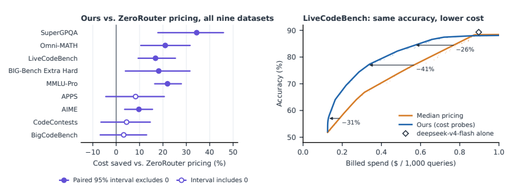
Figure 2 :Cost saved at matched accuracy, billed prices.Left: cost saved by ours relative to Zero- Router’s pricing, both with our success predictions and our 4B scout, with 95% intervals; hollow where the interval includes zero (Table 1). Right: LiveCodeBench cost–accuracy frontiers of our cost probe and median pricing (one training set); arrows mark the saving at matched accuracy, and the diamond is deepseek-v4-flash on every query.
Original paper · CC BY 4.0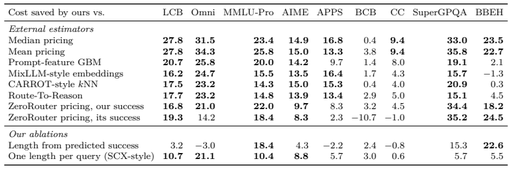
Table 1 :Cost saved (%) by our cost probe relative to each estimatorat matched accuracy. Every row uses our success predictions except the second ZeroRouter row, which uses its own. Both ZeroRouter rows predict query difficulty from our 4B scout’s activations (Section B.5 gives the version as published). Bold: statistically significant (95% paired bootstrap interval excludes zero). Ours is ahead in 69 of the 72 comparisons with external estimators, significantly in 50. Estimators are described in Section B.5.
Original paper · CC BY 4.0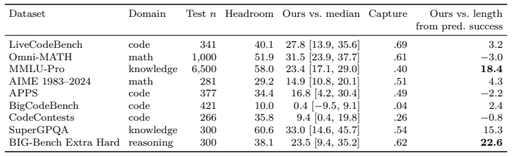
Table 3 :Headroom and capture on every dataset.Cost saved (%) relative to median pricing by perfect per-query cost knowledge (headroom) and by our cost probe, with 95% intervals; capture is their ratio. Last column: cost saved by the cost probe relative to our ablation that takes length from predicted success; bold: interval excludes zero.
Original paper · CC BY 4.0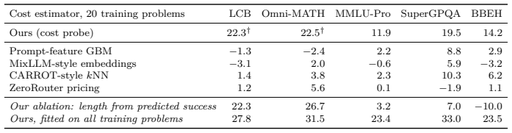
Table 4 :Few labels.Cost saved (%) relative to median pricing fitted on the same problems, when each cost estimator is fitted on 20 random training problems, two subsets per training set.†: ours exceeds every external estimator (95% intervals exclude zero). Below the line, for reference: our ablation, which exceeds ours on Omni-MATH, and ours fitted on all training problems, relative to median pricing fitted on all of them.
Original paper · CC BY 4.0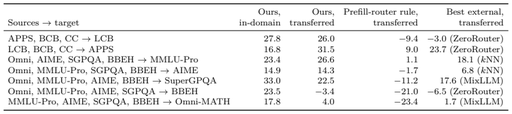
Table 5 :A router moved to a new benchmark.Cost saved (%) relative to the target’s own median pricing. Ours: success and cost probes trained on the sources, with every choice made on their calibration splits; external estimators transfer the same way, each with its own success model. Prefill-router rule: the transferred success probes with median pricing. Ours is significantly ahead of every alternative in every training set on LCB and MMLU-Pro (9 of 10 on AIME). SGPQA: SuperGPQA; Omni: Omni-MATH’s 500-problem set.
Original paper · CC BY 4.0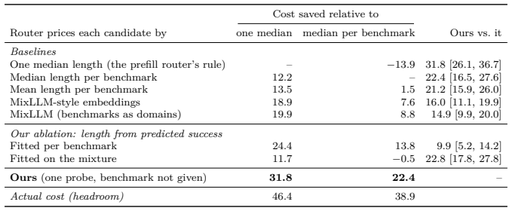
Table 6 :One router for mixed traffic.All nine benchmarks in one mixture (150 test problems each), with the same five candidates and success probes in every row. Cost saved (%) at matched accuracy, with 95% intervals resampled within each benchmark; every “ours vs. it” interval excludes zero in all ten training sets. Estimators with access to benchmark identity are given each query’s true benchmark (an optimistic baseline); ours is not (Section B.5).
Original paper · CC BY 4.0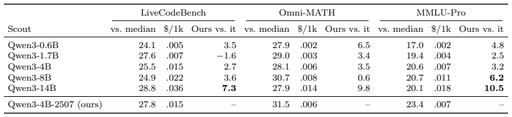
Table 7 :Scout size.Qwen3 scouts from 0.6B to 14B (the original releases, which switch between thinking and non-thinking modes) and ours (4B Instruct-2507), each feeding both probes. vs. median: cost saved (%) relative to median pricing with the row’s own success probes. $/1k: the scout’s forward pass per 1,000 queries on one H100 at $2 per hour. Ours vs. it: cost saved (%) by our router relative to the row’s, each paying for its own scout’s pass, at our spend in the middle of the accuracy band (one training set); bold: 95% interval excludes zero. Scouts from other model families in Table 16.
Original paper · CC BY 4.0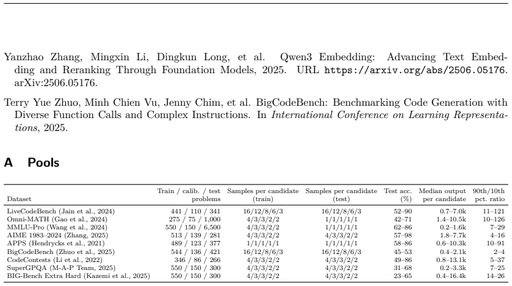
Table 8 :Pools.Split sizes (problems with a valid answer from every candidate), median samples per candidate (in Table 2’s order), and ranges over candidates of test accuracy, median output length (tokens) and the 90th/10th-percentile length ratio. Omni-MATH and MMLU-Pro train on Omni-MATH-500 and a 1,000-question subject-stratified sample and test on 1,000 and 6,500 further problems; the other datasets use a random held-out split. Billed rates (USD per million input / output tokens): gpt-oss-20b 0.029 / 0.134, deepseek-v4-flash (StreamLake) 0.042 / 0.084, gpt-oss-120b 0.020 / 0.257.
Original paper · CC BY 4.0
Table 9 :Reasoning versus non-reasoning candidates on the same problems.Headroom, our saving relative to median pricing (s.d. over training sets) and capture, for five reasoning and five non-reasoning candidates, on the test problems every candidate of both pools answers validly (MMLU-Pro: a 2,000- problem subset). Here perfect cost knowledge prices each problem at its billed cost, so Omni-MATH’s reasoning headroom differs slightly from Table 3. The non-reasoning saving excludes zero in every training set on LCB and Omni-MATH and in none on MMLU-Pro.
Original paper · CC BY 4.0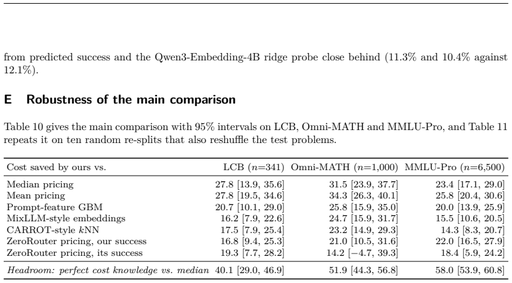
Table 10 :Cost saved at matched accuracy, billed costs.Cost saved (%) by our cost probe relative to each estimator, with 95% intervals. Every row uses our success predictions except ZeroRouter pricing with its own success model; both ZeroRouter rows predict item parameters from our scout’s activations. All intervals exclude zero except against ZeroRouter with its own success model on Omni-MATH (ours ahead in 7 of 10 training sets). Last row: the headroom, of which the cost probe captures 69%, 61% and 40%. Estimators in Section B.5.
Original paper · CC BY 4.0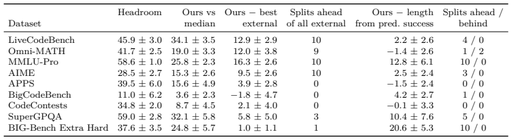
Table 11 :Ten random re-splits per dataset, which, unlike the training sets, also reshuffle the test prob- lems (original sizes; every probe and estimator refitted, configurations chosen on calibration). Mean±s.d. over splits of cost saved (%) relative to median pricing, and of our saving relative to the best external esti- mator in each split and to length from predicted success. “Splits ahead”: splits in which ours is significantly ahead of every external estimator, and (last column) ahead of / behind length from predicted success. No external estimator is significantly cheaper than ours in any split. Values differ from Table 3; the conclusions do not.
Original paper · CC BY 4.0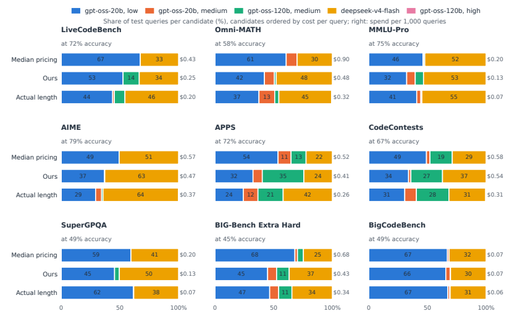
Figure 3 :Candidate shares at matched accuracy(one training set). Share of test queries (%) sent to each candidate at the middle of the accuracy band that all three pricings reach; right: spend per 1,000 queries. Candidates are ordered by mean cost per query; shares below 10% are unlabelled.
Original paper · CC BY 4.0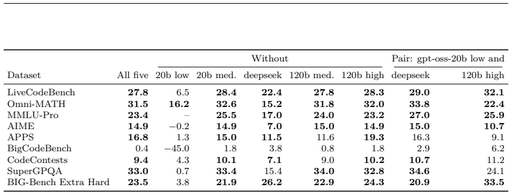
Table 12 :Which candidates the saving needs.Cost saved (%) by our cost probe relative to median pricing, with the router refitted on a subset of the five candidates; bold: 95% interval excludes zero. –: the frontiers do not overlap (MMLU-Pro without gpt-oss-20b at low effort, where deepseek-v4-flash has the lowest median cost per call).
Original paper · CC BY 4.0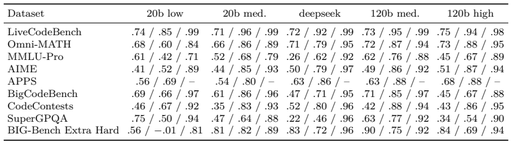
Table 13 :How much of each candidate’s length we predict, and how much depends on the problem.TestR 2 of log mean output length: our probe / a linear map from the other candidates’ actual lengths on the same problem / the share of variance between problems rather than between samples. A dash means the share is not computable, because APPS has one sample per problem.
Original paper · CC BY 4.0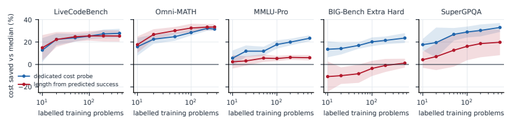
Figure 4 :Length labels needed.Cost saved relative to median pricing fitted on the same problems, when cost is fitted onnlabelled training problems: our cost probe (blue) versus length from predicted success (red), which needs length labels only to map success logits to length. Two random subsets per training set; bands:±1 s.d. over training sets.
Original paper · CC BY 4.0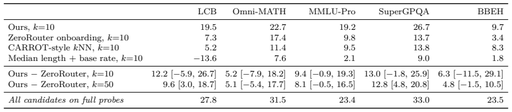
Table 14 :Onboarding a new model fromkexamples.Cost saved (%) relative to the full pool at median pricing, mean over three held-out models (gpt-oss-20b with both efforts, gpt-oss-120b with both efforts, deepseek-v4-flash) and four random choices of theklabelled problems per training set (the same problems for every method). Differences in points, with 95% intervals.
Original paper · CC BY 4.0
Table 16 :Other scouts.Each scout’s activations feed both probes, refitted with the paper’s recipes (Omni- MATH and MMLU-Pro, billed costs).R2: test log-lengthR2, mean over candidates. vs. median: cost saved (%) relative to median pricing with the row’s own success predictions. Ours vs. it: cost saved by our router relative to the row’s, with 95% intervals (bold: excludes zero) and the number of training sets in which ours is significantly ahead; ours is significantly behind in one training set only (Phi-4-mini, MMLU-Pro).
Original paper · CC BY 4.0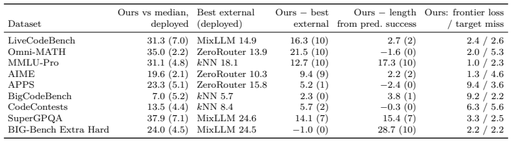
Table 17 :Deployable policies.Each estimator picks on the calibration split the cheapestVreaching each of ten accuracy targets, applied once to the test set. Cost saved (%) relative to median pricing’s deployed policies at the accuracy reached, mean over targets (in parentheses: s.d. over training sets for our saving; for differences, the number of training sets in which ours is significantly ahead; ours is significantly behind only in one APPS and one Omni-MATH set, against length from predicted success). Last column: extra cost over our own test frontier at the accuracy reached (%) / mean|test accuracy−target|(points). Billed prices.
Original paper · CC BY 4.0Quote from the paper
Aristides Milios, Christopher Pal (2026). Scout Before You Route: Predicting Task Success and Token Count from a Small LLM Prefill. arXiv:2611.09028v1. https://arxiv.org/abs/2611.09028v1
BibTeX
@misc{milios2026scout,
  title = {{Scout Before You Route: Predicting Task Success and Token Count from a Small LLM Prefill}},
  author = {Aristides Milios and Christopher Pal},
  year = {2026},
  eprint = {2611.09028},
  archivePrefix = {arXiv},
  url = {https://arxiv.org/abs/2611.09028v1}
}