Paper commentary
ReSID: Rethinking Long-Tail Retrieval in Generative Recommendation through Item Reachability
ReSID recovers long-tail items that beam search prunes in generative recommendation
- Problem Generative recommendation struggles to retrieve long-tail items under tight serving budgets. Beam search prunes most tail targets before exact SID matching can find them, and widening the beam raises serving cost.
- Method ReSID builds Semantic IDs from parallel subspaces, so an error at one position does not spread to others. It guides beam search with popularity debiasing and user-semantic scores, then recovers tail items by partial SID matching.
- Results On Industrial, partial matching raises tail Recall@200 from 9.75% to 20.39%. The gain comes with competitive overall accuracy and lower latency under narrow beams.
Where long-tail items get lost in SID-based generative retrieval
Generative recommendation represents each item as a Semantic ID, a short sequence of discrete tokens, and casts retrieval as generating that sequence. Expanding the beam to surface more long-tail candidates directly inflates serving costs, which makes the problem sharper in industrial settings. Existing long-tail work focuses on the training stage, redesigning training objectives and tokenization schemes or adapting SID encoding.
Those methods still rely on standard beam search followed by exact SID matching at inference, so a well-learned tail item can still be pruned or rejected.
The authors call this loss the long-tail reachability bottleneck and measure it on Industrial with parallel 6×16 SIDs and beam 20. By the final step, exact-path failure reaches 90.2% for tail targets, while head targets fail at 58.7%. A target that leaves the beam this early has no path left for any later matching rule to recover.
Relaxing the matching to allow up to three mismatched tokens still leaves 58.4% of tail targets unreachable. So recovering tail items at the matching stage alone is insufficient, and beam search itself must be modified to keep promising tail prefixes alive.
The three stage-wise analyses lead to a roadmap that ReSID follows across construction, decoding, and matching. Parallel SID construction keeps position-wise signals reliable, and partial matching recovers tail items when full generation fails. Guided beam search then prevents promising tail prefixes from being pruned too early, so they reach the matching stage.
Parallel SIDs keep tail signals intact at equal code length
Sequential and parallel SIDs use the same nominal code space, so any gap in tail reachability comes from how the codes are built. Sequential construction quantizes the residual left by each earlier layer, so every token inherits the errors of the tokens before it. Parallel construction splits the item representation into distinct subspaces and quantizes each one with its own codebook.
The authors compare both on Industrial at two settings of the same code space, 256 codes times 3 positions (short) and 16 codes times 6 positions (long), with beam 20 and exact matching.
Parallel SIDs beat sequential ones on every tail accuracy and coverage metric in both settings. In the short configuration, tail Recall@200 rises from 8.62% to 13.02%. In the long configuration, tail effective coverage nearly doubles, from 4.70% to 9.16%. The authors explain the gap through head dominance: each sequential token depends on the residuals of earlier layers, so head items already in early prefixes get amplified at later positions.
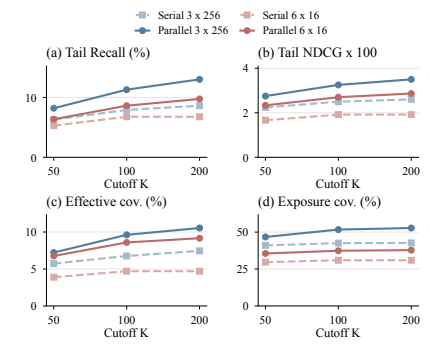
Figure 2 : Effect of SID construction on tail retrieval (Indus- trial; beam 20, exact matching). The nominal code space is identical:256 3 = 166. Dashed squares: serial; solid circles: par- allel. All four metrics are shown at𝐾=50,100,200.
Original paper · CC BY 4.0Parallel isolation is the property behind this result, and the authors prove it for the construction itself. Changing the quantizer at one position leaves the codes at every other position unchanged. The proof assumes a fixed quantizer and nearest-centroid assignment, so it describes the construction rather than a trained model. Sequential SIDs, by contrast, let a residual drift grow with depth and flip later assignments, as the authors show in their analysis of residual drift.
That drop narrows the head-to-tail NLL gap by 17.14%, which ties the theory back to the trained model.
The parallel advantage matters for the next question because exact matching still misses most tail targets. Parallel SIDs keep valid item signals at the remaining positions, which is what partial matching later exploits.
Partial matching recovers items exact matching drops
Exact matching accepts a candidate only when its full SID equals a decoded sequence, which is a strict test when every position must be right. The authors instead ask how many targets fall within a mismatch tolerance of at least one complete beam. Under exact matching, tail retrieval lags far behind head retrieval, and longer codes do worse than shorter ones.
Because parallel SIDs isolate errors, the decoded sequences still keep valid item signals at the remaining positions. At zero mismatches, head targets reach 41.32% and tail targets 9.75%. Allowing one to three mismatched positions lifts tail reachability to 41.56%, against 59.77% for head.
Many missed tail targets are close to a decoded beam, so the gap is not hopeless. Relaxing exact matching to partial matching over the same decoded beams raises tail Recall@200 from 9.75% to 20.39%. Reachability alone is not retrieval, so the authors also measure the items that partial matching returns. On Office, tail reachability at three mismatches rises from 6.18% to 39.80%.
Actual tail Recall@200 on Office rises from 6.18% to 17.63% under the same protocol.
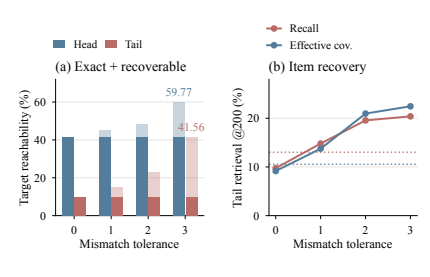
Figure 3 : Local evidence and item recovery (Industrial; fixed beam 20). (a) Fraction of targets within the mismatch toler- ance of a single complete beam: solid segments denote exact hits; pale segments show additional recoverable targets. (b) Tail Recall and effective coverage at 𝐾= 200after partial matching of parallel6 × 16SIDs. Dotted lines: parallel3 × 256 exact matching. Panel (a) measures candidate reachability; panel (b) measures ranked item retrieval.
Original paper · CC BY 4.0Partial matching has a limit, because relaxing the tolerance further brings diminishing returns and irrelevant noise. Even with three mismatched tokens, 58.4% of tail targets remain unreachable on Industrial. Beyond three mismatches the authors see diminishing returns and growing irrelevant noise, so they keep r at three. Matching cannot rescue targets whose whole tolerance neighborhood was already pruned during beam search.
That finding points the next question upstream, to why beam search loses tail prefixes.
Why beam search prunes tail prefixes first
Beam search drops tail prefixes long before the matching stage ever sees them. With parallel 6×16 SIDs and beam 20 on Industrial, 62.5% of tail targets leave the beam after two decoding steps. By the final step, exact-path failure reaches 90.2% for tail targets, against 58.7% for head targets.
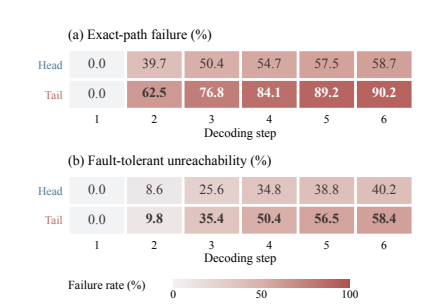
Figure 4 : Early beam-search failure on Industrial (parallel 6× 16, beam 20). (a) Exact-path failure: the target prefix has left the beam. (b) Fault-tolerant unreachability: no retained prefix admits a catalog-valid completion within three mis- matches of the target. Darker cells indicate higher failure. Final exact failure is 90.25% for tail versus 58.68% for head; 50.36% of tail targets are already unrecoverable by step 4.
Original paper · CC BY 4.0Partial matching looks like the obvious rescue, so Figure 4(b) relaxes the requirement to three mismatches. Even under this test, 58.4% of tail targets remain unreachable at the final step. Loosening the tolerance further brings diminishing returns and adds irrelevant noise, so a wider tolerance isn't the fix.
By step 4, 50.4% of tail targets have already lost every recoverable prefix in the beam. At the same step, 65.2% of head targets still keep at least one recoverable prefix. The tail loss happens before beam search finishes, so the matching stage never receives these targets.
Matching can only recover what the beam still holds, so the ceiling sits upstream in decoding. The authors therefore conclude that guided beam search must keep promising tail prefixes alive during decoding. ReSID answers this with a popularity-debiased and user-semantic-aware beam search.
Building long parallel SIDs
ReSID builds each item's Semantic ID by quantizing separate latent subspaces in parallel, not along a residual chain. An MLP encoder maps the item text embedding x_i to a latent vector z_i, which is split evenly into L subspaces. Each position ℓ owns its own codebook and assigns its subspace z_i^(ℓ) to the nearest codeword. The chosen codewords are concatenated into a reconstructed vector, so the item's code is the tuple of one index per position.
Because every position quantizes its own subspace, no position receives a residual from an earlier one.
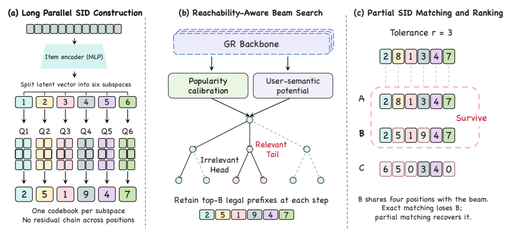
Figure 5 : Overview of the ReSID framework. (a) Long Parallel SID Construction: Item representations are partitioned into distinct subspaces and quantized by independent codebooks without cross-position residual chains. (b) Reachability-Aware Beam Search: Popularity calibration and user-semantic potential jointly guide step-wise prefix expansion to retain promising tail branches within the top-𝐵 legal prefixes. (c) Partial SID Matching and Ranking: Rather than requiring exact sequence matches, partial matching recovers candidate items that share sufficient position-wise tokens with the decoded beams.
Original paper · CC BY 4.0 · Muyu Zou, Shunye Tang, Yi Xu, Haibo Xing, Yandong Wang, Lingyu Mu, Jinxin Hu · ReSID: Rethinking Long-Tail Retrieval in Generative Recommendation through Item Reachability · Original paper figure · Extracted the figure area from page 5 of the original PDF.The authors contrast this with sequential SIDs, whose residual inputs carry upstream quantization shifts forward. A decoder reconstructs the item from the quantized vector, trained under standard reconstruction and commitment losses. The public benchmarks use L=6 with 16 codes per position, while In-house uses L=8 with 300 codes per position.
The parallel SID construction has a fixed isolation property: perturbing the quantizer at one position leaves the codes at all other positions unchanged. The authors use this property to argue that a local shift stays within its own subspace and never reaches other positions.
On top of these codes, ReSID trains a standard Transformer recommender with cross-entropy loss. The recommender encodes the user history H_u and predicts each code from the codes before it, P_θ(c_{i,ℓ} | H_u, c_{i,<ℓ}). Later, the decoding stage freezes this base recommender and adds guidance signals during beam search. That drop narrows the head-to-tail NLL gap by 17.14%, which supports the parallel design at the code level.
Guiding beam search toward tail prefixes
Head prefixes fill a narrow beam because popular codes receive much higher transition probabilities. ReSID estimates token priors \(\pi(v\mid p)\) from training frequencies and subtracts \(\lambda\log\pi(v\mid p)\) from the logits before softmax. With λ=0.5 the penalty lowers the scores of popular branches and leaves room for tail prefixes.
The user-semantic score asks how well a prefix fits the user's interest. For a prefix p, the score averages \(\exp(q_u^\top t_i/\tau)\) over the valid catalog items under that prefix and then takes the log: \(\Phi_u(p)=\log\bigl(\frac{1}{|I(p)|}\sum_{i\in I(p)}\exp(q_u^\top t_i/\tau)\bigr)\).
The two signals combine into one beam score: \(S_u(p\|v)=S_u(p)+\log\tilde P_\theta(v\mid H_u,p)+\beta[\Phi_u(p\|v)-\Phi_u(p)]\). The β term gives a bonus to a branch that raises the user match, and β is set to 0.4. The beam keeps the top B legal prefixes at each step, with B=20 on the public benchmarks and 100 on In-house. The authors note that these semantic scores can be cached for requests whose user state has not changed.
Partial matching and ranking
Standard generative retrieval keeps only items whose full SID matches a decoded sequence, so near misses get thrown away. ReSID replaces that exact check with partial SID matching under a mismatch tolerance r, which is set to 3 on every dataset. Because parallel SIDs isolate errors across positions, a decoded sequence with a wrong token can still carry correct tokens elsewhere.
Partial matching exploits that local agreement instead of discarding the whole sequence.
After L decoding steps, the beam holds B complete SID sequences. ReSID compares every catalog item against these B decoded sequences. It retrieves each item whose SID differs from at least one decoded sequence in at most r tokens. Then it ranks the retrieved candidates, putting those with fewer mismatched tokens first. Among candidates with the same mismatch count, the ones matched by higher-scoring beams rank higher.
This tie-break links the ranking back to the guided beam search, because the beam score carries the popularity calibration and user-semantic terms. Exact matching would have given a tail target no credit at all when its SID missed one position. The mismatch tolerance is a single knob, and the paper keeps it fixed rather than tuning it per dataset.
Overall and long-tail retrieval results
ReSID lifts long-tail retrieval over every baseline on the three datasets, and the gain is largest on In-house. On In-house, tail Recall@200 rises to 36.62, compared to 18.94 for Ghost, the strongest baseline on every long-tail column. Tail NDCG@200 goes from 0.0734 to 0.1464 on the same dataset. ReSID also attains the highest long-tail EffCov@200 on all datasets.
Overall accuracy stays competitive, even though the representative GR methods lead on overall metrics on the public datasets. On In-house, ReSID leads on every metric and raises overall R@200 from the strongest baseline's 37.65 to 48.28. The authors tie the public-dataset lead of the GR baselines to popularity skew, since long-tail items receive only 20–22% of training interactions.
ReSID reaches more items overall, with the highest overall EffCov and ExpCov, instead of concentrating on popular ones. The gain doesn't come from a larger search, since ReSID uses beam 20 against 200 on the public datasets. On In-house, ReSID runs with beam 100 against 300 for the baselines. The authors read this as evidence that the gains come from preserving and recovering relevant candidates.
All methods share the same lightweight encoder–decoder GR backbone, so the comparison isolates the SID scheme and long-tail mechanism.
Which component carries the gain
Removing partial matching hurts the most in the ablation on Industrial and Office. Without it, overall R@200 falls by 33.0% and tail R@200 falls by 66.1% relative to full ReSID. Tail ExpCov@200 also drops from 99.31% to 63.73%, so exact matching throws away a large share of useful SID evidence. Partial matching therefore accounts for the largest single share of the gain.
The two guided beam search signals each help tail retrieval, but by smaller margins. Removing popularity calibration cuts tail R@200 by 8.7%, while removing user-semantic alignment cuts it by 6.2%. Both removals also lower overall R@200 and EffCov@200, which the authors read as evidence that keeping tail candidates alive doesn't cost overall quality.
Swapping parallel SIDs for sequential SIDs of the same length is the third ablation. Tail R@200 falls by 17.3%, and tail EffCov@200 falls by 3.64 points.
Mechanism checks behind the gains
Partial matching supplies the largest share of tail hits, so the gains don't rest on a rare fallback path. On Industrial at K=200, partial matching contributes 51.26% of all tail hits, which is 183 out of 357. On Office the share reaches 66.09%, which is 191 out of 289 hits. Table 5 splits tail hits into Total Hits and Partial-Only Hits, and the partial share is listed for each cutoff.
The swap test keeps popularity calibration fixed and replaces each user's query vector with another user's. With the true user, tail R@200 is 21.22% on Industrial against 20.63% with a swapped user. On Office, the true user gives 20.54% tail R@200 against 18.41% with a swapped user. Both settings keep tail exposure near 99%, so the difference isn't explained by wider coverage.
The authors read the gap as user semantics keeping tail prefixes that fit the user's interest.
The authors next examine the decoding steps where every recoverable prefix of a tail target falls out of the top-20 beam. Single-step popularity calibration lets the dropped tail prefix overtake 1.31% to 3.86% of those in-beam rivals. Most of these rivals have higher popularity priors, at 83.53% to 95.45% on Industrial and 89.47% to 91.21% on Office.
Sensitivity to the three hyper-parameters
ReSID doesn't hinge on a fine-tuned setting for its three hyper-parameters, and the sweep in Figure 7 shows why. The authors vary λ, β and r one at a time on the Office validation set, holding the others at their defaults of λ=0.5, β=0.4 and r=3. For λ from 0.3 to 0.7 and β from 0.2 to 0.6, overall R@200 stays within 36.52 to 37.16. Over the same ranges, long-tail R@200 stays within 19.79 to 20.67.
Overall R@200 drops only marginally, from 37.16 to 36.52, as λ grows.
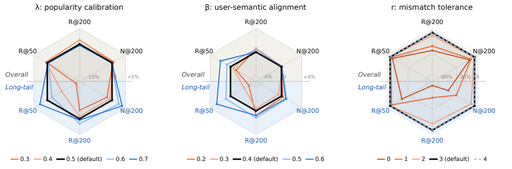
Figure 7 : Hyper-parameter analysis of ReSID on the Office validation set. Each spoke shows a metric relative to the default configuration (𝜆=0.5,𝛽=0.4,𝑟=3, in black), with all requests in the upper half and long-tail requests in the lower half. Values below and above the default are drawn in orange and blue, respectively.
Original paper · CC BY 4.0A larger β mostly helps the early cutoff, lifting R@50 from 27.60 to 28.46 on all requests. On long-tail requests, the same β change moves R@50 from 8.55 to 9.11. The mismatch tolerance r matters far more than the two guidance weights. Long-tail R@200 rises from 7.28 at r=0 to 18.45 at r=2, and then to 20.35 at r=3. At r=4 the results equal those at r=3, so the gain saturates.
Because the default r=3 sits at the saturation point, the authors don't need a larger tolerance to get the gain. The authors use one set of guidance and matching hyper-parameters on every dataset, with no per-dataset tuning. They conclude that this single setting is consistent with the lack of careful tuning across datasets. The sweep runs only on the Office validation set, so the stability on Industrial and In-house isn't shown here.
Serving cost: does a narrower beam cut latency and raise throughput?
On the public benchmarks, ReSID decodes with a beam width of 20, while every baseline uses a beam width of 200. Each method runs on an Apple M4 CPU in FP32 with identical thread settings, and every method returns 200 unique items. Timing covers history encoding, generation, beam-search guidance, partial matching and ranking.
Averaged over all datasets, the baselines incur 2.0 to 8.2 times the latency of ReSID. The same baselines achieve only 0.06 to 0.27 times ReSID's throughput. Ghost is the most expensive, which the authors attribute to the longer SIDs of its tail items. Popularity calibration and partial matching add no model parameters, because both are inference-time operations.
On In-house, ReSID's mean batch inference latency is 63.75 ms for batches of 512 requests on NVIDIA L20 GPUs. That batch figure covers encoder computation, complete beam-search decoding and matching. The 10.3 ms online figure comes from single-request serving in the C++/CUDA engine. In the online A/B test, ReSID's mean online response time is 10.3 ms.
Online A/B test results for ReSID
Each bucket received 15% of randomized traffic, so the two groups were sized the same way. The control group ran a TIGER-style generative retrieval system. The treatment group swapped in ReSID, while all other retrieval channels and downstream ranking stayed unchanged.
Long-tail items were labeled with the same offline cumulative-click rule used in the offline experiments. Compared to the control, ReSID raised advertising revenue by 1.3%, CTR by 1.1%, and GMV by 0.8%. Long-tail exposure share rose by 4.0% in the same comparison. The authors report all these differences as significant at p < 0.05 in a two-sided test.
The online gains match the offline direction, where ReSID led on long-tail metrics and coverage against the TIGER baseline. Online, ReSID's gains come from a retrieval channel that serves the main user traffic. The mean online response time was 10.3 ms, which the authors report alongside the gains.
The conclusion summarizes these offline and online results as evidence for the effectiveness and efficiency of ReSID. The paper reports the A/B test as one deployment result, not as a separate long-term study.
What the experiments leave out
Most of the controlled bottleneck analyses run on Industrial, and the Office versions sit in the appendix. The Office repeats use seed 42 and beam 20, and the paper didn't test other seeds or beam widths there. The online A/B test covers one advertising platform, running from July 1 to July 12, 2026.
The Appendix D bias argument rests on Assumption D.2, which the authors state as an assumption rather than verify for trained models. The proofs take the head-aligned codeword shifts as given, so the bias account depends on that premise holding.
The public-data efficiency numbers come from an Apple M4 CPU in FP32, with the same 64 requests repeated for three rounds. The In-house timing uses an NVIDIA L20 in BF16 with batch size 512 and history length 128, a different setup from the CPU runs. On the public datasets, ReSID uses 6 positions with 16 codes and beam 20, while baselines use beam 200.
On In-house, ReSID uses 8 positions with 300 codes and beam 100, against beam 300 for the baselines.
The guidance and matching settings, λ=0.5, β=0.4 and r=3, stay fixed across all datasets. The authors didn't tune these per dataset, so per-dataset optima aren't reported. The sensitivity sweeps run on the Office validation set rather than on Industrial or In-house.
Paper info
- Authors
- Muyu Zou, Shunye Tang, Yi Xu, Haibo Xing, Yandong Wang, Lingyu Mu, Jinxin Hu
- Venue
- arXiv · Preprint
- First published
- 2026-11-12
- Added
- 2026-11-13
- Updated
- 2026-11-12
- Version
- v1
- arXiv
- 2611.16404
- Category
- cs.IR
- Original paper terms
- CC BY 4.0
- What we show
- Paper info, commentary and permitted figures from the original paper
AI commentary is a separate explanation from the original paper and may contain errors. The original paper and figures follow each source's terms of use and any rights noted separately.
Abstract
Generative recommendation (GR) represents items with discrete Semantic IDs (SIDs) and casts retrieval as sequence generation. Under skewed interaction distributions and tight serving budgets, GR struggles to retrieve long-tail items. In this work, we are the first to study long-tail reachability across the complete pipeline of SID construction, decoding, and matching. We find that under equal code lengths, parallel SID construction consistently outperforms sequential SIDs on tail items. Moreover, even when full generation fails, decoded sequences carry locally consistent information that retrieves relevant tail items via partial matching. Yet this recovery is bounded by upstream search, failing once beam search prunes all prefixes completable within a fixed mismatch tolerance. Motivated by these findings, we propose ReSID to jointly preserve and recover tail candidates. Built on long parallel SIDs, ReSID pairs popularity-debiased and user-semantic-aware beam search to keep promising paths alive with partial SID matching to recover items from surviving tokens. ReSID achieves state-of-the-art long-tail retrieval while maintaining competitive overall accuracy, with lower latency and higher throughput under narrow beams. ReSID is deployed in our production system, serving main user traffic with substantial business gains. We release our complete code and model checkpoints to support full reproducibility and real-world deployment at https://github.com/Gabriel-reina/ReSID.
Quote from the paper
Muyu Zou, Shunye Tang, Yi Xu, Haibo Xing, Yandong Wang, Lingyu Mu, Jinxin Hu (2026). ReSID: Rethinking Long-Tail Retrieval in Generative Recommendation through Item Reachability. arXiv:2611.16404v1. https://arxiv.org/abs/2611.16404v1
BibTeX
@misc{zou2026resid,
  title = {{ReSID: Rethinking Long-Tail Retrieval in Generative Recommendation through Item Reachability}},
  author = {Muyu Zou and Shunye Tang and Yi Xu and Haibo Xing and Yandong Wang and Lingyu Mu and Jinxin Hu},
  year = {2026},
  eprint = {2611.16404},
  archivePrefix = {arXiv},
  url = {https://arxiv.org/abs/2611.16404v1}
}