Paper commentary
Geometry-Informed Neural Networks
Neural fields can generate diverse shapes from design constraints without any training data
- Problem Shape generators usually need large datasets of example shapes, which geometry and engineering rarely have. Without data, a generator trained on constraints alone tends to collapse onto just a few shapes.
- Method GINNs train shape-generating neural fields using only design objectives and constraints. They add a diversity constraint on a batch of shapes, so the generator returns many different solutions instead of one.
- Results On the obstacle task, the diversity constraint was needed to avoid mode-collapse, as shown by 16 superposed solutions with and without it.
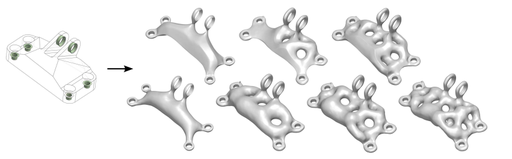
Figure 1 : We train geometry-informed neural networks to produce shapes satisfying geometric design requirements. For example, we generate parts that connect the cylindrical interfaces within the sketched design region depicted on the left. To highlight the user’s control over the problemand the solutions, we specify different additional requirements on the number of holes and surface smoothness. By complementing the design requirements with a diversity constraint, we can train a shape-generative model without data as further illustrated in Figures 3, 5 and 6.
Original paper · CC BY 4.0 · Arturs Berzins, Andreas Radler, Eric Volkmann, Sebastian Sanokowski, Sepp Hochreiter, Johannes Brandstetter · Geometry-Informed Neural Networks · Original paper figure · Extracted the figure area from page 2 of the original PDF.The data gap in shape design
Deep learning works well where data is abundant, but geometry, design, engineering and physics often lack large datasets. That scarcity blocks supervised shape generators, which need many example shapes to learn from. Formal problem descriptions, such as objectives and constraints, can stand in for data in these disciplines. Previous works for PDEs, molecular science, and combinatorial optimization show that such descriptions can suffice to train models without any data.
The existing data-free methods don't carry over directly to shapes. Boltzmann generators avoid mode-collapse with an entropy-regularizing term, which presupposes invertibility. Because of that invertibility requirement, Boltzmann generators don't apply to function spaces. PINNs can also suffer from ill numerical properties, since they minimize the squared residual of the strong form.
Many geometric problems have several good answers, and optimizing one shape directly misses the alternatives.
A neural field as the shape, plus a diversity constraint
A GINN represents each shape as a neural field, and the field is trained on design requirements alone. The sign of the field implicitly defines the shape, and the boundary is the set where the field equals zero. The authors use a neural network with parameters θ to represent this implicit function, chosen for memory efficiency, continuity, and differentiability.
Because the field is smooth, each geometric requirement can be rewritten as a differentiable constraint violation. Table 1 gives examples such as the design region, the interface, and the prescribed normal, each with its own constraint violation.
The authors also require the field to approximate the signed-distance function of the shape. This removes much of the ambiguity of implicit functions that describe the same geometry. The signed-distance property also helps compute persistent homology, surface point samples, and diversity. The eikonal constraint is treated like the other geometric constraints during training.
A generator trained only on constraints tends to produce just a few shapes, so the authors add a diversity constraint on the solution set. Without data, the diversity of the generator can't come from a training set, so the authors add it as a constraint.
Each constraint violation and the objective become expected values over the latent distribution pZ. Diversity is measured with a minimal aggregation measure over pairwise distances between shapes. The distance uses only the integrals over the shape boundaries, which partly reduces the globality of the L2 distance between SDFs. Training then becomes a constrained problem, handled as unconstrained problems with the augmented Lagrangian method.
How one training step works
A generator G maps a latent variable z to a function f, so the solution set is the image of the latent distribution. The generator is a modulated base network, which gives a conditional neural field f(x) = F(x; z). Each constraint violation and the objective are averaged over samples of z, so the training acts on the whole generator rather than on one shape.
Diversity is computed on a batch of k i.i.d. sampled shapes, because the minimal aggregation is only defined for finite sets. For each shape, the method finds the smallest distance to any other shape in the batch. It then aggregates these values with a square root and a square, which gives the minimal aggregation measure. This choice is motivated by a concavity property that favours uniform coverage of the available space.
The pairwise distance integrates one shape's squared function over the other shape's boundary, which is close to a chamfer discrepancy. The authors note that this distance is not a metric on functions, but it does compare the geometries they represent.
The constrained problem is solved with an adaptive augmented Lagrangian method, which adds weighted constraint terms and quadratic penalties. The multipliers and penalty parameters update during training, so no weight has to be hand-tuned for each loss. The method works best when the losses are on a similar scale. Connectedness and hole count come from persistent homology on a cubical complex of the implicit function.
Smoothness is an integral of a curvature expression over the surface, and the bracket uses the surface-strain, the sum of the squares of the two principal curvatures.
Obstacle task: diversity against mode-collapse
The obstacle task asks for shapes that connect two vertical interfaces in a rectangular design region around a circular obstacle. The interfaces carry prescribed outward-facing normals, and each shape must avoid the obstacle while connecting them. Because this problem admits infinitely many solutions, a generator should return a spread of shapes rather than one.
With the generative softplus-MLP and a one-dimensional latent space, the naive model mode-collapses. The additional diversity constraint mitigates this collapse, as Figure 5c illustrates.
The authors show a superposition of 16 solutions, trained once with the diversity loss and once without it. Without the diversity loss the superposition appears at the top of the figure, and with it at the bottom. They state that the diversity loss is required to avoid mode-collapse in this setup. The diversity term uses the minimal aggregation measure, whose concavity promotes uniform coverage of the available space.
The constraint is applied as a hinge on the batch diversity, so it only penalizes diversity that falls below the threshold.
The figure covers one task and one softplus-MLP setup, so it doesn't show the effect for every generator or problem. A larger threshold δ̄ gives a more pronounced organization, but over-specifying it impedes convergence.
Latent structure and generalization from diversity
With the diversity constraint, the GINN produces more than several solutions, and the authors also observe a latent space structure. For the bracket, the model uses a two-dimensional latent space, and k = 9 random samples are drawn from it every training iteration. Traversing this latent space gives continuously morphing feasible shapes, which the authors read as generalization.
The authors also state that the same pattern appears in all four experiments that include the diversity constraint.
The wheels task uses the domain X = [-1, 1]^2 and a ring-shaped design region with 0.22 ≤ x1^2 + x2^2 ≤ 0.82. The interface is the boundary of this ring, and a soft 5-fold cyclic symmetry constraint is added. The symmetry constraint samples a point, rotates it by 2/5 π four times, and minimizes the variance of the implicit function at these five points.
Alternatively, the authors note that exact symmetry can be imposed with a periodic encoding of the input. Traversing the two-dimensional latent space of the discovered wheel shapes gives the structured layout shown in Figure 5d. A larger version of this wheel latent space is available in Figure 7.
The authors also compare neural field models, and the choice of model affects which latent shapes the generator can produce. Figure 8 shows that WIRE outperforms softplus-MLP and SIREN, which the authors attribute to their spectral behavior. They don't claim the latent structure holds for every model, since the comparison was made visually.
Breadth of tasks and the bracket formulation
The generative PINN targets an under-determined PDE, which tests whether the diversity idea reaches beyond geometry. Because this system has infinitely many solutions, Figure 4 shows Turing patterns that morph during latent space interpolation.
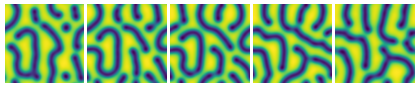
Figure 4 : A generative PINN producing Turing patterns that morph during latent space interpolation. This is a result of searching for diverse solutions to an under-determined PDE.
Original paper · CC BY 4.0Plateau's problem seeks a minimal-area surface M for a prescribed boundary Γ, and its constraints require zero mean curvature κH on M. The authors use the implicit representation for simplicity, and the result in Figure 5a approximates the known solution. The parabolic mirror switches to an explicit height function f on [−1, 1] with the interface constraint f(0) = 0.
Its reflected rays must intersect at the focal point (0, 1), so the learned curve approximates a parabolic mirror, as Figure 5b shows.
The obstacle task connects two vertical interfaces in a 2D rectangular design region while avoiding a circular obstacle. A naive generative softplus-MLP with dim(z) = 1 mode-collapses there, and the diversity constraint in Figure 5c mitigates it. The wheels task uses a ring-shaped design region with 0.22 ≤ x1^2 + x2^2 ≤ 0.82 and a 5-fold cyclic symmetry constraint.
The authors enforce this symmetry softly by rotating a sampled point and minimizing the variance of f at five points.
The jet engine bracket fills a freeform design region and attaches to five cylindrical interfaces. Instead of minimizing volume under a linear elasticity PDE, the authors minimize the surface-strain E subject to connectedness. Keeping a PDE solver out of the training loop is left to a follow-up work, and all resulting shapes stay smooth and singly connected.
Runtime and optimization cost
A single bracket shape needs roughly 10K iterations, which takes about 30 minutes. The diverse model costs more, running for around 50K iterations or 5 hours on one GPU. Adaptive ALM balances up to seven loss terms automatically, but the variance in several losses stays high.
The diversity and smoothness terms are the hardest to optimize. Curvature is a second-order differential operator, so the authors expect it to be ill-conditioned. They point to second-order optimizers as a route forward, citing Ryck et al. (2024) and Rathore et al. (2024).
The persistent homology solver takes 75% of the total time, because it runs as an expensive multi-processed CPU task. The surface strain takes roughly 10% of the time, mostly because of the Hessian it requires. Surface point sampling usually takes 15% of the total time. Dropping the eikonal constraint makes training slower, since the implicit function loses its geometric regularity and sampling gets harder.
The eikonal constraint also has a strong effect on the connectedness, smoothness, and diversity metrics. Appendix C.3 gives more runtime details, and Appendix C.2 reports the ablations of each constraint and of ALM.
Network choice and ablations
The GINN experiments compare three neural field models that differ mainly in their activation function: softplus-MLP, SIREN and WIRE. Every model needs well-defined, non-vanishing first and second derivatives, because the iso-level normals and curvatures are computed from them. In a visual comparison, WIRE gives better results than softplus-MLP and SIREN.
The authors attribute this advantage to the spectral behavior of WIRE. Input concatenation serves as the conditioning mechanism for all of these models.
The eikonal constraint pushes the scalar field toward the distance field property, so the implicit function approximates the signed-distance function. The GINN treats this eikonal constraint the same way as its geometric constraints during training. Removing the eikonal constraint strongly affects the connectedness, smoothness and diversity metrics, because the implicit function loses its geometric regularity.
Without the constraint, the runtime also increases. Surface point sampling, which usually takes 15% of total time, becomes less efficient. The authors' surface sampling strategy gives lower variance of the losses and better convergence than a naive strategy.
Across the bracket variations, the same setup and hyperparameters are used for every run. The authors present this as evidence of the robustness of GINNs and of the adaptive ALM approach. Figure 3 shows how the design requirements add up step by step, from the design region to the diversity constraint. The ablations of each constraint and of ALM are reported in Appendix C.2.

Figure 3 : The user can define geometric problems and solve them using the GINN framework. Here, we illustrate the results of progressively adding more design requirements, overall resulting in a shape generative model trained without data.
Original paper · CC BY 4.0Limitations and open questions
The bracket task is a modified version of the engineering design challenge that the authors took from a GE and GrabCAD competition. Instead of minimizing volume under a linear elasticity PDE constraint, GINNs minimize surface smoothness under a connectedness constraint. Because no PDE solver sits in the training loop, the GINN results aren't compared with established topology-optimization methods.
The authors defer that PDE solver integration to a follow-up work.
The authors studied GINNs only in the limit of no data. They note that GINNs could also integrate partial observations of one or several shapes, which they leave for later. The diversity measure is computed on batches of k i.i.d. sampled shapes, because Equation 2 is only well-defined for finite sets. Diversity on infinite sets, especially with manifold structure, is left to future research.
The shape distance isn't a metric on functions, but it tracks the geometries those functions represent. So the diversity measure isn't a metric on the solution space, and the authors accept that because they care about the shapes.
The diversity and smoothness terms are hard to optimize. Several losses keep high variance, even though adaptive ALM balances up to seven loss terms. Curvature is a second-order differential operator, so the authors expect ill-conditioning and point to second-order optimizers.
Paper info
- Authors
- Arturs Berzins, Andreas Radler, Eric Volkmann, Sebastian Sanokowski, Sepp Hochreiter, Johannes Brandstetter
- Venue
- arXiv · Preprint
- First published
- 2024-2-21
- Added
- 2026-10-31
- Updated
- 2025-7-18
- Version
- v4
- arXiv
- 2402.14009
- Category
- cs.LG · cs.CV
- Original paper terms
- CC BY 4.0
- What we show
- Paper info, commentary and permitted figures from the original paper
AI commentary is a separate explanation from the original paper and may contain errors. The original paper and figures follow each source's terms of use and any rights noted separately.
Abstract
Geometry is a ubiquitous tool in computer graphics, design, and engineering. However, the lack of large shape datasets limits the application of state-of-the-art supervised learning methods and motivates the exploration of alternative learning strategies. To this end, we introduce geometry-informed neural networks (GINNs) -- a framework for training shape-generative neural fields without data by leveraging user-specified design requirements in the form of objectives and constraints. By adding diversity as an explicit constraint, GINNs avoid mode-collapse and can generate multiple diverse solutions, often required in geometry tasks. Experimentally, we apply GINNs to several problems spanning physics, geometry, and engineering design, showing control over geometrical and topological properties, such as surface smoothness or the number of holes. These results demonstrate the potential of training shape-generative models without data, paving the way for new generative design approaches without large datasets.
Quote from the paper
Arturs Berzins, Andreas Radler, Eric Volkmann, Sebastian Sanokowski, Sepp Hochreiter, Johannes Brandstetter (2024). Geometry-Informed Neural Networks. arXiv:2402.14009v4. https://arxiv.org/abs/2402.14009v4
BibTeX
@misc{berzins2024geometry,
  title = {{Geometry-Informed Neural Networks}},
  author = {Arturs Berzins and Andreas Radler and Eric Volkmann and Sebastian Sanokowski and Sepp Hochreiter and Johannes Brandstetter},
  year = {2024},
  eprint = {2402.14009},
  archivePrefix = {arXiv},
  url = {https://arxiv.org/abs/2402.14009v4}
}