논문 해설
Geometry-Informed Neural Networks
기하 정보를 반영한 신경망
- 연구 문제 데이터가 부족한 형상 설계 영역에서 설계 목적과 제약만으로 형상 생성 신경장을 학습할 수 있는지 묻습니다.
- 연구 방법 형상을 부호거리 성격의 신경장으로 표현하고, 기하·위상 제약을 미분 가능한 손실로 바꾸어 적응형 증강 라그랑주 방법으로 학습합니다. 다양성 제약을 추가하여 여러 해를 얻습니다.
- 주요 결과 장애물 문제에서 다양성 제약이 모드 붕괴를 완화했고, 잠재공간 순회로 연속적으로 변하는 형상을 얻었다고 보고됩니다. 반응-확산 계와 Plateau 문제에서도 생성 결과를 보였습니다.
데이터 없이 형상을 학습하려는 이유
형상 생성 모델은 보통 대량의 형상 데이터셋으로 학습합니다. 그러나 3차원 컴퓨터 그래픽, 설계, 공학, 물리 분야에서는 대규모 형상 데이터셋이 드뭅니다. 이 논문은 데이터 없이 설계 목적과 제약만으로 형상 생성용 신경장을 학습할 수 있는지를 묻습니다. 이를 위해 기하 정보 신경망인 GINNs를 제안합니다. GINNs는 사용자가 정한 목적 함수와 제약 조건을 미분 가능한 손실로 바꾸어 신경장을 훈련합니다. 저자들은 PINNs와 유사한 구조이지만 미분, 적분, 기하, 위상 제약을 함께 다룬다는 점을 차별점으로 제시합니다. 또한 설계 문제에는 같은 조건을 만족하는 여러 해가 존재하는 경우가 많으므로, 해 집합의 다양성을 명시적 제약으로 추가하는 것을 핵심 변경점으로 삼습니다.
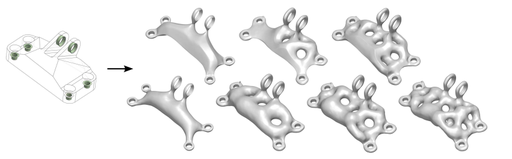
Figure 1 : We train geometry-informed neural networks to produce shapes satisfying geometric design requirements. For example, we generate parts that connect the cylindrical interfaces within the sketched design region depicted on the left. To highlight the user’s control over the problemand the solutions, we specify different additional requirements on the number of holes and surface smoothness. By complementing the design requirements with a diversity constraint, we can train a shape-generative model without data as further illustrated in Figures 3, 5 and 6.
원문 · CC BY 4.0 · Arturs Berzins, Andreas Radler, Eric Volkmann, Sebastian Sanokowski, Sepp Hochreiter, Johannes Brandstetter · Geometry-Informed Neural Networks · 원문 그림 인용 · 원본 PDF 2쪽에서 그림 영역을 추출했습니다.제약을 신경장 손실로 바꾸는 방식
GINNs는 형상을 부호 있는 스칼라 함수 f로 표현합니다. 함수의 부호로 형상 영역과 경계가 정의되며, 이 함수는 부호거리함수에 근사하도록 eikonal 제약으로 함께 학습됩니다. 설계 영역, 인터페이스, 법선 조건은 f에 대한 제약 위반량 c_i(f)로 바뀌어 손실에 들어갑니다. 연결성과 위상은 영속 호몰로지로 계산한 결과를 이용해 미분 가능한 잔차로 바꿉니다. 여러 제약의 강도를 수동으로 맞추지 않기 위해 적응형 증강 라그랑주 방법을 사용합니다. 이 방법은 제약마다 벌점 매개변수와 라그랑주 승수를 갱신하며, 저자들은 손실들의 규모가 비슷할 때 가장 잘 작동한다고 설명합니다. 다양성은 배치의 형상 쌍 거리를 최소 집계 측도로 모아 정의합니다.
이 집계 측도는 각 해에서 가장 가까운 다른 해까지의 거리를 기준으로 하므로, 한 쌍씩 떨어진 해들이 고르게 퍼지도록 유도합니다.

Figure 3 : The user can define geometric problems and solve them using the GINN framework. Here, we illustrate the results of progressively adding more design requirements, overall resulting in a shape generative model trained without data.
원문 · CC BY 4.0 · Arturs Berzins, Andreas Radler, Eric Volkmann, Sebastian Sanokowski, Sepp Hochreiter, Johannes Brandstetter · Geometry-Informed Neural Networks · 원문 그림 인용 · 원본 PDF 5쪽에서 그림 영역을 추출했습니다.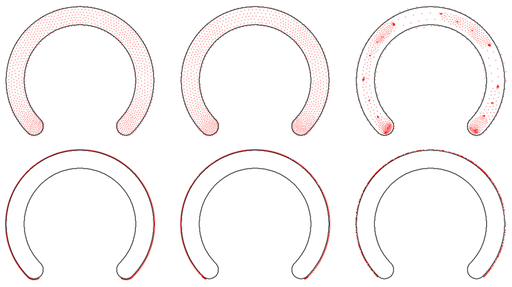
Figure 13 : A visual comparison of different diversity losses in a simple 2D example (F = R 2 and the feasible set K is the partial annulus). Each point f ∈ F represents a candidate solution. The points are optimized to maximize the diversity within the feasible set. The top row shows the minimal aggregation δmin as defined in Equation 26. The bottom row shows the total aggregation δsum as defined in Equation 27. Each column uses a different exponent p ∈ {0.5, 1, 2}. For 0 ≤ p ≤ 1 the minimal aggregation diversity δmin is concave meaning it favors increasing smaller distances over larger distances. This leads to a uniform coverage of the feasible set. In contrast, the δmin is convex for p ≥ 1 as indicated by the formed clusters for p = 2. Meanwhile, δsum pushes the points to the boundary of the feasible set for all p.
원문 · CC BY 4.0 · Arturs Berzins, Andreas Radler, Eric Volkmann, Sebastian Sanokowski, Sepp Hochreiter, Johannes Brandstetter · Geometry-Informed Neural Networks · 원문 그림 인용 · 원본 PDF 28쪽에서 그림 영역을 추출했습니다.다양성 제약과 잠재공간 생성
생성기는 잠재 변수 z를 입력받아 조건부 신경장 f(x)=F(x;z)를 만듭니다. 학습 중에는 배치마다 여러 z를 샘플링하여 해 집합을 만들고, 그 집합의 다양성을 제약으로 둡니다. 원문은 다양성 제약이 없으면 단순한 생성 모델이 모드 붕괴를 보인다고 설명하며, 이를 완화하기 위해 다양성 제약을 추가합니다. 학습이 끝난 뒤에는 2차원 잠재공간을 순회하여 연속적으로 변하는 형상을 얻을 수 있습니다. 저자들은 이 구조화된 잠재공간이 학습 데이터 없이도 일반화하는 형상을 준다고 해석합니다. 이 해석은 제트 엔진 브래킷 실험처럼 특정 설정에서 관찰된 결과에 근거합니다.
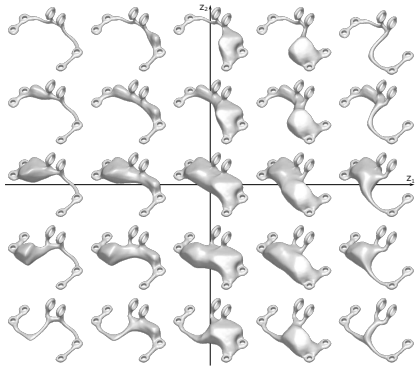
Figure 6 : With the diversity constraint, GINNs not only produce multiple solutions but also discover a latent space structure. Traversing the 2D latent space morphs solutions, i.e., the model generalizes. The latent space is also orga- nized – a central bulky shape becomes thinner in the radial direction, and the axes can be identified by how the shape connects on the sides. Figure 9 shows a large 9 × 9 version.
원문 · CC BY 4.0 · Arturs Berzins, Andreas Radler, Eric Volkmann, Sebastian Sanokowski, Sepp Hochreiter, Johannes Brandstetter · Geometry-Informed Neural Networks · 원문 그림 인용 · 원본 PDF 8쪽에서 그림 영역을 추출했습니다.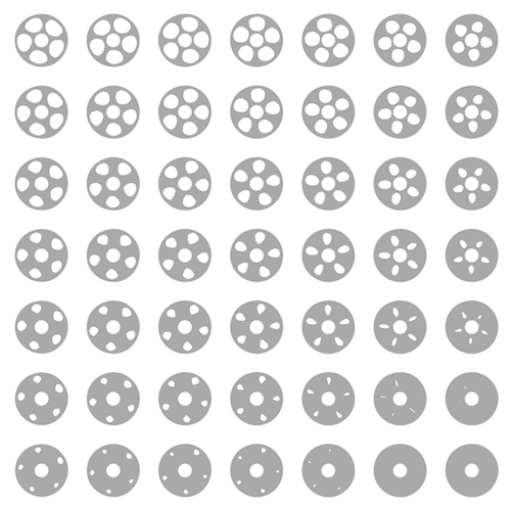
Figure 7 : GINNs produce diverse shapes with a structured latent space. The shapes morph continuously into one another when traversing the 2D latent space. From the top-left to bottom-right, the holes become smaller, while from bottom-left to top-right, the holes move inwards.
원문 · CC BY 4.0 · Arturs Berzins, Andreas Radler, Eric Volkmann, Sebastian Sanokowski, Sepp Hochreiter, Johannes Brandstetter · Geometry-Informed Neural Networks · 원문 그림 인용 · 원본 PDF 16쪽에서 그림 영역을 추출했습니다.검증 과제와 평가 범위
저자들은 반응-확산 계, Plateau 문제, 포물선 거울, 장애물, 바퀴, 제트 엔진 브래킷을 다룹니다. 반응-확산 실험에서는 두 개의 동일한 SIREN 네트워크를 u와 v 장에 사용하고 주기 경계 조건을 강제했습니다. 이 실험은 초기 조건 없이 정상 상태 잔차만으로 학습하며, 결과는 연속적으로 변하는 Turing 패턴입니다. Plateau 문제는 MLP와 tanh 활성화로 학습했고 알려진 최소 곡면 해를 근사한다고 보고됩니다. 장애물 문제에서는 단순 softplus-MLP가 모드 붕괴를 보였고 다양성 제약이 이를 완화했다고 보고됩니다. 브래킷 실험에서는 WIRE 네트워크가 softplus-MLP와 SIREN보다 좋은 결과를 보였다고 보고됩니다.
이 비교는 WIRE 3 × 128 구조와 ω0 = 18, s0 = 6 고정값을 사용한 설정에 한정됩니다.
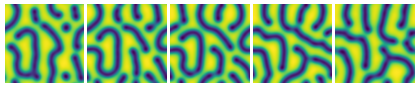
Figure 4 : A generative PINN producing Turing patterns that morph during latent space interpolation. This is a result of searching for diverse solutions to an under-determined PDE.
원문 · CC BY 4.0 · Arturs Berzins, Andreas Radler, Eric Volkmann, Sebastian Sanokowski, Sepp Hochreiter, Johannes Brandstetter · Geometry-Informed Neural Networks · 원문 그림 인용 · 원본 PDF 7쪽에서 그림 영역을 추출했습니다.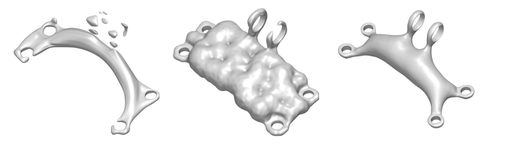
Figure 8 : Comparison of architectures trained for 10k epochs to produce a single shape. From left to right: softplus-MLP, SIREN, WIRE. The softplus-MLP is unable to fit the interfaces due to the low-frequency bias. SIREN converges much slower than WIRE, especially at the interfaces, and does not produce a smooth shape.
원문 · CC BY 4.0 · Arturs Berzins, Andreas Radler, Eric Volkmann, Sebastian Sanokowski, Sepp Hochreiter, Johannes Brandstetter · Geometry-Informed Neural Networks · 원문 그림 인용 · 원본 PDF 17쪽에서 그림 영역을 추출했습니다.절제 실험과 다양성 측정
절제 실험에서 eikonal 제약을 제거하면 연결성, 평활도, 다양성 지표가 크게 달라진다고 보고됩니다. 이는 eikonal 제약이 암시적 함수의 기하 정규성을 유지한다는 저자들의 해석과 함께 읽어야 합니다. 다양성은 δmean으로 측정합니다. 이 지표는 여러 형상 쌍의 CD2 거리로부터 계산됩니다. 2차원 잠재공간에서 샘플한 GINN 형상 집합의 다양도는 0.167이고 simJEB 데이터셋의 196개 샘플은 0.099라고 보고됩니다. 저자들은 두 집합이 서로 다른 목표를 최적화하므로 직접 비교가 어렵다고 밝힙니다. 실행 시간은 단일 브래킷 형상이 약 10K 반복 또는 30분, 다양성 모델이 약 50K 반복 또는 5시간이라고 보고됩니다.
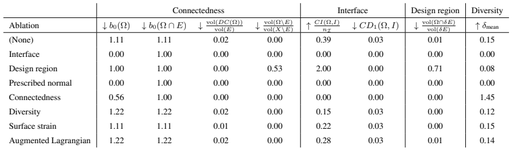
Table 3 : Metrics for the ablations of the obstacle problem for multiple shape solutions.
원문 · CC BY 4.0 · Arturs Berzins, Andreas Radler, Eric Volkmann, Sebastian Sanokowski, Sepp Hochreiter, Johannes Brandstetter · Geometry-Informed Neural Networks · 원문 그림 인용 · 원본 PDF 19쪽에서 그림 영역을 추출했습니다.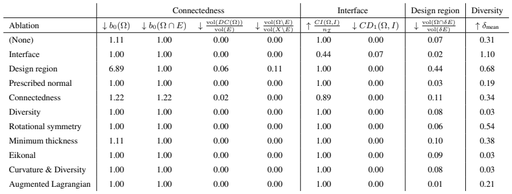
Table 4 : Metrics for the ablations of the wheel problem for multiple shape solutions.
원문 · CC BY 4.0 · Arturs Berzins, Andreas Radler, Eric Volkmann, Sebastian Sanokowski, Sepp Hochreiter, Johannes Brandstetter · Geometry-Informed Neural Networks · 원문 그림 인용 · 원본 PDF 20쪽에서 그림 영역을 추출했습니다.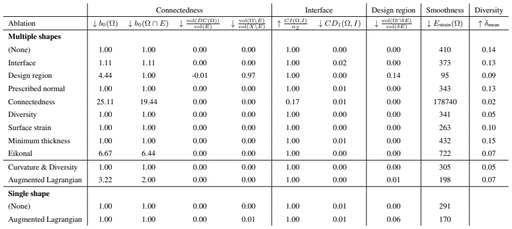
Table 5 : Metrics for ablations of the jet engine bracket problem for single and multiple shape solutions.
원문 · CC BY 4.0 · Arturs Berzins, Andreas Radler, Eric Volkmann, Sebastian Sanokowski, Sepp Hochreiter, Johannes Brandstetter · Geometry-Informed Neural Networks · 원문 그림 인용 · 원본 PDF 20쪽에서 그림 영역을 추출했습니다.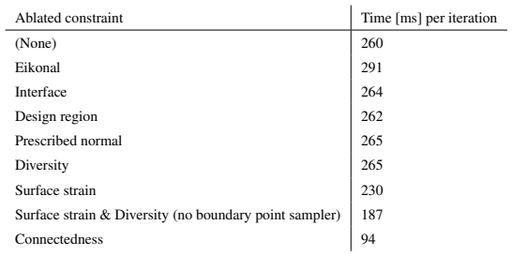
Table 6 : Time per iteration when ablating each constraint. Largest differences from the baseline (None) indicate compu- tationally expensive components of the method, most notably the connectedness constraint (due to the CPU-based PH calculation) and the boundary sampler required for calculating both the diversity and surface-strain.
원문 · CC BY 4.0 · Arturs Berzins, Andreas Radler, Eric Volkmann, Sebastian Sanokowski, Sepp Hochreiter, Johannes Brandstetter · Geometry-Informed Neural Networks · 원문 그림 인용 · 원본 PDF 21쪽에서 그림 영역을 추출했습니다.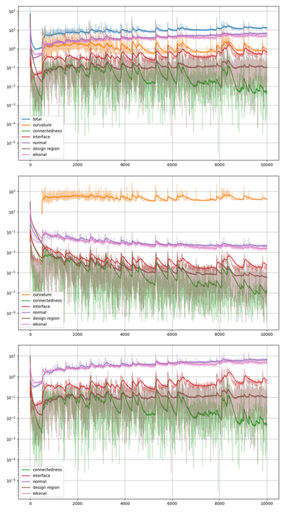
Figure 11 : Loss plots for training a single shape of the bracket problem. The solid lines are exponential-moving averages (factor 0.99) of the noisy values in lighter colors. (a) The losses used for backpropagation. (b) The unweighted losses of each constraint. (c) The λ values of each constraint.
원문 · CC BY 4.0 · Arturs Berzins, Andreas Radler, Eric Volkmann, Sebastian Sanokowski, Sepp Hochreiter, Johannes Brandstetter · Geometry-Informed Neural Networks · 원문 그림 인용 · 원본 PDF 25쪽에서 그림 영역을 추출했습니다.범위와 한계
이 연구는 데이터 없는 설정에 집중하며, 기존 위상 최적화 방법과 본문에서 직접 비교하지 않았다고 밝힙니다. 브래킷 과제는 체적 최소화와 선형 탄성 PDE 제약 대신 표면 평활도 최소화와 연결성 제약을 쓰는 수정된 설정입니다. 따라서 이 결과를 원래 설계 과제의 성능으로 바로 옮길 수는 없습니다. 저자들은 데이터 없는 접근의 응용을 과학 및 공학 설계에 한정된다고 논의합니다. 또한 평활도와 다양성 항은 최적화가 어려워 반복 수를 늘린다고 보고됩니다.
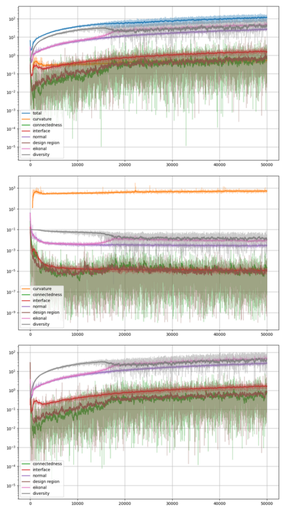
Figure 12 : Loss plots for training multiple shapes of the bracket problem. The solid lines are exponential-moving averages (factor 0.99) of the noisy values in lighter colors. (a) The losses used for backpropagation. (b) The unweighted losses of each constraint. (c) The λ values of each constraint.
원문 · CC BY 4.0 · Arturs Berzins, Andreas Radler, Eric Volkmann, Sebastian Sanokowski, Sepp Hochreiter, Johannes Brandstetter · Geometry-Informed Neural Networks · 원문 그림 인용 · 원본 PDF 26쪽에서 그림 영역을 추출했습니다.논문 정보
- 저자
- Arturs Berzins, Andreas Radler, Eric Volkmann, Sebastian Sanokowski, Sepp Hochreiter, Johannes Brandstetter
- 학회·저널
- arXiv · 프리프린트
- 최초 공개일
- 2024년 2월 21일
- 등록일
- 2026년 10월 31일
- 수정일
- 2025년 7월 18일
- 버전
- v4
- arXiv
- 2402.14009
- 분류
- cs.LG · cs.CV
- 원문 이용 조건
- CC BY 4.0
- 제공 범위
- 논문 정보, 해설, 허용된 원문 그림
AI 해설은 논문 원문과 별개의 설명이며 오류가 있을 수 있습니다. 원문과 그림은 각 출처의 이용 조건과 따로 표시된 권리를 따릅니다.
초록
Geometry is a ubiquitous tool in computer graphics, design, and engineering. However, the lack of large shape datasets limits the application of state-of-the-art supervised learning methods and motivates the exploration of alternative learning strategies. To this end, we introduce geometry-informed neural networks (GINNs) -- a framework for training shape-generative neural fields without data by leveraging user-specified design requirements in the form of objectives and constraints. By adding diversity as an explicit constraint, GINNs avoid mode-collapse and can generate multiple diverse solutions, often required in geometry tasks. Experimentally, we apply GINNs to several problems spanning physics, geometry, and engineering design, showing control over geometrical and topological properties, such as surface smoothness or the number of holes. These results demonstrate the potential of training shape-generative models without data, paving the way for new generative design approaches without large datasets.
원문 인용
Arturs Berzins, Andreas Radler, Eric Volkmann, Sebastian Sanokowski, Sepp Hochreiter, Johannes Brandstetter (2024). Geometry-Informed Neural Networks. arXiv:2402.14009v4. https://arxiv.org/abs/2402.14009v4
BibTeX
@misc{berzins2024geometry,
  title = {{Geometry-Informed Neural Networks}},
  author = {Arturs Berzins and Andreas Radler and Eric Volkmann and Sebastian Sanokowski and Sepp Hochreiter and Johannes Brandstetter},
  year = {2024},
  eprint = {2402.14009},
  archivePrefix = {arXiv},
  url = {https://arxiv.org/abs/2402.14009v4}
}