논문 해설
DeepCrossAttention: Supercharging Transformer Residual Connections
DeepCrossAttention: Transformer 잔차 연결 극대화
- 연구 문제 표준 잔차 연결의 단순 합산이 이전 층 정보를 희석하는지 확인하고, 입력 의존 가중치와 깊이 방향 교차 주의로 이를 완화할 수 있는지 검토합니다.
- 연구 방법 이전 층 출력의 학습 가능한 가중 결합인 GRN을 일반화하고, 이를 트랜스포머 디코더의 쿼리·키·값 생성에 적용한 DeepCrossAttention을 제안합니다.
- 주요 결과 LM1B 6층 모델에서 DCA는 Transformer의 perplexity 18.98보다 낮은 18.06을 보고하며, ViT-S/16 ImageNet 실험에서도 정확도가 76.4에서 77.1로 높아졌다고 보고합니다.
잔차 연결의 정보 희석 문제
표준 잔차 연결은 이전 층들의 출력을 단순히 합산하므로 모든 이전 층을 같은 중요도로 취급합니다. 저자들은 이 구조에서 일부 층에 담긴 유용한 정보가 덜 유용한 정보와 섞여 희석된다고 가설을 세웁니다. 이 가설을 확인하기 위해 저자들은 입력을 복원하는 단순한 과제를 설정합니다. 저랭크 층으로 구성된 모델에 잔차 연결을 더한 뒤, 잔차 네트워크가 항등 변환을 쉽게 학습하는지 비교합니다. 이 실험에서 일반 ResNet은 충분히 학습되지 않았고, 학습 가능한 잔차 가중치를 쓴 GRN-v1이 훨씬 작은 손실에 도달했습니다. 따라서 이 논문의 출발점은 잔차 연결의 고정된 합산 방식이 모델 용량을 제한할 수 있다는 점입니다.
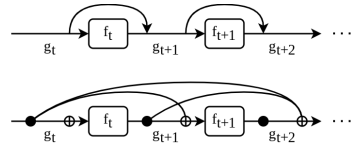
Figure 2 . Two alternative schematic representations of standard ResNet. The top represents the recursive form, the bottom repre- sents the explicit sum.
원문 · CC BY 4.0 · Mike Heddes, Adel Javanmard, Kyriakos Axiotis, Gang Fu, MohammadHossein Bateni, Vahab Mirrokni · DeepCrossAttention: Supercharging Transformer Residual Connections · 원문 그림 인용 · 원본 PDF 3쪽에서 그림 영역을 추출했습니다.층 출력의 가중 결합으로 일반화한 GRN
저자들은 잔차 네트워크를 이전 층 출력들의 가중 선형 결합으로 일반화한 세 가지 방식을 제안합니다. GRN-v1은 모든 특징 차원에 같은 가중치 벡터를 적용하며, 이 벡터는 1로 초기화된 뒤 학습됩니다. GRN-v2는 특징 차원마다 서로 다른 가중치 벡터를 두고 원소별 곱으로 적용합니다. GRN-v3는 차원 의존 가중치에 입력 특징으로부터 계산되는 항을 더하며, 이 항은 ReLU 비선형 함수를 거쳐 모든 차원에 같은 값으로 더해집니다. 세 방식의 파라미터는 AdamW 최적화기로 학습 중 함께 갱신됩니다. 메모리와 계산 비용을 줄이기 위해 저자들은 중간 층을 모두 저장하지 않고 처음 층과 마지막 k개 층만 명시적으로 유지하는 변형도 제안합니다.
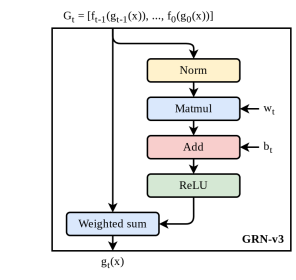
Figure 3 . Computation diagram of GRN-v3.
원문 · CC BY 4.0 · Mike Heddes, Adel Javanmard, Kyriakos Axiotis, Gang Fu, MohammadHossein Bateni, Vahab Mirrokni · DeepCrossAttention: Supercharging Transformer Residual Connections · 원문 그림 인용 · 원본 PDF 3쪽에서 그림 영역을 추출했습니다.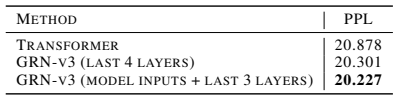
Table 9 . Perplexity (PPL) on LM1B with and without the model inputs for 6-layer GRN-v3.
원문 · CC BY 4.0 · Mike Heddes, Adel Javanmard, Kyriakos Axiotis, Gang Fu, MohammadHossein Bateni, Vahab Mirrokni · DeepCrossAttention: Supercharging Transformer Residual Connections · 원문 그림 인용 · 원본 PDF 22쪽에서 그림 영역을 추출했습니다.DeepCrossAttention 디코더 블록
DeepCrossAttention(DCA)은 GRN-v3를 트랜스포머 디코더 블록에 적용하는 방법입니다. 각 블록에는 같은 이전 층 출력 스택을 입력으로 받는 세 개의 GRN-v3 인스턴스가 있으며, 이들이 각각 어텐션의 쿼리, 키, 값을 생성합니다. 어텐션 메커니즘 자체는 바꾸지 않고, 쿼리·키·값 입력을 깊이가 다른 층 출력의 결합으로 구성합니다. 이 구조를 저자들은 깊이 방향 교차 주의라고 부릅니다. 잔차 연결은 블록 입력이 출력에 직접 더해지지 않고 어텐션과 피드포워드 모듈의 입력에 포함되도록 유지됩니다.
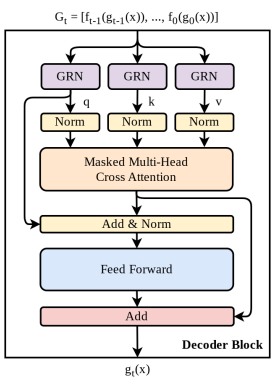
Figure 4 . Computation diagram of a DCA decoder block.
원문 · CC BY 4.0 · Mike Heddes, Adel Javanmard, Kyriakos Axiotis, Gang Fu, MohammadHossein Bateni, Vahab Mirrokni · DeepCrossAttention: Supercharging Transformer Residual Connections · 원문 그림 인용 · 원본 PDF 4쪽에서 그림 영역을 추출했습니다.저랭크 선형 모델의 이론 분석
이론 분석은 y가 Ax와 노이즈의 합으로 주어지는 저랭크 선형 설정에서 진행됩니다. 각 층의 랭크 r_t의 합인 collective rank r*가 모델의 표현 용량을 나타내는 핵심 양입니다. 저자들은 Baseline, ResNet, GRN-v1, GRN-v2, GRN-v3가 표현할 수 있는 함수 클래스를 정리합니다. 위험 식은 특징의 공분산이 단위행렬이라는 등방성 가정 아래 Frobenius 노름의 제곱으로 표현됩니다. 이 가정 아래 ResNet의 최소 초과 위험은 A-I의 특이값 분해에 따라 정해지고, GRN-v1과 GRN-v2의 상한은 대각 성분과 trace 항의 제거로 주어집니다. Theorem 4.3은 κ = λmin/λmax와 r*에 대한 부등식이 성립할 때 GRN이 ResNet보다 나은 초과 위험과 모델 크기의 절충을 가진다고 주장합니다.
이 결론은 이 저랭크 선형 설정과 제시된 조건 안에서만 성립합니다.
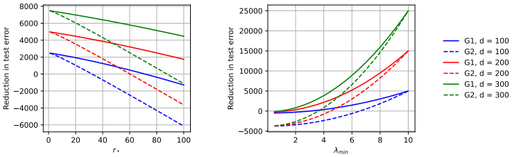
Figure 5 . Gain in the model performance achieved by GRN-v1 and GRN-v2 over ResNet. The plots represents the lower bounds for G1 and G2 given in Theorem 4.3(ii). Observe that the gain at larger dimension d is higher. Left panel shows that the gain decreases as the collective rank r∗ of ResNet increases (λmin = 5, λmax = 10). Right panel shows that the gain increases as the complexity of the target task (κ = λmin/λmax) increases (λmax = 10and r∗ = 50).
원문 · CC BY 4.0 · Mike Heddes, Adel Javanmard, Kyriakos Axiotis, Gang Fu, MohammadHossein Bateni, Vahab Mirrokni · DeepCrossAttention: Supercharging Transformer Residual Connections · 원문 그림 인용 · 원본 PDF 6쪽에서 그림 영역을 추출했습니다.언어 모델링에서의 perplexity 비교
LM1B의 6층 모델에서 Transformer의 perplexity는 18.98 ±0.01이고 DCA는 18.06 ±0.01입니다. 표 5에서는 같은 설정에서 LAuReL, 1X1 DenseFormer, Hyper-Connections와도 비교되며, DCA의 값이 가장 낮게 보고됩니다. 깊이 확장 실험에서 DCA는 모델 파라미터 수 대비 더 낮은 perplexity를 보이며, 30층 DCA가 42층 Transformer보다 낮은 perplexity를 보고합니다. 너비 확장 실험에서는 임베딩 차원 64에서 Transformer와 DCA의 perplexity 차이가 -2.82이고, 1024에서는 -0.39로 줄어듭니다.
저자들은 이 결과를 너비가 커질수록 랭크 기반 이득이 줄어든다는 이론적 예측과 일관된다고 해석합니다. C4의 모델 크기 실험에서도 8-DCA가 모든 비교 크기에서 Transformer보다 낮은 perplexity를 보고합니다.
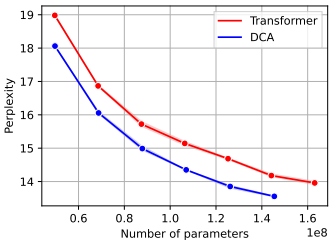
Figure 6 . Perplexity on LM1B with 6, 12, 18, 24, 30, 36, and 42 layer transformer and DCA models.
원문 · CC BY 4.0 · Mike Heddes, Adel Javanmard, Kyriakos Axiotis, Gang Fu, MohammadHossein Bateni, Vahab Mirrokni · DeepCrossAttention: Supercharging Transformer Residual Connections · 원문 그림 인용 · 원본 PDF 7쪽에서 그림 영역을 추출했습니다.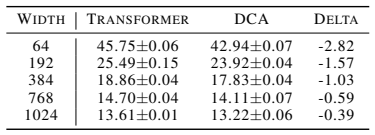
Table 2 . Perplexity on LM1B for models of varying widths.
원문 · CC BY 4.0 · Mike Heddes, Adel Javanmard, Kyriakos Axiotis, Gang Fu, MohammadHossein Bateni, Vahab Mirrokni · DeepCrossAttention: Supercharging Transformer Residual Connections · 원문 그림 인용 · 원본 PDF 8쪽에서 그림 영역을 추출했습니다.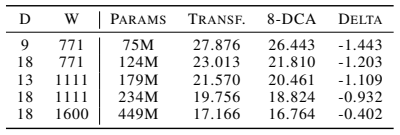
Table 3 . Perplexity on C4 for models of varying depths and widths.
원문 · CC BY 4.0 · Mike Heddes, Adel Javanmard, Kyriakos Axiotis, Gang Fu, MohammadHossein Bateni, Vahab Mirrokni · DeepCrossAttention: Supercharging Transformer Residual Connections · 원문 그림 인용 · 원본 PDF 8쪽에서 그림 영역을 추출했습니다.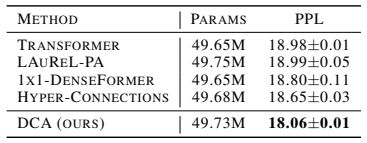
Table 5 . Perplexity (PPL) and parameter count on LM1B using a 6-layer model, comparing DCA with related work.
원문 · CC BY 4.0 · Mike Heddes, Adel Javanmard, Kyriakos Axiotis, Gang Fu, MohammadHossein Bateni, Vahab Mirrokni · DeepCrossAttention: Supercharging Transformer Residual Connections · 원문 그림 인용 · 원본 PDF 9쪽에서 그림 영역을 추출했습니다.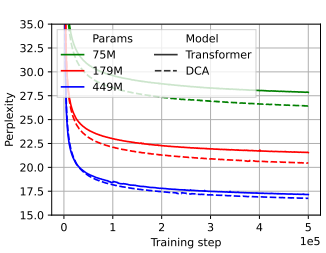
Figure 9 . Perplexity on C4 pre-training versus the number of steps with transformer and 8-DCA models of various sizes.
원문 · CC BY 4.0 · Mike Heddes, Adel Javanmard, Kyriakos Axiotis, Gang Fu, MohammadHossein Bateni, Vahab Mirrokni · DeepCrossAttention: Supercharging Transformer Residual Connections · 원문 그림 인용 · 원본 PDF 22쪽에서 그림 영역을 추출했습니다.학습 시간과 효율 비교
학습 시간 대비 perplexity 실험은 DCA가 같은 학습 시간에서 더 낮은 perplexity에 도달하는지를 확인합니다. 표 1에서 2-DCA는 Transformer가 도달한 perplexity에 정규화 시간 0.33으로 도달한다고 보고됩니다. 저자들은 이를 바탕으로 DCA가 같은 모델 품질을 최대 3배 빠르게 얻는다고 요약합니다. 다만 이 수치는 특정 k 설정과 특정 학습 조건에서 얻은 결과이며, 모든 모델 크기와 모든 하드웨어에서 같은 배수가 나온다는 뜻은 아닙니다. 작은 k 설정은 학습 효율과 추론 지연을 함께 개선하는 것으로 보고됩니다.
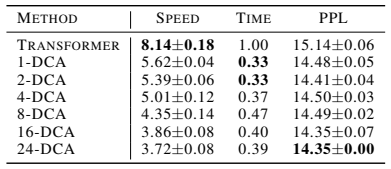
Table 1 . Training speed in batches per second, normalized time for a method to reach the perplexity of the transformer, and the final perplexity (PPL) of the transformer and DCA with varying k.
원문 · CC BY 4.0 · Mike Heddes, Adel Javanmard, Kyriakos Axiotis, Gang Fu, MohammadHossein Bateni, Vahab Mirrokni · DeepCrossAttention: Supercharging Transformer Residual Connections · 원문 그림 인용 · 원본 PDF 8쪽에서 그림 영역을 추출했습니다.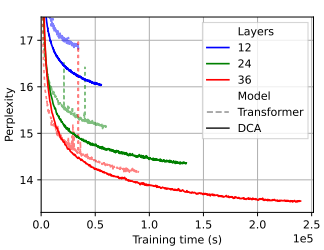
Figure 8 . Perplexity on LM1B pre-training versus the training time with transformer and DCA models of various depths.
원문 · CC BY 4.0 · Mike Heddes, Adel Javanmard, Kyriakos Axiotis, Gang Fu, MohammadHossein Bateni, Vahab Mirrokni · DeepCrossAttention: Supercharging Transformer Residual Connections · 원문 그림 인용 · 원본 PDF 22쪽에서 그림 영역을 추출했습니다.절제 실험과 학습 안정성
절제 실험은 같은 6층 LM1B 설정에서 GRN-v1, GRN-v2, GRN-v3, DCA의 perplexity를 비교합니다. Transformer는 18.98, GRN-v1은 18.80, GRN-v2는 18.43, GRN-v3는 18.41, DCA는 18.06으로 보고됩니다. GRN 변형은 디코더 블록당 하나의 GRN 인스턴스를 쓰고, DCA는 블록당 세 개의 GRN-v3 인스턴스를 쓴다는 점에서 구성이 다릅니다. 이 표는 각 변형이 기준 트랜스포머보다 낮은 perplexity를 보인다는 관찰을 제공하며, 어떤 구성요소가 단독으로 가장 큰 효과를 내는지는 이 표의 범위에서 판단합니다. 학습 안정성에 대해 저자들은 큰 모델에서 Transformer는 loss spike가 관찰되지만 DCA는 유의미한 loss spike가 없었다고 보고합니다.
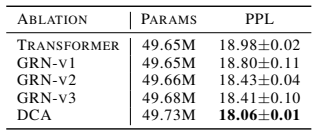
Table 7 . Ablation study of DCA, showing the parameter count and the perplexity (PPL) on LM1B with a 6-layer model.
원문 · CC BY 4.0 · Mike Heddes, Adel Javanmard, Kyriakos Axiotis, Gang Fu, MohammadHossein Bateni, Vahab Mirrokni · DeepCrossAttention: Supercharging Transformer Residual Connections · 원문 그림 인용 · 원본 PDF 9쪽에서 그림 영역을 추출했습니다.ImageNet 비전 트랜스포머 적용
DCA는 언어 모델과 같은 방식으로 ViT에 적용됩니다. 실험은 ViT-S/16 모델, 22M 파라미터 설정, 그리고 Beyer et al. (2022)의 실험 설정을 따릅니다. 표 8에서 ViT의 정확도는 76.4이고 ViT에 DCA를 적용한 모델의 정확도는 77.1입니다. 저자들은 이 결과를 DCA가 비전 영역에도 일반화된다는 근거로 제시합니다. 이 결과는 ImageNet 분류에서 한 모델 크기와 한 설정으로 얻은 것이므로 다른 비전 과제나 더 큰 모델로 바로 확장되지는 않습니다.
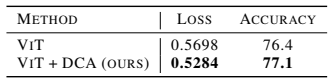
Table 8 . Loss and Accuracy on ImageNet classification.
원문 · CC BY 4.0 · Mike Heddes, Adel Javanmard, Kyriakos Axiotis, Gang Fu, MohammadHossein Bateni, Vahab Mirrokni · DeepCrossAttention: Supercharging Transformer Residual Connections · 원문 그림 인용 · 원본 PDF 9쪽에서 그림 영역을 추출했습니다.적용 범위와 한계
이론 분석은 저랭크 선형 모델을 중심으로 수행되며, 비선형 모델에 대한 결과는 Bottleneck rank를 이용한 확장으로 다룹니다. 저자들은 이 확장에서 Jacobian rank와 Bottleneck rank의 관계를 이용하지만, 이 결과는 MLP 구조와 제시된 가정 아래의 명제로 제한됩니다. 위험 식은 등방성 특징 가정에 의존합니다. 언어 모델링 결과는 LM1B와 C4 중심이며, 너비가 커질수록 DCA의 perplexity 이득이 줄어드는 것이 관찰됩니다. 이미지 분류 결과는 ViT-S/16 한 설정에 한정됩니다. 따라서 이 논문은 제시된 데이터, 모델 크기, 이론 가정 안에서 DCA의 이점을 보여 주며, 모든 아키텍처와 모든 과제에서의 일반적 우위를 증명하지는 않습니다.
논문 정보
- 저자
- Mike Heddes, Adel Javanmard, Kyriakos Axiotis, Gang Fu, MohammadHossein Bateni, Vahab Mirrokni
- 학회·저널
- arXiv · 프리프린트
- 최초 공개일
- 2025년 2월 10일
- 등록일
- 2026년 10월 31일
- 수정일
- 2025년 7월 23일
- 버전
- v2
- arXiv
- 2502.06785
- 분류
- cs.LG
- 원문 이용 조건
- CC BY 4.0
- 제공 범위
- 논문 정보, 해설, 허용된 원문 그림
AI 해설은 논문 원문과 별개의 설명이며 오류가 있을 수 있습니다. 원문과 그림은 각 출처의 이용 조건과 따로 표시된 권리를 따릅니다.
초록
Transformer networks have achieved remarkable success across diverse domains, leveraging a variety of architectural innovations, including residual connections. However, traditional residual connections, which simply sum the outputs of previous layers, can dilute crucial information. This work introduces DeepCrossAttention (DCA), an approach that enhances residual learning in transformers. DCA employs learnable, input-dependent weights to dynamically combine layer outputs, enabling the model to selectively focus on the most relevant information in any of the previous layers. Furthermore, DCA incorporates depth-wise cross-attention, allowing for richer interactions between layers at different depths. Our language modeling experiments show that DCA achieves improved perplexity for a given training time. Moreover, DCA obtains the same model quality up to 3x faster while adding a negligible number of parameters. Theoretical analysis confirms that DCA provides an improved trade-off between accuracy and model size when the ratio of collective layer ranks to the ambient dimension falls below a critical threshold.
원문 인용
Mike Heddes, Adel Javanmard, Kyriakos Axiotis, Gang Fu, MohammadHossein Bateni, Vahab Mirrokni (2025). DeepCrossAttention: Supercharging Transformer Residual Connections. arXiv:2502.06785v2. https://arxiv.org/abs/2502.06785v2
BibTeX
@misc{heddes2025deepcrossattention,
  title = {{DeepCrossAttention: Supercharging Transformer Residual Connections}},
  author = {Mike Heddes and Adel Javanmard and Kyriakos Axiotis and Gang Fu and MohammadHossein Bateni and Vahab Mirrokni},
  year = {2025},
  eprint = {2502.06785},
  archivePrefix = {arXiv},
  url = {https://arxiv.org/abs/2502.06785v2}
}