Paper commentary
Playing for 3D Human Recovery
GTA-Human shows video game footage can train strong human pose models
- Problem Motion capture is too costly to label enough 3D human data, and existing datasets are small and indoors, so models lack varied in-the-wild training data.
- Method GTA-Human records GTA-V gameplay and fits SMPL models to exact 3D keypoints, giving labelled video sequences.
- Results Mixing GTA-Human with real data lowered HMR's PA-MPJPE on 3DPW from 67.5 mm to 60.5 mm, compared with real data alone.
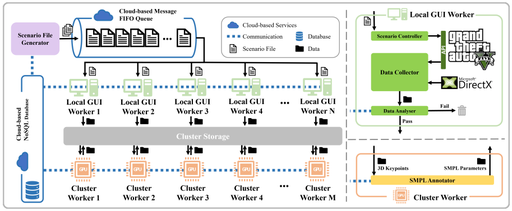
Fig. 2 : Data collection toolchain. Our toolchain is highly scalable as the cloud services are used to coordinate a large number of computation workers. Left: the overview of the pipeline. Top right: an elaborate illustration of Local GUI Worker. Bottom right: an elaborate illustration of Cluster Worker.
Original paper · CC BY 4.0 · Zhongang Cai, Mingyuan Zhang, Jiawei Ren, Chen Wei, Daxuan Ren, Zhengyu Lin, Haiyu Zhao, Lei Yang, Chen Change Loy, Ziwei Liu · Playing for 3D Human Recovery · Original paper figure · Extracted the figure area from page 4 of the original PDF.Why 3D human data is scarce
3D human recovery estimates body pose and shape through parametric models such as SMPL, and training such models needs many labelled examples. Existing datasets are either small in scale, collected in constrained indoor environments, or provide no 3D parametric model annotation at all. Marker-based motion capture, such as HumanEva and Human3.6M, gives accurate 3D labels, but intrusive markers have to be placed on the subjects.
Multi-camera capture systems like Panoptic Studio and HUMBI need no markers, yet their background stays constant and lacks diversity. 3DPW combines inertial measurement units with a moving camera to reach the in-the-wild setting, but IMU drift remains an obstacle and the dataset holds relatively few videos.
The authors look for labels that come almost for free, and they choose the video game Grand Theft Auto V (GTA-V) as the source. Earlier work has shown that video games can give nearly free and perfectly accurate annotations for several computer vision tasks. Game datasets such as JTA provide 3D keypoints for pose estimation and tracking, which covers the keypoint side of the problem.
SAIL-VOS 3D focuses on object detection and mesh reconstruction, but it covers non-parametric human meshes only. None of these game datasets provide the SMPL annotation that this study needs, so the authors build GTA-Human for parametric regression. The resulting dataset features 1.4 million SMPL annotations, which the authors describe as highly competitive against real and synthetic alternatives.
How gameplay becomes SMPL-labelled sequences
The pipeline starts from a cloud database, because the unit of data is a single video sequence that must be tracked through every stage. The database hosts the status of each sequence, and it is updated at each stage of the toolchain. A Scenario File Generator reads this database and retrieves sequence IDs that were never generated or failed earlier.
A cloud-based Message FIFO Queue holds these scenario files as text strings, so multiple Local GUI Workers can fetch jobs first-in-first-out and at the same time.
Each Local GUI Worker is a regular gaming desktop running GTA-V, and it runs three tools: Scenario Controller, Data Collector, and Data Analyser. The Scenario Controller is a plugin that takes scenario files and drives the game engine through its API. It controls subject generation and placement, action assignment, camera placement, in-game time, and weather.
The Data Collector first extracts 3D keypoints from each subject through the API, and the paper adds head top and nose by interpolation to the original 98 keypoints. It transforms the 3D keypoints into camera coordinates with a perspective camera model, then projects them onto the image plane to get 2D keypoints. To check occlusion, it projects light rays at each joint and checks which entity the ray hits first.
It reads the pixel-wise depth directly from the depth buffers, obtains semantic masks through shader injection, and records videos. The Data Analyser computes joint movement speed as the position difference between consecutive frames, which removes slow-moving or stationary actions. It also flags severely occluded or out-of-view subjects, and passing sequences move to Cluster Storage on the GPU cluster while failed ones are deleted.
On each Cluster Worker, a GPU in the cluster, an instance of the SMPL Annotator reads keypoints from Cluster Storage. The annotator upgrades SMPLify in two ways, and the first replaces the 2D keypoint loss with a 3D keypoint loss. The authors argue that 2D keypoints carry depth ambiguity, made worse by weak perspective projection, while 3D keypoints are unambiguous.
What the game data covers
GTA-Human draws its actions from a large in-game database instead of a small fixed set of recorded movements. The authors select 20,000 of the most dynamic and expressive clips, each typically 30-80 frames at 30 FPS. Because those clips come from motion capture of real actors, the authors judge them reasonably realistic for daily city life.
The action set covers a fairly holistic range of city-dwellers' daily activities, which many existing datasets don't offer. Existing datasets either use only a few actions or lack a clearly defined action set at all. The pose distribution of GTA-Human spreads wider than the real datasets and still covers most of their poses.
Locations run from city streets to the wilderness, which an optical or multi-view motion capture studio can't easily reproduce. Those studio systems need indoor environments, so in-the-wild backgrounds are scarce in existing data. The open-world design of GTA gives the authors seamless access to diverse backgrounds. Camera angles are sampled randomly from the distributions of real datasets, balancing diversity and realness.
The data collection tool controls camera position and orientation, which is hard to vary in real life.
The game engine also annotates whether each joint is visible, occluded by other objects, or self-occluded. The authors control the in-game clock directly instead of adjusting image exposure to mimic lighting. Lighting conditions and shadow projections vary widely across the clock, and random rain and snow add weather that is hard to capture in a studio.
The authors define the Real datasets as about 300K frames, and Blended data mixes GTA-Human with them. Human3.6M is fully indoor, and MPI-INF-3DHP has only two outdoor sequences with 728 frames. 3DPW has 60 sequences of unconstrained scenes, so the authors evaluate mainly on its test set for in-the-wild performance.
What mixing game data does to model error
Mixing GTA-Human with real data lowers PA-MPJPE on 3DPW for both image-based and video-based models. The authors test two ways of using GTA-Human: blended training (BT) mixes it with the real datasets from the start. Finetuning (FT) instead adapts an already trained model using mixed data. With BT, HMR's PA-MPJPE on 3DPW falls from 67.5 mm to 60.5 mm, a change of 7.0 mm.
HMR+ falls from 61.7 mm to 56.0 mm with BT, a 5.7 mm improvement over its baseline. HMR with BT lands close to SPIN's 59.2 mm, while HMR+ with BT beats both SPIN and VIBE's 56.5 mm. With finetuning, PARE's PA-MPJPE moves from 50.9 mm to 46.8 mm, a 4.1 mm drop. SPIN's PA-MPJPE moves from 59.2 mm to 52.0 mm under finetuning, a 7.2 mm drop.
Finetuning is much faster than BT, so it lets the authors apply mixing to more base methods such as SPIN and PARE.
For video, the authors train the temporal modules of VIBE on each data source while its per-frame SPIN feature extractor stays fixed. The full GTA-Human set gives 54.1 mm PA-MPJPE, compared to 54.7 mm for the 3DPW training set. A downsampled GTA-Human set matching the size of MPI-INF-3DHP reaches 55.0 mm, compared to 56.5 mm for MPI-INF-3DHP alone.
Mixing all three sources gives 51.9 mm, which the authors read as game data being complementary to the real sets.
In a comparison with other data-driven methods, SPIN finetuned on GTA-Human reaches 52.0 mm PA-MPJPE on 3DPW. Compared with AGORA's 55.3 mm, this suggests that game-playing data can match a costlier scan-based dataset. AGORA is built from expensive industry-level human scans, so the authors call the game data a lower-cost route to a similar effect.
Why real and synthetic data complement each other
Real indoor datasets occupy a different feature region from in-the-wild outdoor data, so a model trained only on indoor data may transfer poorly. In that view, the 3DPW test distribution splits into two main clusters, one covered by GTA-Human and the other by the real datasets. The authors read this as synthetic outdoor data supplying in-the-wild knowledge that the real indoor data doesn't carry.
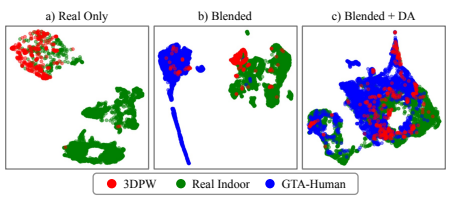
Fig. 7 : Domain gap analysis. We visualize features extracted after the trained backbones via UMAP [75] dimension reduction (the two axes are the principal axes). (a) Training with real data only. (b) Blended training. (c) Blended training with domain adaptation (Ganinet al. [73]).
Original paper · CC BY 4.0Plain BT reaches 58.6 mm PA-MPJPE, while CycleGAN reaches 61.6 mm, so learned data augmentation didn't help here. Chen et al. reaches 57.9 mm and JAN reaches 56.5 mm, so domain adaptive regression and domain generalization both improve on plain BT. Ganin et al. gives the lowest error at 55.5 mm, and the authors explain that its adversarial training pulls the real and GTA-Human distributions together.
In the feature view, this joint distribution matches the in-the-wild 3DPW data better than the blended features do.
How the amount of game data changes error
With HMR under blended training, adding GTA-Human at 0 to 4 times the real data lowers PA-MPJPE on 3DPW from 61.7 mm to 56.0 mm. The authors use the amount of GTA-Human data as multiples of the roughly 300K real frames, so 2× means twice as much synthetic data as real data. The error falls by about 6 mm as GTA-Human data grows, which the authors describe as a consistent downward trend.
The Fig. 8 caption names HMR+ as the base method, while the text names HMR, so the base model is reported inconsistently.
A 100% real setting reaches 65.8 mm at 100K and 61.7 mm at 300K, and it cannot be run beyond 300K. Real data runs out at high ratios, so the N/A cells mean the 75% and 100% real settings can't reach 500K. Even at 300K, adding synthetic data keeps improving results, which the authors read as synthetic data complementing real data.
Fig. 9 studies HMR+ trained with BT and evaluates it on GTA-Human across data density for camera angle, pose and occlusion. The authors bin the examples by data density and average the error per bin to draw each curve. Error rises sharply when data density drops, which the authors take as high sensitivity to data scarcity. The authors suggest synthetic data can cover corner case scenarios that real collection misses.
They didn't test a non-BT setting in Fig. 9, so the trend is reported only for the blended model.

Fig. 9 : Impact of data scarcity. We show that model performance is sensitive to data scarcity, and this observation is consistent on factors such as camera angles, poses, and occlusion. For c) and d), we follow [76] to encode pose as a set of 3D coordinates of the 24 key joints, and plot the distance from the mean pose and T-pose respectively. The data density of e) and f) are in log scale.
Original paper · CC BY 4.0Why SMPL labels beat keypoints for training
The authors compare weak keypoint supervision with strong SMPL supervision, and they find the SMPL labels are critical to training a high-performing model. Under the BT setting on the 3DPW test set, SMPL parameters θ and β are much more effective than body keypoints. Adding 2D and 3D keypoints gives 93.4 mm MPJPE and 60.9 mm PA-MPJPE, while SMPL alone gives 92.0 mm and 56.3 mm.
Using both keypoints and SMPL gives 88.7 mm MPJPE and 56.0 mm PA-MPJPE, so SMPL labels carry most of the benefit.
The authors extend the earlier supervision study by adding 3D keypoints as a stronger form of weak supervision. SMPL annotation still proves far more effective than the 3D keypoints, which the authors treat as the best weak signal. Their findings agree with SPIN, which fits SMPL to 2D keypoints to create pseudo labels during training. SPIN doesn't explain why 3D SMPL works, and the authors note that 2D supervision is inherently ambiguous.
The authors argue that keypoints only guide the shape parameter β through bone length, yet β is needed in joint regression. Ground truth SMPL parameters enter the loss directly against the predicted parameters, as in Equation 1. That direct path gives gradient flow to the learnable SMPL parameters by the shortest route. The 3D keypoints come from joint regression J on the estimated shape, and the kinematic transform M, as in Equation 2 and Equation 4.
The 2D keypoints need an extra translation t, a projection K with focal length f and camera center c, as in Equation 5. The authors believe this longer route and its uncertainties hinder effective learning of the 2D loss in Equation 3.
Whether bigger backbones gain from game data
The HMR baseline is extended to deeper CNNs and Transformers, to test whether the benefit of game data holds beyond ResNet-50. Table 9 reports PA-MPJPE for each backbone, trained with only the real datasets and with blended training that adds GTA-Human. The authors report that including GTA-Human improves every backbone they test, whatever its size or architecture.
ResNet-101 drops from 60.1 mm to 54.5 mm, and ResNet-152 drops from 58.4 mm to 54.3 mm. The authors note that Transformers are under-explored for this task, so there may be room for further gains.
The key comparison is between a small model with game data and a large model without it. ResNet-50 with GTA-Human scores 56.0 mm, compared to 58.4 mm for ResNet-152 trained on real data only. So a smaller model with extra game data can beat a larger model trained only on real data. The authors read this as a sign that data remains a critical bottleneck for accurate pose and shape estimation.
Limits of the evidence
The Human3.6M and MPI-INF-3DHP gains are smaller than the 3DPW gains, and the paper ties this to indoor-outdoor domain gaps. The paper's "Real" set totals about 300K frames, and MPI-INF-3DHP contributes only two outdoor sequences of 728 frames. Human3.6M is fully indoor, so the authors lean on 3DPW to gauge in-the-wild performance. The authors evaluate mainly on the 3DPW test set, which has 60 sequences of unconstrained scenes.
Results are reported in PA-MPJPE, the primary metric, which removes rigid alignment differences before scoring.
Body shape is captured only through bone lengths, which the authors flag as an annotation gap to fix later. The authors say the annotation pipeline may be upgraded to capture the full body shape beyond bone lengths. They didn't test model-free reconstruction, which they place outside the scope of this work. The appendix screening covers about 1k of the 20k action classes, so the rest weren't checked by hand.
The previous section's bigger-backbone gains come from the HMR baseline, so they don't show how other architectures behave under the same mix. The authors plan to go beyond 1.4M data samples, so the scaling limit remains untested.
Paper info
- Authors
- Zhongang Cai, Mingyuan Zhang, Jiawei Ren, Chen Wei, Daxuan Ren, Zhengyu Lin, Haiyu Zhao, Lei Yang, Chen Change Loy, Ziwei Liu
- Venue
- arXiv · Preprint
- First published
- 2021-10-14
- Added
- 2026-11-6
- Updated
- 2024-9-8
- Version
- v3
- arXiv
- 2110.07588
- Category
- cs.CV
- Original paper terms
- CC BY 4.0
- What we show
- Paper info, commentary and permitted figures from the original paper
AI commentary is a separate explanation from the original paper and may contain errors. The original paper and figures follow each source's terms of use and any rights noted separately.
Abstract
Image- and video-based 3D human recovery (i.e., pose and shape estimation) have achieved substantial progress. However, due to the prohibitive cost of motion capture, existing datasets are often limited in scale and diversity. In this work, we obtain massive human sequences by playing the video game with automatically annotated 3D ground truths. Specifically, we contribute GTA-Human, a large-scale 3D human dataset generated with the GTA-V game engine, featuring a highly diverse set of subjects, actions, and scenarios. More importantly, we study the use of game-playing data and obtain five major insights. First, game-playing data is surprisingly effective. A simple frame-based baseline trained on GTA-Human outperforms more sophisticated methods by a large margin. For video-based methods, GTA-Human is even on par with the in-domain training set. Second, we discover that synthetic data provides critical complements to the real data that is typically collected indoor. Our investigation into domain gap provides explanations for our data mixture strategies that are simple yet useful. Third, the scale of the dataset matters. The performance boost is closely related to the additional data available. A systematic study reveals the model sensitivity to data density from multiple key aspects. Fourth, the effectiveness of GTA-Human is also attributed to the rich collection of strong supervision labels (SMPL parameters), which are otherwise expensive to acquire in real datasets. Fifth, the benefits of synthetic data extend to larger models such as deeper convolutional neural networks (CNNs) and Transformers, for which a significant impact is also observed. We hope our work could pave the way for scaling up 3D human recovery to the real world. Homepage: https://caizhongang.github.io/projects/GTA-Human/
Quote from the paper
Zhongang Cai, Mingyuan Zhang, Jiawei Ren, Chen Wei, Daxuan Ren, Zhengyu Lin, Haiyu Zhao, Lei Yang, Chen Change Loy, Ziwei Liu (2021). Playing for 3D Human Recovery. arXiv:2110.07588v3. https://arxiv.org/abs/2110.07588v3
BibTeX
@misc{cai2021playing,
  title = {{Playing for 3D Human Recovery}},
  author = {Zhongang Cai and Mingyuan Zhang and Jiawei Ren and Chen Wei and Daxuan Ren and Zhengyu Lin and Haiyu Zhao and Lei Yang and Chen Change Loy and Ziwei Liu},
  year = {2021},
  eprint = {2110.07588},
  archivePrefix = {arXiv},
  url = {https://arxiv.org/abs/2110.07588v3}
}