Paper commentary
FIDEL: Abugida-Aware Pre-tokenization for Ethiopic Languages
- Problem Subword tokenizers keep only runs of adjacent characters, so the consonantal root of an Ethiopic word, hidden inside fused fidäl characters, cannot be exposed.
- Method FIDEL splits each fidäl character into a consonant and a vowel marker, runs SPLINTER-style reduction on the decomposed word, and records each operation so the text decodes back to standard fidäl.
- Results On Amharic at 64k vocabulary, syllabic_then_splinter reached 63.60 entity-F1 on named-entity recognition against 61.10 for the baseline.
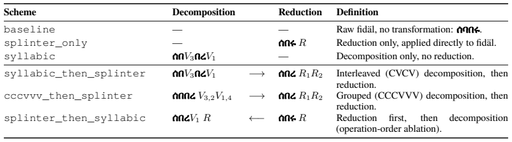
Table 2 : The pre-tokenization schemes, each applied to ሰባበሩ (säbabbäru, “they broke into pieces ”). The arrow gives the order in which the two operations are applied, and a dash marks an operation the scheme does not perform. R1 and R2 are reduction markers, each a single codepoint recording one operation. Appendix B presents the same conditions as pipelines.
Original paper · CC BY 4.0 · Gebreslassie Teklu Reda, Yuval Pinter · FIDEL: Abugida-Aware Pre-tokenization for Ethiopic Languages · Original paper figure · Extracted the figure area from page 4 of the original PDF.Why subword tokenizers miss the Ethiopic root
BPE and UnigramLM both build their vocabularies from runs of adjacent characters, so every token they can find is a contiguous substring. That works when a word's morphemes are strung end to end, but Semitic words interleave a consonantal root with a vocalic template, so the root is rarely one contiguous run.
In Hebrew and Arabic, vowels are often left unwritten, so the written string already shows most of the consonantal skeleton, and SPLINTER has improved downstream tasks in those languages. The fidäl writing system used for Amharic, Tigrinya and Ge'ez works differently, because each character fuses a consonant with one of seven vowel orders into a single codepoint.
A tokenizer therefore never sees the consonants that related forms share, and the root cannot be recovered from the characters it receives.
Amharic shows the problem concretely: the root ሰ–በ–ረ appears in ሰባበሩ with a frequentative template and a changed final vowel order, and the two forms share no symbol at the position of the final consonant. Existing Ethiopic resources take the tokenizer as fixed infrastructure, so the effect of tokenization on these languages had not been isolated.
The study asks whether a reversible transformation placed before an ordinary tokenizer changes tokenization statistics and downstream results when everything else is held fixed.
Splitting each fidäl into consonant and vowel markers
The first step, decomposition, rewrites each fidäl character as a base consonant followed by a vowel marker, which gives two elements per syllable. Two arrangements are compared. The interleaved form (CVCV) keeps each marker directly after its consonant, so adjacency defines the pairing. The grouped form (CCCVVV) lists all consonants first and then the markers, which name their consonant positions.
For ሰባበሩ the two outputs are ሰ በ V3 በ ረ V1 and ሰበበረ V3,2V1,4.
A marker is written \(V_{o,i}\), where o is the vowel order and i is the one-based consonant position, so \(V_{3,2}V_{1,4}\) gives order 3 to the second consonant and order 1 to the fourth. The interleaved form needs no index because adjacency already gives the position, while the grouped form needs one because its markers no longer sit beside their consonants.
A consonant with no marker keeps the first order.
Vowel orders are counted from zero, so V0 is the canonical first order and needs no marker. Because an absent marker always means first order, an unmarked consonant is rebuilt the same way on both sides of the mapping.
Reducing the decomposed word to its root
Applied to raw fidäl, SPLINTER's character deletion removes a whole fused character, so it discards the vowel information along with the consonant. The splinter_only scheme therefore reduces ሰባበሩ only to ሰበሩ, where the vowel order is still inside a fused character, and it can halt at an intermediate form. Reaching the root ሰበረ requires lowering the final vowel marker V1 to first order, and that change becomes possible only after decomposition.
Six conditions are compared: the untransformed baseline, splinter_only, syllabic (decomposition only), syllabic_then_splinter and cccvvv_then_splinter (decomposition followed by reduction), and splinter_then_syllabic, which reverses the order as an ablation. R1 and R2 are reduction markers, each a single codepoint that records one removal.
Reductions repeat while a more frequent attested form exists, so a word with several affixes can be reduced in several steps. Statistics are computed per language, because the Tigrinya word ሰባት (frequency 23) would otherwise reduce to the Amharic ሰባ (frequency 54) under pooled counts.
Checking that encoding is reversible
Decoding is a deterministic inverse: each consonant takes the vowel order given by its marker, unmarked consonants stay in first order, and reduction markers are undone in reverse order. When a model produces malformed marker sequences, a projection procedure described in the appendix decides the decoded output.
Intrinsic statistics across vocabulary sizes
Five measures are computed over a corpus: Rényi efficiency, where higher is better, together with tokens per word (subword fertility), 4+ token words and 1-char tokens, where lower is better.
At 64k with BPE, syllabic_then_splinter gives 1.323 tokens per word against 1.353 for the baseline, and its Rényi efficiency is 0.643 against 0.654. The advantage does not hold at smaller sizes: at 16k the baseline has 1.694 tokens per word and syllabic_then_splinter has 1.696, and at 8k the figures are 1.981 and 2.090.
The syllabic scheme is the least compressed, with 2.391 tokens per word at 64k against 1.353 for the baseline, and 2.630 at 16k against 1.694. It also has the fewest distinct neighbors at every size, from 5628 at 64k down to 2410 at 8k, which points in the opposite direction from its compression.
The grouped and interleaved schemes diverge on these measures too: at 64k, cccvvv_then_splinter has 1.498 tokens per word against 1.323 for syllabic_then_splinter, but a higher Rényi efficiency, 0.668 against 0.643. The same kind of partial agreement appears for UnigramLM at 64k, where syllabic_then_splinter reaches 1.346 tokens per word against 1.382 for the baseline.
No single measure orders the schemes as downstream accuracy does, so the authors read these statistics as descriptions of each representation rather than predictors of task results.
Controlled pretraining setup
Encoders are pretrained from scratch with masked language modeling and pre-layer-normalization on a 385 MB Ge'ez-script corpus of 662 files and 1,447,588 lines, identical across all conditions. Corpus, architecture, optimization budget and evaluation protocol are fixed, so differences in downstream performance are attributed to the representation.
Two model sizes are used, small at about 91M parameters and large at about 165M, each with vocabularies of 16k and 64k. Experiments ran on NVIDIA RTX 3090 GPUs with 24 GB, one GPU per run.
The tasks are named-entity recognition on EthioNER and MasakhaNER, scored with entity-F1, sentiment analysis on AfriSenti, news classification on MasakhaNEWS, and part-of-speech tagging on UD_Amharic-ATT, with the last three scored with weighted F1.
The 64k setting gives room for the extra symbols that decomposition adds, while at 16k every marker competes with a stem for vocabulary slots, and the two correspond roughly to monolingual and multilingual budgets.
Amharic results on four tasks
The reversed-order scheme, splinter_then_syllabic, is the lowest condition at 16k on all four Amharic tasks, with 60.15 entity-F1, 43.63 on sentiment, 86.91 on news and 90.83 on part-of-speech tagging. At 64k it is lowest on sentiment (41.01), news (89.91) and part-of-speech tagging (91.60), but not on named-entity recognition, where syllabic reaches 53.16 against 55.40, so the statement that it is weakest on every task does not hold for that row.
Named-entity recognition gains are not uniform: at 16k, splinter_only reaches 65.80 entity-F1 against 62.79 for the baseline. At 64k, syllabic_then_splinter reaches 63.60 against 61.10, and splinter_only (62.98) and cccvvv_then_splinter (61.51) also exceed the baseline. At 16k, cccvvv_then_splinter (60.20), syllabic (60.23) and splinter_then_syllabic (60.15) fall below the baseline.
The text states that every reduction scheme exceeds the baseline on news classification at both vocabulary sizes; at 64k, splinter_only, syllabic_then_splinter and cccvvv_then_splinter score 92.09, 92.31 and 92.03 against 90.98. At 16k the table does not match that statement for cccvvv_then_splinter, which scores 88.82 against 89.91 for the baseline, while splinter_only (91.91) and syllabic_then_splinter (91.75) do exceed it.
Sentiment is the least stable task: at 64k, syllabic_then_splinter falls to 49.04 against 54.87, while cccvvv_then_splinter (56.43) and syllabic (60.70) rise above it. At 16k all five FIDEL conditions sit below the baseline of 57.02, with splinter_only the closest at 55.31. The authors draw no ranking of the schemes from this task.
Excluding the reversed-order ablation, part-of-speech tagging scores fall between 93.44 and 94.69, and the gaps between schemes lie within the spread observed across runs, so the schemes are not ranked on this task.
Extractive question answering on AmQA
Syllabic_then_splinter has the highest F1 and splinter_only the highest exact-match score, and the authors describe performance as preserved rather than harmed, although only these three conditions are reported for this task.
Arrangement and operation order
The interleaved and grouped schemes differ only in layout, and the difference shows up downstream: at 64k the interleaved form leads named-entity recognition with 63.60 against 61.51, while the grouped form leads sentiment with 56.43 against 49.04. Intrinsically the trade-off runs the other way: the interleaved form uses fewer tokens per word (1.323 against 1.498 at 64k), while the grouped form has higher Rényi efficiency (0.668 against 0.643).
Reversing the order, so that reduction runs before decomposition, gives scores lower than both forward-order composed schemes on every Amharic task at both vocabulary sizes. The authors link this to the reduction map being indexed by position, which fails once the stream has already been rewritten.
Tigrinya and zero-shot Ge'ez tagging
On Tigrinya at 64k, syllabic_then_splinter gives the top news score (86.12 against 85.31 for the baseline) and cccvvv_then_splinter the top part-of-speech score (96.82 against 96.70). Sentiment is highest for the baseline at 64k (86.27), while at 16k splinter_only leads sentiment (86.92 against 86.81) and syllabic_then_splinter leads news (82.67 against 82.10).
Across the Tigrinya tasks, differences among schemes remain under two points.
Ge'ez part-of-speech tagging was transferred zero-shot from Amharic, and its scores run from 36.38 to 38.56 across the eight conditions in the table. The authors attribute this range to the difficulty of zero-shot transfer rather than to any property of the schemes, and they restrict core claims to Amharic.
Limitations
Amharic is the only language evaluated on all four tasks, while Tigrinya and Ge'ez are not fully covered in the reported tables, which the authors attribute to dataset availability. Claims about Ethiopic languages therefore rest mainly on Amharic evidence.
Reductions are learned from corpus frequency without morphological knowledge, so a frequent reduction need not correspond to a morpheme. The reading that reduction consolidates stems at the expense of affixes was not checked against a morphological analyser.
All results come from one corpus and the family of subword algorithms, so whether the same trade-off holds with other pretraining data, or with character- or byte-level models, was not tested. Whether reversibility survives generative decoding, where a model produces sequences never seen during encoding, remains open.
Paper info
- Authors
- Gebreslassie Teklu Reda, Yuval Pinter
- Venue
- arXiv · Preprint
- First published
- 2026-11-15
- Added
- 2026-11-20
- Updated
- 2026-11-15
- Version
- v1
- arXiv
- 2611.20216
- Category
- cs.CL
- Original paper terms
- CC BY 4.0
- What we show
- Paper info, commentary and permitted figures from the original paper
AI commentary is a separate explanation from the original paper and may contain errors. The original paper and figures follow each source's terms of use and any rights noted separately.
Abstract
Subword tokenizers assume that meaningful linguistic units can be recovered by splitting text at learned boundaries, an assumption better suited to concatenative morphology than to Semitic root-and-pattern systems. The challenge is acute for the Ethiopic languages, whose abugida script encodes consonant-vowel units as single characters and hides consonantal structure. We introduce FIDEL (FIdäl DEcomposition and Linearization), a family of reversible abugida-aware pre-tokenization schemes that expose consonant and vowel-order structure, extend SPLINTER reductions from abjad scripts to the Ethiopic abugida, and evaluate them on three Ethiopic languages under controlled conditions, holding corpus, architecture, budget and protocol fixed so that tokenization is the only variable. We report intrinsic tokenizer statistics for BPE and UnigramLM across vocabulary sizes alongside downstream NLP tasks, including transfer scenarios. We find that FIDEL reduction improves news classification consistently and named-entity recognition at larger capacity, while sentiment analysis performance declines under the more aggressive schemes, and extractive question answering performance is preserved.
Quote from the paper
Gebreslassie Teklu Reda, Yuval Pinter (2026). FIDEL: Abugida-Aware Pre-tokenization for Ethiopic Languages. arXiv:2611.20216v1. https://arxiv.org/abs/2611.20216v1
BibTeX
@misc{reda2026fidel,
  title = {{FIDEL: Abugida-Aware Pre-tokenization for Ethiopic Languages}},
  author = {Gebreslassie Teklu Reda and Yuval Pinter},
  year = {2026},
  eprint = {2611.20216},
  archivePrefix = {arXiv},
  url = {https://arxiv.org/abs/2611.20216v1}
}