Paper commentary
Meaning Reaches Object Choice but Not Completion: Where Is a VLA Vulnerable to Landmark Synonyms?
- Problem A success rate cannot show whether a VLA policy picks the wrong object or fails to finish after picking the right one when a landmark word is reworded.
- Method The study pastes, masks and finetunes around one landmark word in GR00T N1.7 and scores bowl choice and completion separately in closed loop.
- Results Landmark-diversified finetuning raised completion on the mirror pair's unpresented synonyms by 18.0, 20.2 and 17.8 points in three training seeds.
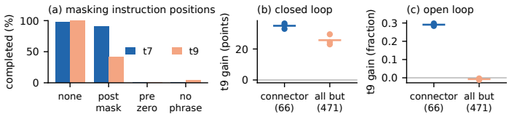
Figure 1 : Two measures that misread the path. (a) Released policy: completion unmasked, with every instruction-word position masked after the connector or also zeroed at its input (§3.3), and with the landmark phrase removed. (b) Closed-loop gain on t9’s four unpresented synonyms from the connector and all-but-connector transplants into the undiversified policy (dots: three seeds, some overlapping; colors here mark the transplant, not the task as in (a); lines: mean). (c) The same in the open-loop retained fraction, which averages all five t9 synonyms, one a finetuning word (Ap- pendix B.6); units differ from (b).
Original paper · CC BY 4.0 · Kurihara, Ryoichi, Sunamoto, Kota · Meaning Reaches Object Choice but Not Completion: Where Is a VLA Vulnerable to Landmark Synonyms? · Original paper figure · Extracted the figure area from page 9 of the original PDF.Why success rates cannot separate choice from completion
A policy can fail after an instruction is reworded even when the task stays the same, and GR00T N1.7 is one of the released policies where this happens. A success rate merges two different failures: choosing the wrong object, and failing to finish after choosing the right one. The study takes GR00T N1.7 and two LIBERO-Spatial tasks that differ only in the landmark word telling the policy which of two bowls to pick up.
Earlier work finds that an instruction's meaning stays inside the policy and that the intended object can still be chosen while success falls, but it does not locate where inside the policy a single word's effect can be changed.
The mirror pair and the test for reaching the choice
The two tasks share one scene, and their landmark nouns differ: t7 names the bowl on the stove and t9 names the bowl on the wooden cabinet. Verbs are held fixed, because the training instructions share them, and only the landmark noun is varied.
Choice is scored by whether an episode comes within 10 cm of a bowl, and the meaning of a landmark word counts as reaching the choice only when three conditions hold together. Completion differences count as separated when the pooled two-proportion z reaches an absolute value of 3, a threshold fixed before measurement; smaller differences are reported as unresolved.
Completion is where the synonyms fall short: 67.6% of t9 synonym episodes complete against the training word's 100%, with z=−4.7, while the t7 pooled figure of 90.0% against 98% is unresolved. As an external check, the parent VLM with its language-model head scores the correct bowl higher in 199/200 cases over the four landmark-dependent tasks, which is not a readout of the policy's own VLM.
Pasting and masking on either side of the connector
The VLM passes one vector per token to the action head, which is the connector followed by the diffusion transformer; the connector mixes all positions before the transformer outputs actions.
Before the connector, pasting the other landmark word's vector at the landmark position alone flips 50 of 50 episodes on both tasks, and 49 of 50 and 50 of 50 with environment seed 100.
After the connector the same paste restores 23.6 points, which is 10.8 points below the pre-connector rescue, while pasting the complement restores 38.8 points. The authors treat the pre-connector paste as a sufficient point of intervention and do not take it to show where the failure starts.
Masking the landmark position after the connector lowers completion in the synonym decision cells from 154/250 to 98/250, a cost of 22.4 points. The same mask also lowers approach to the target from 212/250 to 162/250, a cost of 20.0 points. On the original instruction the same mask gives unresolved differences: t7 49/50 against 49/50 and t9 47/50 against 49/50.
Diversified finetuning and the tensors that carry the repair
The released checkpoint is finetuned on the same demonstrations under three instruction sets, with the VLM kept frozen as in every policy trained here. The undiversified policy keeps the original ten instructions, the landmark-diversified policy draws landmark words at random for t1, t7 and t9, and the verb-diversified policy draws verb phrases from lists of the same sizes.
The effect sits on t9, where completion rises from 61.5–65.0% to 98.5–100%, and t7 is at ceiling for every policy.
The difference between the full diversified finetuning and this connector transplant is +0.2, +0.3 and +0.5 points, unresolved in every seed.
None of the four subsets of those 471 tensors, transplanted alone, carries that share.
After the repair, the post-connector masking cost is 0.42, 0.24 and 0.21 times the undiversified cost, and the diversified cost remains separated from zero in each seed except seed 303 after Holm's correction.
Two measures that point the wrong way
Figure 1 sets out three panels: completion with instruction-word masks on t7 and t9, closed-loop gain from the connector and all-but-connector transplants on t9, and the open-loop retained fraction for the same transplants. Masking every instruction-word position after the connector leaves t7 at 45/50 against 49/50 unmasked, an unresolved difference, which read alone suggests the instruction's words go unused.
On t9 the same mask gives 21/50 against 50/50, so the first measure misreads the path.
The open-loop retained fraction scores a synonym's action chunk on single starting frames with the robot state zeroed, where the original instruction scores 1 and the other landmark word scores 0.
The authors relate this divergence between open-loop and closed-loop scores to similar reports elsewhere. The study therefore recommends judging rewording robustness in closed loop, intervening on both sides of the connector, and scoring choice and completion separately.
Limitations
The repair acts on t9 and was measured with environment seed 0 only, and decision cells change with the environment seed. Repeated runs fall within binomial scatter, but independence across runs is assumed and not proven.
Paper info
- Authors
- Kurihara, Ryoichi, Sunamoto, Kota
- Venue
- arXiv · Preprint
- First published
- 2026-11-18
- Added
- 2026-11-19
- Updated
- 2026-11-18
- Version
- v1
- arXiv
- 2611.24076
- Category
- cs.RO · cs.CL · cs.LG
- Original paper terms
- CC BY 4.0
- What we show
- Paper info, commentary and permitted figures from the original paper
AI commentary is a separate explanation from the original paper and may contain errors. The original paper and figures follow each source's terms of use and any rights noted separately.
Abstract
VLA policies are fragile to rewording. Success rates alone cannot say whether a policy fails to choose the object or to complete the task, nor where in the policy to intervene. We study the released GR00T N1.7 on two LIBERO-Spatial tasks differing only in the landmark word telling which of two bowls to take. Synonyms absent from the training instructions send the policy to the bowl they name, unlike made-up words, yet complete 67.6% of one task's closed-loop episodes, against the original word's 100%. Before the connector between the vision-language model and the action generator, replacing only the landmark tokens' vectors with the other landmark's (pasting) sends nearly every episode to the other bowl. After the connector, pasting at the landmark, the remaining instruction, or the image tokens alone rarely moves the choice, but any two do. Hiding the landmark tokens from the action generator after the connector still lowers completion for the synonyms that fall short. Finetuning on diversified landmark words repairs that one task's completion for synonyms absent from finetuning; finetuning on the original instructions does not. Training only the connector on the diversified words suffices, as does copying the connector of a policy fully finetuned on them into one finetuned on the original instructions. An open-loop score on starting frames misses that weights outside the connector also carry part of the repair. For now, on this evidence, robustness to rewording should be judged in closed loop, with actions executed, intervening on both sides of the connector, scoring choice and completion separately.
Quote from the paper
Kurihara, Ryoichi, Sunamoto, Kota (2026). Meaning Reaches Object Choice but Not Completion: Where Is a VLA Vulnerable to Landmark Synonyms?. arXiv:2611.24076v1. https://arxiv.org/abs/2611.24076v1
BibTeX
@misc{ryoichi2026meaning,
  title = {{Meaning Reaches Object Choice but Not Completion: Where Is a VLA Vulnerable to Landmark Synonyms?}},
  author = {Kurihara, Ryoichi and Sunamoto, Kota},
  year = {2026},
  eprint = {2611.24076},
  archivePrefix = {arXiv},
  url = {https://arxiv.org/abs/2611.24076v1}
}