Paper commentary
Found by Search, Broken by a Shortcut: Transfer and Tampering of Searched Intrinsic Rewards
Searched intrinsic rewards help agents transfer but can be tampered with
- Problem Hand-designed intrinsic rewards can be exploited, as an earlier satiation reward was, when agents fill their own needs. It was unclear whether rewards found by search would avoid this and transfer to unseen tasks.
- Method The authors search four generic drives with CMA-ES instead of hand-designing the reward.
- Results On KeyCorridorS3R2, E scored 0.457 mean area, compared to 0.298 for R.
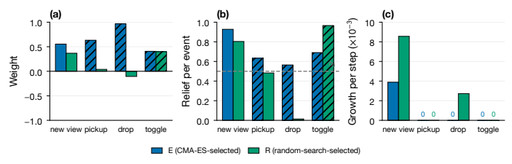
Figure 7 :E pays its first pickup, drop and toggle once per episode; R slightly penalizes drops.(a) Weights, (b) reliefs (dashed:h0) and (c) refill rates of the frozen E and R genomes, per event. Hatched bars mark events whose single occurrence empties the need and whose need never refills. R’s drop penalty is at most about 0.003 of intrinsic reward per drop (derived reference). A record of the frozen rewards. Produced bymake figure7 ; data: results/figure7_genomes.csv.
Original paper · CC BY 4.0 · Chase J. Metoyer · Found by Search, Broken by a Shortcut: Transfer and Tampering of Searched Intrinsic Rewards · Original paper figure · Extracted the figure area from page 14 of the original PDF.Why hand-built rewards need a shortcut test
The earlier paper's hand-built homeostatic satiation reward failed because agents could fill their own needs. The reward was designed by hand, so the failure came from the designer's choices rather than from the search. Singh et al. define primary reward functions as selected for evolutionary success across environments. That framing suggests a search might avoid the hand-design mistake that caused the earlier failure.
The earlier paper's satiation reward wireheaded through that same kind of reset action.
The three questions are whether searched rewards help, whether they transfer, and whether they resist an exploit absent from the search. The authors answer them in three pre-registered stages, so each question gets its own evidence. Stage 1 calibrates tasks and fixes a corrected event detector before any search runs. Stage 3 then tests the selected rewards on training tasks, a held-out task, and a free reset action.
Comparing E and R compares two selected genomes, so one draw per method cannot rank the methods.
CMA-ES runs in pycma with population 10 for 12 generations, starting from initial mean 0.5 in every coordinate. Random search draws 120 candidates uniformly from the same box, so both methods share one latent search space. Because the protocol was committed publicly before any search result existed, the authors could not tune choices after seeing outcomes.
How the drive reward is computed
A candidate reward computes a signed drop in a weighted quadratic drive from four needs at each step. Each of the four needs starts at 0.5 in every episode. At each step a need grows by its refill rate and is relieved by its event in proportion to its relief value. A single clip keeps every need inside the unit interval after this update.
The intrinsic reward is the value of the drive before a step minus its value after the step. PPO trains on the task reward plus this intrinsic reward with coefficient 1.0.
Because the reward telescopes over an episode, the intrinsic return cannot leave a band set by the weights. For any policy and any discount in (0, 1], the return lies between V(h0) minus the sum of positive weights and V(h0) minus the sum of negative weights. A reset at the first step pays P0, which equals the sum of each weight times the squared starting need, and the tamper prediction used this value.
Stage 1 fixed four detector choices, including counting events on an episode's final step and excluding a task-completing pickup. The earlier paper's archived detector skipped final-step pickup and door events and had no drop event, so its counts differ from ours. For E, the start payoff is 0.6396352350711823, computed from its frozen float32 weights.
Its fixed positive sign made the registered prediction a collapse under a reset action.
How the two rewards were selected
The search used the same twelve-number latent box for both methods, so the two selections started from one space. CMA-ES ran 12 generations of population 10, with initial mean 0.5 in every coordinate and initial step size 0.25. Random search drew 120 candidates uniformly from that box, which matched CMA-ES's 120 candidates in total. Seed panels were shared within each generation or batch, so candidates in one group were scored on the same seeds.
Stage 2 trained 1,560 runs in total, including 1,440 search runs and 120 re-evaluation runs. The Stage 2 protocol was locked in commit f757692 and pushed publicly at 14:29:28 UTC on 28 October 2026, before any search run. That lock also froze the winner rule, so the selection rule was fixed before the results existed.
E and R are two selected genomes, so their comparison doesn't rank CMA-ES against random search. Every CMA-ES finalist fell on re-evaluation, while every random-search finalist rose. The winner's-curse reading of the CMA-ES drop is post hoc, and the different re-evaluation seeds are a competing explanation. Runs used whatever CPU type the provider assigned, so every comparison in the final evaluation is unpaired.
Transfer to the held-out task
KeyCorridorS3R2 was never used during the search, so it tests whether a selected reward transfers. Stage 3 compared E with task-only PPO (T), episodic novelty (N) and the random-search reward (R) on this held-out task. Each comparison was a one-sided Mann–Whitney U test on mean training-curve area, with Holm adjustment across the three primary comparisons.
All three primary comparisons were hits: E gained 0.452 over task-only PPO, 0.393 over episodic novelty and 0.159 over R in mean area. Each Holm-adjusted p-value was at most 0.00015, so each gap also met the registered size rule of 0.05.
E solved 4 of 20 seeds, while R, T and N solved none of 20, which the authors report as descriptive. The permutation p-value of 5×10⁻⁶ sits at the permutation floor, so it bounds the evidence rather than estimating it. The satiation reward S solved 20 of 20 seeds with mean area 0.768, against E's 4 of 20 and 0.457 mean area. S was not tested against E, and the authors report this comparison as descriptive only.
So the result shows that generic events transfer, but not as well as events told which matter on this task.
On UnlockPickup, where S uses generic events, E's mean area was 0.349 compared to 0.073 for S, a gap of 0.276. This gap is pre-specified descriptive, so it adds a second task where the generic-event comparison favours E.
Training tasks and the re-evaluation gap
On both training tasks, E beat task-only PPO and episodic novelty in the registered tests. For UnlockPickup, the Holm-adjusted p-values were at most 2×10⁻⁵ against both comparators. So that comparison is not a hit, and the authors don't call it a difference. E versus R on the training tasks was the other comparison, and it missed on both tasks.
The search itself ranked E above R, with the best CMA-ES candidate scoring 0.707 in search. On fresh seeds, that same candidate fell to 0.587 in re-evaluation. The best random-search candidate, 57, scored 0.610 in search and rose to 0.632 on re-evaluation. All 3 random-search finalists scored higher, with changes of +0.022, +0.042 and +0.108.
The authors read the CMA-ES drop as a winner's curse from selecting on noisy three-seed estimates. That reading alone doesn't explain the random-search rises, so the authors look for a second cause. The authors didn't test either explanation.
A reset action collapses learning
The reset action was absent from the search, and its effect on E was tested by retraining E on DoorKey-8x8 with and without it. So pressing it pays the whole current drive, which is the exploit the search never saw. That sign fixed the registered prediction as collapse, tested as a one-sided Mann–Whitney test with no fallback.
The difference of 0.693 sits at the permutation floor, with U = 393.0 and p = 5×10⁻⁶. Seeds solved fell from 20 of 20 to 4 of 20, a pre-specified descriptive result. The reset-on arm also scored below task-only PPO, whose DoorKey-8x8 mean area is 0.286. Tamper-on E's mean area was 0.150 below that baseline, but the two panels used different seeds and no test was registered.
The authors read the tamper-on runs as wireheading-like, following a label they set before the data existed. Tamper-on agents pressed on 7.9% of steps in the final tenth of training, against 14.3% for a uniform policy.
Policy entropy stayed high with the reset action on, at 1.634 nats over all updates against 0.787 without it. Over the final 9 logged updates the entropies were 1.516 and 0.387, with a uniform policy at 1.946 nats. The tamper-on agents kept pressing the reset action and never became decisive, while tamper-off agents did.
What the frozen rewards pay for
E gives positive weights to all four events, and only its view need refills, about every 258 steps. Its pickup, drop and toggle needs are spent by one event, so E pays only the first of each in an episode. A single occurrence empties the need, because the relief at h0 = 0.5 clears it and the need never refills. R has a small negative drop weight of −0.106 and a drop relief of 0.014, so it slightly penalizes drops.
Each drop lowers R's intrinsic reward by at most about 0.003, a derived reference the authors compute from |w|s(2−s). R's drop and view needs refill, while its toggle need is spent by one event and its pickup need takes two.
The authors measured these genome features across all searched candidates, and they label the associations exploratory and post hoc. Among random-search candidates alone, the same toggle contrast was 0.204 against 0.068, and pickup showed the same pattern. The drop association reversed among random-search candidates, 0.105 compared to 0.171.
The authors treat the pooled drop association as unsupported.
Limitations of the held-out and tamper evidence
The transfer claim rests on one held-out task, KeyCorridorS3R2, and the paper says so directly. Search used two training tasks in MiniGrid, so the evidence covers only a narrow set of environments. The paper's own conclusion is that the search selected for the environments it was shown. Those 3 seeds per candidate came from generation-specific seed panels, so the search scores are noisy.
Same-seed runs weren't bit-identical across CPU types, so the comparisons are unpaired. On UnlockPickup, where S uses generic events, S scored below E, which the paper reports as 0.276 higher for E. E against R compares two selected genomes, so it doesn't test the two search methods themselves.
The exploratory analyses are post hoc, and they draw on an adaptively sampled population. The tamper test covers DoorKey-8x8 only, with free presses and E only. Event definitions differ from the earlier paper's archived detector, so comparisons with that paper stay qualitative.
Paper info
- Authors
- Chase J. Metoyer
- Venue
- arXiv · Preprint
- First published
- 2026-11-3
- Added
- 2026-11-5
- Updated
- 2026-11-3
- Version
- v1
- arXiv
- 2611.04838
- Category
- cs.LG · cs.AI
- Original paper terms
- CC BY 4.0
- What we show
- Paper info, commentary and permitted figures from the original paper
AI commentary is a separate explanation from the original paper and may contain errors. The original paper and figures follow each source's terms of use and any rights noted separately.
Abstract
Can a search over innate drives find intrinsic rewards that help a reinforcement-learning agent learn, transfer to a task it never saw, and resist an exploit that was absent during the search? Each candidate reward combines four generic events (a new view, a pickup, a drop and a toggle), each with a weight, a relief and a refill rate. We ran three pre-registered stages; the search protocol was locked in a public, timestamped commit before any search result existed. CMA-ES and an equal-budget random search used 1,560 PPO training runs, and the final evaluation and tamper test used 340. On the held-out task, KeyCorridorS3R2, the CMA-ES-selected reward (E) beat task-only PPO, episodic novelty and the random-search-selected reward (R) in all 3 registered comparisons, all of them meaningful by the registered size rule. Among these generic rewards E transferred best; the earlier paper's satiation reward, which on this task is given hand-wired key and locked-door events, did better (20 of 20 seeds solved against 4 of 20; descriptive). On UnlockPickup, where that reward uses generic events, E's mean area exceeded it by 0.276 (descriptive). On the training tasks there was no registered difference between E and R: both E-over-R tests missed. A free reset action, absent during the search, collapsed E's learning on DoorKey-8x8 (mean area 0.829 without it, 0.136 with it; registered) to below task-only PPO (descriptive). The searched drives helped on every task tested, but a reward given task-specific events did better on the held-out task, and selection gave E no protection against an exploit absent from the search.
Figures from the paper
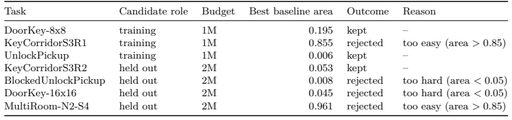
Table 1 :Stage 1 task selection (registeredrule, applied mechanically).Best baseline mean training-curve area over task-only PPO and episodic novelty, 5 calibration seeds per arm, at the budget the rule uses. A training candidate also needed positive task success by 2M in some baseline seed; UnlockPickup met that condition. Produced bymake table1 ; data: results/ table1_calibration.csv.
Original paper · CC BY 4.0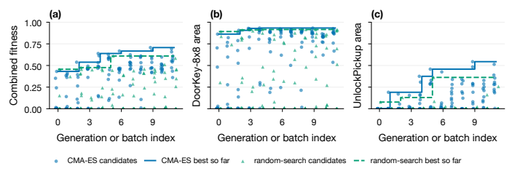
Figure 2 :Both searches found candidates that learned DoorKey-8x8; CMA-ES reached higher search scores on UnlockPickup (3-seed search scores; not confirmed on re- evaluation, Table 2).Search fitness of all 240 candidates (3 seeds per task each) by CMA-ES generation or random-search batch, with each method’s best score so far. Candidates in one generation or batch shared a seed panel; the random-search batch index has no optimization meaning. Search scores are the selection signal, not independent estimates (pre-specified descriptivedata, exploratory/post hocdisplay). Produced by make figure2 ; data: results/figure2_search.
Original paper · CC BY 4.0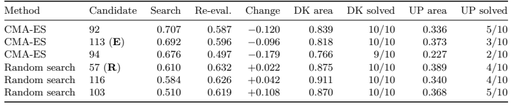
Table 2 :Every CMA-ES finalist fell on re-evaluation; every random-search finalist rose. Search fitness (3 seeds per training task) and re-evaluated fitness (10 fresh seeds per training task) of the 3 finalists per method; the re-evaluated score selects the winner, so it is also a selection-panel score. Valuespre-specified descriptive; the change column is anexploratory/post hoc display. Produced bymake table2; data:results/table2_finalists.csv.
Original paper · CC BY 4.0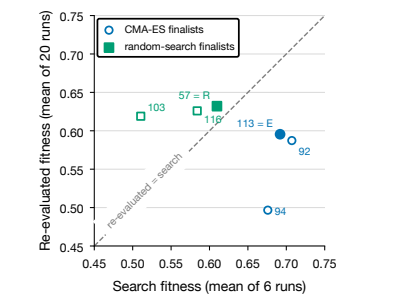
Figure 3 :Search scores overstated the CMA-ES finalists.Finalist search fitness against re- evaluated fitness; filled markers are the frozen winners E and R. Points below the dashed line scored lower on fresh seeds.pre-specified descriptivevalues; the winner’s-curse reading in the text is exploratory/post hoc. Produced bymake figure3; data:results/figure3_finalists.csv.
Original paper · CC BY 4.0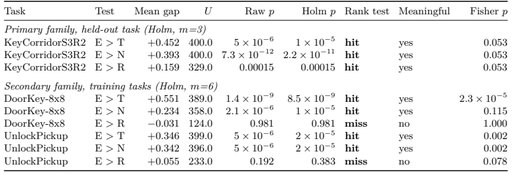
Table 4 :Every planned comparison.One-sided Mann–Whitney tests of E against each compara- tor on mean training-curve area (registered); Holm within each family. “Meaningful” additionally requires an observed mean gap of at least 0.05. A permutationp of5 × 10−6 is the floor for 200,000 resamples. The last column is the protocol’s exploratory one-sided Fisher test on solve counts (pre-specified descriptive), which supplies no hits. Produced bymake table4 ; data: results/table4_comparisons.csv.
Original paper · CC BY 4.0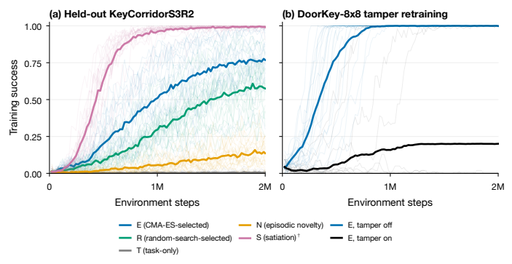
Figure 4 :E learned the held-out task better than T, N and R, and S, whose KeyCorridor events are hand-wired, learned it best; a free reset action collapsed E’s learning on DoorKey-8x8.Training success (rolling success over the last 100 completed training episodes) for every seed (thin) and the seed mean (thick), 20 seeds per line. (a) KeyCorridorS3R2, never used during the search. (b) E retrained with and without the reset action. The registered endpoints are the curve areas (Table 4); on UnlockPickup, where S uses generic events, E’s mean area exceeded S’s (Table 3).†On KeyCorridor tasks S’s events are hand-wired (key pickups only; only the opening of the initially locked door) and its door need refills. The registered Stage 3 figure redrawn from the same data, with relabelled legend entries, a new tamper-on colour, a fuller panel (b) label and a shorter height. Produced bymake figure4; data:results/figure4_heldout_tamper.csv.
Original paper · CC BY 4.0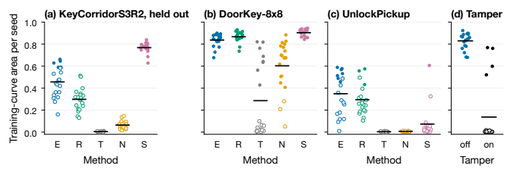
Figure 5 :Per-seed areas show the same ordering as the means, with wide spread for E on the held-out task.Training-curve area of every seed; filled markers are solved seeds, hollow markers unsolved; bars are seed means, 20 seeds per arm. (a)–(c) Final evaluation; S on KeyCorridorS3R2 has hand-wired events, while on UnlockPickup, where S uses generic events, E’s areas were higher. (d) E retrained on DoorKey-8x8 with the reset action off and on.pre-specified descriptive. Produced bymake figure5; data:results/figure5_per_seed.csv.
Original paper · CC BY 4.0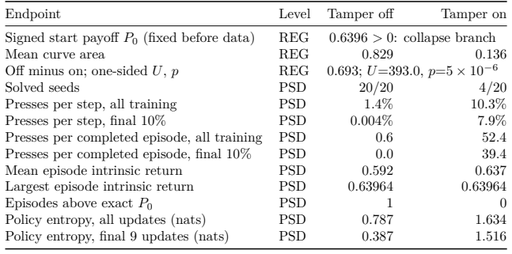
Table 5 :A free reset action collapsed E’s learning, and the tamper-on agents collected nearly the whole episode ceiling.E retrained on DoorKey-8x8, 20 seeds per condition. Press rates and returns are means over seeds. The final 10% of training is the last tenth of environment steps. Level:registeredorpre-specified descriptive. Produced by make table5 ; data: results/table5_tamper.csv.
Original paper · CC BY 4.0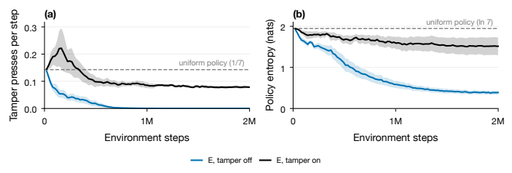
Figure 6 :Tamper-on agents kept pressing and kept high policy entropy; tamper-off agents stopped pressing and became decisive.(a) Share of environment steps on the reset action and (b) PPO policy entropy over training, mean over 20 seeds per condition (all seeds in every logging window) with 95% intervals. Dashed lines are arithmetic references for a uniform policy over the 7 actions (derived reference), not measured policies. Without the tamper flag the action is a no-op, but its presses are still counted.pre-specified descriptive. Produced by make figure6; data:results/figure6_tamper_dynamics.csv.
Original paper · CC BY 4.0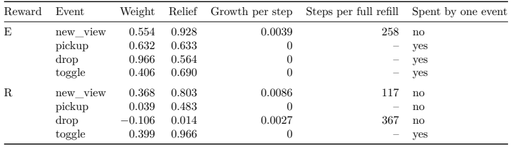
Table 6 :The frozen genomes.Effective float32 parameters. “Spent by one event”: a single occurrence empties the need (relief at leasth0 = 0.5) and the need never refills, so only the first such event in an episode pays. A record of the frozen rewards; “steps per full refill” is1/g (derived reference). Produced bymake table6; data:results/table6_genomes.csv.
Original paper · CC BY 4.0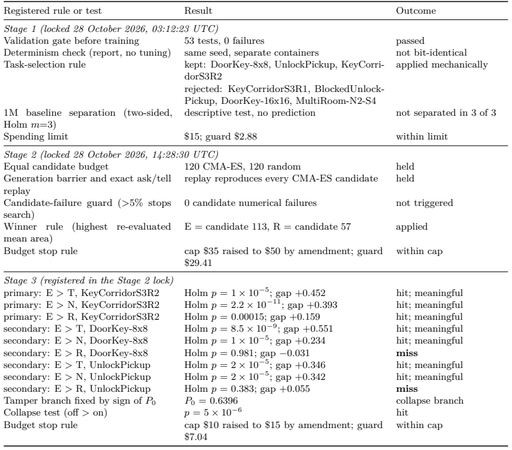
Table 7 :Registered rules and their outcomes.Stage 1 rules come from the locked Stage 1 protocol; Stage 2 and Stage 3 rules from the locked Stage 2 protocol. The Stage 1 separation test was registered as a two-sided, descriptive test with no prediction. Produced bymake table7 ; data: results/table7_outcomes.csv.
Original paper · CC BY 4.0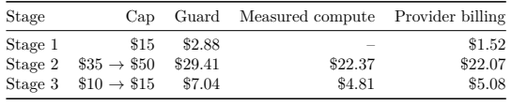
Table 9 :Spending by stage, in three quantities that overlap and must not be added.The guard is a conservative reservation total, not a charge. The measured compute estimate multiplies requested resources by measured wall time. Provider billing covers complete billing intervals only and is not a final invoice. Produced bymake table9; data:results/table9_costs.csv.
Original paper · CC BY 4.0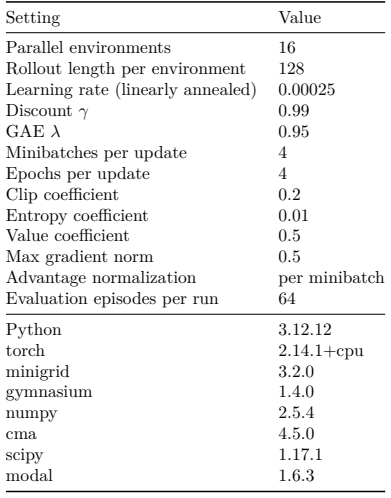
Table 11 :PPO settings (the earlier paper’s) and software versions.From the archived trainer configuration and the locked environment. Produced bymake table11 ; data: results/ table11_hyper.csv.
Original paper · CC BY 4.0Quote from the paper
Chase J. Metoyer (2026). Found by Search, Broken by a Shortcut: Transfer and Tampering of Searched Intrinsic Rewards. arXiv:2611.04838v1. https://arxiv.org/abs/2611.04838v1
BibTeX
@misc{metoyer2026found,
  title = {{Found by Search, Broken by a Shortcut: Transfer and Tampering of Searched Intrinsic Rewards}},
  author = {Chase J. Metoyer},
  year = {2026},
  eprint = {2611.04838},
  archivePrefix = {arXiv},
  url = {https://arxiv.org/abs/2611.04838v1}
}