Paper commentary
A Dependable Hybrid Machine Learning Model for Network Intrusion Detection
- Problem Machine learning intrusion detectors struggle when intrusion data is imbalanced and contains many irrelevant features, and accuracy alone can hide type-1 and type-2 errors.
- Method Balances the training data with SMOTE, keeps a reduced feature set chosen by XGBoost, then trains RF, DT, KNN, MLP, CNN and ANN on it and compares them.
- Results Random Forest reached 99.99% accuracy on KDDCUP’99 and 100% on CIC-MalMem-2022, both with 20 selected features.
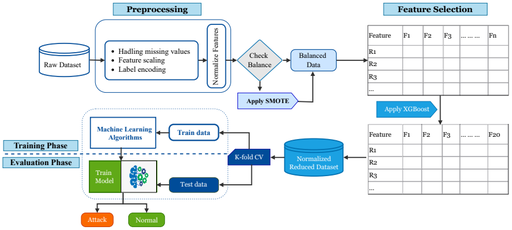
Figure 4 : Proposed framework for feature selection and intrusion detection.
Original paper · CC BY 4.0 · Md. Alamin Talukder, Khondokar Fida Hasan, Md. Manowarul Islam, Md Ashraf Uddin, Arnisha Akhter, Mohammad Abu Yousuf, Fares Alharbi, Mohammad Ali Moni · A Dependable Hybrid Machine Learning Model for Network Intrusion Detection · Original paper figure · Extracted the figure area from page 15 of the original PDF.Why intrusion detection on imbalanced, high-dimensional data is hard
Machine learning-based intrusion detection can flag anomalous behaviour on internet-connected devices, but building such a system is difficult. Compared with signature matching, learning-based detectors often raise more false positives and need a large amount of training data. Irrelevant and excessive features enlarge the dimension of the input and hinder accurate classification, which lowers the reliability of the model.
Class imbalance is a further problem, because a classifier can end up predicting the dominant class more accurately than the others. Many earlier studies reported precision, recall and f1-score on imbalanced data, and most did not build a confusion matrix to count type-1 and type-2 errors.
The study therefore pairs class balancing with dimension reduction and evaluates the models with a confusion matrix as well as with accuracy. Its research question is whether combining SMOTE balancing with XGBoost feature selection improves intrusion detection by ML and DL classifiers on two datasets.
A balance-then-select pipeline with a model comparison
The pipeline runs in five stages, and each stage feeds the next. Raw records are first cleaned, scaled and label-encoded, then the classes are checked and SMOTE is applied only when they are imbalanced. XGBoost then keeps the most relevant features, and the reduced data is split into training and testing sets with K-fold cross-validation before the classifiers are trained and compared.
Missing values are handled by deleting rows that contain nan, infinite values or duplicate entries. Standardization subtracts each attribute's mean and divides by that attribute's standard deviation, so attributes measured in different units fall into a comparable range.
SMOTE creates synthetic minority-class records by modifying selected records one column at a time, based on differences from their neighbouring records. The authors choose oversampling of the minority class over undersampling, and they apply it to KDDCUP’99 because that dataset is imbalanced and balancing is meant to limit overfitting.
XGBoost is an embedded feature selection method, so the selection is built into model training rather than being a separate filter step. The reported proposed-model rows use 20 features selected by XGBoost.
RF, DT, KNN, MLP, CNN and ANN are all trained on the reduced data, and the best-performing model is recommended for intrusion detection.
Two benchmark datasets with different structure
The experiments use 10% of KDDCUP’99, taken from the file kddcup.data 10 percent.gz, to reduce experiment time and cost. Each record has 41 input features, and the dataset contains 494021 data points. The records are grouped into dos (391458), u2r (52), r2l (1126), probe (4107) and normal (97278) classes.
CIC-MalMem-2022 is a memory-based dataset of obfuscated malware that includes spyware, ransomware and Trojan horse samples. Because KDDCUP’99 is multiclass and imbalanced while CIC-MalMem-2022 is binary and balanced, the two tests cover different kinds of problem.
KDDCUP’99 results across classifiers
On the multilabel task, the proposed pipeline gives 99.99% accuracy for RF, 99.99% for DT, 99.98% for KNN and 99.93% for MLP. The paper reports accuracy gains of 0.01%, 0.03%, 0.01% and 0.01% for RF, DT, KNN and MLP when the selected features are used.
The multilabel confusion matrices show that RF and DT place most records on the diagonal, with very few off-diagonal errors. For RF, 2 Normal records are predicted as DoS and 1 as Probe, while the DoS row has 38983 correct predictions. The authors conclude that RF outperforms the other ML and DL algorithms in both binary and multilabel classification.
CIC-MalMem-2022 binary results
On binary classification, RF, DT, KNN, MLP, CNN and ANN reach 100%, 100%, 99.97%, 100%, 99.98% and 100% accuracy respectively. RF, DT, MLP and ANN reach 100%, while KNN gives the lowest accuracy at 99.97%, with an RMSE of 1.85%.
The RF confusion matrix has 3012 benign and 2847 malware records correctly classified, with no errors. KNN makes one benign-to-malware and one malware-to-benign error, giving 3011 and 2846 on the diagonal. The ROC AUC is 100% for RF, DT, KNN and MLP.
After comparing all ML and DL algorithms, the authors select RF and ANN for binary intrusion detection on this dataset.
The epoch sweep used as a scalability check
Scalability is checked by extending the number of epochs from 125 to 200, and the accuracy of the proposed approach stays nearly unchanged. The authors read this stability as evidence of flexibility and scalability.
Comparison with previously reported accuracies
The authors argue that their XGBoost-based selection gives more value than PSO, BAT, IGR, CR, ReF, EFS and FGLCC+CFA, because XGBoost uses second-derivative information and L1 and L2 regularisation. These comparison rows come from different papers with their own feature selection methods, classifiers and feature counts, so they are reported numbers rather than a controlled comparison.
Limitations
The model has not been tested against emerging threats, which the authors leave to future work once newer datasets are available. The authors also plan to compare their results with an ensemble feature selection method that uses the union and intersection of features. The KDDCUP’99 evaluation uses only 10% of the dataset.
Paper info
- Authors
- Md. Alamin Talukder, Khondokar Fida Hasan, Md. Manowarul Islam, Md Ashraf Uddin, Arnisha Akhter, Mohammad Abu Yousuf, Fares Alharbi, Mohammad Ali Moni
- Venue
- arXiv · Preprint
- First published
- 2022-12-8
- Added
- 2026-11-6
- Updated
- 2023-1-27
- Version
- v2
- arXiv
- 2212.04546
- DOI
- 10.1016/j.jisa.2022.103405
- Category
- cs.CR · cs.LG
- Original paper terms
- CC BY 4.0
- What we show
- Paper info, commentary and permitted figures from the original paper
AI commentary is a separate explanation from the original paper and may contain errors. The original paper and figures follow each source's terms of use and any rights noted separately.
Abstract
Network intrusion detection systems (NIDSs) play an important role in computer network security. There are several detection mechanisms where anomaly-based automated detection outperforms others significantly. Amid the sophistication and growing number of attacks, dealing with large amounts of data is a recognized issue in the development of anomaly-based NIDS. However, do current models meet the needs of today's networks in terms of required accuracy and dependability? In this research, we propose a new hybrid model that combines machine learning and deep learning to increase detection rates while securing dependability. Our proposed method ensures efficient pre-processing by combining SMOTE for data balancing and XGBoost for feature selection. We compared our developed method to various machine learning and deep learning algorithms to find a more efficient algorithm to implement in the pipeline. Furthermore, we chose the most effective model for network intrusion based on a set of benchmarked performance analysis criteria. Our method produces excellent results when tested on two datasets, KDDCUP'99 and CIC-MalMem-2022, with an accuracy of 99.99% and 100% for KDDCUP'99 and CIC-MalMem-2022, respectively, and no overfitting or Type-1 and Type-2 issues.
Quote from the paper
Md. Alamin Talukder, Khondokar Fida Hasan, Md. Manowarul Islam, Md Ashraf Uddin, Arnisha Akhter, Mohammad Abu Yousuf, Fares Alharbi, Mohammad Ali Moni (2022). A Dependable Hybrid Machine Learning Model for Network Intrusion Detection. arXiv:2212.04546v2. https://doi.org/10.1016/j.jisa.2022.103405
BibTeX
@article{talukder2022dependable,
  title = {{A Dependable Hybrid Machine Learning Model for Network Intrusion Detection}},
  author = {Md. Alamin Talukder and Khondokar Fida Hasan and Md. Manowarul Islam and Md Ashraf Uddin and Arnisha Akhter and Mohammad Abu Yousuf and Fares Alharbi and Mohammad Ali Moni},
  year = {2022},
  eprint = {2212.04546},
  archivePrefix = {arXiv},
  doi = {10.1016/j.jisa.2022.103405},
  url = {https://arxiv.org/abs/2212.04546v2}
}