Paper commentary
Pixels over Symbols: Sensory Realism Improves Behavioral Alignment in Models of Cognition
Sensory realism makes cognitive models behave more like humans than abstract inputs
- Problem Cognitive models usually take one-hot codes instead of images, and nobody had tested whether that changes behavior. Such abstract inputs may therefore misrepresent how cognition works.
- Method The authors train sensory-realistic models that take images and abstract models that take symbolic vectors on the same 43 memory tasks. They then compare both with human response data.
- Results Image-input models match human behavior more closely than abstract models across five architectures, with a gap of 0.199 in human consistency. The input format, not the recurrent weights, drives most of this gap.
Why abstract inputs need a test
Cognitive models usually receive stimuli as one-hot or scalar codes rather than the high-dimensional signals a brain receives. That convention rests on two grounds, and the first is computational. Developing cognitive models that process raw sensory data had been computationally infeasible. Processing natural inputs such as high-resolution images at scale was not possible until recently.
The second ground is theoretical: sensory observations are assumed to be abstracted before they reach cognitive brain regions. Studies of primate associational cortices report categorical encoding of stimuli, which supports this view.
Abstract inputs also inherit a long experimental tradition, because cognitive paradigms use dots, gratings, or colored patches. Models are then designed to mirror these paradigms, so the abstract format spreads from experiment into model. Sensory-realistic models can now capture behavioral and neural responses in perceptual and language tasks.
Several studies have started applying such models to memory and decision-making, yet the authors note it remains unclear whether sensory realism matters. The assumption that abstract models reproduce cognitive behavior as effectively has not been tested directly.
No prior work has asked whether the format of the input modulates the cognitive behavior that emerges. No prior work has also asked whether the internal solutions these models find depend on the input geometry. This matters because many mechanistic claims about circuit dynamics and decision algorithms rest on models trained with abstract inputs.
The authors close this gap with a comparison of abstract-input and sensory-realistic networks on memory-dependent decision tasks. They pair the models with human behavioral data and analyze both error patterns and recurrent dynamics.
The paper reports that sensory-realistic models reproduce human behavioral responses significantly more closely than abstract-input counterparts.
Two input routes into one sequence model
The design keeps the sequence model fixed and changes only what enters it. Abstract models receive a hand-built vector per frame, made of one-hot category, identity and position codes, scalar rotation and scale, and a one-hot task index. The abstract vector has 8 category dimensions, 64 identity dimensions, 9 position dimensions, 3 rotation dimensions, 1 scale dimension and 43 task dimensions.
Natural models receive the image itself, which the frozen pretrained vision encoder turns into token embeddings. Attention pooling then collapses those tokens into one embedding of size D, and the task index is concatenated to it.
Both routes pass through the same projection, zproj_t = GELU(LayerNorm(W_in z̃_t)), so each route reaches the same width D. The projection stands in for the input stage of each route, and the rest of the network sees only the projected vector. A sequence module f_θ carries a hidden state h_t from frame to frame, taking the projected input and the previous state.
A linear head W_out reads a LayerNorm of that hidden state and produces two class logits, one for match and one for non-match.
The vision encoder stays frozen, so training changes the input projection, the sequence module and the output head. Abstract models receive object identity as one-hot vectors, so the training split keeps every object in training. Otherwise, the identity inputs for held-out objects would never be updated, and Abstract models would have no useful identity information for them.
Both model types are trained on the same 43 tasks from four families, which the authors built with iWISDM. The Abstract and Natural models therefore share one task set and differ only in how each stimulus enters the network.
Tasks, stimuli and the human benchmark
Figure 1 lays out the design: humans, models trained on either input type, and pretrained VLMs all respond to the same trial structure. Each group's responses become choice probabilities for every trial, and those probabilities feed the behavioral metrics. Natural models receive the image itself, while Abstract models receive symbolic vectors, so the comparison isolates the input format.
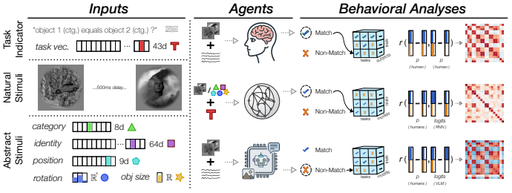
Figure 1 :Schematic of the Experimental Setup.Models receive both task and stimulus information in their inputs. Task indicator is provided in either textual or one-hot while stimuli are presented in their naturalistic or abstract formats. In the abstract format, information about the primary object in the scene is provided as a combination of one-hot (category, object identity, position) and scalar values. Three groups are studied: humans, neural network models trained on abstract or natural inputs, and pretrained vision-language models. Behavioral responses are collected from each group and used to estimate the choice probabilities for each task trial. These probabilities are then used to calculate behavioral consistency with humans using different metrics.
Original paper · CC BY 4.0 · Hao Yuan Bai, Xiaoxuan Lei, Zihan Weng, Motahareh Pourrahimi, Lucas Gomez, Pouya Bashivan · Pixels over Symbols: Sensory Realism Improves Behavioral Alignment in Models of Cognition · Original paper figure · Extracted the figure area from page 3 of the original PDF.Stimuli come from the HvM dataset, which contains 5,760 images of objects on naturalistic backgrounds. The authors excluded the 100 images shown to human participants from training and validation. The remaining 5,660 images were split 3:1 within each object and variation level, giving 4,271 training and 1,389 validation images. Every object therefore appears in training, which the design needs because Abstract models take object identity as a one-hot input.
If some objects were held out, their identity input weights would never be updated, so Abstract models would have no useful identity signal for them.
Training uses 43 tasks from four families built with iWISDM: DMS, NBack, InterDMS and CtxDMS. DMS asks whether a sample and a test stimulus match on one target feature, which is the basic unit of the battery. NBack compares the current stimulus with the one n frames back, while InterDMS interleaves two independent DMS subtasks. CtxDMS makes the target feature of the second subtask depend on the outcome of the first.
For the behavioral test, the authors used 100 stimulus pairs balanced for category, identity and position. Twenty unique participants were recruited per task, and each task page included instructions and an example trial. Compositional tasks were split into 18 elementary conditions, so each group yields an 18 by 100 response matrix. Models were evaluated with 6 seeds per architecture, and VLM responses were scored on the same matrices.
Human consistency was computed from split-half groups of 10 participants, and model seeds were split into groups of 3.
Image input raises human consistency
Natural models and Abstract models were compared across five sequential architectures, all using the same training setup. The Natural models used ResNet-50 pre-trained with CLIP as the vision backbone. Abstract models reached significantly higher validation accuracy, 0.93-0.99 against 0.70-0.81 for Natural models. To remove that accuracy gap, the authors selected Abstract checkpoints with validation accuracy closest to 80%.
Those checkpoints matched the accuracy range of the Natural models on the MTurk dataset.
Across the five architectures, final checkpoints don't show higher human consistency, except for RNNs. Natural models, including VLMs, exceed their Abstract counterparts in human consistency regardless of the sequential architecture. The Natural models exceed their Abstract counterparts by 0.199, with a 95% CI of [0.170, 0.229] and paired t(4) = 18.76.
The gap holds in all 18 task conditions, with paired t(17) = 9.36. Feature-level analysis splits the trials into categories (30%), identities (33%), and positions (37%). Natural models are more human-consistent than Abstract models on every feature.
Within the three features, Abstract models come closest to humans on identity trials. Because the task families differ, the authors also correlated probability vectors within each family. Natural LSTMs are the most human-like on InterDMS and DMS trials, and Transformers lead on CtxDMS.
The authors then tested whether simple properties of the natural input explain the gap. Adding noise to mimic perceptual uncertainty lowered human consistency to zero. So neither dimensionality nor perceptual uncertainty alone explains the gap. That result points the authors toward input geometry and recurrent computation as the next things to separate.
To separate them, the authors run substitution analyses on the LSTM models, with ResNet-CLIP for Natural.
Swapping recurrent weights and projections
The key move is to freeze one model's recurrent weights and retrain only the projections on the other input type. A θAbs→Nat model loads frozen Abstract recurrent weights and trains the input and output projections on natural input. The reverse model, θNat→Abs, freezes Natural recurrent weights and trains the projections on abstract input.
Freezing the output head as well gives the (θ+W out) variants, which keep only the input projection trainable. A frozen, randomly initialized θ serves as the baseline, so the authors can separate what the projections alone can learn.
On natural input, θAbs→Nat reached 0.446 human consistency, close to the 0.452 of the natively trained Natural LSTM. A frozen untrained recurrent module gave 0.274, well below that result. (θ+W out)Abs→Nat reached only 0.258, so freezing the readout too costs alignment. The authors read this as the input carrying the alignment, not the recurrent weights.
On abstract input the substitutions helped little, with human consistency rising from 0.082 to 0.138 and 0.188. That is barely above 0.126 for an untrained recurrent module. These Abstract models used final checkpoints rather than the accuracy-matched ones. Freezing the output head further raised consistency on abstract input but lowered it on naturalistic input.
The untrained recurrent module's accuracy also depends on the input, at 0.78 on abstract input against 0.61 on natural input. In the dimensionality-matched models, retraining only the output projection dropped accuracy to chance in both directions. Retraining only the input projections recovered behavioral alignment and kept task accuracy, so the input projection matters most.
The authors conclude that the behavioral gap depends more on input representations than on recurrent weights.
Do the recurrent dynamics match?
The authors asked whether transplanted recurrent weights settle into dynamics that look native to the model they came from. Neural networks trained on symbolic inputs are widely used to explain how cognitive tasks are solved by neural dynamics. Their earlier results showed that Abstract models match human behavior poorly, but improve once their projections are retrained on natural inputs.
Two mechanisms could explain this improvement. Either the two models converge to similar recurrent computations, or the retrained input projection compensates for different dynamics. The distances are computed between sequence-core hidden states, and native models' seed-to-seed distances form the noise floor.
This holds for µ≥5 and most other DSA settings. An untrained recurrent module stays far from the native models, so the retrained projection alone doesn't produce this match. The input doesn't carry the match either, since the projected input stays far from that of native Natural models. The authors read this as the trained Abstract recurrent module producing dynamics similar to Natural models when driven by natural inputs.
Freezing the readout as well breaks the match. In the dimensionality-matched Abstract models, (θ+W out)Abs→Nat does stay within the native Natural seed-to-seed variability. A trained recurrent module therefore needs an input projection adapted to the new modality.
With abstract input, the recovery is only partial. This holds even when the projected input matches the native models. The behavioral gap therefore depends more on input representations than on recurrent weights, and the authors didn't identify which input properties matter.
Vision encoders, VLMs and RSA
The vision encoder choice also shapes human consistency, and the sweep points in one direction. Vision encoders pretrained with CLIP generally reached higher human consistency and accuracy than their ImageNet-supervised counterparts. DINOv3 was the most human-consistent vision encoder in that sweep. A frozen, randomly initialized ResNet-CLIP reached only 0.52 MTurk accuracy, and its human consistency dropped to almost zero.
That negative control shows the frozen encoder alone doesn't carry the task, so the pretrained features matter.
Pretrained VLMs fell behind most task-trained Natural models at reproducing human response patterns. gemini-3.1-pro-preview scored 0.821 on identity trials, compared to 0.814 for human participants. It exceeded human accuracy on every feature, though on identity only marginally. Its category consistency was the lowest among the VLMs, while its position consistency reached 0.369.
Gemini's position consistency trailed only the Natural LSTM, which reached 0.381.
The RSA analyses link response structure to human consistency. Natural models had much higher cross-task RSA alignment values than Abstract models, with paired t(4) = 8.13 and p = 1.2×10 −3. Cross-stimulus RSA tracked human consistency closely, with a correlation of 0.962. Human consistency also correlated strongly with the κ error-consistency metric, as shown in Fig.
10.
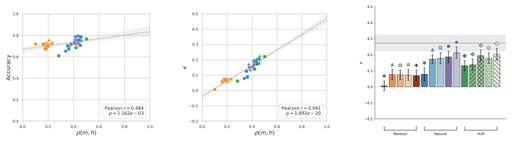
Figure 10 :Correlation of behavioral metrics.Across models, human consistency ρ(m, h)is almost linearly related to error consistency κ (Pearson r= 0.941 ) and much less to accuracy (r= 0.484 ), which motivates measuring model behavior beyond accuracy.
Original paper · CC BY 4.0Dimensionality and visual difficulty matching were the controls for the Abstract input. Matching the input dimensionality lowered Abstract human consistency from 0.183 to 0.115. So neither simple input property alone explains the gap between the two model types.
Limits of the current evidence
The best tested models account for 64% of the behavioral consistency observed across human participants, so a large part of the reliable structure stays unexplained. The authors point to factors outside their framework, including reward-history-dependent adaptation, metacognitive monitoring, and individual differences in learning strategy.
They also point to linguistic and conceptual priors built up over a lifetime of naturalistic experience as a possible missing piece.
Large VLMs reproduced a substantial fraction of human consistency without any task-specific training, which the authors read as a sign that multimodal pretraining transfers to structured cognitive demands. Larger and more demographically diverse cohorts would give more stable measures and allow analyses of individual differences in model-human alignment.
A frozen random encoder doesn't learn the tasks, which is why this confound can't be resolved with the current design. Training Abstract models on inputs that gradually move toward each vision encoder's space would directly test this account, and the authors did not run that test.
Natural images occupy a low-dimensional manifold inside a high-dimensional pixel space, so this control doesn't capture that structure. The intrinsic geometric properties of sensory realism that drive behavioral alignment therefore remain unidentified. The authors suggest class-conditional optimal transport as a way to morph one-hot encodings toward natural embeddings and get a dose-response curve.
Representational similarity analysis, centered kernel alignment, and linear probing could show where task-relevant variables emerge.
Paper info
- Authors
- Hao Yuan Bai, Xiaoxuan Lei, Zihan Weng, Motahareh Pourrahimi, Lucas Gomez, Pouya Bashivan
- Venue
- arXiv · Preprint
- First published
- 2026-11-7
- Added
- 2026-11-10
- Updated
- 2026-11-7
- Version
- v1
- arXiv
- 2611.10565
- Category
- q-bio.NC · cs.AI
- Original paper terms
- CC BY 4.0
- What we show
- Paper info, commentary and permitted figures from the original paper
AI commentary is a separate explanation from the original paper and may contain errors. The original paper and figures follow each source's terms of use and any rights noted separately.
Abstract
Computational models of cognition have traditionally relied on abstract symbolic inputs that approximate sensory experiences with simplified vector representations. This simplification reflects historical computational constraints and a long-held assumption that the details of sensory realism are incidental to the study of cognitive processes. Recent advances have enabled the development of sensory-realistic models capable of performing diverse cognitive tasks, yet whether sensory realism meaningfully shapes cognition has not been formally established. We address this gap through a large-scale empirical comparison of abstract and sensory-realistic neural network models trained on a battery of memory-dependent decision-making tasks. Our results show that sensory-realistic models mirror human behavioral response patterns significantly more than their abstract counterparts, though a substantial gap to human internal behavioral consistency remains even for the best tested models. By analyzing the internal dynamics of these systems, we find that the learned recurrent weights are not the main source of this divergence. In fact, frozen abstract-trained weights driven by sensory-realistic inputs recover the human consistency of sensory-realistic models. The resulting dynamics are also within the seed-to-seed variability of sensory-realistic models. Together, our findings argue that across a broad set of visual working-memory tasks, sensory realism accounts for a substantial portion of the model-human behavioral agreement, more than the choice of sequence architecture and comparable to the choice of vision encoder. These results suggest that findings obtained from abstract task models in neuroscience should be more carefully interpreted in light of their potential behavioral limitations.
Quote from the paper
Hao Yuan Bai, Xiaoxuan Lei, Zihan Weng, Motahareh Pourrahimi, Lucas Gomez, Pouya Bashivan (2026). Pixels over Symbols: Sensory Realism Improves Behavioral Alignment in Models of Cognition. arXiv:2611.10565v1. https://arxiv.org/abs/2611.10565v1
BibTeX
@misc{bai2026pixels,
  title = {{Pixels over Symbols: Sensory Realism Improves Behavioral Alignment in Models of Cognition}},
  author = {Hao Yuan Bai and Xiaoxuan Lei and Zihan Weng and Motahareh Pourrahimi and Lucas Gomez and Pouya Bashivan},
  year = {2026},
  eprint = {2611.10565},
  archivePrefix = {arXiv},
  url = {https://arxiv.org/abs/2611.10565v1}
}