Paper commentary
Reproducing the Speech Labels of Qwen3-Omni's Talker: Mimi in bf16, and a Last-Frame Pitfall
Mimi run in bf16 matches the labels behind Qwen3-Omni's Talker
- Problem Outsiders cannot fine-tune Qwen3-Omni's Talker on matching labels because the encoder that made its training labels was never released. Decoding matches alone leave open which weights, precision and preprocessing were used.
- Method The authors score candidate encoders with a teacher-forced likelihood test. Calibration models trained on known labels show that the Talker prefers codes from kyutai's moshi package with bf16 weights.
- Results The Talker's score favors moshi with bf16 weights at −1.212, compared to −0.509 for transformers bf16. A decoder-based test failed calibration, so it cannot be trusted.
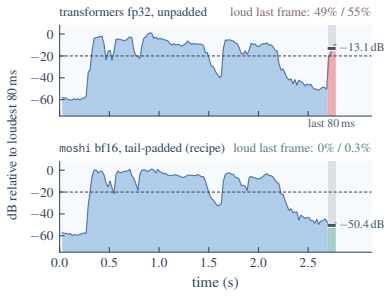
Figure 5 : Energy per 20 ms of one held-out Chinese sentence generated after LoRA voice adaptation, same text and sampling seed, with unpadded transformers fp32 labels (top) and with the recipe (bottom), in dB relative to the loudest 80 ms of the sentence; the two utterances differ slightly because the models differ. The bar marks the level of the shaded last 80 ms, the dashed line −20 dB. With the transformers labels the last 80 ms jump by 36 dB (from−49to−13dB; Chinese average +22 dB); with the recipe they fall to −50 dB. Percent- ages: share of generated sentences whose last 80 ms is above −20 dB (Chinese / English, mean of 3 training seeds; Table 3).
Original paper · CC BY 4.0 · Yuxuan Chen · Reproducing the Speech Labels of Qwen3-Omni's Talker: Mimi in bf16, and a Last-Frame Pitfall · Original paper figure · Extracted the figure area from page 8 of the original PDF.Why matching labels are out of reach
Each frame carries 16 codebooks: the Talker predicts the first, a multi-token predictor handles the other 15, and Code2Wav turns the codes into a 24 kHz waveform.
That missing encoder decides the labels used to fine-tune the Talker, so without it outsiders can't reproduce the training targets that set the voice. Community members had found that the codes decode with the decoder of kyutai's Mimi, and some projects already use Mimi to make labels. A decoding match still leaves open which weights, precision, library and preprocessing were used.
The choices matter: bf16 inference alone changes 12% of the codebook 1–4 codes, and loudness normalization changes 67%.
Probes for the encoder's identity
The central idea is that the Talker and its MTP were trained with cross-entropy on the unreleased encoder's codes, so a candidate that matches that encoder should look more likely to them. The authors feed each candidate's codes through the Talker and MTP under teacher forcing, then compare the resulting likelihoods with those of the fp32 reference codes.
The score is averaged over frames and codebooks 0 to 15: \[ \Lambda(C)=\frac{1}{T}\sum_{t}\sum_{k=0}^{15}\bigl[\log p(c^{\mathrm{ref}}_{t,k})-\log p(c^{C}_{t,k})\bigr] \] A negative value means the model prefers the candidate's codes.
A white-box check comes first: it fits ridge regressions from Mimi's codebook vectors to each Qwen codebook embedding table. The Talker's table reaches a cross-validated R2 of 0.45, and the MTP's tables reach 0.77 to 0.89, while shuffled rows destroy the fit. A codec with Mimi's architecture but other weights, Qwen3-TTS-Tokenizer-12Hz, predicts nothing, which rules out a different tokenizer.
The same check can't separate the public encoder from a fine-tuned one that keeps the same quantizer.
The authors also tried a decoder test, which swaps single codes and asks whether the quantization margins predict how far Code2Wav's output moves. The fp32 reference ranked highest, with an AUC of 0.701, which looked like support for the same-encoder hypothesis.
Calibrating the likelihood test
A likelihood can favor some codes just because they are easier to predict, so the authors train small code language models with the Talker's factorization on each encoder's labels. These calibration models are trained on 107.6 h of VCTK and AISHELL-3 audio. A model trained on C's labels should prefer C, and two seeds of the same model measure the noise, which is about 0.01.
The decoder test fails the same check. Three decoders trained from scratch all rank the reference first, including one trained only on random-5% labels.
Read against the Talker, the calibrated models show which candidates the Talker resists. The Talker penalizes transformers bf16 codes at −0.509, with a 95% speaker-level bootstrap interval from −0.654 to −0.384. Every model penalizes loudness-normalized codes heavily, and the Talker's penalties for the three random perturbations are tiny, at +0.026, +0.023 and +0.077.
Band-limiting is only partly ruled out: the Talker prefers band-limited test speech at −0.743, but its own generated speech suggests its labels contain less than 20% band-limited material.
Which implementation matches the Talker
The implementations diverge in several places at once: which kernels run, where values are cast, and how the quantizer measures distance. Residual quantization chains the codebooks, so one flipped code alters all the later ones. The authors encoded the test set with 22 variants and trained calibration models on each set of labels.
The Talker orders the variants the same way as a calibration model trained on moshi bf16 labels: moshi with bf16 weights first, then transformers bf16 and moshi with autocast, then fp16, fp32 and TF32. Its value for moshi bf16 is −1.212, compared to −0.511 for transformers bf16 in eager mode.
The preference survives a change of GPU, even though the codes themselves change. Encoding on an H100 instead of an RTX PRO 6000 changes 4–7% of the bf16 codes in codebooks 1–4, and the Talker's value for moshi bf16 codes is −1.232 compared to −1.212. The Talker's own sampled codes point the same way: the moshi bf16 calibration model fits them 0.683 nats per frame better than the fp32 model, with a CI of 0.60 to 0.75.
The authors note that this fingerprint constrains the implementation but not the weights.
The last-frame pitfall
Mimi's encoder is causal, so appending zeros changes only the last frame. The difference comes from how transformers handles the incomplete last frame: it pads inside each convolution, so the deeper layers see the network's response to silence.
Only the 6 utterances whose length is already a multiple of 1920 come out identical.
Figure 3 splits the Talker's Λ into a last-frame part and a part for the other frames, across batch sizes. The last-frame part falls to about −0.84 at n=2 and about −1.50 at n=8, while the other frames stay between −0.51 and −0.55.
What LoRA fine-tuning on these labels shows
The authors trained a LoRA on the Talker for two new voices: AISHELL-3 speaker SSB0033, with 23.4 minutes, and VCTK speaker p239, with 23.5 minutes. Each label set was run with three seeds, and only the labels changed between runs.
Intelligibility and speaker similarity didn't separate the label sets. CER differences ranged from −0.23 to +0.27 points, and similarity differences were at most 0.001. The difference lies at the end of the audio.
With unpadded transformers labels, about half the generated sentences end with a short noise burst. The burst is already present in the labels: 54% of unpadded transformers fp32 Chinese labels end above −20 dB, against at most 1.5% for moshi or padded labels. Padding alone removes it, because the moshi labels and padded transformers labels decay normally at the end.
Figure 5 shows one Chinese sentence: with unpadded transformers fp32 labels the last 80 ms jump by 36 dB, while the recipe keeps that segment near −50 dB. CSM-1B shows the same problem, with the released model's last frame costing 199.4 nats compared to 80.1 with moshi fp32 labels. Across these runs, 44–55% of Qwen3-Omni sentences ended in a noise burst after fine-tuning on unpadded labels.
Why the English voice drifts
In the merged checkpoint the LoRA also changes the shared Talker weights, so the preset voices Chelsie and Aiden speak with the new voices too. For spoken English questions the voice drifted toward the Chinese target speaker, with similarity to the voice's own text answers falling from 0.995 to 0.81 for p239.
Toolkit and decoding
The talker_tune tool prepares labels with the recipe, trains a LoRA adapter on the Talker and MTP, merges it into a full checkpoint and evaluates the result. In the authors' runs, 2.5 minutes of speech per speaker already carried the voice, and the Talker LoRA carried it rather than the MTP.
For listening to or scoring 16-codebook Mimi codes, Code2Wav beats Mimi's own decoder. Code2Wav's output lies 555 samples early relative to its input, so it has to be shifted back before comparing with reference audio.
Paper info
- Authors
- Yuxuan Chen
- Venue
- arXiv · Preprint
- First published
- 2026-11-24
- Added
- 2026-11-25
- Updated
- 2026-11-24
- Version
- v1
- arXiv
- 2611.32286
- Category
- cs.SD · cs.AI · eess.AS
- Original paper terms
- CC BY 4.0
- What we show
- Paper info, commentary and permitted figures from the original paper
AI commentary is a separate explanation from the original paper and may contain errors. The original paper and figures follow each source's terms of use and any rights noted separately.
Abstract
Qwen3-Omni speaks through a Talker predicting 16 codebooks of a 12.5 Hz audio codec, but the encoder that made its training labels was not released, so new voices cannot be trained on matching labels. We identify this encoder from the released model's behavior. White-box regression shows that the codebook embeddings of the Talker, its multi-token predictor and the Code2Wav decoder match the first 16 codebooks of kyutai's Mimi layer by layer. A decoder-based test looks convincing but fails calibration: decoders trained on known labels cannot tell them apart. Teacher-forced Talker likelihoods, calibrated with 13 code language models trained on known labels, do tell implementations apart: the Talker prefers labels from kyutai's moshi package with bf16 weights over every other variant we tried. Loudness normalization and band-limiting of 20% or more of the data are ruled out. Separately, transformers' MimiModel encodes the last frame differently from kyutai's encoder unless the input length is a multiple of 1920 samples. After LoRA fine-tuning on its labels, 44--55% of generated sentences end in a noise burst, and the same frame costs the Mimi-based CSM-1B 119 nats; padding the input removes both. We release the encoding recipe, a label checker and a Talker fine-tuning toolkit.
Quote from the paper
Yuxuan Chen (2026). Reproducing the Speech Labels of Qwen3-Omni's Talker: Mimi in bf16, and a Last-Frame Pitfall. arXiv:2611.32286v1. https://arxiv.org/abs/2611.32286v1
BibTeX
@misc{chen2026reproducing,
  title = {{Reproducing the Speech Labels of Qwen3-Omni's Talker: Mimi in bf16, and a Last-Frame Pitfall}},
  author = {Yuxuan Chen},
  year = {2026},
  eprint = {2611.32286},
  archivePrefix = {arXiv},
  url = {https://arxiv.org/abs/2611.32286v1}
}