Paper commentary
From Geometry to Function: A Multi-Task LiDAR Benchmark Dataset for Semantic and Functional Parsing of Urban Facades
HFX3D benchmark pairs facade LiDAR geometry with functional labels
- Problem Existing facade LiDAR benchmarks stop at geometry and semantic labels, so they cannot say what each building element does.
- Method HFX3D labels each facade in three tiers: semantic, instance, and functional. Annotators refine functional attributes from geometry and context, then check them by hand.
- Results PointNet++ scored 29.19 mIoU, above Point Transformer v2 at 20.65, on the held-out test split.
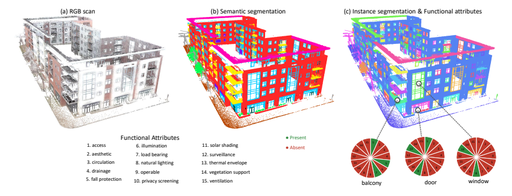
Figure 2 .Three tiers of facade annotation.From a raw MLS scan we provide (a) registered RGB, (b) 12-class semantic segmentation, and (c) per-instance segmentation. Each instance additionally carries a 15-attribute functional vector, shown as radial glyphs for a representative balcony, door, and window (green = present, red = absent).
Original paper · CC BY 4.0 · Abdiaziz Muse, Tooba Javed, Tao Pu, Jiju Poovvancheri, Dong Chen · From Geometry to Function: A Multi-Task LiDAR Benchmark Dataset for Semantic and Functional Parsing of Urban Facades · Original paper figure · Extracted the figure area from page 2 of the original PDF.Where facade LiDAR benchmarks stop
Facade LiDAR benchmarks already capture geometry in fine detail and label common components well. ZAHA introduced the hierarchical Level of Facade Generalization for fine-grained semantic parsing. UnderOneFacade emphasized geographic diversity and cross-domain generalization, but it doesn't provide instance or functional labels. None of these sets records what an element does, such as whether a window is operable or whether a column is load-bearing.
That gap matters because BIM reconstruction, structural analysis and energy modelling depend on function, not only on the class label.
Two windows can share a semantic label yet differ in operability, so a class-level label isn't enough. Figure 1 shows window operability, door access and stair fall protection varying within a single semantic class. Instance separation adds a second difficulty, because repetitive windows and adjacent balconies are hard to split apart. Instance segmentation works well indoors on ScanNet, but outdoor facade parsing of repeated elements remains comparatively underexplored.
Semantic segmentation has its own gap, since severe class imbalance and similar planar geometry leave rare classes with low recall. Functional standards such as CityGML, IFC and Getty AAT attach properties like load-bearing role and thermal-envelope membership to building elements. To the best of the authors' knowledge, existing LiDAR facade benchmarks don't provide per-instance functional attribute annotations.
HFX3D brings these functional concepts into a single LiDAR benchmark with semantic, instance and per-instance functional annotations.
Three annotation tiers on 26 scanned buildings
HFX3D stacks three annotation tiers on the same scans, moving from semantic classes to instances and then to functional attributes. A GeoSLAM ZEB Horizon handheld mobile LiDAR scanner captured the 26 buildings, with a co-mounted ZEB Vision camera supplying per-point RGB colour. The authors drew the buildings from 50 surveyed across five Halifax neighbourhoods, choosing a final subset that varies facade complexity, height, material and era.
GeoSLAM Faro Connect reconstructed and denoised each cloud, and CloudCompare then cleaned, coloured and exported it.
Four trained annotators labelled the point clouds by hand in CloudCompare, using the co-registered ZEB Vision fisheye imagery as visual reference. The annotators used 12 semantic classes, from wall and window through column and arch. Every building then went through two review rounds by annotators who had not labelled it, and disagreements went to majority vote.
After first-round corrections, the second-round mean Cohen's Kappa reached 0.99, and window stayed the hardest frequent class. Instances came from DBSCAN run on each semantic class, with ϵ tuned per building from 0.09 to 0.7. DBSCAN produced 8,586 candidate instances, and annotators refined them to 6,418 final instances, a 25.3% reduction.
The authors read this drop as DBSCAN's tendency to over-segment, and review corrected errors in both directions. Wall and terrain hold most labelled points, so class imbalance follows, with door and arch far rarer.
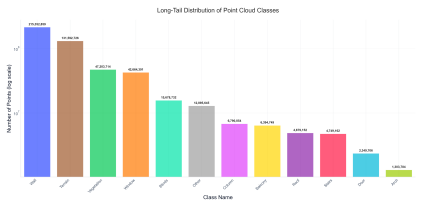
Figure 3 .Long-tailed class distribution (log scale).Wall and terrain dominate, while fine elements such as door and arch are far rarer.
Original paper · CC BY 4.0How a functional label is assigned
Each semantic instance starts with candidate attributes from a class-based mapping, built with reference to IFC 4.3 and the Getty Art & Architecture Thesaurus. Every candidate carries an expert-set prior \(P(a|c)\), which gives the starting odds for that attribute. A class fixes these priors, but it does not fix whether a particular window opens or whether a column is structural.
Refinement uses two extra signals per attribute: geometric evidence from dimensions, depth, orientation, elevation and ground contact, and contextual evidence from proximity, overlap, attachment and support. The three sources combine in the odds domain, with no class- or attribute-specific weights. The odds of the refined confidence equal the product of the three odds, as in the following equation.
\[ \frac{f_I(a)}{1-f_I(a)} = \frac{P_I(a)}{1-P_I(a)} \cdot \frac{G_I(a)}{1-G_I(a)} \cdot \frac{C_I(a)}{1-C_I(a)} \] Because conditional independence holds only approximately, the authors treat \(f_I(a)\) as a functional confidence rather than a calibrated posterior probability.
For attributes that need no refinement, both \(G_I(a)\) and \(C_I(a)\) are set to 0.5, which leaves the semantic prior unchanged. Evidence above 0.5 strengthens the prior and evidence below 0.5 weakens it, and an attribute is suggested as present when \(f_I(a) \ge 0.5\).
Annotators then check each highlighted instance in 3D, using scanner imagery and Google Street View, and correct or add attributes. For window operability they rely on visible geometric cues and imagery, and for columns they revise the load bearing and aesthetic attributes.
Two review rounds on ten buildings agreed on 93.2% of applicable attribute decisions. In a second test on two buildings, two second-round annotators reached 99.0% agreement, with a Cohen's kappa of 0.93. The split is 18 training, 4 validation and 4 test buildings, so no building contributes points to more than one split.
Semantic segmentation: KPConv leads, rare classes fail
Seven architectures were trained on the training split and then scored on the held-out test split. Each model had to cover every point before scoring, so six of the seven models used a shared KNN-crop procedure. KPConv instead used its reference potential-guided spherical sampling, because its radius-neighbourhood pipeline can't consume fixed-size crops.
All models shared a 7-dimensional input of XYZ, RGB and intensity, and none of them used test-time augmentation.
PointNet++ scored 29.19 mIoU and PointNet scored 26.30, both above Point Transformer v2 at 20.65. Point Transformer v3 reached 28.18, while DGCNN ranked last with 15.37. RandLA-Net scored 16.94, placing it just above DGCNN in the table. The most sophisticated architectures therefore did not win automatically, a pattern that differs from indoor S3DIS results.
Per-class IoU tracks class frequency, so KPConv scored 80.37 on wall and 91.59 on terrain. On the rarer classes, KPConv reached 42.05 on window, 19.47 on door and 0.01 on arch. Arch accounts for only 0.3% of the points, and every model recovered it with negligible IoU. PointNet++ reached 63.73 on stairs, yet it scored 0.00 on door and on arch.
The authors read class imbalance as a major bottleneck, which may partly explain why architectural sophistication doesn't translate into higher scores. They suggest class-balanced re-weighting or focal loss as remedies, but they didn't run either experiment in the paper. The authors note that similar rare-class struggles appear on TUM-FACADE and ZAHA.
Instance segmentation: the evaluation pipeline sets the score
Three learned methods were trained from raw point features, with no ground-truth semantic labels given as input. SoftGroup reached 0.2923 AP50, compared to 0.0883 for ISBNet and 0.0427 for PointGroup. SoftGroup also led at AP25 with 0.4044, while ISBNet reached 0.2276 at that threshold. On one validation building, ground-truth masks reached only 0.31 AP50 at subsampled resolution, against 0.91 with masks propagated to every point.
The authors therefore propagated masks to every point before scoring, and grouped PointGroup and SoftGroup at 7.5 cm. A 0.9 m grouping radius, by contrast, chained neighbouring elements together. PointGroup over-fragmented, because 52 trees in one test building drew 358 confident vegetation predictions. Those vegetation predictions outranked correct predictions elsewhere in pooled AP.
ISBNet scored well only on balconies, at 0.54 AP50. Columns and stairs, with only 14 and 5 test instances, supplied about 70% of SoftGroup's mAP.
Windows are the most numerous class, yet SoftGroup's window AP fell from 0.56 at IoU 0.25 to 0.22 at IoU 0.50. So windows are easier to locate than to delineate, which makes boundary precision the weak spot. Table 5 gives an oracle baseline, where geometry-based clustering receives each point's ground-truth class, so it isn't directly comparable to Table 4.
HDBSCAN reached 0.3430 AP50, versus 0.2725 for DBSCAN, 0.0871 for MeanShift and 0.0615 for KMeans. Balconies and columns reached 0.62 and 0.66 AP50 under HDBSCAN, but windows reached only 0.05 because density clustering merges neighbouring panes.
Cross-dataset transfer to ZAHA
The authors compared HFX3D against ZAHA, the closest published facade benchmark, after remapping both to a shared 11-class taxonomy. Vegetation was dropped because it is absent from ZAHA, and models received xyz-only input so that feature differences were removed. Every one of the seven architectures followed the same protocol as the semantic segmentation experiments in Section 4.1.
Figure 6 reports in-domain, cross-dataset and mixed-trained mIoU for each architecture, evaluated on HFX11 and ZAHA11.
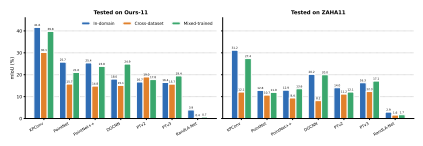
Figure 6 .Cross-dataset mIoU by test domain.For each archi- tecture: in-domain, cross-dataset, and mixed-trained (HFX11 + ZAHA11) mIoU, evaluated on HFX11 (left) and ZAHA11 (right).
Original paper · CC BY 4.0KPConv leads every setting in Figure 6, yet its transfer is strongly asymmetric. The reverse direction loses only one point, so the drop depends on which dataset supplies the training data. Every model tested on ZAHA scores lower when trained on HFX3D than when trained on ZAHA, a uniform domain penalty in that direction. The authors attribute the asymmetry to several factors, including HFX3D's broader environmental and architectural variability, label-space harmonisation, and annotation-convention differences.
On HFX3D, cross-dataset training depends on the architecture rather than hurting every model. Point Transformer v2 improves when trained on ZAHA instead of HFX3D itself. Point Transformer v3 is essentially unaffected, while the remaining architectures lose substantially. Mixed training helps DGCNN and Point Transformer v3 on HFX3D, but it hurts KPConv, PointNet, and RandLA-Net.
The effect on ZAHA is smaller in either direction, so mixing the two datasets doesn't give a uniform benefit.
Functional labels: geometry and context help, with limits
Functional labels get a three-way ablation against the human-validated labels: semantic prior, geometric evidence and graph context. A small MLP serves as the learned baseline, reading 21 per-instance metric descriptors of size, shape, elevation, orientation and point density. The ambiguous subset keeps instances whose class does not fix the full attribute set, using a threshold tau of 0.05.
This yields 16 ambiguous pairs across seven semantic classes, and 1,131 and 714 instances in the All and Ambiguous test subsets.
The semantic prior alone reaches an mF1 of 0.4808 on the ambiguous subset, so class membership does not fix instance function. Geometry alone scores 0.7039 on the ambiguous subset, and context alone scores 0.6746, so both sources add evidence beyond the class. Combining all three sources gives 0.6606 ambiguous mF1, below geometry alone, because incomplete or opposing evidence limits the fusion.
The learned MLP reaches 0.7304 mF1 on all instances, averaged over 10 seeds, with 0.5590 exact set match. Exact set match peaks at 0.5434 on the ambiguous subset, since one wrong applicable attribute invalidates the whole instance-level set. Partial surface coverage and uneven point density can hide handles, opening seams and articulated parts that separate an operable window from a fixed one.
Occlusion from neighbouring components and vegetation can hide structural junctions, so the context graph misses attachment and support relations. Rare attributes such as drainage and vegetation support have too few positive samples for reliable assignment.
Limitations of the labels and benchmarks
The functional labels rest on visual judgement, so they can't be checked against the structural drawings a building owner would hold. Load bearing is therefore assessed visually, which makes it a visual judgement rather than a verified structural property. The authors audited the labels with two review rounds on ten buildings, where the rounds agree on 93.2% of applicable attribute decisions.
The dataset covers 26 buildings in Halifax, all captured with a GeoSLAM ZEB Horizon handheld mobile LiDAR scanner.
The instance scores depend on the evaluation pipeline, so the reported AP changes with the way masks are handled. Propagating the masks to every point raised that same score to 0.91, so the authors chose propagation before scoring. They grouped PointGroup and SoftGroup at 7.5 cm, a setting that the paper reports for those two methods only.
The cross-dataset results come from one shared 11-class taxonomy, with vegetation dropped, so they reflect that harmonised label space. The authors also name annotation-convention differences between the two datasets as a possible cause of the asymmetry.
Interior scans and thermal sensing are outside the current dataset, and the authors list them as future work.
Paper info
- Authors
- Abdiaziz Muse, Tooba Javed, Tao Pu, Jiju Poovvancheri, Dong Chen
- Venue
- arXiv · Preprint
- First published
- 2026-11-5
- Added
- 2026-11-9
- Updated
- 2026-11-5
- Version
- v1
- arXiv
- 2611.08645
- Category
- cs.CV · cs.AI · cs.GR · cs.LG
- Original paper terms
- CC BY 4.0
- What we show
- Paper info, commentary and permitted figures from the original paper
AI commentary is a separate explanation from the original paper and may contain errors. The original paper and figures follow each source's terms of use and any rights noted separately.
Abstract
Understanding building facades is central to urban digital twins, heritage modelling, and sustainable city analysis, yet existing LiDAR benchmarks stop at geometry and semantic segmentation and offer little support for reasoning about the functional role of each architectural element. We introduce HFX3D, a large-scale urban facade benchmark of approximately 492 million LiDAR points from 26 buildings in Halifax, Canada, captured across four seasons, day and night, and varied weather. Each facade is annotated at three tiers, semantic, instance, and per-instance functional attributes, making it, to our knowledge, the first facade dataset to pair geometry and semantics with functional labels. Annotations are produced by a semi-automatic pipeline that combines geometry-guided heuristics with expert validation. We benchmark representative point-based, graph-based, convolutional, and transformer architectures and find that semantic segmentation is already challenging under severe class imbalance, while instance separation of repetitive structures and functional reasoning from geometry are substantially harder. The benchmark establishes a new foundation for function-aware 3D urban understanding. Project page: https://jijup.github.io/hfx3d-benchmark/ ; code: https://github.com/jijup/hfx3d-benchmark
Quote from the paper
Abdiaziz Muse, Tooba Javed, Tao Pu, Jiju Poovvancheri, Dong Chen (2026). From Geometry to Function: A Multi-Task LiDAR Benchmark Dataset for Semantic and Functional Parsing of Urban Facades. arXiv:2611.08645v1. https://arxiv.org/abs/2611.08645v1
BibTeX
@misc{muse2026from,
  title = {{From Geometry to Function: A Multi-Task LiDAR Benchmark Dataset for Semantic and Functional Parsing of Urban Facades}},
  author = {Abdiaziz Muse and Tooba Javed and Tao Pu and Jiju Poovvancheri and Dong Chen},
  year = {2026},
  eprint = {2611.08645},
  archivePrefix = {arXiv},
  url = {https://arxiv.org/abs/2611.08645v1}
}