Paper commentary
Hallucinations in Large Multilingual Translation Models
Large multilingual translation models hallucinate most often on low-resource language pairs
- Problem Earlier hallucination studies covered only small bilingual models on high-resource languages, so large multilingual systems stayed largely unmeasured.
- Method The authors test M2M models and ChatGPT across more than 100 translation directions. They flag hallucinations with perturbation and oscillation detectors, then swap in a fallback model's output.
- Results On low-resource English-centric pairs, M2M (S) averages a 15.20 hallucination rate, compared with 11.22 for M2M (L).
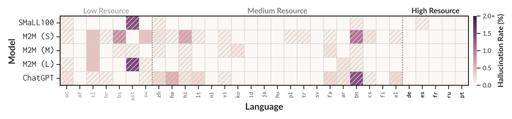
Figure 1 : Heatmap of hallucination rates for each model in the languages considered. Pattern-filled cells indicate at least one hallucination under perturbation for a given model-language pair.
Original paper · CC BY 4.0 · Nuno M. Guerreiro, Duarte Alves, Jonas Waldendorf, Barry Haddow, Alexandra Birch, Pierre Colombo, André F. T. Martins · Hallucinations in Large Multilingual Translation Models · Original paper figure · Extracted the figure area from page 5 of the original PDF.Why large multilingual systems need a closer look
Multilingual translation models serve many language pairs from a single set of weights, which makes them attractive for deployment. Those studies used models under 100M parameters, trained on a single English-centric high-resource language pair. This leaves an open question about how often large models hallucinate across translation directions, domains and data conditions.
Because M2M models are trained on parallel data, their failures can be compared against those of a system that learns differently. ChatGPT is the second class, and it is trained on massive monolingual data with a strong bias towards English, without requiring parallel data. ChatGPT achieves surprisingly high translation quality across a wide range of language pairs, which makes it a fair test case.
The authors also check whether the two classes fail in different ways, since ChatGPT's hallucinations differ in kind from those of conventional models.
The study covers more than 100 translation directions across various resource levels, going beyond English-centric language pairs. The authors release code and over a million translations in more than 100 translation directions.
Two kinds of hallucination and how they are flagged
The study splits hallucinations into two groups: those triggered by a perturbed source and natural ones that appear on clean input. A hallucination under perturbation occurs when a model produces a significantly lower quality translation for a slightly perturbed input than for the original input. The perturbations include misspellings of words, insertion of frequent tokens at the start of the source, and capitalization errors.
Natural hallucinations occur without any perturbation, and the authors treat them as rare and hard to study. They follow a taxonomy in which natural hallucinations are either largely fluent detached hallucinations or oscillatory hallucinations. Detached hallucinations bear minimal or no relation to the source, while oscillatory hallucinations contain erroneous repetitions of words and phrases.
The perturbation detector uses two rules: a minimum threshold on the original translation, and an extremely low maximum on the perturbed one. Rule (i) keeps low-quality translations of unperturbed sources from counting as perturbation hallucinations. To handle many models at once, the authors keep only sources where all models reach spBLEU > 9.
They sort these sources by average quality across models and select the top 20% as candidates. A perturbed translation counts as a hallucination when its spBLEU is below 3, and this fixes a sample size across language pairs.
ALTI+ evaluates the relative contributions of the source and target prefixes to each model prediction. Because hallucinations are detached from the source, ALTI+ flags them by identifying sentences with minimal source contribution. The authors set the ALTI+ threshold at the lowest 0.02% of score distributions on high-resource WMT benchmarks.
TNG is a black-box heuristic for oscillatory hallucinations that compares the top repeated translation n-gram count with the top repeated source n-gram count. The authors use n = 4 and t = 2, so the difference must be at least t. To keep precision high, they drop candidates whose LaBSE or CometKiwi scores exceed the top 10% of WMT scores.
Where perturbations trigger hallucinations
The perturbation experiments use FLORES-101 and translate only out of English, across 31 language pairs. The authors apply the minimal perturbations from Xu et al. (2023): misspelled words, frequent tokens inserted at the start, and capitalization errors. The authors keep the top 20% of those sentences and flag a hallucination when the perturbed translation falls below spBLEU 3.
Average hallucination rates fall as resource levels rise for every model except ChatGPT. For high-resource languages, hallucinations are almost non-existent, and only SMaLL100 hits one of five languages. M2M (L) and SMaLL100 show higher rates than the smaller M2M (S) when translating to Asturian. ChatGPT reverses the trend, producing hallucinations in 10 of 19 mid-resource languages versus 4 of 7 low-resource ones.
Its hallucinations take the form of off-target translations, overgeneration, or failed attempts to translate. ChatGPT never produces oscillatory character hallucinations under perturbation, unlike the conventional NMT models. Most of these ChatGPT hallucinations can be reversed by further sampling, which points to unlucky generation rather than a model defect.
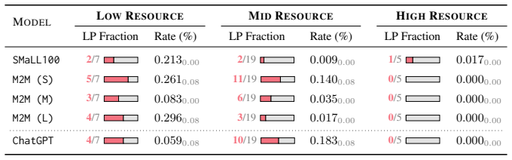
Table 1 : Fraction of languages for which models produces at least one hallucination under perturbation, and average hallucination rate (and median, in subscript) across all languages at each resource level.
Original paper · CC BY 4.0The authors correlate perturbation hallucinations with the spBLEU of the unperturbed sources using Pearson correlation. The correlation is very weak across all models, so original translation quality barely predicts which sentences hallucinate. The authors read this as evidence that even minimal perturbations can shift translation quality significantly.
Natural hallucinations across directions and domains
The English-centric setup pairs 32 languages with English, giving 64 directions. Low-resource pairs stand out, with every M2M model averaging above 10% on hallucination rate. M2M (S) hallucinates in 15 of 16 low-resource pairs, and M2M (L) hallucinates in 14 of 16. Their average low-resource rates are 15.20 for M2M (S) and 11.22 for M2M (L).
Scaling up the M2M family lowers these rates, and the gains are largest for mid- and high-resource pairs.
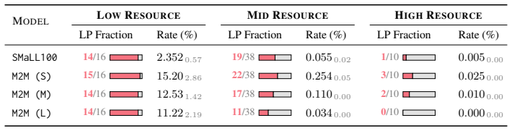
Table 2 : Fraction of LPs on the English-centric setup for which models produce at least one hallucination, and average hallucination rate (and median, in subscript) across all LPs at each resource level.
Original paper · CC BY 4.0In low-resource pairs, detached hallucinations occur more often than oscillatory ones. The authors read this as models relying less on the source context when translating to or from low-resource languages. SMaLL100 uses a 12-layer encoder and a shallow 3-layer decoder, with the target language code placed on the encoder side. The authors hypothesize that this design pushes the model toward the encoder representations, which reduces detachment from the source.
Among M2M models, COMET-22 tracks hallucination rates closely for low-resource pairs, but for SMaLL100 that link is weak.
Over 90% of off-target hallucinations occur when translating out of English. Translating into English, nearly all mid- and high-resource hallucinations are oscillatory. Toxic text mostly appears in translations out of English and almost always affects low-resource pairs. Over 1 in 8 hallucinations in Tamil contain toxic text. The authors trace these toxic outputs to patterns in the training data, and SMaLL100 copies the toxic hallucinations of its teacher.
The non-English-centric setup covers 25 language pairs and largely repeats the English-centric pattern. SMaLL100 significantly outperforms the M2M models in low-resource non-English-centric pairs. On TICO medical data, hallucination rates don't consistently exceed those on FLORES for the same pairs. The authors hypothesize that training on over 7 billion web-gathered parallel sentences mitigates domain shift.
Fallback systems and which ones repair outputs
A fallback system swaps in another model's output when the primary model produces a hallucination. The authors start with same-family fallbacks, using SMaLL100, M2M (M) and M2M (L) to repair M2M (S). Reversal rate is the share of the original system's hallucinations that the fallback corrects. For M2M models, reversal rates are consistently higher for oscillatory hallucinations than for detached ones.
The authors tie this stickiness to the shared training data, since same-family models learned from the same data.
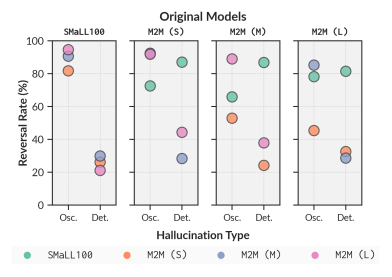
Figure 3 : Reversal rates for oscillatory (Osc.) and detached (Det.) hallucinations when using mod- els of the same family as fallback systems.
Original paper · CC BY 4.0SMaLL100 reverses detached hallucinations more often than oscillatory ones when it serves as the fallback. M2M (L) struggles most to reverse the detached hallucinations that its distilled counterpart SMaLL100 produces. The authors read this as evidence that model defects can persist and be shared during distillation. SMaLL100 differs from the M2M models in training data, training procedure and architecture.
Scaling within the family doesn't fix the problem, so the authors argue that different architectures and training data could bring larger gains.
The authors test two external fallbacks: ChatGPT, prompted as in Section 3, and NLLB, a 3.3B-parameter model from the NLLB family. The reference point is M2M (L) at 73.63 COMET-22 on low-resource pairs in the English-centric setup. External fallbacks lift the quality of hallucinated translations, especially for low-resource languages. NLLB generally beats ChatGPT for low- and mid-resource languages, though ChatGPT still beats the same-family M2M systems there.
With ChatGPT as the fallback, oscillatory hallucinations are almost entirely eliminated. The authors note that hallucinations from prompted LLMs still occur, but they differ in properties and surface forms. They leave the investigation of those differences to future work.
Limitations of the hallucination findings
The authors state that their findings rest on the M2M family of multilingual models. Whether the findings hold for other families, such as NLLB, remains unclear to the authors. The perturbation detection relies on BLEU, which the authors adopt following earlier work. Lexical metrics like BLEU ranked worse than reference-based neural metrics in the WMT22 Metrics Shared Task.
The authors therefore acknowledge that their detection approach inherits the limits of the metrics it uses.
ChatGPT's training data is not publicly available, so the authors cannot guarantee that it was not exposed to their evaluation data. ChatGPT is a system whose training data and training regime are unknown. Since the model sits behind API walls, documentation is scarce, which limits what the authors can verify. Without glass-box access, the authors couldn't measure how much the source text contributes to ChatGPT's translations.
Detached hallucinations for ChatGPT therefore stay unmeasured, so the ALTI+ based detection used for the M2M models doesn't apply to it. Despite these limits, the authors believe their findings still give relevant insights into the translations ChatGPT generates.
Paper info
- Authors
- Nuno M. Guerreiro, Duarte Alves, Jonas Waldendorf, Barry Haddow, Alexandra Birch, Pierre Colombo, André F. T. Martins
- Venue
- arXiv · Preprint
- First published
- 2023-3-28
- Added
- 2026-11-6
- Updated
- 2023-3-28
- Version
- v1
- arXiv
- 2303.16104
- Category
- cs.CL
- Original paper terms
- CC BY 4.0
- What we show
- Paper info, commentary and permitted figures from the original paper
AI commentary is a separate explanation from the original paper and may contain errors. The original paper and figures follow each source's terms of use and any rights noted separately.
Abstract
Large-scale multilingual machine translation systems have demonstrated remarkable ability to translate directly between numerous languages, making them increasingly appealing for real-world applications. However, when deployed in the wild, these models may generate hallucinated translations which have the potential to severely undermine user trust and raise safety concerns. Existing research on hallucinations has primarily focused on small bilingual models trained on high-resource languages, leaving a gap in our understanding of hallucinations in massively multilingual models across diverse translation scenarios. In this work, we fill this gap by conducting a comprehensive analysis on both the M2M family of conventional neural machine translation models and ChatGPT, a general-purpose large language model~(LLM) that can be prompted for translation. Our investigation covers a broad spectrum of conditions, spanning over 100 translation directions across various resource levels and going beyond English-centric language pairs. We provide key insights regarding the prevalence, properties, and mitigation of hallucinations, paving the way towards more responsible and reliable machine translation systems.
Quote from the paper
Nuno M. Guerreiro, Duarte Alves, Jonas Waldendorf, Barry Haddow, Alexandra Birch, Pierre Colombo, André F. T. Martins (2023). Hallucinations in Large Multilingual Translation Models. arXiv:2303.16104v1. https://arxiv.org/abs/2303.16104v1
BibTeX
@misc{guerreiro2023hallucinations,
  title = {{Hallucinations in Large Multilingual Translation Models}},
  author = {Nuno M. Guerreiro and Duarte Alves and Jonas Waldendorf and Barry Haddow and Alexandra Birch and Pierre Colombo and André F. T. Martins},
  year = {2023},
  eprint = {2303.16104},
  archivePrefix = {arXiv},
  url = {https://arxiv.org/abs/2303.16104v1}
}