Paper commentary
Bursts That Outlast Themselves: Persistent Degradation in Prefix-Cached Agent Serving
Prefix-cached agent servers can stay degraded after a short burst of extra traffic
- Problem A burst can push a prefix-cached agent server into a degraded state that does not recover. Sessions still in the system evict each other's prefixes, so each turn is recomputed.
- Method The budgeter sums the resident KV demand of admitted sessions and parks them at turn boundaries once it exceeds 0.95 of the pool.
- Results The budgeter recovered all seven matched collapsed runs within minutes, while throttling new admissions recovered only 1 of 7.
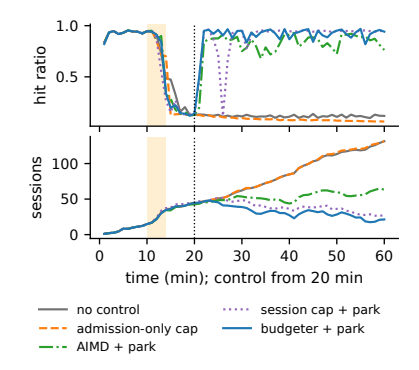
Figure 5 . Recovery with no control and four controllers enabled at minute 20, one seed (identical arrivals; this seed was collapsed at minute 20 in every arm).
Original paper · CC BY 4.0 · Wen Huang, Jack Liu · Bursts That Outlast Themselves: Persistent Degradation in Prefix-Cached Agent Serving · Original paper figure · Extracted the figure area from page 7 of the original PDF.Why a short burst can leave a cache cold
Prefix caching keeps agent serving affordable, because a hit only prefills the tokens appended since the last turn. A miss forces the engine to recompute the whole context, which the paper puts at 10–40× more work for an agent. The question is what happens to a server that loses its hit ratio and never gets it back.
Figure 1 pairs two vLLM runs that receive the same session arrivals, and only one of them gets a five-minute burst of extra arrivals.
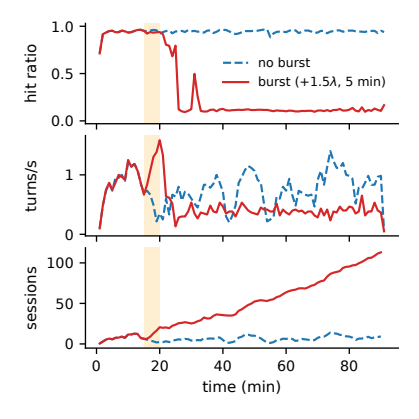
Figure 1 . A burst that outlasts itself. Same model, same server, same base arrivals; the red run additionally receives a 5-minute injected burst (shaded). Its hit ratio and throughput never recover after the burst ends, while its blue no-burst twin stays healthy.
Original paper · CC BY 4.0The sustaining effect is specific to stateful LLM serving, because closed-loop sessions make the number of sessions in the system grow with response time. Each active session needs its prefix resident to hit, so when service slows, LRU evicts prefixes before their next turns. The authors don't claim the loop or session admission as new; their contribution concerns the dynamics of entering and leaving the regime.
For an operator the regime is easy to misdiagnose, since GPU utilization stays high and latency alarms fire.
How slow service fills the cache
Slower service fills the cache with more sessions because agent sessions are closed loops, so the offered load depends on the server. A slower response time R therefore raises N directly, so the population of sessions grows as service slows.
Every active session needs its prefix resident to hit, so the prefixes that must stay in the KV pool scale with that population. Cached blocks are evicted by LRU when running requests need space, and the pool is shared between running requests and idle sessions' prefixes. When the combined context of those sessions outgrows the pool, LRU evicts each session's prefix before its next turn.
Each eviction turns the next turn into a full recomputation, which slows service further and keeps more sessions in the system.
The miss penalty is large: on an MI300X serving Qwen3-8B, a mid-session turn at a 21.6K context costs about 2 s of prefill on a miss. The same turn costs about 0.15 s on a hit, a ratio that grows linearly with session length. In one seed-501 pair, resident demand sat at about 0.6 of the KV pool before the burst. The burst pushed demand to 1.4× the pool at minute 25, and it kept climbing to 4.8× the pool over the last 5 minutes.
The no-burst twin peaked at 0.83 of the pool and never crossed it, so the authors inferred the misses from prefixes evicted between turns rather than measuring eviction events.
Paired runs isolate history dependence
The paired design gives each burst run and its no-burst twin the same base arrival stream, so both arms see the same sessions at the same times. Only the burst run gets an independent stream of extra sessions, at rate 1.5λ for 5 minutes starting at minute 15. Because the base load after the burst is identical in both arms, any gap between them comes from history rather than offered load.
The authors track the hit ratio, the number of sessions in the system, and cohort completion, and they call a run persistently degraded once every window from its first degraded one, with hit ratio below 0.5, stays degraded to the end.
At λ=0.035 sessions/s, about 70% of the cache-warm capacity, most no-burst runs stayed healthy for 90 minutes at a 0.94 to 0.95 hit ratio. In the burst arm the hit ratio settled near 0.1, and turn throughput fell to about 0.4 turns/s. The burst arm degraded persistently in 9 of 12 pairs, and no pair showed the reverse, where only the no-burst twin degraded.
Two pairs degraded in both arms, and one pair stayed healthy in both. A two-sided sign test over the discordant pairs gives p = 0.00391.
Ten of the twelve no-burst twins ran at the same base load without degrading. The other two degraded on their own, 25 and 30 minutes into the run, which the authors read as the metastable signature rather than plain overload. Two of four runs ended at their twins' level, and the other two were still draining at a slow pace.
A session cap that kept the active population below the pool produced 0 of 10 persistently degraded runs in an earlier matrix. A prefix-cache flush with preemption left 1 of 5 runs persistently degraded at λ=0.04 with no extra load. Trigger size alone doesn't decide the outcome: bursts injecting 11 and 13 extra sessions collapsed runs, while one injecting 17 did not.
Checking beyond Qwen3-8B on vLLM
Qwen3-32B on its full KV pool, replaying SWE-bench trace shapes, tests whether the effect holds for a larger model. At λ=0.025, a 4-minute 2× burst left one of four runs persistently degraded, and a second run ended partially degraded. Their end hit ratios were 0.34 and 0.81, against 0.95 to 0.97 for all four no-burst runs. A longer no-burst run degraded on its own after about 55 minutes, so the authors treat 32B as weaker evidence of history dependence than 8B.
At λ=0.03, runs degraded with or without a trigger, so the authors use that load only to study recovery.
When the degraded regime can drain
The degraded regime can drain only when the arrival rate λ is below 1/S.
The authors measured c(L) on runs with prefix caching disabled, so the cost does not depend on the collapse itself. They used 48 complete two-minute windows with at least four requests running, and regressed window length on completed turns and their total prompt tokens. The fit gives c(L) = −0.06 s + 0.146 ms × L, with the intercept described as a fit artifact.
That yields S ≈ 78 s and 1/S ≈ 0.013 sessions/s for the synthetic workload, which sits well below the loads where collapse was observed. The authors stress that this is a necessary condition, and they don't present it as a prediction of the boundary.
To test the bound, the authors collapsed the server and then lowered the arrival rate. At λ=0.006, that work fell by about 900 engine-seconds per hour in one seed. At λ=0.010 it stayed roughly flat, between −67 and +132 per hour over three seeds. At λ=0.014 it grew by +604 and +663 per hour in two seeds, and at λ=0.018 it grew in one seed.
No cache re-formed during observation, which covered 2 hours, or 80 minutes for two partial runs.
The break-even therefore lies near 0.010 to 0.014, which brackets the model's 0.013 sessions/s. So a bigger pool raises the trigger size needed to collapse a server, but it doesn't remove the failure. Collapse is determined by rare combinations, such as a burst, a restart, or an unlucky arrival cluster, rather than average load. Admission control reaches only new arrivals, so the sessions already inside the system must be handled another way.
Getting out with parking
A collapsed server has two problems, and parking attacks the second one directly. That restores throughput and drains the queue, which is why suspending admitted sessions works faster than admission throttling alone.
The authors implement all controllers at the gateway, with no engine changes, using one shared actuator. They differ only in how they set the limit, because the gateway checks each session before every turn. The budgeter sums context plus output budget over the admitted set A, giving D = sum over s in A of (Ls + os). It admits sessions while D is at most 0.75C and parks them when D exceeds 0.95C, where C is the engine's KV-pool size reported at startup.
Because of this hysteresis band, D can exceed 0.75C as admitted sessions grow.
If the session is admitted and D exceeds 0.95C, the gateway parks it, so no in-flight request is interrupted. Parked sessions keep their place in the queue and are re-admitted as a whole, with parked sessions going ahead of new ones. The authors fixed the thresholds 0.75 and 0.95 before the section 6 experiments and didn't tune them per workload.
A session-count limit would need an assumed per-session demand, while the budgeter needs only C and its two thresholds.
An adaptive cap sets K to 0.75C divided by an EWMA of observed demand, with alpha 0.02 per turn. Latency AIMD adjusts K every 10 s and halves it when the median turn latency exceeds 15 s, starting from K=32. The admission-only cap holds K=16 active sessions and never parks admitted ones, so it tests throttling alone.
Recovery after a collapse: which controllers got an 8B server back
Seven seeds collapsed in every arm, and they start control from matched states with 29 to 48 sessions in the system. Each arm starts from remaining turns within 6% of its seed's mean, which keeps the comparison fair across controllers. Recovery was judged by the first 5-minute window after which every later window stays at a hit ratio of 0.8 or higher.
The budgeter recovered all seven seeds within the first 5-minute window after control began. The session cap recovered all seven within at most 6 minutes, while the admission-only cap recovered one of the seven. Two-sided exact paired tests gave p=0.031 for the budgeter against the admission-only cap and for the session cap against it.
Latency AIMD with parking recovered 5 of 7 after 14 to 25 minutes. The admission-only cap recovered 2 of 8 runs, 21 to 23 minutes later, and four of those runs stayed below a 0.1 hit ratio to the end. Both limits that park sessions against the pool's capacity recovered every collapsed run, ending at a 0.93 to 0.95 hit ratio. The gap points to parking sessions already in the system, which admission throttling of new arrivals never touches.
On this homogeneous workload, a session cap tuned to the measured per-session demand performed as well as the budgeter.
Heterogeneous sessions need a token budget
An admission-only cap failed the same way, with 0 of 3 runs recovered and an end hit ratio of 0.05 to 0.08. An EWMA-adaptive cap recovered within 21 minutes in this setting. The budgeter recovered all three seeds in under 5 minutes, with hit ratios of 0.92 to 0.97. The authors used a stronger trigger, 3× arrivals for 5 minutes, with 100-minute runs, and without control every run stayed degraded at a hit ratio of 0.12 to 0.13.
Both the budgeter and the adaptive cap brought the hit ratio back in each collapsed run. They completed 54 to 96% and 83 to 97% of the sessions arriving in the next 20 minutes, versus 0 to 7% without control. The queue still grew, at 4 to 8 sessions per 10 minutes, because arrivals of 1.5 to 1.6 per minute outpaced completions of 0.7 to 1.3 per minute.
The controllers restore efficiency but can't create capacity, so draining the backlog needs more capacity or load shedding.
Qwen3-8B at λ=0.075 ran short interactive sessions for 30 minutes, then long autonomous ones, with no burst. Without control, the shift alone drove both seeds into the degraded regime, ending at a hit ratio of 0.08. Caps of 22 or 34 sessions were too loose for the long sessions, so they collapsed like the uncontrolled server in 4 of 4 runs.
The budgeter and the EWMA-adaptive cap avoided both failures, with 0 of 4 collapsed and no gateway wait in the first phase.
Prevention and the CPU host tier
The budgeter can also run from the start, before any collapse, which the authors treat as prevention. It admits sessions while resident demand stays at or below 0.75C and parks them above 0.95C, with C the engine's KV-pool size. The thresholds were fixed before the experiments and weren't tuned for each workload. The 2×, 2-minute burst produced 0 of 5 collapsed runs, and a cache flush produced 0 of 3.
On Qwen3-32B with SWE-bench trace shapes, 0 of 4 budgeted runs collapsed. Two runs in that 32B group still ended partially degraded: one uncontrolled, and one under a session cap tuned on a lighter load.
The authors then tested a host tier, using vLLM's native CPU offloading with 128 GiB, about ≈0.9M tokens. In the paired design, 4 of 6 burst runs still ended persistently degraded, at a hit ratio of 0.12. All 6 of their no-burst twins stayed healthy, so the host tier didn't remove the regime. In the recovery design, all 3 uncontrolled runs collapsed late.
The budgeter, enabled at minute 20 before any collapse, kept all 3 runs healthy.
Offloading did delay the collapse, moving persistent degradation from minutes 20–25 to minutes 40–60. They expect faster offload paths would raise the threshold, but they didn't test that claim. They tested the budgeter with offloading only for prevention, not for recovery.
What queued users actually get
The study tracks users through the completion of each arrival cohort, not only through the hit ratio. A recovered cache doesn't finish the queue by itself, so sessions arriving after control began still have to be served. The p90 for the budgeter was 16.9 minutes, while the session cap had a median of 12.3 minutes and a p90 of 15.6 minutes.
Never-collapsed uncontrolled runs took a median of 3.8 minutes, the baseline for these recovered sessions.
The admission-only cap left 317 of 349 sessions unfinished. Without control, none of those sessions finished.
On 32B with trace shapes, the budgeter completed 65 to 92% of the sessions arriving in the 20 minutes after control began. An adaptive cap completed 35 to 95%, while no-control, admission-only and fixed-cap runs completed 0 to 3%. Parking delays some sessions, and that delay raises throughput for everyone else.
Figure 8 averages these cohort completions over the runs that collapsed when control began.
Limitations: what the evidence does not test
The trace replay keeps session lengths and timing but not content, truncates at 38K tokens, and doesn't execute agents. The study uses one GPU type, one replica and finite windows, with no routing, autoscaling, client retries or production evidence. Production contexts are longer, with a median per-call context above 100K on TraceLab, so the miss penalty would rise.
The authors expect that longer context lowers N∗ for a fixed pool, but they haven't measured it.
On Qwen3-32B the backlog never drained within the run, so queue-stability evidence comes from the 8B runs alone. The controllers restored engine efficiency with the 32B trace mix, but they couldn't add capacity that wasn't there. Draining that backlog would need additional capacity or load shedding, and the paper doesn't test either option.
The 32B mix arrives at 1.5 to 1.6 arrivals per minute against 0.7 to 1.3 completions per minute.
The SGLang runs used an earlier driver version, so their arrivals are not identical to the vLLM runs. SGLang was tested with the same model, pool size and nominal workload parameters, so the comparison is approximate. The threshold-sensitivity runs used a post-recovery throughput comparison that the authors call not strictly matched.
Where prior agent-serving work stops and this paper starts
CONCUR, MISA-T, VAMP and KAIROS each describe cache-efficiency collapse as concurrency rises. CONCUR reports middle-phase thrashing in offline agentic batch inference. The comparison table marks same-load history dependence as not demonstrated for these four systems. Only this paper's row is checked in all four columns.
KAIROS avoids that region with context-occupancy admission and hysteresis. KAIROS doesn't test the case with a removed trigger, and it doesn't measure recovery once collapsed. Basin, proposed in concurrent work by Lu et al. (2026), orders and budgets the admission of new sessions. Admitted sessions run to completion under Basin. Service recovered once the burst sessions were terminated.
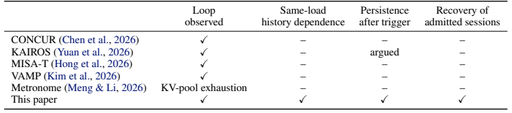
Table 4 . What prior agent-serving work establishes about cache-induced collapse. “Same-load history dependence”: identical subsequent load, different outcome depending on a past trigger. “Recovery of admitted”: measured recovery once collapsed, with control over already-admitted sessions. “–”: not demonstrated in the cited evaluation; CONCUR has agent pause/resume, but does not measure recovery from an established collapse.
Original paper · CC BY 4.0The budgeter is Denning's load control applied at the gateway, and the authors claim no novelty for it. What the authors add is the closed-loop setting, where cache misses lengthen session lifetimes.
Lu et al. report a 10-minute surge that cuts goodput by about 88% for the following hour. EfficientAgent applies Denning's load control to host-tier KV offloading. Eviction-policy work such as RR-Evict replays recorded sessions rather than asking whether a burst leaves lasting degradation. Yao et al. (2026) assume exogenous inter-turn times, so their analysis leaves out the latency feedback that sustains the degraded regime.
Paper info
- Authors
- Wen Huang, Jack Liu
- Venue
- arXiv · Preprint
- First published
- 2026-11-10
- Added
- 2026-11-11
- Updated
- 2026-11-10
- Version
- v1
- arXiv
- 2611.13412
- Category
- cs.DC · cs.AI · cs.LG
- Original paper terms
- CC BY 4.0
- What we show
- Paper info, commentary and permitted figures from the original paper
AI commentary is a separate explanation from the original paper and may contain errors. The original paper and figures follow each source's terms of use and any rights noted separately.
Abstract
LLM agents drive inference engines with closed-loop sessions whose context grows every turn, and serving them economically depends on prefix caching: a hit costs an incremental prefill of about a thousand tokens, a miss recomputes a 10--40K-token context. We show that this makes prefix-cached agent serving metastable. With an identical base workload, a few minutes of extra arrivals leaves a vLLM server in a degraded regime--a ~10% hit ratio, about half the throughput, and a backlog that grows for the remaining 70 minutes--while its no-burst twin stays healthy (9 of 12 pairs; none in the reverse direction). The regime appears at loads the cache-warm server sustains, is absent without prefix caching, and also appears with Qwen3-32B on SWE-bench agent trace shapes and on SGLang, which tolerates larger triggers. Slower service keeps more sessions in the system, their working set outgrows the KV pool, and every turn becomes a recomputation; a first-order workload-balance condition, calibrated independently, brackets when the regime can drain. Getting out is the harder problem: throttling new admissions recovered 1 of 7 matched collapsed runs, while suspending admitted sessions against a capacity-based limit recovered all of them within minutes. A CPU offload tier delays the collapse but does not prevent it. A budgeter that bounds the resident KV demand of active sessions to the pool, with thresholds that need no per-workload tuning, prevented the failure in every run we tested.
Quote from the paper
Wen Huang, Jack Liu (2026). Bursts That Outlast Themselves: Persistent Degradation in Prefix-Cached Agent Serving. arXiv:2611.13412v1. https://arxiv.org/abs/2611.13412v1
BibTeX
@misc{huang2026bursts,
  title = {{Bursts That Outlast Themselves: Persistent Degradation in Prefix-Cached Agent Serving}},
  author = {Wen Huang and Jack Liu},
  year = {2026},
  eprint = {2611.13412},
  archivePrefix = {arXiv},
  url = {https://arxiv.org/abs/2611.13412v1}
}