Paper commentary
The Deception Archive as a repository of standardized datasets for large-scale verbal deception detection research
The Deception Archive gathers 41 standardized verbal deception datasets into one repository
- Problem Verbal deception datasets are spread across fields and stored in mixed formats, so researchers struggle to find, access and reuse them. This limits cross-study comparison and the development of robust models.
- Method The Deception Archive is a curated repository built from a systematic review of the literature. The authors retrieve candidate datasets, then convert each one by hand into a shared format with common variables.
- Results The archive holds 41 standardized datasets containing 387,995 truthful or deceptive statements. It gives centralized access to the data and its metadata, which supports cross-dataset validation.
Why verbal deception datasets are hard to reuse
Verbal deception research starts from the idea that lying changes how people organize and phrase their accounts. Cognitive Load Theory argues that inventing an account costs more mental effort than reporting the truth, because deceivers must suppress the truth and stay consistent. Reality Monitoring predicts that truthful accounts carry richer perceptual, contextual, and sensory information.
The Verifiability Approach predicts that deceivers avoid details that others could check independently. Automated methods built on these cues need large, well-documented corpora, so model quality depends on the data as much as on the learning algorithm.
The bottleneck has shifted away from building analytical techniques toward securing suitable datasets for training and evaluation. Datasets have multiplied over the past two decades, yet they sit in different scientific areas. They also come in non-standardized formats, which makes each resource harder to compare. Researchers therefore spend considerable effort locating, retrieving, and understanding each resource before they can compare or reproduce anything.
Such fragmentation limits reproducibility and slows the scientific progress of verbal deception research.
The Deception Archive responds to this problem by curating datasets from a large-scale systematic review of the computational literature. It pairs each dataset with standardized metadata so researchers can discover, compare, and reuse resources more easily. The underlying review screened an initial 29,023 publications from peer-reviewed literature and preprints.
The archive is accessible through an interactive, searchable interface and through OSF and Zenodo.
Building the archive from a systematic review
The authors built their candidate pool on the publications of a recent systematic review and meta-analysis. That review followed PRISMA guidelines and screened an initial 29,023 publications from peer-reviewed literature and preprints. Screening and eligibility checks left 289 eligible records, each coded for methodological, computational and dataset variables.
Ten records were dropped because it was unclear whether the datasets were newly collected or reused from earlier studies.
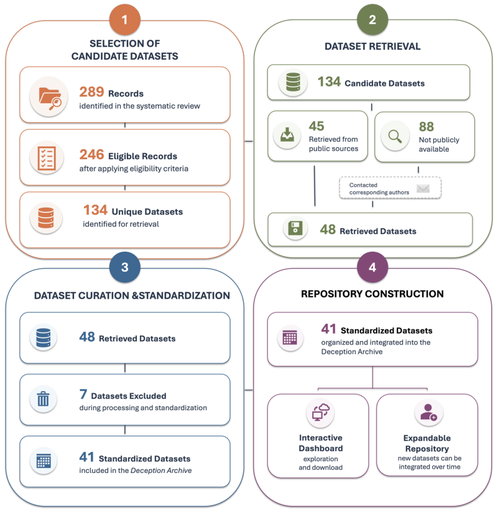
Figure 1 . Overview of the Deception Archive development workflow
Original paper · CC BY 4.0 · Caterina Borgese, Riccardo Loconte, Lucca Pfründer, Bennett Kleinberg · The Deception Archive as a repository of standardized datasets for large-scale verbal deception detection research · Original paper figure · Extracted the figure area from page 4 of the original PDF.Twenty records lacked ground-truth label information, and thirteen lacked a documented academic publication. These exclusions left 246 final eligible records, from which the authors identified 134 unique datasets for retrieval. Of those 134 datasets, 56 were reused across several publications and 78 were newly developed.
Figure 1 summarizes the full curation protocol, which the authors ran in four phases. For each of the 134 datasets, the authors first checked the related publications for download links, supplementary materials and external repository references. When the publication gave no route to the data, they searched OSF, GitHub, Kaggle and project websites, which retrieved 46 datasets.
For the remaining 88 datasets, the authors e-mailed 82 corresponding authors to request the original data. Authors who did not reply within 14 days received a reminder two weeks after the first email. Only 11 authors (13.4%) responded, and nine of them replied to the first email. Three of the responders provided their datasets, which brought the collection to 49 datasets for standardization.
Standardizing each dataset
The authors processed each retrieved dataset by hand, because file formats, data structures and variable names differed widely. They read the documentation and, where needed, the original publication to interpret each annotation scheme correctly. This step lets the authors map each dataset's structure onto one shared format.
Each dataset was reshaped into six core variables, starting with a unique dataset identifier for traceability across the repository. A participant identifier records whether several statements came from the same individual within a dataset. The original text and the original veracity label stay unmodified, so the creators' annotations remain visible.
A standardized binary veracity label, truthful versus deceptive, supports cross-dataset analyses. Dataset-level fields then cover design, ground-truth level, class proportions, format, topic, deception type and data source.
When information was missing, the authors contacted the corresponding authors again to resolve the issue. A dataset was excluded only when this contact failed to supply what reliable standardization required. Two datasets lacked the original textual data, so they were excluded. Two more had missing or ambiguous ground-truth labels, one lacked enough documentation and one duplicated an included dataset.
The Amazon Review Dataset and the Yelp Dataset weren't retrieved, because their exceptionally large size didn't fit the curation workflow.
After these exclusions, the Deception Archive comprised 41 standardized datasets in a common data structure. Table 1 lists each metadata field with a short description and an example. The example for participant ID, HIP_2022_1, shows how statements from one dataset's individuals get linked.
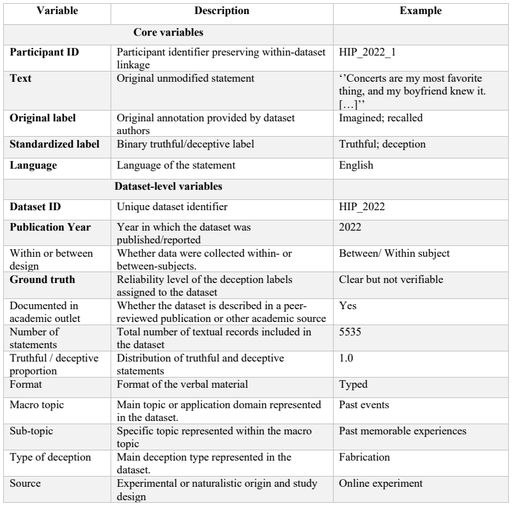
Table 1 . Metadata fields included in the Deception Archive
Original paper · CC BY 4.0What the archive contains
The archive holds 387,995 statements spread across 41 standardized datasets. Dataset sizes run from 62 to 108,688 statements, with a median of 1,492.00. The wide range comes from mixing small experimental corpora with large data collections gathered online. The standard deviation of 25,704.07 reflects the same heterogeneity in corpus size.
Most datasets are in English: 29 datasets, or 70.7%, account for 95.5% of all statements. The archive also spans nine languages beyond English. Supplementary Table S1 lists the full distribution of these dataset characteristics.
Typed rather than transcribed text appears in 31 datasets, or 75.6%. Fabrication is the predominant deception type in 30 datasets, or 73.2%. Clear but non-verifiable is the most common ground-truth level, found in 22 datasets (53.7%). Supplementary Table S2 defines each ground-truth level, so users can judge how reliable the labels are. Experimental or quasi-experimental designs supply most of these datasets.
The authors excluded datasets that could not be reliably standardized, so the 41 datasets form a filtered set.
Using the archive for model evaluation
The archive ships 41 standardized dataset files in UTF-8 CSV format, one per dataset, alongside a metadata table and a README. Each file is named after its dataset identifier, so users can match files to the metadata table. The standardized veracity label is coded 0 for truthful and 1 for deceptive. The original labels keep finer distinctions where they exist, which the standardized binary label doesn't carry.
The participant identifier lets a user keep every statement from one person in the same partition. Training and test splits built this way avoid data leakage in within-subjects datasets. The archive gives every statement in each dataset a participant identifier, so the grouping can be done for each dataset. The standardized binary label supports analyses that span several datasets at once.
Users must account for unbalanced truthful and deceptive proportions in some datasets. Generalizing across datasets therefore needs care, because English material dominates the archive. When an individual dataset is used, its original source publication should be cited alongside the archive.
The data sit on Zenodo and the OSF, and the archive is released under a CC BY 4.0 license.
Limitations of the Deception Archive
The archive holds only datasets that the authors could retrieve, interpret and standardize from the available materials. Many datasets described in the literature are therefore absent, because their data or documentation were unavailable. Of the 46 datasets retrieved from public sources, the authors added three datasets after contacting corresponding authors.
Of the 11 authors who responded to the data request, four said the original data were no longer available. Standardization also removed datasets, because the authors could not supply the information needed for reliable harmonization.
The second limitation concerns scope, since the current version focuses on datasets from the automated verbal deception detection literature. Verbal deception datasets developed outside this research area, such as manually annotated verbal cues of deception, aren't included. Such datasets could be incorporated in future releases. The open structure lets researchers contribute additional datasets over time, which supports continued expansion.
Paper info
- Authors
- Caterina Borgese, Riccardo Loconte, Lucca Pfründer, Bennett Kleinberg
- Venue
- arXiv · Preprint
- First published
- 2026-11-9
- Added
- 2026-11-10
- Updated
- 2026-11-9
- Version
- v1
- arXiv
- 2611.12196
- Category
- cs.CL
- Original paper terms
- CC BY 4.0
- What we show
- Paper info, commentary and permitted figures from the original paper
AI commentary is a separate explanation from the original paper and may contain errors. The original paper and figures follow each source's terms of use and any rights noted separately.
Abstract
Computational advances in natural language processing and machine learning have substantially expanded the use of automated approaches in verbal deception research. However, existing verbal deception datasets remain fragmented across disciplines, as they are often difficult to identify, access, and reuse, limiting cross-study comparisons and the development of robust computational models. We present the Deception Archive, a curated and standardized repository of publicly available verbal deception datasets built upon a large-scale systematic review. Eligible datasets were retrieved, manually inspected, and standardized following a structured data curation workflow. The current repository comprises 41 publicly available datasets containing 387,995 truthful or deceptive statements. The archive represents a heterogeneous repository (e.g., in data size, topic of investigation, ground-truth, etc.) and a living resource for integrating newly available deception datasets over time. By providing centralized access to standardized datasets and accompanying metadata, the Deception Archive facilitates dataset discovery, cross-dataset validation, and reproducible evaluation of computational models.
Quote from the paper
Caterina Borgese, Riccardo Loconte, Lucca Pfründer, Bennett Kleinberg (2026). The Deception Archive as a repository of standardized datasets for large-scale verbal deception detection research. arXiv:2611.12196v1. https://arxiv.org/abs/2611.12196v1
BibTeX
@misc{borgese2026deception,
  title = {{The Deception Archive as a repository of standardized datasets for large-scale verbal deception detection research}},
  author = {Caterina Borgese and Riccardo Loconte and Lucca Pfründer and Bennett Kleinberg},
  year = {2026},
  eprint = {2611.12196},
  archivePrefix = {arXiv},
  url = {https://arxiv.org/abs/2611.12196v1}
}