Paper commentary
Reject and Report: Forgery-Evident Undetectable Watermarks for Generative Image Models
Tripwire-WM flags forged images that undetectable watermarks would otherwise silently accept
- Problem Undetectable watermarks can be forged from a single image, and existing defenses either miss most forgeries or flag genuine images. SemBind rejects forgeries without reporting them, so owners never learn their model is being abused.
- Method Tripwire-WM hides an image hash in unused latent magnitudes, so forgeries are rejected and reported.
- Results On MS-COCO with GS++, Tripwire-WM accepted 1.8% of reprompting forgeries, compared to 46.2% for SemBind.
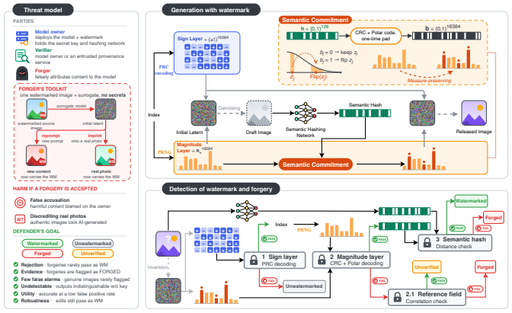
Figure 2 : Overview.Left:the threat model: without the key, a forger holding one water- marked image and a surrogate model reprompts its latent into new content or imprints it onto a real photo, so that the result carries the watermark.Top right:generation: the signs carry the watermark as in PRC or GS++, and the semantic hash of a draft image is encoded and committed into the latent magnitudes, from which the released image is generated.Bot- tom right:detection, which ends in one of the four verdicts of Section 2.
Original paper · CC BY 4.0 · Yihan Wang, Haochen Sun, Xi He, Yaoliang Yu, N. Asokan · Reject and Report: Forgery-Evident Undetectable Watermarks for Generative Image Models · Original paper figure · Extracted the figure area from page 5 of the original PDF.Why reject-only watermarks leave owners blind
The authors start from the point that a provenance scheme is only as strong as its resistance to forgery. Undetectable in-generation watermarks hide the signal in the signs of the initial latent, so anyone who can invert one watermarked image can recover that latent. From that latent an adversary can either reprompt new content or imprint the watermark onto a clean photograph.
SemBind binds the signs to image semantics, so a transplanted latent no longer verifies, but it still accepts up to 46% of reprompting forgeries on MS-COCO. Its rejected forgeries lose the watermark entirely, so the owner cannot tell how often its images are being abused. The external anomaly detectors of Lee et al. show the opposite trade-off: G-Cos flags only 19.7 to 24.0% of reprompting forgeries while alerting on 96.8 to 98.0% of blurred genuine images.
Using the magnitudes as an empty channel
The key idea is that in PRC or GS++ the signs carry the watermark, while the magnitudes are fresh half-normal noise that holds no information. The authors write a 128-bit semantic commitment, a hash of the image, into those magnitudes. Because the signs are left as in the base scheme, detection, robustness and undetectability of that scheme are not touched.
The reason this exposes a forgery is that a transplanted latent keeps its valid sign pattern but brings a commitment to the source image's content. A mismatch between that commitment and the query image is therefore positive evidence of forgery, not the absence of a watermark. Since the signs also give the index of the source generation, a flagged forgery points to the image that was abused.
How generation and detection run
Generation first encodes an index into the signs with the sign layer, then expands reference magnitudes and a one-time pad from the index and a secret key. The authors generate a draft image from the signed reference latent, and the hash of that draft becomes the commitment. The commitment is protected by an error-correcting code and XORed with the pad, which is why the embedded bits stay uniform.
Each padded bit then selects between the reference magnitude and its reflection, using the quantile reflection Flip(a) = F^{-1}(1 - F(a)), where F is the half-normal CDF. This reflection is a measure-preserving involution, so the magnitudes remain exactly half-normal whatever is committed. The released image is then generated from this latent, so the commitment describes an image that is different from the draft yet of the same prompt.
At verification the verifier inverts the query image and decodes the index and signs, and an index that does not decode means the image is Unwatermarked. Otherwise it reads the commitment from the magnitudes and compares it with the semantic hash of the query image, returning Watermarked on a match. When the code fails, a reference-field check separates Forged from Unverified, so a failed read does not by itself raise an alert.
Why undetectability still holds
Undetectability here means that anyone without the key cannot tell watermarked outputs from unwatermarked ones, even with many queries. The authors prove this by a sequence of hybrid games that replace the sign patterns, the pads and the reference magnitudes with random values, one step at a time. Each step is justified by the multi-query IND$-CPA security of the sign layer, the security of the PRNG, or the one-time pad.
The theorem holds under the assumption that the sign layer is multi-query IND$-CPA secure and that the magnitude-layer PRNG is secure. The proof therefore shows that the commitment does not weaken the underlying scheme's undetectability, but it does not make the sign layer itself any stronger.
Forgery rejection and evidence on MS-COCO
The authors test reprompting and imprinting forgeries made with an SD 2.1 surrogate and with an SD 1.5 surrogate, over five random seeds. Figure 1 shows the kind of input and verdict each case produces, and the imprinting forgery is onto a real public-domain photograph.
With GS++, Tripwire-WM accepted 1.8% of reprompting forgeries under the owner's own model, compared to 46.2% for SemBind. On imprinting forgeries with the owner's model, Tripwire-WM accepted none and flagged all of them.
The external detectors catch forgeries only in part, and they also alert on genuine images, so their alerts do not single out forgeries. So the authors' evidence is the commitment mismatch rather than a separate anomaly score, but the result holds for two datasets, two surrogates and five seeds.
Robustness and image quality
On MS-COCO the FID is 25.69 for unwatermarked images and 25.70 for Tripwire-WM with PRC.
Adaptive forgers and their limits
Such a reflected forgery is still rejected, but silently. Figure 4 shows these rates for each replacement strategy with and without the check.
The check lies outside the guarantees, so the authors note that a forger with a leaked hashing network can adapt to it.
Limitations
The secret hashing network carries no computational guarantee, unlike the watermark key, so its secrecy is a weaker protection.
Recent cryptanalysis identifies weaknesses of the LDPC-based PRC at practical parameters, which weakens the undetectability of the sign layer and so of Tripwire-WM. The magnitude layer is unaffected by that cryptanalysis, so a stronger scheme with pseudorandom signs and free magnitudes could replace PRC. The experiments use only two datasets, two diffusion models and five seeds, and the adversary's surrogates are SD 2.1 and SD 1.5.
Paper info
- Authors
- Yihan Wang, Haochen Sun, Xi He, Yaoliang Yu, N. Asokan
- Venue
- arXiv · Preprint
- First published
- 2026-11-18
- Added
- 2026-11-20
- Updated
- 2026-11-18
- Version
- v1
- arXiv
- 2611.25226
- Category
- cs.CR · cs.AI · cs.CV
- Original paper terms
- CC BY 4.0
- What we show
- Paper info, commentary and permitted figures from the original paper
AI commentary is a separate explanation from the original paper and may contain errors. The original paper and figures follow each source's terms of use and any rights noted separately.
Abstract
Provenance schemes such as those based on content watermarks let images from a generative model be traced back to it. A practical watermarking scheme must be accurate at a low false-positive rate (FPR), robust under content-preserving processing, and undetectable. In addition, it must resist forgery; otherwise, even from a single watermarked image and a surrogate model, an adversary can imprint the watermark onto an arbitrary image or regenerate new content that carries it, falsely attributing harmful content to a model or making authentic photographs appear AI-generated. We argue that a watermarking scheme should not only reject forgeries but also report them: a forgery rejected as unwatermarked leaves no trace of the attempt. State-of-the-art forgery-resilient undetectable watermarking schemes, such as SemBind, fall short on both counts. External anomaly detectors that do report forgeries either miss most of them or falsely flag genuine images after common processing. We propose Tripwire-WM, the first forgery-evident framework for undetectable watermarks. It commits the semantics of the generated image to the magnitudes of the initial latent noise, which the sign-based watermarks leave unused, through a distribution-preserving embedding; a forged image carries a valid watermark but with a commitment that does not match its content, so the detector both rejects it and reports it as forged. Built on the pseudorandom code (PRC) watermark and Gaussian Shading++, Tripwire-WM provably preserves their undetectability. On MS-COCO, with the owner's own model as the surrogate, it accepts no imprinting forgery, compared with up to 55.0% for SemBind, and reports all of them as forged; it also accepts at most 1.8% of reprompting forgeries, against up to 46.2% for SemBind. Meanwhile, it accepts at least 99% of genuine watermarked images at 10^{-6} FPR and matches the robustness of the base schemes.
Quote from the paper
Yihan Wang, Haochen Sun, Xi He, Yaoliang Yu, N. Asokan (2026). Reject and Report: Forgery-Evident Undetectable Watermarks for Generative Image Models. arXiv:2611.25226v1. https://arxiv.org/abs/2611.25226v1
BibTeX
@misc{wang2026reject,
  title = {{Reject and Report: Forgery-Evident Undetectable Watermarks for Generative Image Models}},
  author = {Yihan Wang and Haochen Sun and Xi He and Yaoliang Yu and N. Asokan},
  year = {2026},
  eprint = {2611.25226},
  archivePrefix = {arXiv},
  url = {https://arxiv.org/abs/2611.25226v1}
}