論文解説
An In-Silico Audit of Topographic Organization in a Multimodal Brain-Response Model
多モーダル脳応答モデルにおける地形的構造のインシリコ監査
- 課題 TRIBE v2が視野の位置や周波数の位置といった地形的な構造を保っているかは、元々検証されていません。
- 手法 刺激を生成し、TRIBE v2の予測時系列にpRF、hemifield、運動、tonotopyの当てはめを行いました。その結果を人間の地図と、spin testで比較しています。
TRIBE v2の検証で抜けていた地形的構造
TRIBE v2は、ビデオ、オーディオ、テキストの入力から、fsaverage5表面の頂点ごとのfMRI応答を予測する基盤モデルです。元の評価は、顔、場所、身体、単語といったカテゴリ選択的なlocalizerと言語対比に集中しており、感覚皮質の代表的な地形的構造であるretinotopy、tonotopy、運動選択性は検証していませんでした。この論文は、この欠けている部分を埋めるため、TRIBE v2の予測にこれらの構造が現れるかを人間の地図と比較しています。中心となる問いは、ビデオの特徴が空間平均された後で応答ヘッドに入るため、視野の位置情報が失われるのかどうかです。著者らは、この構造のために位置ベースの地図は除かれると仮定し、これをH1仮説としました。
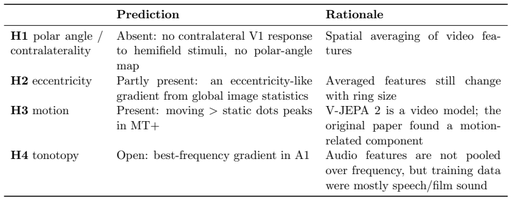
Table 1 : Hypotheses, stated before running the model.
出典 · CC BY 4.0 · Strawa, Jakub · An In-Silico Audit of Topographic Organization in a Multimodal Brain-Response Model · 論文の図を引用 · 元のPDFの2ページ目から図の部分を抽出しています。刺激と予測応答への当てはめ
刺激は、回転するチェッカーボードのウェッジ、拡大するリング、左右のhemifieldの点滅、放射状に動くドットフィールドで作りました。聴覚刺激は175 Hz–5.6 kHzの範囲で、上昇と下降の対数トーンスイープです。ビデオはV-JEPA 2 giantが、オーディオはWav2Vec-BERT 2.0が符号化し、テキストの経路は使いませんでした。予測は頂点ごとに1 Hzで得ています。
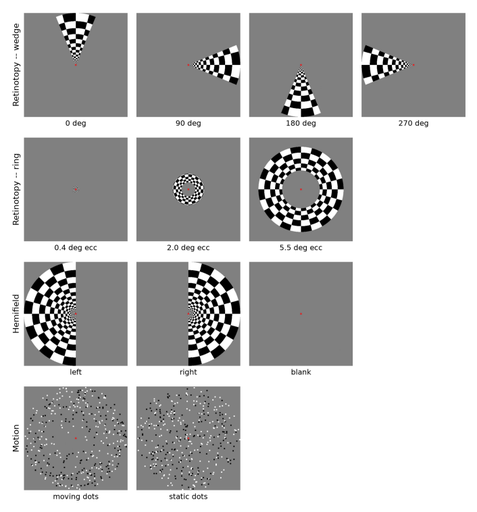
Figure 1 : Representative frames from each stimulus video.Retinotopy – wedge:a 45°checker- board wedge rotating through a full cycle (shown at 0°, 90°, 180°and 270°).Retinotopy – ring:a checkerboard annulus expanding logarithmically from near fixation (0.4°) to the screen edge (shown at 0.4°, 2.0°and 5.5°eccentricity).Hemifield:left, right and blank blocks of a flickering checker- board restricted to one visual hemifield.Motion:radially moving vs. static random-dot fields used as an MT+ localizer. All frames are shown at native 512×512 resolution with the central fixation marker.
出典 · CC BY 4.0 · Strawa, Jakub · An In-Silico Audit of Topographic Organization in a Multimodal Brain-Response Model · 論文の図を引用 · 元のPDFの3ページ目から図の部分を抽出しています。当てはめは、人間のfMRI時系列に用いる方法をそのまま予測時系列に適用しました。retinotopyでは、2Dガウス型のpRFを格子探索で当てはめ、ウェッジの周波数fと2fのパワー比を計算しました。hemifieldは対側と同側の応答差の効果量を、運動はmovingとstaticの応答差の効果量を用いました。tonotopyでは、対数周波数のガウス型チューニング曲線を、上昇と下降のスイープに同時に当てはめました。
対照モデルによるパイプラインの検証
実際のモデルを動かす前に、正解が既知のstand-inモデルでパイプラインを検証しました。一方のモードは、BensonテンプレートのpRFとA1の周波数勾配を埋め込み、もう一方のモードは、視覚の頂点に面積やウェッジの向きといった大域統計だけを、聴覚の頂点に音のon/offだけを見せるようにしました。この2つ目のモードは、H1とH4が成り立つ場合に期待される応答を模した陰性対照です。
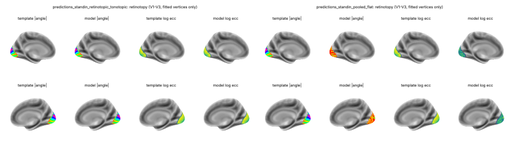
Figure 2 : Fitted pRF maps from the stand-in model.Left:retinotopic+tonotopic mode (positive control) recovers the planted polar-angle/eccentricity structure.Right:pooled+flat mode (negative control, matching TRIBE’s expected architecture-level behavior) shows no positional structure.
出典 · CC BY 4.0 · Strawa, Jakub · An In-Silico Audit of Topographic Organization in a Multimodal Brain-Response Model · 論文の図を引用 · 元のPDFの5ページ目から図の部分を抽出しています。陽性対照では、対側性、polar angle、周波数勾配の効果が強く復元されました。陰性対照では、R1、R2、T1は0に近く、R2bは偶然と同程度でした。ただしR3 eccentricityは、4つの乱数シードのうち1つでのみ有意でした。この結果から、eccentricityの主張には面積を揃えたリング対照が必要だと判断しました。
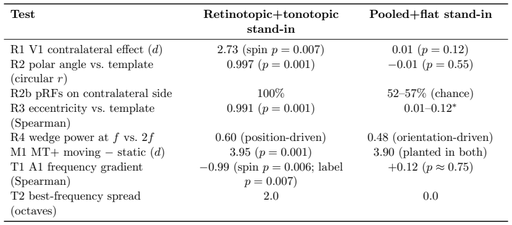
Table 2 : Stand-in model validation. ∗Across four random seeds of the pooled model, the eccentricity correlation (R3) was significant in only one (0.12,p= 0.04); see Section 4.
出典 · CC BY 4.0 · Strawa, Jakub · An In-Silico Audit of Topographic Organization in a Multimodal Brain-Response Model · 論文の図を引用 · 元のPDFの5ページ目から図の部分を抽出しています。視野の位置地図の不在
実際のTRIBE v2の予測では、V1–V3の頂点の100%が当てはめの基準を通過しましたが、位置構造は現れませんでした。対側hemifieldの効果はd = 0.048(p = 0.237)で0に近く、polar angleとBensonテンプレートの円形相関はr = −0.024(p = 0.595)でした。R2bは0.61で、偶然の場合の0.5に近い値でした。
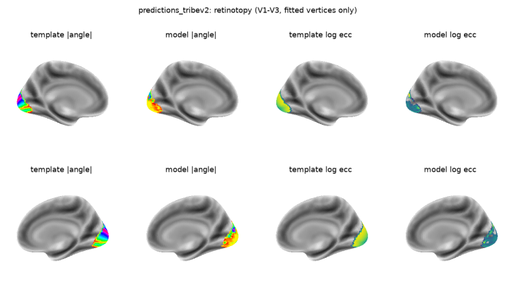
Figure 4 : Fitted pRF maps (—polar angle—, log eccentricity) from real TRIBE v2 predictions on the wedge and ring stimuli (two hemispheres shown), compared against the Benson template. The model’s maps (right-hand columns within each pair) show no structure resembling the template’s smooth angular/eccentricity gradients.
出典 · CC BY 4.0 · Strawa, Jakub · An In-Silico Audit of Topographic Organization in a Multimodal Brain-Response Model · 論文の図を引用 · 元のPDFの7ページ目から図の部分を抽出しています。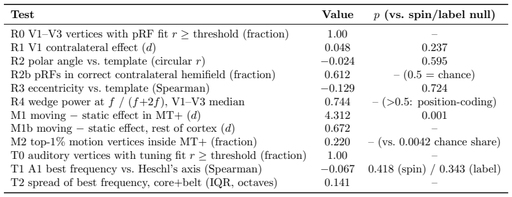
Table 3 : Full results on real TRIBE v2 predictions, all six stimuli (four video, two audio).
出典 · CC BY 4.0 · Strawa, Jakub · An In-Silico Audit of Topographic Organization in a Multimodal Brain-Response Model · 論文の図を引用 · 元のPDFの9ページ目から図の部分を抽出しています。R3 eccentricityは、標準のリング形状ではSpearman −0.129(p = 0.724)で有意ではありませんでした。面積を揃えたリングと、5°、20°の刺激サイズの対照では、同じ指標が正の有意な相関に変わりました。著者らは、この結果を大域的な画像統計に由来するeccentricityに似た信号と解釈しており、安定した位置コードとは見なしていません。ウェッジ幅30°と90°でも、R2の帰無結果は維持されました。一方、R4は0.744で0.5より大きく、H1のきれいな確認とは完全には一致しませんでした。
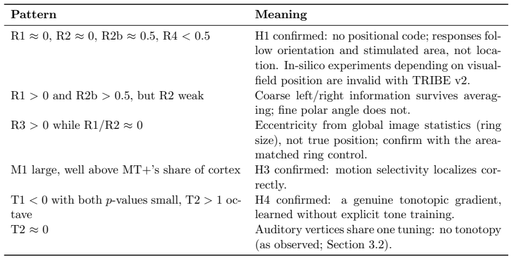
Table 4 : Interpretation key applied to the full result set. Note: the real TRIBE v2 data match the “H1 confirmed” row on R1/R2/R2b butnoton R4 (0.744>0.5); R4 is treated as a separate, unresolved caveat rather than a condition on the H1 verdict (see Section 3.3).
出典 · CC BY 4.0 · Strawa, Jakub · An In-Silico Audit of Topographic Organization in a Multimodal Brain-Response Model · 論文の図を引用 · 元のPDFの10ページ目から図の部分を抽出しています。A1周波数勾配の不在
TRIBE v2はトーンスイープに強く反応し、すべてのcoreとbeltの頂点が当てはめの基準を通過しました。しかし、coreとbeltのbest frequencyの分散は0.141オクターブにとどまりました。同じ指標は陽性対照では2.0オクターブでした。A1のSpearman ρは−0.067で、spin pは0.418、ラベル順列のpは0.343であり、勾配は確認されませんでした。
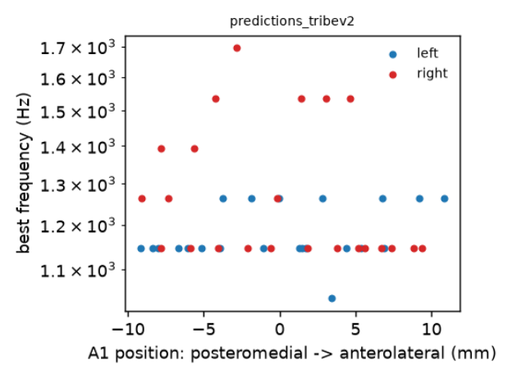
Figure 3 : Best-frequency map and gradient along A1 from real TRIBE v2 predictions on the tone- sweep stimuli. No posteromedial-to-anterolateral gradient is visible.
出典 · CC BY 4.0 · Strawa, Jakub · An In-Silico Audit of Topographic Organization in a Multimodal Brain-Response Model · 論文の図を引用 · 元のPDFの6ページ目から図の部分を抽出しています。等ラウドネスのトーンを使った対照でも、Spearman rは−0.081、spin pは0.405でした。著者らは、この結果から、この不在は音量のアーティファクトではないと解釈しています。
MT+における運動選択性の局在
動く点と静止した点の効果量は、MT+の中でd = 4.31(spin p = 0.001)でした。最も強い運動選択の上位1%の頂点のうち22.0%がMT+にあり、MT+は皮質の0.42%を占めます。これは約50倍以上の濃縮です。
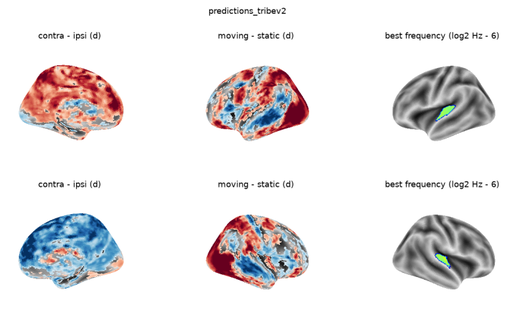
Figure 5 : Left: contralateral-minus-ipsilateral hemifield contrast (two hemispheres). Middle: moving-minus-static motion contrast, showing a focal cluster in the expected MT+ location. Right: best-frequency map in and around A1, showing no spatial gradient (Section 3.2).
出典 · CC BY 4.0 · Strawa, Jakub · An In-Silico Audit of Topographic Organization in a Multimodal Brain-Response Model · 論文の図を引用 · 元のPDFの8ページ目から図の部分を抽出しています。この結果は、位置依存的なコードがないTRIBE v2でも、運動のような特徴の同一性情報が解剖学的に正しい領域に現れることの根拠です。無音のオーディオトラックを除いた実験では、MT+の効果はd = 3.25に下がり、上位1%の濃縮も10.7%に減少しました。それでも確認結果を変えるほどではありませんでした。
適用範囲と残された問題
著者らは、位置ベースの実験、たとえば対側hemifieldのlocalizerやpRFマッピングは、このモデルでは信頼しにくいと考えています。一方、カテゴリや特徴レベルの選択性の実験は、この論文では運動の例で確認されました。視覚における位置コードの不在は、空間平均という構造と関連している可能性が高いですが、この論文ではモデルを修正して原因を検証してはいません。聴覚の原因は未解明のままで、オーディオの学習データ、オーディオエンコーダ、応答ヘッドの集約のどれが原因かは、この研究では区別できません。
論文情報
- 著者
- Strawa, Jakub
- 学会・ジャーナル
- arXiv · プレプリント
- 公開日
- 2026年11月13日
- 登録日
- 2026年11月16日
- 更新日
- 2026年11月13日
- バージョン
- v1
- arXiv
- 2611.18105
- カテゴリ
- q-bio.NC · cs.AI
- ライセンス
- CC BY 4.0
- 掲載内容
- 論文情報・解説・論文の図
この解説は、Refivuの韓国語解説をAIで翻訳したものです。不正確な翻訳や誤りが含まれる可能性があります。論文と図の利用条件は各出典に従います。
アブストラクト
TRIBE v2 (d'Ascoli et al., 2026) predicts fMRI responses across the cortical surface from video, audio and text. Its authors validated it with category-selective localizers (faces, places, bodies, words) and language contrasts, but not with the classic topographic organization of sensory cortex: retinotopy, tonotopy, and motion selectivity in area MT+. There is a clear architectural reason to expect retinotopy to fail: TRIBE's video features are averaged over space before the response head, which should discard visual-field position. I present mapping stimuli, a fitting pipeline adapted from standard fMRI mapping analyses, and a stand-in model with known ground truth that serves as a positive and negative control, and apply them to TRIBE v2's predictions, comparing the fitted maps with human atlases using spin tests. TRIBE v2 shows a sharp split. There is no contralateral hemifield response and no polar-angle map, robustly across stimulus controls. There is no tonotopic gradient in primary auditory cortex: best frequencies span an interquartile range of only 0.14 octaves across core and belt, and the null persists with loudness-equalized tones. An eccentricity-like gradient appears only when the ring geometry changes, consistent with global image statistics rather than a positional code. In contrast, motion selectivity is strong and precisely localized: 22% of the 1% most motion-selective vertices fall in MT+, which covers 0.42% of cortex. In-silico experiments that depend on feature identity appear viable with TRIBE v2, while those that depend on visual-field or frequency position are not supported by the current model.
この論文を引用
Strawa, Jakub (2026). An In-Silico Audit of Topographic Organization in a Multimodal Brain-Response Model. arXiv:2611.18105v1. https://arxiv.org/abs/2611.18105v1
BibTeX
@misc{jakub2026silico,
  title = {{An In-Silico Audit of Topographic Organization in a Multimodal Brain-Response Model}},
  author = {Strawa, Jakub},
  year = {2026},
  eprint = {2611.18105},
  archivePrefix = {arXiv},
  url = {https://arxiv.org/abs/2611.18105v1}
}