論文解説
Where Is Uncertainty Observed? A Mechanistic Understanding of Uncertainty Quantification in LLMs
不確実性はどこで観測されるのか:LLMにおける不確実性定量化の機構的理解
- 課題 LLMの応答の信頼性を測るとき、不確実性を計算のどの地点で観測するかによって推定の可否が左右されます。しかし既存の分類は、この軸をほとんど扱ってきませんでした。
- 手法 残差ストリームで、構造、表現、分布、意味の4つの観測レンズを定義し、情報の決定関係に沿って順序づけします。
観測地点が重要な理由
LLMの応答を信頼してよいかを判断するには、不確実性を測る必要があります。既存の分類は、不確実性の出所や推定方法によってUQ手法を分けてきましたが、モデルの計算のどの地点で不確実性を観測するかは主に扱ってきませんでした。同じ質問でも観測地点が違えば推定器が使える情報は変わるため、観測地点は手法の設計上の選択として扱うべきです。この論文は、この問いを中心に4つの機構的な観測レンズを定義し、正解予測において各レンズが持つ信号を測定しています。
4つの観測レンズ
この論文は、不確実性を予測状態の分散として定義し、それを残差ストリームの4地点で観測します。構造レンズは、アテンションヘッドとFFNが残差ストリームに加える個別の書き込みΔhを観測し、表現レンズは隠れ状態h(ℓ)そのものを読み取ります。分布レンズは、unembeddingとsoftmaxで得られるトークン分布を観測し、意味レンズは、サンプルされた出力同士の意味関係Rで定義した意味分布を観測します。4つのレンズは残差ストリームにつながっており、構成要素の和g_sum、unembeddingの写像g_unemb、意味の写像g_Rを経由して、内部の観測が外部の観測を決める順序になっています。
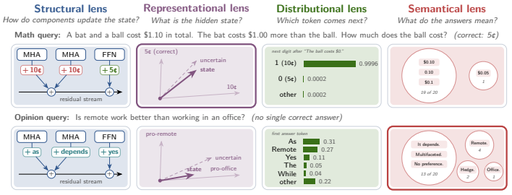
Figure 2 : Four lenses applied to two queries. For the math query, the sampled answers agree on a wrong answer, so semantic uncertainty is low, but the hidden state lies near the uncertain direction. For the opinion query, the token distribution spreads over many phrasings, but the answers share one stance. A colored frame marks the suited lens. Illustrative values from an experiment on Qwen2.5-0.5B-Instruct (Qwen et al., 2025).
出典 · CC BY 4.0 · Xiaoyu Liang, Virginia Ceccatelli, Aliai Eusebi, Tobias Braun, Nils Loose, Carlo Malagnino, Lorenzo Cavallaro · Where Is Uncertainty Observed? A Mechanistic Understanding of Uncertainty Quantification in LLMs · 論文の図を引用 · 元のPDFの2ページ目から図の部分を抽出しています。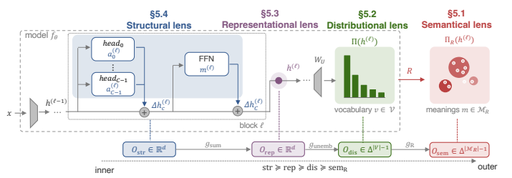
Figure 3 : Four mechanistic observation lenses in the residual stream.
出典 · CC BY 4.0 · Xiaoyu Liang, Virginia Ceccatelli, Aliai Eusebi, Tobias Braun, Nils Loose, Carlo Malagnino, Lorenzo Cavallaro · Where Is Uncertainty Observed? A Mechanistic Understanding of Uncertainty Quantification in LLMs · 論文の図を引用 · 元のPDFの9ページ目から図の部分を抽出しています。正解信号の測定方法
実験は、Qwen2.5-7B-Instruct、Qwen2.5-7B-Base、Llama-3.1-8B-InstructでTriviaQA、PopQA、MMLUを用いて行いました。各レンズの観測から入れ子になった特徴量の集合を作り、教師あり学習のプローブであるDecBaseで正解かどうかを予測しました。TriviaQAとPopQAではロジスティック回帰と隠れ層が1層のMLPを、MMLUではロジスティック回帰のみを使用しました。性能はAUROCとAUPRCで評価しています。意味レンズの特徴量は、貪欲な回答と20個のサンプルから作成しました。
レンズごとの正解信号の違い
DecBaseのAUROCは、概ね構造レンズから意味レンズへ進むにつれて低くなりました。MMLUではレンズ間の差がほとんどなくなりましたが、著者らは、選択式の形式が出力の多様性を抑えるためだと解釈しています。既存の推定器であるSE、TE、INSIDE、RAUQは、対応するDecBaseと同等か、それより低い性能でした。

Table 4 : Decodability baseline (DecBase) AUROC for correctness prediction. Cell blue shading is the improvement from the semantical lens in that column.Abbreviations: Qwen-Inst/Qwen-Base = Qwen2.5- 7B-Instruct/Base, Llama-Inst = Llama-3.1-8B-Instruct.
出典 · CC BY 4.0 · Xiaoyu Liang, Virginia Ceccatelli, Aliai Eusebi, Tobias Braun, Nils Loose, Carlo Malagnino, Lorenzo Cavallaro · Where Is Uncertainty Observed? A Mechanistic Understanding of Uncertainty Quantification in LLMs · 論文の図を引用 · 元のPDFの16ページ目から図の部分を抽出しています。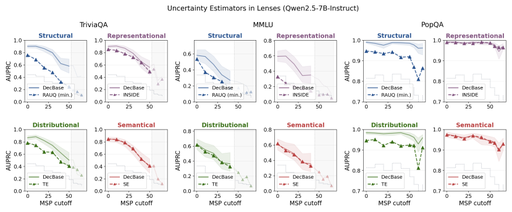
Figure 5 : AUPRC of uncertainty estimators and DecBases across confidence levels. The gray dashed line marks the chance level baseline, and gray shading marks cutoffs with fewer than 50 incorrect answers.
出典 · CC BY 4.0 · Xiaoyu Liang, Virginia Ceccatelli, Aliai Eusebi, Tobias Braun, Nils Loose, Carlo Malagnino, Lorenzo Cavallaro · Where Is Uncertainty Observed? A Mechanistic Understanding of Uncertainty Quantification in LLMs · 論文の図を引用 · 元のPDFの17ページ目から図の部分を抽出しています。測定範囲の限界
実験では、1つのプローブ系列が各レンズから取り出せる正解信号のみを測定しています。そのため、レンズの情報が別の手法で活用される可能性は確定していません。また、実験で使用したモデルとデータセットの範囲内で結果を解釈する必要があります。著者らも、g_unembとg_Rの間の差が課題やモデルによって変わるのかはまだ明確ではないと述べています。
論文情報
- 著者
- Xiaoyu Liang, Virginia Ceccatelli, Aliai Eusebi, Tobias Braun, Nils Loose, Carlo Malagnino, Lorenzo Cavallaro
- 学会・ジャーナル
- arXiv · プレプリント
- 公開日
- 2026年11月11日
- 登録日
- 2026年11月13日
- 更新日
- 2026年11月11日
- バージョン
- v1
- arXiv
- 2611.15735
- カテゴリ
- cs.CL · cs.AI · cs.LG
- ライセンス
- CC BY 4.0
- 掲載内容
- 論文情報・解説・論文の図
この解説は、Refivuの韓国語解説をAIで翻訳したものです。不正確な翻訳や誤りが含まれる可能性があります。論文と図の利用条件は各出典に従います。
アブストラクト
Knowing when a large language model's (LLM's) response can be trusted is critical for its safe use. Uncertainty quantification (UQ) can help LLMs recognize if their responses may be unreliable. Existing taxonomies organize UQ methods by uncertainty source or estimation mechanism. They leave unresolved the question of where uncertainty is observed in the model's computation. The answer matters because the observation point determines whether an estimator has access to enough information to recover a given target, and how well it can recover it. Drawing on mechanistic interpretability, we define four mechanistic observation lenses: the structural lens observes component updates, the representational lens observes hidden states, the distributional lens observes token probabilities, and the semantical lens observes distributions over meanings. We relate these lenses through the residual stream and order them by the information they carry, which gives a principle for selecting UQ methods for different targets. We survey existing methods through the four lenses. Furthermore, we distinguish evaluation targets, criteria, and metrics to clarify different UQ evaluation protocols. Finally, we identify open problems and research directions to connect uncertainty estimation to the internal computation and downstream use of LLMs.
この論文を引用
Xiaoyu Liang, Virginia Ceccatelli, Aliai Eusebi, Tobias Braun, Nils Loose, Carlo Malagnino, Lorenzo Cavallaro (2026). Where Is Uncertainty Observed? A Mechanistic Understanding of Uncertainty Quantification in LLMs. arXiv:2611.15735v1. https://arxiv.org/abs/2611.15735v1
BibTeX
@misc{liang2026where,
  title = {{Where Is Uncertainty Observed? A Mechanistic Understanding of Uncertainty Quantification in LLMs}},
  author = {Xiaoyu Liang and Virginia Ceccatelli and Aliai Eusebi and Tobias Braun and Nils Loose and Carlo Malagnino and Lorenzo Cavallaro},
  year = {2026},
  eprint = {2611.15735},
  archivePrefix = {arXiv},
  url = {https://arxiv.org/abs/2611.15735v1}
}