論文解説
When Does Confidence Reveal Problem Difficulty?
信頼度はいつ問題の難易度を明らかにするのか
- 課題 モデル自身が示す確信度が、項目の集団ベースの難易度をどの程度反映しているのかは不明です。
- 手法 複数の参照モデルの誤答率を難易度とし、摂動不一致やエントロピーなどの確信信号が、この難易度とどの程度相関するかをSpearmanで比較します。
- 結果 HARPとE2H-AMCでは、1−PCが集団難易度と正の相関を示しました。正解した項目に限っても、HARPでは0.423、E2H-AMCでは0.550でした。
モデルの確信度は項目の難易度を示すのか
大規模言語モデルは、同じベンチマークでも項目ごとに性能が大きく異なります。既存研究は、確信信号がモデル自身の答えが正しいかをどれだけよく予測するかに主に注目してきました。一方、項目の難易度は、複数のモデルや人の正誤を集計して別に測られてきました。そのため、よく使われる確信信号が項目固有の難しさを含んでいるのかは明らかではありませんでした。この論文では、この問いを確かめるため、確信信号と参照モデル集団ベースの難易度との関係を調べています。
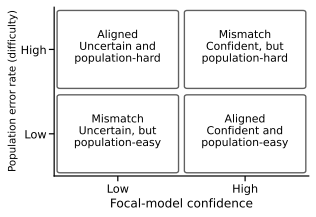
Figure 1 : Conceptual distinction between model con- fidence and population difficulty. Aligned cases corre- spond to high confidence on relatively easy problems or low confidence on difficult problems. Mismatched cases illustrate that an individual model’s confidence need not agree with the population difficulty.
出典 · CC BY 4.0 · Xiyu Bao, Langyuan Cui, Hwee Tou Ng, Chun Kai Ling · When Does Confidence Reveal Problem Difficulty? · 論文の図を引用 · 元のPDFの4ページ目から図の部分を抽出しています。難易度の目標と確信信号の定義
項目の難易度は、参照モデル集団のうち答えを誤ったモデルの割合として操作的に定義します。各focal modelの正誤が、そのモデル自身の難易度目標に直接入らないよう、残りのモデルだけで目標を計算するleave-one-model-out方式を使います。確信信号としては、複数の意味保存摂動での答えの不一致である1−PC、複数のサンプル回答の意味エントロピー、解法の長さ、トークンエントロピーなどを比較します。1−PCは、一致する答えのペアの割合を21組のペアを分母として割った値の補数です。値が大きいほど、答えが不安定であることを表します。
HARPとE2H-AMCでの相関
HARPとE2H-AMCでは、それぞれ500項目を使いました。モデル設定ごとにSpearman相関をまず求めた後、同じ重みで平均しました。1−PCは両データセットとも集団難易度と正の相関を示し、正解した項目に限っても相関が残りました。この制限分析では、1−PCの平均相関はHARPで0.423、E2H-AMCで0.550でした。トークンエントロピーは、両データセットで比較的弱い相関にとどまりました。
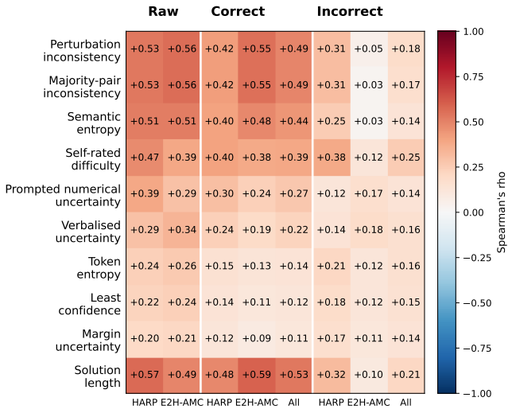
Figure 3 : Associations between model-derived signals and population difficulty on E2H-AMC and HARP. Rows are signals and while columns distinguish analyses over all problems, correctly answered problems, and incorrectly answered problems. Each cell is an equal-weight mean Spearman correlation.
出典 · CC BY 4.0 · Xiyu Bao, Langyuan Cui, Hwee Tou Ng, Chun Kai Ling · When Does Confidence Reveal Problem Difficulty? · 論文の図を引用 · 元のPDFの6ページ目から図の部分を抽出しています。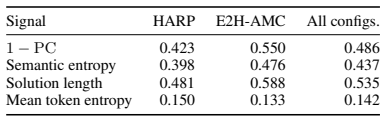
Table 2 : Mean Spearman correlations between model- derived signals and leave-one-model-out population dif- ficulty, restricted to problems correctly answered by the focal model. Correlations are computed separately for each model–dataset configuration and averaged equally across available configurations.
出典 · CC BY 4.0 · Xiyu Bao, Langyuan Cui, Hwee Tou Ng, Chun Kai Ling · When Does Confidence Reveal Problem Difficulty? · 論文の図を引用 · 元のPDFの6ページ目から図の部分を抽出しています。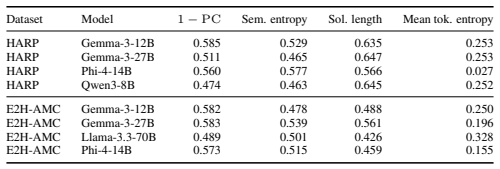
Table 13 : Per-model Spearman correlations with population difficulty for the four primary signals.
出典 · CC BY 4.0 · Xiyu Bao, Langyuan Cui, Hwee Tou Ng, Chun Kai Ling · When Does Confidence Reveal Problem Difficulty? · 論文の図を引用 · 元のPDFの21ページ目から図の部分を抽出しています。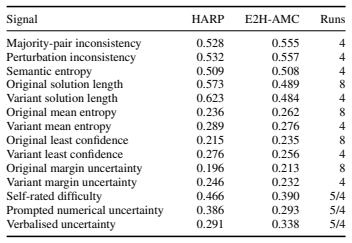
Table 14 : Additional signal correlations. The run count is shown as HARP/E2H-AMC when coverage differs.
出典 · CC BY 4.0 · Xiyu Bao, Langyuan Cui, Hwee Tou Ng, Chun Kai Ling · When Does Confidence Reveal Problem Difficulty? · 論文の図を引用 · 元のPDFの22ページ目から図の部分を抽出しています。数学以外のタスクへの拡張
MMLU、ProofWriter、SQuADで、Phi-4-14B、Gemma-3-12B、GPT-OSS-120Bをfocal modelとして評価しました。9つのモデルとタスクの設定すべてで、1−PCは集団難易度と正の相関を示し、信頼区間には0が含まれませんでした。ただし、著者らは多重比較を調整しなかったと述べています。そのため、この結果は一つずつ独立に確かめられた結果というより、一貫した傾向として読むのが適切です。
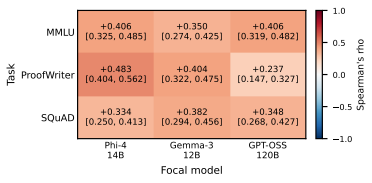
Figure 5 : Spearman correlations between perturbation inconsistency (1−PC ) and population difficulty across MMLU, ProofWriter, and SQuAD. Each cell reports Spearman’sρwith its95%confidence interval.
出典 · CC BY 4.0 · Xiyu Bao, Langyuan Cui, Hwee Tou Ng, Chun Kai Ling · When Does Confidence Reveal Problem Difficulty? · 論文の図を引用 · 元のPDFの7ページ目から図の部分を抽出しています。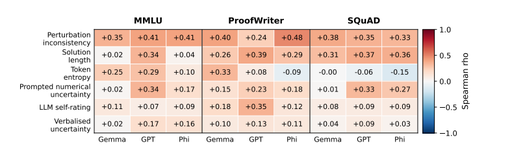
Figure 6 : Wider-domain signal associations with model-population difficulty. Rows are signals; columns are the three focal models within each task.
出典 · CC BY 4.0 · Xiyu Bao, Langyuan Cui, Hwee Tou Ng, Chun Kai Ling · When Does Confidence Reveal Problem Difficulty? · 論文の図を引用 · 元のPDFの17ページ目から図の部分を抽出しています。ルーティングへの適用実験
ルーティング実験では、1−PCが中間域にある項目を、より強いモデルへ送る二重閾値方式を使いました。閾値は較正用の項目で決め、テスト項目では固定しました。2つの弱いモデルのどちらでも、この方式は比較基準をわずかに上回る精度でした。ただし改善幅は大半が小さいものでした。この結果は、選択的に上方へ変える可能性を示す予備的な証拠と解釈すべきです。
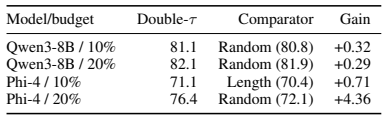
Table 4 : Test accuracy (%) of the perturbation- consistency interval policy (Double-τ) and the strongest available baseline at each routing budget. Gain is the accuracy improvement in percentage points, and Routed is the actual percentage of test items escalated. Results are aggregated over 280 test items per weak model.
出典 · CC BY 4.0 · Xiyu Bao, Langyuan Cui, Hwee Tou Ng, Chun Kai Ling · When Does Confidence Reveal Problem Difficulty? · 論文の図を引用 · 元のPDFの8ページ目から図の部分を抽出しています。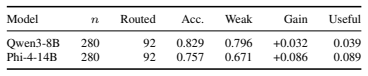
Table 16 : Medium-band routing results on the 280-item test partition. “Useful” is the fraction of items on which escalation changes an incorrect weak answer to a correct answer.
出典 · CC BY 4.0 · Xiyu Bao, Langyuan Cui, Hwee Tou Ng, Chun Kai Ling · When Does Confidence Reveal Problem Difficulty? · 論文の図を引用 · 元のPDFの22ページ目から図の部分を抽出しています。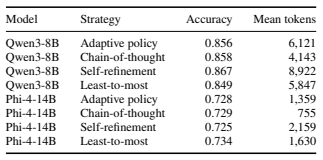
Table 17 : Adaptive-inference test accuracy and mean generated tokens on the test split.
出典 · CC BY 4.0 · Xiyu Bao, Langyuan Cui, Hwee Tou Ng, Chun Kai Ling · When Does Confidence Reveal Problem Difficulty? · 論文の図を引用 · 元のPDFの22ページ目から図の部分を抽出しています。限界
難易度目標は有限の参照モデル集団に依存するため、本質的な難易度や人が与えた難易度とは見なせません。摂動ベースの信号は追加の生成が必要なため、導入時のコストが伴います。
論文情報
- 著者
- Xiyu Bao, Langyuan Cui, Hwee Tou Ng, Chun Kai Ling
- 学会・ジャーナル
- arXiv · プレプリント
- 公開日
- 2026年11月14日
- 登録日
- 2026年11月17日
- 更新日
- 2026年11月14日
- バージョン
- v1
- arXiv
- 2611.19173
- カテゴリ
- cs.AI
- ライセンス
- CC BY 4.0
- 掲載内容
- 論文情報・解説・論文の図
この解説は、Refivuの韓国語解説をAIで翻訳したものです。不正確な翻訳や誤りが含まれる可能性があります。論文と図の利用条件は各出典に従います。
アブストラクト
While confidence signals are commonly evaluated for their ability to predict a model's own correctness, their relationship with problem difficulty remains less understood. In this work, we investigate a wide range of confidence-related signals and whether they can serve as indicators of problem difficulty across various task domains. We find that perturbation inconsistency, semantic entropy, and solution length exhibit strong associations with population difficulty than token-level uncertainty. Notably, these relationships persist even when restricting the analysis to problems correctly answered by the focal model, suggesting that such signals capture information about difficulty beyond their ability to predict the model's own correctness. We further explore applications of these signals, illustrating the potential and limitations of using confidence-related signals to guide inference-time decisions. Our findings highlight the utility of model-specific signals as imperfect but informative proxies for population-level problem difficulty.
この論文を引用
Xiyu Bao, Langyuan Cui, Hwee Tou Ng, Chun Kai Ling (2026). When Does Confidence Reveal Problem Difficulty?. arXiv:2611.19173v1. https://arxiv.org/abs/2611.19173v1
BibTeX
@misc{bao2026when,
  title = {{When Does Confidence Reveal Problem Difficulty?}},
  author = {Xiyu Bao and Langyuan Cui and Hwee Tou Ng and Chun Kai Ling},
  year = {2026},
  eprint = {2611.19173},
  archivePrefix = {arXiv},
  url = {https://arxiv.org/abs/2611.19173v1}
}