論文解説
What Matters for Cross-Modal Alignment
クロスモーダル整列で重要な要素
- 課題 ペアデータなしで固定された画像エンコーダとテキストエンコーダを整列する方法は、自然画像では機能しますが、医療画像では失敗します。
- 手法 共有部分空間の分散比と符号を分析し、少数のペアでリッジ回帰によるマッピングとレポート分類器を学習します。
- 結果 CT-RATEでは200ペアのLightAlignがCT-CLIPを上回る0.754 AUROCを記録しました。
zero-pair整列が失敗する理由
この論文では、ペアデータを使わずに固定された画像エンコーダとテキストモデルを対応づけるzero-pair整列が、自然画像でのみ成功するのかが問われています。著者らは、COCOではFOSCTTM 0.012で整列できる一方、CTデータでは56個のエンコーダとテキストの組み合わせがすべて、ランダムと同程度(0.440–0.536)にとどまると報告しています。原因を探るため、2つのモダリティが共に変化する共有部分空間における画像の分散比ηを中心的な変数としています。医療画像ではηが小さく、CTでは0.5–10.5%、胸部X線では2–3.5%です。
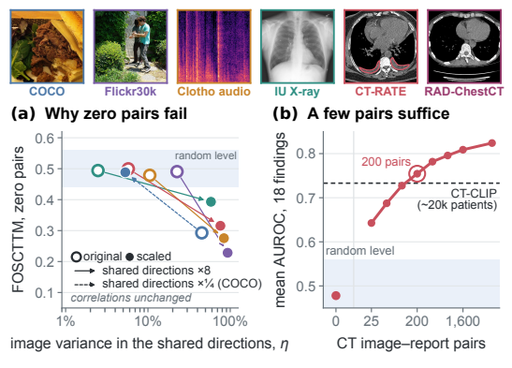
Figure 1 . A large variance share is necessary for zero-pair alignment, and 200 pairs outperform an end-to-end model. Top: one held-out example per dataset, framed in its marker color (CT: one axial slice).(a)Each marker is one dataset (open: before, filled: after scaling the shared directions eight-fold at unchanged canonical correlations); horizontal: mean fraction η of image variance in the shared directions; vertical: FOSCTTM, lower is better (shaded: random level). Scaling the shared directions aligns all four failing datasets (solid arrows, after sign correction; each combination in Fig. 3); shrinking them on COCO to a quarter breaks the alignment (dashed arrow).(b)Mean AUROC over 18 findings on the 3,002 test scans vs. pair count (red curve; ring: 200 pairs, both encoders frozen); dashed line: CT-CLIP, trained end to end on the image–report pairs of about 20,000 patients without finding labels.
出典 · CC BY 4.0 · Yipeng Sun, Jiajun Wang, Siyuan Mei, Yan Xia, Siming Bayer, Vincent Christlein, Andreas Maier · What Matters for Cross-Modal Alignment · 論文の図を引用 · 元のPDFの2ページ目から図の部分を抽出しています。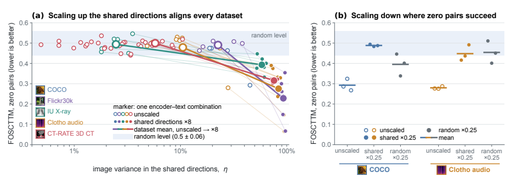
Figure 3 . Without paired data, the zero-pair method finds the shared subspace only when it holds a large share of the variance.(a)Horizontal: share η of image variance in the shared directions (log scale). Vertical: FOSCTTM at zero pairs. Color: dataset. Each encoder–text combination (three-seed mean): open: original; filled: shared directions scaled eight-fold at unchanged canonical correlations (sign correction: oracle signs on Flickr30k, Clotho, IU X-ray; GW sign selection on CT). Large markers: dataset means. Band: random level (0.44–0.56).(b)Where zero pairs work, shrinking the shared directions to a quarter breaks alignment on COCO (DINOv2 mean × MPNet; Clotho: AST × MPNet); shrinking random directions of equal variance (gray) breaks COCO less (FOSCTTM 0.395 vs. 0.488) and Clotho about as much (0.454 vs. 0.448). Dots: single seeds; lines: three-seed mean.
出典 · CC BY 4.0 · Yipeng Sun, Jiajun Wang, Siyuan Mei, Yan Xia, Siming Bayer, Vincent Christlein, Andreas Maier · What Matters for Cross-Modal Alignment · 論文の図を引用 · 元のPDFの7ページ目から図の部分を抽出しています。位置の特定と符号の決定
整列は2段階に分けて考えられます。まず主成分に射影して共有方向の位置を求め、次に各方向の符号を決めます。著者らは、画像特徴が歪んでいる(skewed)ため3次モーメントが符号によって変わり、鏡像マッピングはGromov–Wasserstein損失関数の値が高いと説明しています。この損失関数で符号パターンを選び、ペアなしで鏡像マッピングを補正します。ペアの数を選ぶ段階では、200ペアのパイロットと検出閾値 n⋆ = d(1+1/r) を用います。最終手法のLightAlignは、固定された2つのエンコーダの間でリッジ回帰により画像をテキスト空間へ写像し、レポートテキストだけで学習したロジスティック分類器が所見を予測します。
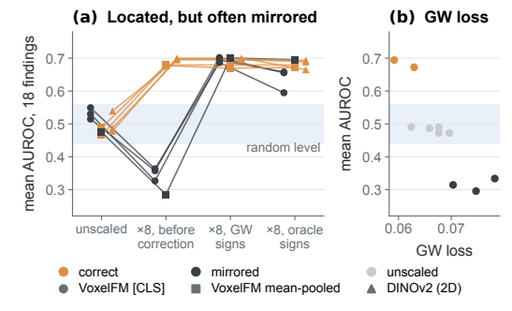
Figure 4 . A located subspace is often mirrored, and the GW loss distinguishes the mirror without paired data.(a)Mean AUROC over 18 findings per seed on CT for three encoder–text combinations (circle: V oxelFM [CLS] token, block 11,× Qwen3.5-9B; square: V oxelFM mean-pooled patch tokens × Qwen3.5-4B; triangle: DINOv2 on 2D slices × Qwen3.5-4B): original features, shared directions scaled eight-fold before sign correction, and signs chosen by the GW loss (Eq. (2)) or by oracle signs. Each line is one seed, colored by the orientation of its map before sign correction (orange: correct; black: mirrored). Band: random level.(b)GW loss against mean AUROC (V oxelFM patch×Qwen3.5-4B, five seeds). Gray: original; orange: correct; black: mirrored.
出典 · CC BY 4.0 · Yipeng Sun, Jiajun Wang, Siyuan Mei, Yan Xia, Siming Bayer, Vincent Christlein, Andreas Maier · What Matters for Cross-Modal Alignment · 論文の図を引用 · 元のPDFの8ページ目から図の部分を抽出しています。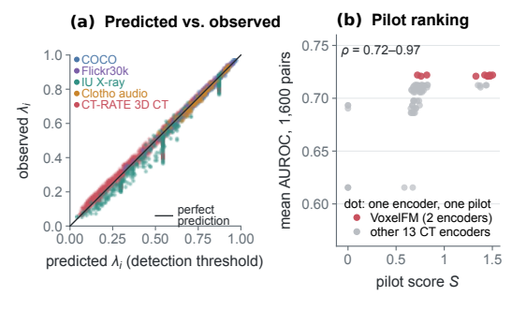
Figure 5 . The random-matrix detection threshold predicts how many pairs localization requires, and a 200-pair pilot ranks the encoders. (a)Top three squared sample canonical correlations λi of every setting, predicted by Eqs. (3)–(4) against observed (CT-RATE: 2,550 settings); line: perfect prediction; color: dataset.(b)A 200-pair pilot score (Qwen3.5-4B middle layer, d= 64 ) ranks 15 CT encoders by AUROC at 1,600 pairs. Horizontal: pilot score S, the summed estimated strengths of the detected shared directions. Each dot: one encoder in one of five independent 200-pair pilots; red: the two V oxelFM encoders; light gray: the other 13.ρ: Spearman rank correlation per pilot, 0.72–0.97.
出典 · CC BY 4.0 · Yipeng Sun, Jiajun Wang, Siyuan Mei, Yan Xia, Siming Bayer, Vincent Christlein, Andreas Maier · What Matters for Cross-Modal Alignment · 論文の図を引用 · 元のPDFの9ページ目から図の部分を抽出しています。CTと胸部X線での結果
CT-RATEでは200ペアで学習したLightAlignが、CT-CLIPを上回る平均AUROC(0.754 対 0.733)を記録しました。この比較は、CT-CLIPが約20,000人の患者でエンドツーエンドに学習されたモデルという条件のもとで行われました。CheXpertでは約5%のペアで平均AUROC 0.862を達成したと報告しています。共有方向の分散を8倍に広げると、CTの3つの組み合わせのFOSCTTMは0.50から0.32に下がりました。同じ設定でGW符号選択は、CTの鏡像マッピング4シードすべてを補正し、平均AUROCを0.35から0.69に引き上げました。
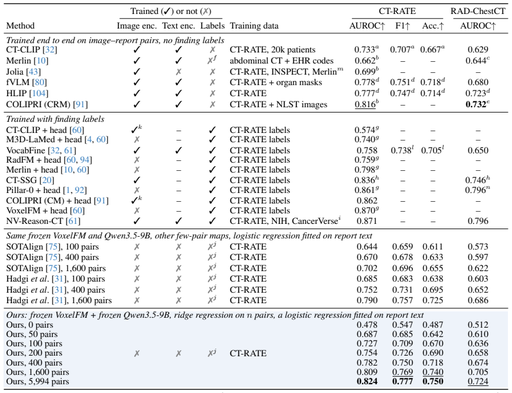
Table 1 . Multi-abnormality classification on 3D chest CT. CT-RATE: test set, i.e., the official validation set (3,002 scans, 18 findings), mean AUROC, weighted F1, and accuracy at the receiver operating characteristic (ROC) corner threshold of CT-CLIP [32]. RAD-ChestCT: OOD hospital, 3,630 volumes, 16 findings; ours applies the CT-RATE map and classifier unchanged. Labels: finding-label supervision; –: no text encoder, not reported, or not evaluated. Published models: numbers from the cited papers; SOTAlign and Hadgiet al.: fitted by us. Ours: frozen V oxelFM block 11 + Qwen3.5-9B middle layer, selected on validation patients; ridge regression onn pairs, report classifier, five seeds; 0 pairs uses the Wasserstein Procrustes method [76]. COLIPRI (CRM): contrastive + report generation + masked autoencoder; (CM): without report generation. NLST: National Lung Screening Trial. V ocabFine: CT-CLIP fine-tuned on 18 labels. Other few-pair maps: Table S2.Bold: best without image labels; underline : second best.
出典 · CC BY 4.0 · Yipeng Sun, Jiajun Wang, Siyuan Mei, Yan Xia, Siming Bayer, Vincent Christlein, Andreas Maier · What Matters for Cross-Modal Alignment · 論文の図を引用 · 元のPDFの4ページ目から図の部分を抽出しています。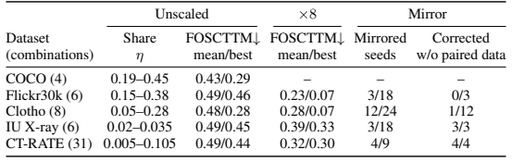
Table 2 . Scaling the shared directions aligns all four failing datasets. Combinations: encoder–text combinations of Fig. 3a, three seeds each. Share η: fraction of image variance in the shared directions (range). FOSCTTM: dataset mean / best combination. ×8: shared directions scaled eight-fold at fixed correlations, signs corrected (oracle signs from paired test correlations; GW sign selection on CT). CT-RATE×8 and mirror columns: the three combinations of Fig. 4a (nine seeds). Mirrored seeds: maps on scaled features whose FOSCTTM improves by more than 0.1 under the best of the 210 sign patterns on paired validation data, as mirrored / all seeds. Corrected without paired data: mirrored seeds where GW sign selection (Eq. (2); variants: Table S25) recovers over half of that improvement. –: not applicable.
出典 · CC BY 4.0 · Yipeng Sun, Jiajun Wang, Siyuan Mei, Yan Xia, Siming Bayer, Vincent Christlein, Andreas Maier · What Matters for Cross-Modal Alignment · 論文の図を引用 · 元のPDFの7ページ目から図の部分を抽出しています。適用範囲と設定への依存性
結果は、ペアの数と評価条件によって変わります。RAD-ChestCTの評価は、CT-RATEで学習したマッピングと分類器を変更せずに適用したものです。ただし設定表全体の承認は、この論文の記述だけでは確認できません。また、Qwen3.5-4Bの代わりに110Mのテキスト埋め込みモデルが複数のデータセットでより良い結果を示したという観察は、この研究の設定の範囲内で報告されたものです。
論文情報
- 著者
- Yipeng Sun, Jiajun Wang, Siyuan Mei, Yan Xia, Siming Bayer, Vincent Christlein, Andreas Maier
- 学会・ジャーナル
- arXiv · プレプリント
- 公開日
- 2026年11月15日
- 登録日
- 2026年11月17日
- 更新日
- 2026年11月15日
- バージョン
- v1
- arXiv
- 2611.20000
- カテゴリ
- cs.CV · cs.AI
- ライセンス
- CC BY 4.0
- 掲載内容
- 論文情報・解説・論文の図
この解説は、Refivuの韓国語解説をAIで翻訳したものです。不正確な翻訳や誤りが含まれる可能性があります。論文と図の利用条件は各出典に従います。
アブストラクト
The Platonic Representation Hypothesis posits that models trained on different modalities converge toward a shared representation. Related work aligns frozen image and text encoders on natural images without paired data. We test zero-pair alignment on five datasets across four modalities: natural images, environmental audio, chest radiographs, and 3D computed tomography (CT). It succeeds only on COCO and fails on the other four. We analyze the failures and find that alignment must first locate the subspace where the modalities co-vary and then orient the mapping within it. Consistent with previous studies, medical imaging is the hardest case: its shared subspace carries the smallest fraction of the variance. When this fraction is small, alignment needs image-text pairs, and random-matrix theory predicts how many pairs are needed. These findings motivate LightAlign: a few pairs let a ridge regression between two frozen encoders locate and orient the mapping simultaneously, and a classifier fitted only on report text then predicts findings from the mapped images. On 3D CT, LightAlign surpasses models trained end to end on image-report pairs without finding-level labels: with only 200 pairs, LightAlign outperforms CT-CLIP on CT-RATE (0.754 vs. 0.733 AUROC), and with only 100 CT-RATE pairs, it does so on RAD-ChestCT, an out-of-distribution dataset from a different hospital. On CheXpert, it reaches 0.862 mean AUROC with only about 5% as many pairs as models trained on MIMIC-CXR.
この論文を引用
Yipeng Sun, Jiajun Wang, Siyuan Mei, Yan Xia, Siming Bayer, Vincent Christlein, Andreas Maier (2026). What Matters for Cross-Modal Alignment. arXiv:2611.20000v1. https://arxiv.org/abs/2611.20000v1
BibTeX
@misc{sun2026what,
  title = {{What Matters for Cross-Modal Alignment}},
  author = {Yipeng Sun and Jiajun Wang and Siyuan Mei and Yan Xia and Siming Bayer and Vincent Christlein and Andreas Maier},
  year = {2026},
  eprint = {2611.20000},
  archivePrefix = {arXiv},
  url = {https://arxiv.org/abs/2611.20000v1}
}