論文解説
The Dark Matter of Clinical Data: An Identification Limit on Disentangling Physiology from Care Process in electronic health records
臨床データの暗黒物質:電子カルテから生理状態と診療過程を分離することの識別限界
- 課題 EHRの検査値は、患者の生理状態と検査を行うかどうかの判断が共に作り出した結果です。そのため、観測データから二つの要因を分離できるかが問題になります。
- 手法 値とオーダーを分けるPID分解と、サイト間の表現条件付き結果不変性の検定を検討します。二つの戦略が識別できるものと識別できないものを区別します。
- 結果 センチネル符号化の下ではPIDはオーダー情報を識別できません。サイト横断検定は結合仮説を反証または確認できますが、生物学的不変性は識別できません。
研究課題と既存の戦略
臨床検査値には、患者の生理状態だけでなく、どの検査をいつオーダーするかという臨床判断と地域の診療慣行が反映されています。学習された表現もこの記録を圧縮するため、生理と診療過程が混ざって入り込みます。この論文は、二つの戦略がこの絡み合いを実際にほどけるのかを検討します。一つは、一つのデータセット内で値とオーダー情報を分ける partial information decomposition(PID)です。もう一つは、サイト間で学習された関係が同じかを見るサイト横断の不変性検定です。著者らは、両戦略とも一般に期待されるほどの識別力は得られず、それぞれが何を確定できるかを絞り込んで示しています。
潜在生理と観測記録の構造
モデルは、潜在生理状態、サイト環境、潜在オーダー意図、測定前の途中終了、オーダー指示子、記録値、学習された表現、結果で構成されます。記録値は検査が行われた場合にのみ存在し、検査がなければ値は structural undefinedness の状態になります。これは、存在するが観測されない値や、生成されたが失われた欠測値とは区別されます。分析者は、しばしばセンチネルコードでこの値を埋め、すべての患者に値があるかのようにします。biological invariance は、同じ潜在生理状態では結果の分布がサイトにかかわらず同じであるという仮定です。この論文で識別可否が検討される中心的な仮説です。
二つのモデルが同じ観測結合分布を作る場合、observational equivalence の関係にあると見なします。
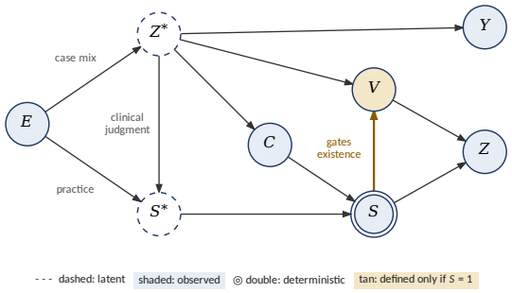
Figure 1 :Clinical data-generating process.Dashed circles are latent; shaded circles are observed; the double circle marks a deterministic node (S =S⋆(1−C )); the tan nodeV exists only when S = 1. The environment enters the record twice, through case mix (E→Z ⋆) and through practice (E→S ⋆), so any representationZ computed from the record inherits both physiology and care process. The absent edgeE→Y encodes Assumption 4, and the absent edgesS→Y and Z→Y encode Assumption 6a (both stated in Section 3.3).
出典 · CC BY 4.0 · 元のPDFの6ページ目から図の部分を抽出しています。値とオーダーを一つのデータセットで分けられるか
最初の結果は、オーダーが分析物のレベルによって変わると、未検査の患者の分布をデータから復元できないということです。そのため、値とオーダー情報を分ける分割は識別されません。記録値をセンチネルで符号化すると、記録値がオーダー指示子のエントロピーをすべて含むことになります。このとき、Williams–Beer公理を満たし、単射的な再符号化に不変な冗長性の尺度では、PIDがオーダー指示子の情報すべてを冗長情報として割り当てます。この結論は、その公理と再符号化不変性を満たす尺度すべてに当てはまり、標準的な尺度もこのクラスに含まれます。したがって、センチネル符号化された値に対するPIDの結果を、値とオーダーの寄与を分離したものとして読むことはできません。
サイト横断検定と生物学的不変性の識別限界
サイト横断検定は結合仮説を反証または確認できますが、biological invariance そのものを識別することはできません。生物学的不変性が成り立つのに検定が失敗するモデルと、観測的に同等なモデルが存在し、そのモデルでは生物学的不変性は偽です。作業例は二値変数で構成され、case mixはq0=0.3、q1=0.7と異なります。誤り率は10%で、結果機構は二つのサイトで同じです(µ0=0.2, µ1=0.8)。この条件では、同じ表現セルの死亡率の差は9.6 percentage pointsと計算されます。同じ観測分布を作る別のモデルでは、サイトごとの結果機構が現れます。また、検定を通過しても生物学的不変性が確定するわけではありません。
この結果は、この作業例のモデルクラスの中で示されたものです。
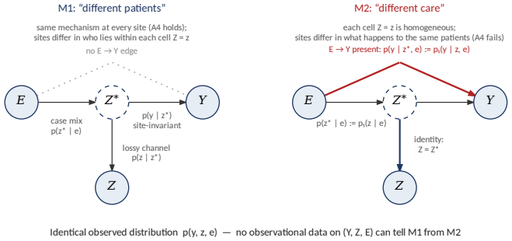
Figure 3 :Observational equivalence.Left, M1: biological invariance holds (noE→Y edge), case mix differs by site, and the representation is lossy, so the posterior over physiology within a cell Z =z depends on the site. Right,M2 (Lemma 1): the latent state is the representation itself and the outcome mechanism is site-specific (E→Ypresent). Both induce the samep(y,z,e).
出典 · CC BY 4.0 · 元のPDFの14ページ目から図の部分を抽出しています。識別を回復する測定条件
オーダーがすべての患者に日常的に行われる測定では、オーダーゲートが取り除かれます。命題4は、行われた検査が全サイトで同じ分析法により結果に関係する生理を正確に要約する場合、生物学的不変性が識別されると述べています。命題5は、二値の生理状態で二つの検査の誤りが独立であり、サイトのcase mixが異なる場合に識別が可能だと述べています。これらの命題は、観測分布では確認できない検査特性についての仮定に依拠しています。その仮定は、検査の知識によって裏付けられる必要があります。
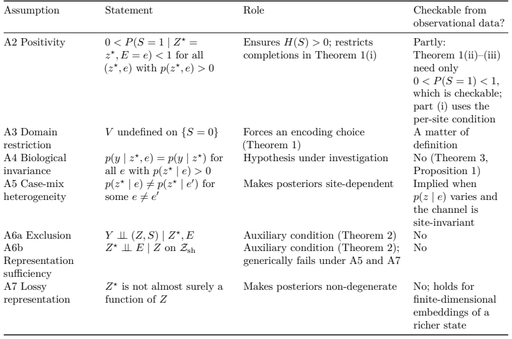
Table 1 : Assumptions, their role, and whether observational data can check them. Assumption 1 (censoring ignorability) is used by no result and is discussed in SI S1.
出典 · CC BY 4.0 · 元のPDFの8ページ目から図の部分を抽出しています。適用範囲と限界
定理と命題はモデルクラスの中では厳密ですが、感度計算と作業例は二値変数と対称な誤り率を仮定しています。Proposition 3 は普遍的な結果ではなく、有限の状態空間で測度0の集合を扱う一般的(generic)な結果です。この論文は識別限界を示すことに焦点を置いており、部分識別情報の可能性を排除するものではありません。連続型の埋め込みに対する検定の選択や、一般的な感度モデルは、この論文では扱いません。
報告の仕方と解釈の境界
サイト横断の不変性の結果は、生物学的な差や同一性の証拠ではなく、記述された結合仮説に対する検定として報告すべきです。失敗した検定は結合仮説が誤りであることを示しますが、どの仮定が誤りかは示しません。通過した検定は、生物学的不変性を確認するものではありません。感度分析、日常測定に基づくanchoring、介入による変動は、識別の境界を補うことができます。この論文は、観測EHR研究が依然として情報を与えると見ていますが、その解釈はこの境界の内側で行われるべきです。
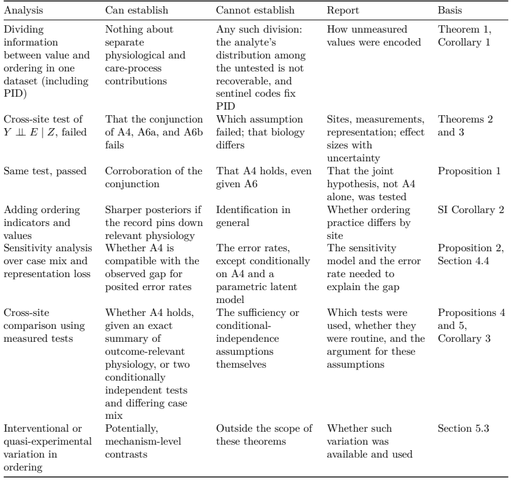
Table 3 : What each analysis can establish from observational data, and what should be reported.
出典 · CC BY 4.0 · 元のPDFの24ページ目から図の部分を抽出しています。論文情報
- 著者
- Shahin, Mohammad, Chaisutyakorn, Krittaphas, Proios, Dimitrios, Restrepo, David, Mishra, Vishala, Zhang, Boya, Sivaraman, Aadarsh, Roy, Sparsh, Abril, Benet Fité, Chen, Tina Yen-Ting, Kwak, Hyunjung Gloria, Waschka, Andre Kurepa, Mathur, Vinayak, Celi, Leo Anthony
- 学会・ジャーナル
- arXiv · プレプリント
- 公開日
- 2026年11月9日
- 登録日
- 2026年11月10日
- 更新日
- 2026年11月9日
- バージョン
- v1
- arXiv
- 2611.11726
- カテゴリ
- cs.LG · stat.ME
- ライセンス
- CC BY 4.0
- 掲載内容
- 論文情報・解説・論文の図
この解説は、Refivuの韓国語解説をAIで翻訳したものです。不正確な翻訳や誤りが含まれる可能性があります。論文と図の利用条件は各出典に従います。
アブストラクト
Representations learned from electronic health record (EHR) data encode patient physiology together with the clinical process that decides what is measured, when, and for whom. We formalize the data-generating process with latent physiology, ordering intent, laboratory values that exist only when measured, a learned representation, and clinical environments, and analyze two strategies for undoing this entanglement. First, no division of the information carried by laboratory "value" and "ordering" channels is identified from a single dataset: when ordering depends on the analyte, its distribution among untested patients is not recoverable, and a sentinel code for the undefined recorded value makes it carry all the entropy of the ordering indicator, fixing partial information decomposition (PID) for every redundancy measure satisfying the Williams-Beer axioms and invariant under injective re-encoding. Second, cross-site invariance of representation-conditional outcomes is a falsifiable implication of biological invariance taken jointly with exclusion and representation-sufficiency conditions, but not an identification strategy: we construct observationally equivalent models that disagree about biological invariance, whether the invariance test fails or passes. For binary physiology this happens exactly when case mix differs, the representation is lossy, and physiology affects the outcome. A worked example yields a 9.6-percentage-point cross-site gap under an unchanged biological mechanism. Tests performed for every patient remove the ordering gate, and measured tests can restore identification: biological invariance is identified when a test exactly summarizes outcome-relevant physiology, or, for binary physiology, when two tests with independent errors are available at sites with different case mix. Cross-site analyses should be reported as tests of a stated joint hypothesis.
この論文を引用
Shahin, Mohammad, Chaisutyakorn, Krittaphas, Proios, Dimitrios, Restrepo, David, Mishra, Vishala, Zhang, Boya, Sivaraman, Aadarsh, Roy, Sparsh, Abril, Benet Fité, Chen, Tina Yen-Ting, Kwak, Hyunjung Gloria, Waschka, Andre Kurepa, Mathur, Vinayak, Celi, Leo Anthony (2026). The Dark Matter of Clinical Data: An Identification Limit on Disentangling Physiology from Care Process in electronic health records. arXiv:2611.11726v1. https://arxiv.org/abs/2611.11726v1
BibTeX
@misc{mohammad2026dark,
  title = {{The Dark Matter of Clinical Data: An Identification Limit on Disentangling Physiology from Care Process in electronic health records}},
  author = {Shahin, Mohammad and Chaisutyakorn, Krittaphas and Proios, Dimitrios and Restrepo, David and Mishra, Vishala and Zhang, Boya and Sivaraman, Aadarsh and Roy, Sparsh and Abril, Benet Fité and Chen, Tina Yen-Ting and Kwak, Hyunjung Gloria and Waschka, Andre Kurepa and Mathur, Vinayak and Celi, Leo Anthony},
  year = {2026},
  eprint = {2611.11726},
  archivePrefix = {arXiv},
  url = {https://arxiv.org/abs/2611.11726v1}
}