論文解説
Test-Time Symmetrization: Scaling Laws for Model-Agnostic Learning under Structure
構造のもとでのモデル非依存学習のためのスケーリング法則:Test-Time Symmetrization
- 課題 同じ推論予算を、デコーディングの再サンプリングと入力の書き換えのどちらに使うべきかは、これまで経験的にしか扱われてきませんでした。
- 手法 凍結されたモデルに対し、入力の群による書き換えをランダムにいくつか選び、各書き換えで推論の軌跡をサンプリングして結果を平均する、スパースな書き換え対称化を提案します。
- 結果 グラフの辺数の計数(n=24、Qwen2.5-7B)では、予算16のとき、自己一貫性の0.81に対し、書き換え対称化は0.92を記録しました。
言語モデル推論時の2つの乱数性
言語モデルの推論時の計算量を増やす方法は、通常、同じプロンプトから複数の推論軌跡をサンプリングし、多数決や検証器で答えを選ぶことです。この論文は、そうしたデコーディングの乱数性とは別に、同じ問題を別の表現に変える書き換え(rewriting)という2つ目の乱数性を扱います。グラフのノード番号を変えたり、選択式問題の選択肢の順序を変えたりしても意味は同じですが、モデルの答えは変わることがあります。そのため、同じフォワードパスの予算をデコーディングに使うか書き換えに使うかが中心的な問いになります。
書き換え軌道とデコーディングファイバー
論文は、プロンプト空間に有限群Gが作用すると仮定し、ある意味的な問題xの軌道G·xを、同じ問題の等価な表現の集まりとして定義します。凍結されたモデルは、各書き換えg·xから生成分布p(·|g·x)で推論軌跡を抽出し、デコーディング規則Dは、その条件付き分布をヒルベルト空間の元に変換します。自己一貫性の投票確率、ロジットの平均、検証器による重み付き投票がそのような規則の例です。完全な対称化は、すべての書き換えについての平均P_G Fを取り、スパース近似では、群から一様に抽出した多重集合Sについての平均A_S Fに置き換えます。全体平均 q^D_x = P_G F^D_x は、書き換えの出発点に対して不変ですが、答えのクラス間の差は保たれます。
デコーディング再サンプリングが書き換えを代替できない理由
定理1は、元のプロンプトからどれだけ多くの軌跡を抽出しても、不変の決定が異なりうることを示します。2つの応答フィールドV(0)とV(1)はg=eで同じ値をとるため、元のプロンプトから得られる観測の分布は2つの世界で同じです。しかし、全群平均PG F(j)は互いに異なるクラスを最大化するため、2つの世界で正しい不変の決定は異なります。したがって、2つの世界が同じ確率で存在するなら、どのアルゴリズムも誤りは少なくとも1/2になります。これは、軌跡をさらに抽出すると元の表現の乱数性は減らせても、別の書き換えでモデルがどう振る舞うかは明らかにできない、という意味です。
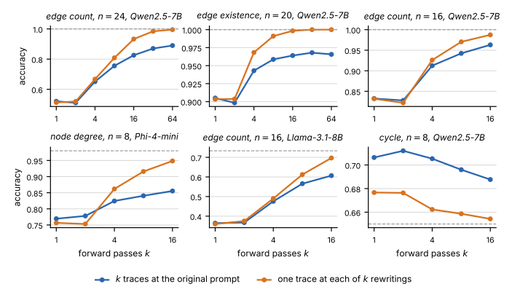
Figure 3 :Accuracy against the number of forward passes(Theorem 1). Accuracy against the number of forward passeskwhen allktraces are sampled at the original prompt and voted (blue), or one trace is sampled at each ofkrandom rewritings (orange), for six (task, size, model) cells. The dashed line is the vote over all traces at all rewritings. The last panel is the one task on which both aggregations hurt, discussed in the text.
出典 · CC BY 4.0 · Tahmasebi, Behrooz, Weber, Melanie · Test-Time Symmetrization: Scaling Laws for Model-Agnostic Learning under Structure · 論文の図を引用 · 元のPDFの8ページ目から図の部分を抽出しています。スパース書き換えの対数スケーリング法則
この上界は群の大きさの対数に依存し、一般に最適です。したがって、|S| = O(ε⁻²(log|G| + log(1/δ)))個の書き換えがあれば、相対L2誤差εを得られ、答えクラスの数には依存しません。系3は、同じ事象がデコーディング後のフィールドでも成り立つことを示しており、デコーダの乱数シードと軌跡の実現に対しても経路ごとに保たれます。
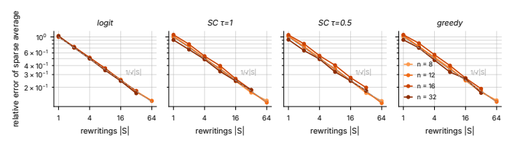
Figure 5 :Relative error of the sparse average on language-model fields(Theorems 2 and 3). Relative error∥A SF−P GF∥/∥F−P GF∥of the sparse average against|S|for Qwen2.5-7B on graphs withn∈ {8,12,16,32}nodes, one sharedS, four decoding rules applied to the same next- token fields, median over seven tasks.P GFis estimated from64independent rewritings and the estimation noise is subtracted (Section H.8). The dashed line is|S| −1/2.
出典 · CC BY 4.0 · Tahmasebi, Behrooz, Weber, Melanie · Test-Time Symmetrization: Scaling Laws for Model-Agnostic Learning under Structure · 論文の図を引用 · 元のPDFの9ページ目から図の部分を抽出しています。グラフタスクにおける書き換えとデコーディングの比較
Qwen2.5-7Bで、n=24ノードのグラフの辺数計数タスクを、予算16のフォワードパスで比較しました。自己一貫性は同じプロンプトから16個の軌跡を投票し、書き換え対称化は16個の書き換えからそれぞれ1つずつサンプリングしました。その結果、自己一貫性の精度は0.81、書き換え対称化は0.92で、差は+10.8ポイント、95%区間は[+3.8, +18.4]でした。したがって、利得はすべてのタスクで見られたわけではなく、モデルの答えが入力の表現に依存するタスクで主に見られました。
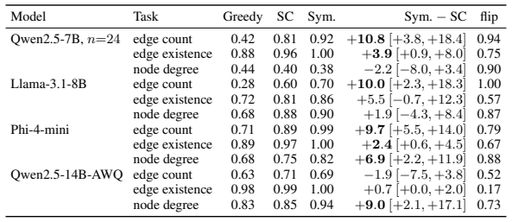
Table 1 : Accuracy atB= 16forward passes on graphs withn= 16nodes (n= 24for Qwen2.5- 7B). One greedy pass, self consistency with16traces (SC), and16rewritings with one trace each (Sym.), with the paired gain of Sym. over SC in accuracy points and its95%interval. The column “flip” is the fraction of instances whose greedy answer changes across the16rewritings. Bold means that the interval excludes zero.
出典 · CC BY 4.0 · Tahmasebi, Behrooz, Weber, Melanie · Test-Time Symmetrization: Scaling Laws for Model-Agnostic Learning under Structure · 論文の図を引用 · 元のPDFの9ページ目から図の部分を抽出しています。選択肢の順列実験
ARC-Challengeで、4つの選択肢の順列群S4を使いました。これは、等変な答えを扱うときに整列の段階が必須であることを示しています。
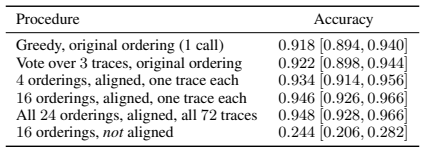
Table 6 : ARC-Challenge with permuted options, Qwen2.5-7B,500questions, with95%bootstrap intervals over questions. “Aligned” maps each predicted letter back to the option it names before voting (Section 3), and “not aligned” votes over the letters as written.
出典 · CC BY 4.0 · Tahmasebi, Behrooz, Weber, Melanie · Test-Time Symmetrization: Scaling Laws for Model-Agnostic Learning under Structure · 論文の図を引用 · 元のPDFの34ページ目から図の部分を抽出しています。厳密な対称性とパラフレーズによる代替
保証は、対称性が既知で正確なときに成り立ちます。対称性がわからない場合はパラフレーズカーネルを使えますが、そのときはカーネルのドリフトが誤差に加わり、軌道全体にわたる一様性は保証されません。論文のパラフレーズ実験でも、置き換えの方法は一部の利得しか回復しませんでした。
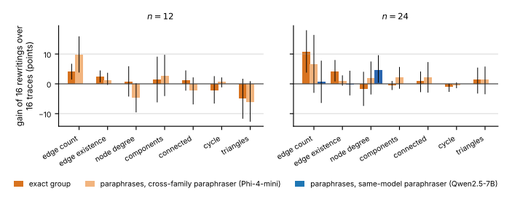
Figure 9 : Gain of16rewritings over16traces on the same orbit, for the exact group and for the two paraphrasers, Qwen2.5-7B answering, with95%intervals over instances.
出典 · CC BY 4.0 · Tahmasebi, Behrooz, Weber, Melanie · Test-Time Symmetrization: Scaling Laws for Model-Agnostic Learning under Structure · 論文の図を引用 · 元のPDFの35ページ目から図の部分を抽出しています。論文情報
- 著者
- Tahmasebi, Behrooz, Weber, Melanie
- 学会・ジャーナル
- arXiv · プレプリント
- 公開日
- 2026年11月18日
- 登録日
- 2026年11月19日
- 更新日
- 2026年11月18日
- バージョン
- v1
- arXiv
- 2611.24032
- カテゴリ
- cs.AI
- ライセンス
- CC BY 4.0
- 掲載内容
- 論文情報・解説・論文の図
この解説は、Refivuの韓国語解説をAIで翻訳したものです。不正確な翻訳や誤りが含まれる可能性があります。論文と図の利用条件は各出典に従います。
アブストラクト
Test-time compute has emerged as a powerful way to improve the accuracy of language models at inference time, with scaling laws quantifying how accuracy improves with additional forward passes. Existing scaling laws, however, focus on repeated sampling from a fixed prompt, even though many tasks admit multiple equivalent representations of the same underlying problem. A graph does not depend on how its nodes are numbered, and a program does not depend on the names of its variables, yet language models can change their answers under such rewritings. In this paper, we study test-time symmetrization, which uses forward passes on rewritings of the input and aggregates the resulting answers over the group $G$ of rewritings. We prove that no amount of sampling and repeated decoding from a single representation can replace rewriting, while only $O(\log |G|)$ random rewritings suffice to recover the information provided by all $|G|$ rewritings. The same set of $O(\log |G|)$ rewritings provides simultaneous approximation across models, decoding rules, and sampled reasoning traces, and the logarithmic scaling is optimal in general. We validate the theory with experiments on Qwen2.5-7B, Phi-4-mini, Llama-3.1-8B, and Qwen2.5-14B, with chain-of-thought reasoning, on graph reasoning, logical deduction, and multiple-choice question answering. At the same number of forward passes, spending them on rewritings of the input is substantially more accurate than spending them on repeated sampling from the original prompt whenever the model's answer depends on how the input is written, and the number of rewritings needed grows only logarithmically with the number of possible rewritings, as the theory predicts. Our results provide a principled way to enforce symmetries at inference time when they cannot be built into the model, which we call model-agnostic symmetrization.
この論文を引用
Tahmasebi, Behrooz, Weber, Melanie (2026). Test-Time Symmetrization: Scaling Laws for Model-Agnostic Learning under Structure. arXiv:2611.24032v1. https://arxiv.org/abs/2611.24032v1
BibTeX
@misc{behrooz2026test,
  title = {{Test-Time Symmetrization: Scaling Laws for Model-Agnostic Learning under Structure}},
  author = {Tahmasebi, Behrooz and Weber, Melanie},
  year = {2026},
  eprint = {2611.24032},
  archivePrefix = {arXiv},
  url = {https://arxiv.org/abs/2611.24032v1}
}