論文解説
Directional Bias in Quantile SGD and Score-Inversion Inference under Dependence
依存データでも分位点の信頼区間を、候補の検定を反転して作る
- 課題 quantile SGDの保証の多くは、入力が独立だと仮定しています。しかし時系列のように入力が依存すると、更新が一方向に偏り、既存の保証では説明できません。
- 手法 本研究は、閾値を動かさず、分位点の候補を1つずつ固定して検定します。受理されたすべての候補の凸包を区間として出します。
- 結果 固定した窓のもとで被覆誤差がO(n^-1/2)となる区間を、密度や積率を仮定せずに作れることを示します。実験では、ブロックブートストラップに近い被覆率を、より低い計算量で得られます。
依存データでquantile SGDが偏る理由
quantile SGDは、観測ごとに適応的な閾値と比べることで分位点を追跡し、メモリは定数で済みます。この更新は、オンライン共形予測や分位点型のTD学習にも使われており、そこでの入力は時系列として依存しています。それでも、再帰的な分位点の保証の多くは入力が独立であることを仮定してきました。
依存があると、直近の観測が閾値を動かし、次の入力を予測してしまうため、更新が一方向に偏ります。時間反転では、定常ストリームの周辺分位点とスコアのすべての自己共分散は変わりません。それでも、quantile SGDの主要な偏りは変わり、Section 4の例では係数が前向きで−.113、後ろ向きで−.038になります。スコアの共分散だけを見る検定では、この違いを捉えられないということです。
平均化SGDでは、ステップサイズがt^-γに比例するとき偏りはO(n^-γ)です。
偏りの展開と閾値の遅延
まず観測は固定のr個のイノベーションから作られ、r以上離れた観測は互いに独立だと仮定します(A1)。SGDの閾値は指示関数1(Xt≤q)−τを使って毎回更新され、ステップサイズは c(t+t0)^−γ で、1/2<γ<1です。この更新の偏りを、閾値と現在の観測の相互作用と曲率項の和として展開するのが本論文の中心です。
鍵は、閾値qt−1が直近のr−1個の観測によって押されている点です。それらの観測が現在のXtの条件付き密度を動かすと、更新は一定の向きに偏ります。相互作用の大きさは、ラグkごとのE{ψt−k ft(q⋆)}を足し合わせたκrで表されます。この量はスコアの共分散ではなく、二変量分布の境界微分で書けます。
そこで閾値をr期遅らせると、qt−rは現在のXtと独立になり、相互作用を取り除けます。遅延dを1つずつ増やすと、ラグの相互作用が1つずつ消え、すべての観測と主要な二次モーメントは保たれます。十分な遅延では、条件付き密度の仮定も要らなくなります。既存の展開は滑らかな更新を仮定しますが、指示関数は不連続なので、著者らは条件付き分布関数を移動する閾値の上で展開しました。
固定候補のスコア反転による区間
次に、閾値を動かさずに固定した候補qごとに重みつきのスコアSn(q)を計算し、その大きさが分散の基準以下かを検定します。候補のスコアは母集団分位点で中心化されているため、閾値の偏りは入りません。受理された候補の集合の閉凸包を区間とし、分散は窓幅bの局所的な自己共分散で推定します。重みは等重みや対称化した有限フィルタ重みを選べ、対称重みでは観測を逆順にしても区間は変わりません。
理論の証明では、依存データ向けの正規近似(Rinott型の境界)と分散の集中不等式を組み合わせます。データで窓を選ぶ場合は、bn=⌈√log n⌉のような窓で、誤差がO(log n/√n)となる上界が与えられます。分散が小さすぎるときの床として1/nを置き、受理集合を連結にするため床をより大きくした連結床区間も比べられています。
端点の計算は、近傍の和を毎回数えると候補ごとに重くなりますが、Fenwick木で部分和を持つと全体をO(n log n)で走査できます。Fenwick木の更新と部分和はどちらもO(log n)で、必要な記憶はO(n)です。直接走査とFenwick走査は、2≤n<120の3,000の乱数配置で、端点と成分数がすべて一致しました。
実験が裏づけたことと、その範囲
Section 4の例では、前向きの偏り係数が−.113、後ろ向きが−.038で、差が残りました。この差は、共分散が同じでも偏りが変わるという主張と整合します。遅延dを増やしたときの係数の変化は単調ではなく、ラグごとの符号付きの寄与が効いていると見られます。
被覆率は、n=3,000のi.i.d.設定でS-floorが99.44%、S-hullが95.38%、E-hullが95.44%となりました。床が目標の分位点で効いて区間が広がるため、S-floorは名目より過剰に被覆します。床を外したS-hullは、95.38%の被覆率を保ちながらS-floorより29.4%短い区間になります。図5は、床の有無による被覆率と区間長を並べたものです。ブロックブートストラップとの比較では、MA(11)、n=3,000でE-hullが94.50%、CBB4が93.83%で、差は.67ポイント、対応のMCSEは.58です。
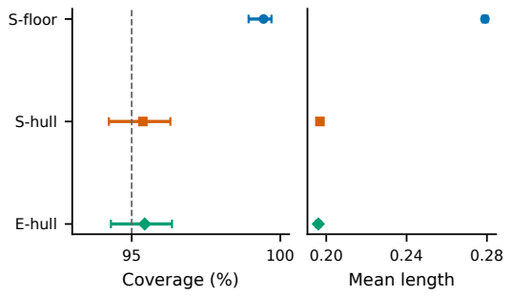
Figure 5 : Variance-floor control on 1,600 i.i.d. Cauchy streams,n = 3,000, with the power window. S-floor and S-hull differ in the floor and acceptance rule; E-hull also uses equal weights. Coverage bars are Wilson 95% Monte Carlo intervals; length bars are mean±1.96MCSE.
出典 · CC BY 4.0 · Xiaoli Li, Qianqian Lei, Wei Biao Wu · Directional Bias in Quantile SGD and Score-Inversion Inference under Dependence · 論文の図を引用 · 元のPDFの46ページ目から図の部分を抽出しています。窓が短すぎると共分散の一部を落とし、被覆が下がることを示しています。計算では、n=3,000、b=512で、Fenwick scanはdirect scanより10.89倍速く、Fenwick scanの時間はbにほぼ依存しません。
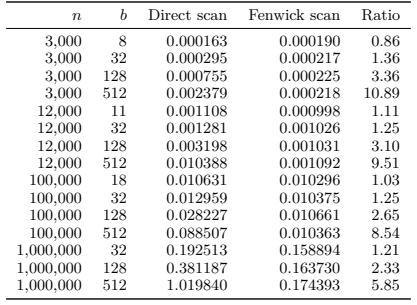
Table 8 : Single-thread scan times in seconds (median of five runs; three atn = 106), equal weights,τ =.25. Both scans return identical intervals.
出典 · CC BY 4.0 · Xiaoli Li, Qianqian Lei, Wei Biao Wu · Directional Bias in Quantile SGD and Score-Inversion Inference under Dependence · 論文の図を引用 · 元のPDFの31ページ目から図の部分を抽出しています。限界と未解決の課題
偏りの展開は、有限のイノベーション記憶と減少ステップサイズを前提としています。一定ステップサイズや、ブートストラップされた目標への拡張は今後の課題です。著者らは、AR(1)の実験では幾何的な依存のもとでも偏りの係数が予測的だと見ています。
E-hullの窓を8から15に広げると被覆率は93.69%から94.81%に上がりますが、区間は長くなります。固定窓の結果は、窓の選び方によって被覆率が大きく変わることを示しています。
論文情報
- 著者
- Xiaoli Li, Qianqian Lei, Wei Biao Wu
- 学会・ジャーナル
- arXiv · プレプリント
- 公開日
- 2026年11月20日
- 登録日
- 2026年11月24日
- 更新日
- 2026年11月20日
- バージョン
- v1
- arXiv
- 2611.28367
- カテゴリ
- stat.ML · cs.LG
- ライセンス
- CC BY 4.0
- 掲載内容
- 論文情報・解説・論文の図
この解説は、Refivuの韓国語解説をAIで翻訳したものです。不正確な翻訳や誤りが含まれる可能性があります。論文と図の利用条件は各出典に従います。
アブストラクト
Quantile stochastic gradient descent (SGD) tracks a quantile by comparing each observation with an adaptive threshold, and closely related updates calibrate online conformal sets and drive quantile temporal-difference learning. Their inputs are serially dependent, yet existing guarantees largely assume independence. We show that dependence creates a directional bias that score autocovariances cannot detect: reversing a stationary stream leaves every score autocovariance unchanged but can change the leading bias threefold. For finite memory and decreasing stepsizes, the bias splits into lag-specific interactions between the threshold and the current observation and a curvature term; delaying the threshold removes the interactions one lag at a time while keeping every observation and the leading variance. At stepsizes near $t^{-1/2}$, as used for online inference, the bias is comparable to the standard error and makes an SGD-based interval miss mostly on one side. Testing fixed candidates instead keeps the score centered, so calibration depends only on score autocovariances. Extending local-dependence self-normalized approximations to the implemented acceptance hull, we show that inverting these tests gives a density-free, moment-free interval for the population quantile with $O(n^{-1/2})$ coverage error for a fixed sufficient lag window, a rate that is sharp for this interval, and a guarantee for data-selected windows; an exact scan takes $O(n\log n)$ time. Experiments confirm the lag-by-lag predictions and show calibration competitive with block bootstrap at lower cost.
論文の図
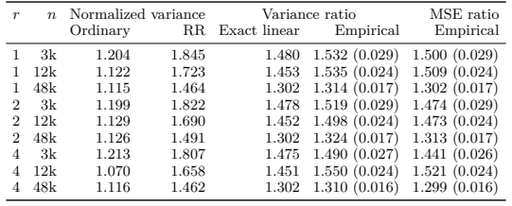
Table 6 : Shared-stream Richardson–Romberg extrapolation on 4,000 streams per setting. Empirical variances are normalized byv∞/n, wherev∞ = Ω/h2. All ratios compare RR with ordinary averaged SGD. The exact linear ratio uses (48); parentheses on empirical ratios report paired MCSEs.
出典 · CC BY 4.0 · Xiaoli Li, Qianqian Lei, Wei Biao Wu · Directional Bias in Quantile SGD and Score-Inversion Inference under Dependence · 論文の図を引用 · 元のPDFの28ページ目から図の部分を抽出しています。
Table 12 : Time reversal, 4,000 paired replications per row. Biases, contrasts and MCSEs are multiplied by103. Predictions use the leading term and the finite-nrecursion of Appendix B.7.
出典 · CC BY 4.0 · Xiaoli Li, Qianqian Lei, Wei Biao Wu · Directional Bias in Quantile SGD and Score-Inversion Inference under Dependence · 論文の図を引用 · 元のPDFの42ページ目から図の部分を抽出しています。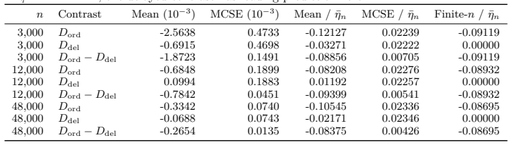
Table 14 : Paired directional contrasts fromq0 = 0. Predictions for the normalized ordinary and removed contrasts areB
出典 · CC BY 4.0 · Xiaoli Li, Qianqian Lei, Wei Biao Wu · Directional Bias in Quantile SGD and Score-Inversion Inference under Dependence · 論文の図を引用 · 元のPDFの42ページ目から図の部分を抽出しています。
Table 18 : Coverage (%) / mean length of nominal 95% intervals on 600 common streams per row. CBBj uses circular blocks of lengthj⌈n1/3⌉and 399 resamples. Coverage MCSE is about .89 percentage point near 95%.
出典 · CC BY 4.0 · Xiaoli Li, Qianqian Lei, Wei Biao Wu · Directional Bias in Quantile SGD and Score-Inversion Inference under Dependence · 論文の図を引用 · 元のPDFの45ページ目から図の部分を抽出しています。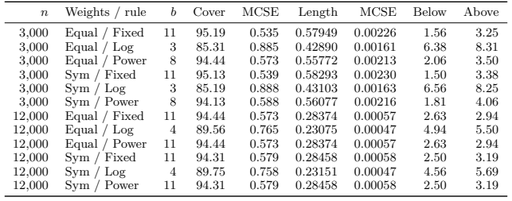
Table 20 : Fixed-window control: coverage, directional misses and coverage MCSE in percentage points; length and its MCSE on the observation scale. Each row uses 1,600 streams, paired across configurations at the samen. All intervals are finite, and no true-candidate nonpositive variance or small-floor activation occurs.
出典 · CC BY 4.0 · Xiaoli Li, Qianqian Lei, Wei Biao Wu · Directional Bias in Quantile SGD and Score-Inversion Inference under Dependence · 論文の図を引用 · 元のPDFの47ページ目から図の部分を抽出しています。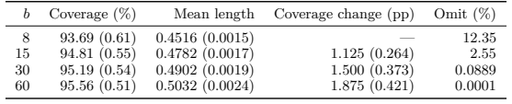
Table 21 : AR(.8) window sensitivity on 1,600 independent streams,n = 3,000and τ =.25. E-hull uses floor1/n and Cauchy margins. Parentheses report MCSEs; coverage differences fromb = 8are paired and measured in percentage points. Omit is the percentage of finite-sample score variance excluded by the window.
出典 · CC BY 4.0 · Xiaoli Li, Qianqian Lei, Wei Biao Wu · Directional Bias in Quantile SGD and Score-Inversion Inference under Dependence · 論文の図を引用 · 元のPDFの48ページ目から図の部分を抽出しています。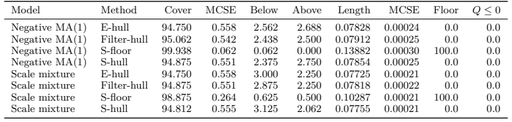
Table 22 : Negative-dependence and conditional-scale results. Coverage, directional misses, floor activation, and nonpositive variance are percentages. MCSE is the sample standard deviation across 1,600 streams divided by√ 1600. Length is on the observation scale.
出典 · CC BY 4.0 · Xiaoli Li, Qianqian Lei, Wei Biao Wu · Directional Bias in Quantile SGD and Score-Inversion Inference under Dependence · 論文の図を引用 · 元のPDFの49ページ目から図の部分を抽出しています。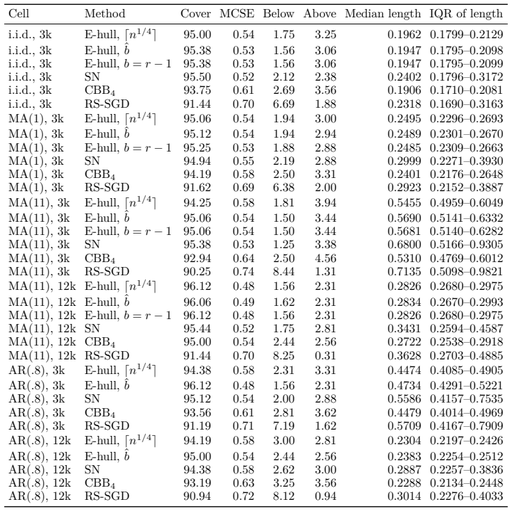
Table 23 : Interval comparison, 1,600 streams per cell. Coverage, its MCSE and directional misses in percent; “Below” meansU < q⋆ and “Above” meansL > q⋆. Lengths are summarized by their median and interquartile range.
出典 · CC BY 4.0 · Xiaoli Li, Qianqian Lei, Wei Biao Wu · Directional Bias in Quantile SGD and Score-Inversion Inference under Dependence · 論文の図を引用 · 元のPDFの50ページ目から図の部分を抽出しています。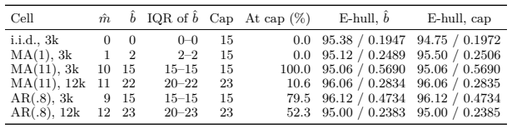
Table 26 : Bias of the RS-SGD averaged iterate (×103, MCSE in parentheses) against the finite-n recursion and the leading term for its scheduleηt = 3t−.505, q0 = 0, with 300 warm-up steps excluded; the bias in standard deviations of the averaged iterate; miss rates (%) below and above the target predicted by a Gaussian pivot with the finite-nbias, and observed. Cell Bias Finite-n
出典 · CC BY 4.0 · Xiaoli Li, Qianqian Lei, Wei Biao Wu · Directional Bias in Quantile SGD and Score-Inversion Inference under Dependence · 論文の図を引用 · 元のPDFの51ページ目から図の部分を抽出しています。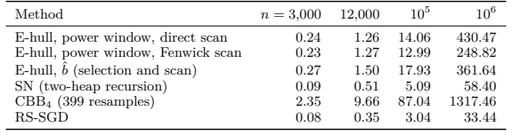
Table 27 : Median single-thread time in milliseconds.
出典 · CC BY 4.0 · Xiaoli Li, Qianqian Lei, Wei Biao Wu · Directional Bias in Quantile SGD and Score-Inversion Inference under Dependence · 論文の図を引用 · 元のPDFの52ページ目から図の部分を抽出しています。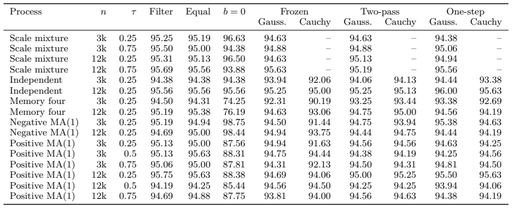
Table 29 : Connected-floor, known-window validation: coverage percent- ages,b =r− 1,λ = 1. Inversion coverage events are identical for Gaussian and Cauchy margins by transformation equivariance and are listed once; Wald methods are listed for both margins. Scale-mixture observations are untransformed and appear under the Gaussian column.
出典 · CC BY 4.0 · Xiaoli Li, Qianqian Lei, Wei Biao Wu · Directional Bias in Quantile SGD and Score-Inversion Inference under Dependence · 論文の図を引用 · 元のPDFの55ページ目から図の部分を抽出しています。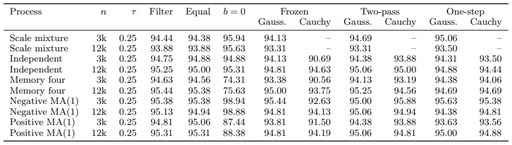
Table 30 : Connected-floor, log-window validation: coverage percentages, b=⌈ √logn⌉,λ= 1/2, arranged as in Table 29.
出典 · CC BY 4.0 · Xiaoli Li, Qianqian Lei, Wei Biao Wu · Directional Bias in Quantile SGD and Score-Inversion Inference under Dependence · 論文の図を引用 · 元のPDFの55ページ目から図の部分を抽出しています。この論文を引用
Xiaoli Li, Qianqian Lei, Wei Biao Wu (2026). Directional Bias in Quantile SGD and Score-Inversion Inference under Dependence. arXiv:2611.28367v1. https://arxiv.org/abs/2611.28367v1
BibTeX
@misc{li2026directional,
  title = {{Directional Bias in Quantile SGD and Score-Inversion Inference under Dependence}},
  author = {Xiaoli Li and Qianqian Lei and Wei Biao Wu},
  year = {2026},
  eprint = {2611.28367},
  archivePrefix = {arXiv},
  url = {https://arxiv.org/abs/2611.28367v1}
}