論文解説
Why Units Die in the Layer After a Frozen Random Encoder, and What the Number of Live Units Measures
凍結エンコーダ後段の死んだユニットを入力の偏りで減らす方法
- 課題 凍結エンコーダの後の層では、多くのReLUユニットが死んで学習できなくなり、学習も遅くなります。生存ユニット数が何を表すのかも分かっていませんでした。
- 手法 本研究は、各層の入力の偏りを表すオフセットを学習前に測り、大きければ入力の平均を引きます。引く前と後で、生存ユニット数と学習の速さを比べます。
- 結果 Pongで入力の平均を引くと、生存ユニット数が59から63に増え、学習の速さが学習済みエンコーダに近づきました。
凍結エンコーダ後段でユニットが死ぬ問題
強化学習エージェントは、重みを学習しないエンコーダの上に学習層を載せるだけで、Atariゲームを学習できます。その学習層のユニットの多くは死んでしまい、学習中に動かなくなります。ReLUは入力和が負になるとゼロを出力するため、どの画面でも入力和が負なら、そのユニットには学習信号が届きません。
死んだユニットは、ネットワークが学習を続けられなくなった兆しとして数えられることが多いです。前報では、生存ユニット数がゲームの複雑さを表すと解釈していました。ただし、死んだユニットが多い理由がゲームの複雑さによるのか、ほかの要因によるのかは分かっていませんでした。
凍結エンコーダのPongエージェントは、学習済みエンコーダの場合の8.9倍以上のエージェントステップを必要としました。生存ユニットは64のうち3から8程度にとどまりますが、専門家レベルのプレイに届いたエージェントも存在します。そのため、生存ユニットが少ないことが、そのまま失敗を意味するわけではありません。
そこで本研究は、ユニットが死ぬ原因を調べ、生存ユニット数が何を測るのかを確かめる問いに向かいます。
オフセットと学習率という二つの量
中心となる考えは、ユニットの境界線が入力の点群のどちら側に来るかで、画面ごとにオンとオフが決まるという点です。点群が原点の近くに散らばっていれば、ランダムな境界線はたいてい点群を二分するので、ユニットは一部の画面で動きます。一方、点群が原点から遠く固まっていると、境界線は群を外しやすく、ユニットは全画面でオンかオフのどちらかに固定されます。この偏りを表す量がオフセットで、平均ベクトルの長さを総分散の平方根で割って定義されます。 \( \gamma(F)=\|\mathrm{mean}(F)\| / \sqrt{\mathrm{tr}\,\mathrm{cov}(F)} \)
もう一つの量は、1回の学習ステップで入力和がどれだけ動けるかを表すステップの大きさです。Adamでは1ステップで各重みは約学習率だけ動き、その変化が同じ向きに揃うと、入力和は学習率にファンイン(入力の数)を掛けた分だけ動きます。つまり、3,136個の入力をもつFC1のユニットは、64個の入力をもつFC2のユニットより一歩で大きく動きやすくなります。
図1は、この二つの仕組みを示す概念図で、実データから得た値ではありません。左では点群が原点近くにあって境界線が点群を切るため、ユニットは生き残ります。右では点群が遠くに固まり、境界線が点群を外すので、全画面で0を出すユニットが死にます。
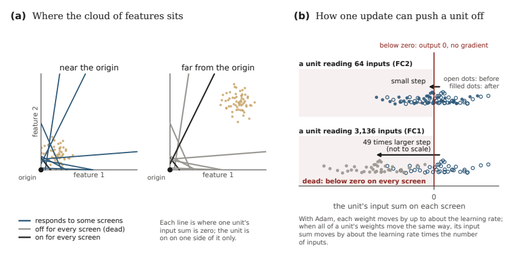
Figure 1 : How a unit of the first dense layer dies, drawn as a schematic and not from data. (a) Dots are screens, and each line marks where one unit’s input is zero. On the left the screens form a cloud near the origin, and most lines cut through it. On the right the cloud is far from the origin compared with its spread, most lines miss it, and a unit that is off for every screen is dead. (b) One update moves a unit’s input on every screen at once, and a unit with more inputs can move further.
出典 · CC BY 4.0 · Scott M. Norton · Why Units Die in the Layer After a Frozen Random Encoder, and What the Number of Live Units Measures · 論文の図を引用 · 元のPDFの3ページ目から図の部分を抽出しています。オフセットはSimon, Adams and Zouがスパースオートエンコーダの学習開始時について示したもので、学習中の死や後段の層への適用は扱われていませんでした。
オフセットの測定と操作の方法
エージェントは84×84のグレースケール画像を4枚重ねた入力を受け取り、3つの畳み込み層からなるエンコーダに通します。エンコーダは画面ごとに3,136個の数を出し、その重みは乱数のまま固定されます。その後段のFC1とFC2は、それぞれ64ユニットで学習されます。学習はPPOで行い、学習率は2.5e-4、標準の学習長は50 million agent stepsです。
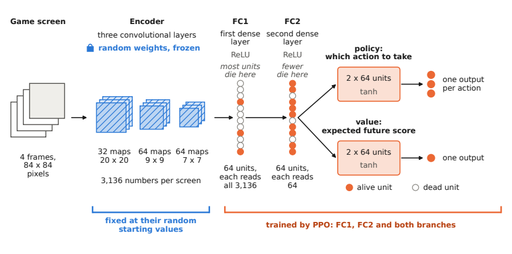
Figure 2 : The network of our agents. Four stacked greyscale frames of 84 by 84 pixels pass through an encoder of three convolutional layers whose random weights are never trained, which gives 3,136 numbers for each screen. These feed the first dense layer (FC1) and then the second (FC2), of 64 units each, and after FC2 a policy branch and a value branch, each with two more layers of 64 units. Everything after the encoder is trained. The filled and open circles illustrate alive and dead units and are not counts.
出典 · CC BY 4.0 · Scott M. Norton · Why Units Die in the Layer After a Frozen Random Encoder, and What the Number of Live Units Measures · 論文の図を引用 · 元のPDFの9ページ目から図の部分を抽出しています。オフセットは、画面の集合をエンコーダに通して得た出力を行に並べた表から測ります。同じエンコーダでも、どの画面集合で測るかで値は大きく変わり、セットによって3倍から8倍の差が出ました。たとえば未変更のBreakoutエンコーダ6つは、混合セットでは2.787から3.061、ランダムプレイの画面では13.005から18.459でした。そのため本研究は、どの画面で測ったオフセットかを常に明記しています。
オフセットを上げるには、エンコーダ最後の畳み込み層のバイアスに定数を足します。下げるには、保存された画面の平均を全画面から引く中心化を行い、エンコーダが見る入力を変えます。エンコーダの出力に固定の3,136個の値を足すshiftという操作もあり、画面を変えずにオフセットだけを動かせます。スパースオートエンコーダでは、活性化を平均の方向に動かし、全体の大きさは保つ形でオフセットを上げました。
生存ユニットは、0.01 rule(平均出力が0.01を超える)か1 percent rule(入力和が1パーセント以上の画面で正)のどちらかで数えます。本研究は1 percent ruleを主な規則とし、分析の前に決めた優先順位に従いました。2つの規則は54のBreakout実行のうち48で同じ数になり、異なった規則や画面で数えた値は比べてはいけません。
Pongで中心化した効果
Pongでは、未変更の画面の凍結エンコーダで生存ユニット数が3から6でしたが、中心化すると59から63に増えました。未変更の画面では、凍結エンコーダのエージェントは50 million agent stepsの間に学習スコア18へ届きませんでした。中心化すると、すべてのエージェントが5 million agent steps以内に18へ届き、学習済みエンコーダが未変更の画面で届いた速さに近づきました。学習に必要なステップ数の比は、3回の実行の中央値で0.699から1.216倍でした。
図7は、6組のネットワークを凍結と学習済み、未変更と中心化の4条件で比べたもので、上段がPong、下段がBreakoutです。同じ繰り返し実験で、同じ設定の3回の実行は18に届くステップが最大1.796倍ずれたので、「about as fast」は繰り返しの差の範囲内という意味です。中心化した凍結エンコーダは、中心化した学習済みエンコーダより1.421から2.274倍多くのステップを要しましたが、この比較は単一の実行で、繰り返しは行っていません。
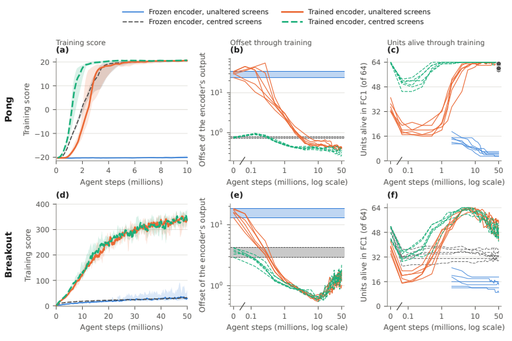
Figure 7 : The same six networks in four settings, in Pong (top) and Breakout (bottom): encoder frozen or trained, screens unaltered or centred (dashed). Left: training score, the median of the six agents with a band from the lowest to the highest, each curve smoothed over 25 logged points. Middle: the offset of the encoder’s output on random-play screens. Lines are trained encoders and bands the range of the frozen ones, which do not change. Right: FC1 units alive by the 1 percent rule, one line per agent. The dots in the top right panel are the frozen-encoder agents on centred screens, which were counted only at the end.
出典 · CC BY 4.0 · Scott M. Norton · Why Units Die in the Layer After a Frozen Random Encoder, and What the Number of Live Units Measures · 論文の図を引用 · 元のPDFの21ページ目から図の部分を抽出しています。凍結エンコーダの出力から、ボールとパドルの位置を直線で読めるかを調べると、未変更の画面でも決定係数は0.832から0.985でした。著者らは、未変更の画面での遅さは、エンコーダ自体ではなく後段の層から来ると考えています。この確認は実験後に加えたもので、事前に決めた検定ではありません。
Breakoutで差が残った理由
Breakoutでは、凍結エンコーダの平均学習スコアは学習済みエンコーダより、中心化の有無にかかわらず199.736から232.404点低いままでした。つまり、生存ユニットを増やしても学習スコアは改善しませんでした。
中心化後のBreakoutのオフセットは、ランダムプレイの画面で2.921から4.245あり、Pongの0.721から0.793より大きく残ります。そのため、残ったオフセットが原因なのか、ランダムエンコーダのほかの性質が原因なのかは、この実験では区別できません。一方、学習済みエンコーダは、未変更の画面からでも学習中に自分でオフセットを下げていました。Pongでは23.94から34.28から0.395から0.431へ、Breakoutでは13.005から18.459から1.019から1.712へ下がりました。ただし、生存ユニットが戻る時期とオフセットが下がる時期は重なるものの、どちらが原因かは試していません。
生存ユニットを増やしても学習が良くなるとは限らない
FC1だけの学習率を49で割ると、Breakoutの生存ユニット数は通常の学習率での14.5から、7で割ったときの36、49で割ったときの43に増えました。この増え方は、繰り返し実行の間の最大差である7ユニットより大きいものです。しかし、49で割ったBreakoutエージェントは36から46の生存ユニットを持ちながら、平均学習スコアは通常の学習率のすべての実行より低くなりました。
Pongでは、学習率を49で割ると生存ユニット数が3から6から34から41に増えましたが、50 million agent stepsの間に学習スコア0へ届いたエージェントはいませんでした。ただし、学習率を下げるとFC1の学習自体も遅くなる可能性があり、これは試していないため、低いスコアだけで余分なユニットが無意味だとは言えません。Pongの中心化では生存ユニットの増加と学習の速さが同時に起きましたが、オフセットを変えると両方が動くため、生存ユニットだけの効果は切り出せません。反対の方向を示す根拠として、先行研究のPongエージェント3つは生存ユニットが5、7、11で、スコアは+14、+18、+19でした。
他の系統での検証と学習率の指数
画像分類器では、データ全体の平均を引くことで、256ユニットのうち170と185ユニットが多く生存しました。
画像分類器では、ファンインに対して生存ユニット数を一定に保つための学習率の指数を推定しました。全ファンインを使うと指数は1.158で、95%区間は1.109から1.181でした。最大のファンイン2,048を除くと0.923になりました。平方根則は両方の場合で退けられており、学習率がファンインにほぼ比例するという考えと整合します。
スパースオートエンコーダでは、学習率0.003で中心化により死んだユニットの割合が0.407から0.005に下がりました。ファンインのテストは最初、指数0.670で事前の基準を満たさず、入力の座標の問題を直した後に0.971になりました。
実務での手順と限界
学習前には、固定された入力のサンプルからオフセットを測り、大きければ入力の平均を引くことを検討できます。中心化はBreakoutエージェントで、中央値の生存ユニットを0.01 ruleで16から27に増やしました。ただし大きなオフセットの閾値は示されず、Breakoutでは混合セットの3.06から3.34の間で生存数が急に落ちました。正規化層を使う場合は、引く平均の種類と配置を確かめる必要があります。
生存ユニットの多くは学習の早い段階で失われるため、中心化は学習の初めから行うのが望ましいと考えられます。これは失われる時期からの推測で、後から適用した場合は試していません。報告の際は、数え方、画面、学習時点、入力のオフセットを一緒に書くことを勧めています。
証拠は小さなネットワーク、3つのゲーム、そして多くの設定で1回ずつの実行に基づいています。画像分類器やエージェントでは、オフセットを変えると入力の大きさも変わるため、オフセットだけの効果とは言い切れません。学習率の効果は、オフセットの効果より弱い根拠にとどまります。Sokar and Castroの第1層への集中は見られず、値ベースの手法は試していません。Sticky actionsを使ったテストでは、学習スコアが低かったのは6組中4組で、事前の規則の5組を満たしませんでした。
論文情報
- 著者
- Scott M. Norton
- 学会・ジャーナル
- arXiv · プレプリント
- 公開日
- 2026年11月22日
- 登録日
- 2026年11月24日
- 更新日
- 2026年11月22日
- バージョン
- v1
- arXiv
- 2611.29752
- カテゴリ
- cs.LG · cs.AI
- ライセンス
- CC BY 4.0
- 掲載内容
- 論文情報・解説・論文の図
この解説は、Refivuの韓国語解説をAIで翻訳したものです。不正確な翻訳や誤りが含まれる可能性があります。論文と図の利用条件は各出典に従います。
アブストラクト
Reinforcement-learning agents can learn Atari games through a convolutional encoder whose random weights are never trained. They reach expert play in Pong and, without random action repeats, in Breakout, but training takes far longer and few ReLU units in the layer after the encoder stay alive. A dead unit outputs zero for every input and cannot learn. In earlier work we took the number of live units to measure the game's complexity. Here we ask why units die and correct that conclusion. We find that more units die as the layer's inputs lie farther from zero relative to how much they vary. We call this ratio the offset. Earlier work showed this in sparse autoencoders at the start of training. We saw it after training in agents, image classifiers, a reservoir computer and sparse autoencoders on GPT-2. A random encoder leaves the offset of its input roughly unchanged, and a formula predicted its median offset within 25 percent in all 44 cases. So a game with a bright, mostly unchanging screen gives the next layer a large offset. In Pong, subtracting the average screen raised the number of live units from between 3 and 6 of 64 to between 59 and 63, so the number alone cannot show a game's complexity. On unaltered screens none of the agents reached a training score of 18 in 50 million steps. With the subtraction all did within 5 million, about as fast as a trained encoder on unaltered screens. In Breakout the subtraction left more units alive, but average training scores did not clearly improve, and a large gap to a trained encoder remained. So we do not treat their number as something to raise for its own sake. The evidence is from small networks and three games, and in agents and image classifiers changing the offset also changed the size of the inputs. We suggest measuring the offset before training a layer on a fixed front end and, if it is large, trying to subtract the mean input.
論文の図
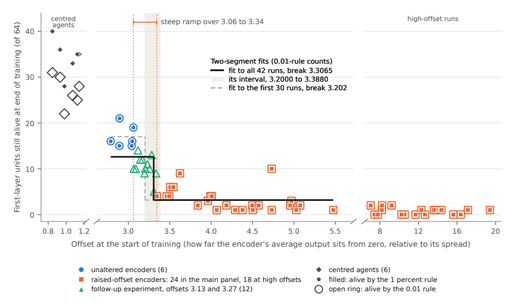
Figure 3 : Final FC1 units alive in each Breakout agent against its encoder’s offset before training. Blue circles are unaltered encoders, orange squares raised-offset encoders, green triangles the 12 follow-up runs and grey diamonds centred agents. Filled markers use the 1 percent rule, open ones the 0.01 rule. The black and dashed steps are two-segment fits (Supplement S2.1). The bracket marks the ramp from 3.06 to 3.34.
出典 · CC BY 4.0 · Scott M. Norton · Why Units Die in the Layer After a Frozen Random Encoder, and What the Number of Live Units Measures · 論文の図を引用 · 元のPDFの13ページ目から図の部分を抽出しています。
Table 3 : What the offset in each game depends on (Atari agents). The first four number columns come from the raw pixels of the mixed sets of screens with exact duplicate screens removed; the squared pixel offset is the energy divided by the product of the next two. The encoder columns use 10,000 of those screens (Supplement S2.7). The counts come from other runs and other screens than the offsets beside them (Table S6 in Supplement S2.6). The Pong count covers the earlier study’s runs with and without sticky actions, and the runs without them had 3 to 8.
出典 · CC BY 4.0 · Scott M. Norton · Why Units Die in the Layer After a Frozen Random Encoder, and What the Number of Live Units Measures · 論文の図を引用 · 元のPDFの17ページ目から図の部分を抽出しています。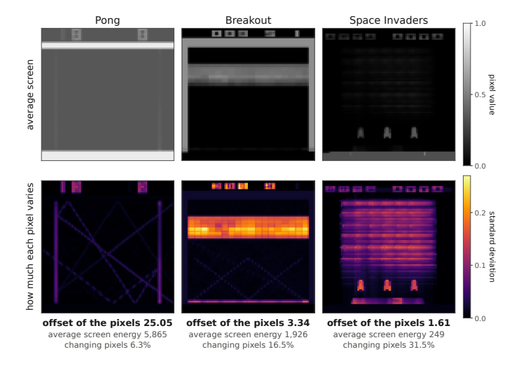
Figure 5 : The average screen of each game (top) and how much each pixel varies from screen to screen (bottom), with pixel values scaled from 0 to 1. In Pong the thin lines are the paths of the ball. In Breakout the brightest band is the bricks, present in some screens and gone in others.
出典 · CC BY 4.0 · Scott M. Norton · Why Units Die in the Layer After a Frozen Random Encoder, and What the Number of Live Units Measures · 論文の図を引用 · 元のPDFの18ページ目から図の部分を抽出しています。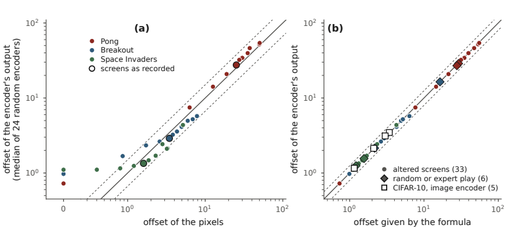
Figure 6 : The output of a random encoder has roughly the same offset as the pixels, and a formula predicts it. (a) Median encoder offset over 24 random encoders against the offset of the raw pixels, for the 33 conditions of Table S7 (Supplement S2.7); dashed lines mark a factor of 1.5. (b) The same offsets against the formula, with dashed lines at 25 percent. Diamonds are the random-play and expert-play screens of each game, squares are CIFAR-10 (Tables S8 and S9 in Supplement S2.7).
出典 · CC BY 4.0 · Scott M. Norton · Why Units Die in the Layer After a Frozen Random Encoder, and What the Number of Live Units Measures · 論文の図を引用 · 元のPDFの19ページ目から図の部分を抽出しています。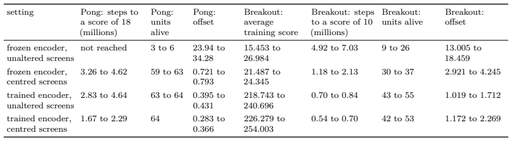
Table 4 : The same six networks in four settings, after 50 million agent steps with sticky actions off. Each cell gives the lowest and the highest of the six encoders. Steps are the agent step, in millions, at which the training score first reached 18 in Pong or 10 in Breakout. Units alive, of 64, are by the 1 percent rule, and offsets are those at 50 million steps, which for a frozen encoder are its offsets throughout. Both are measured with each model’s own encoder on random-play screens, the first 25,000 Pong screens or the 50,000 Breakout screens. Each setting has one run of 50 million steps per encoder, except the frozen encoder on unaltered Breakout screens, which has three. For it the score and the step are medians of the three runs, and the count spans all 18. Supplement S4.6 gives every encoder’s values.
出典 · CC BY 4.0 · Scott M. Norton · Why Units Die in the Layer After a Frozen Random Encoder, and What the Number of Live Units Measures · 論文の図を引用 · 元のPDFの21ページ目から図の部分を抽出しています。この論文を引用
Scott M. Norton (2026). Why Units Die in the Layer After a Frozen Random Encoder, and What the Number of Live Units Measures. arXiv:2611.29752v1. https://arxiv.org/abs/2611.29752v1
BibTeX
@misc{norton2026units,
  title = {{Why Units Die in the Layer After a Frozen Random Encoder, and What the Number of Live Units Measures}},
  author = {Scott M. Norton},
  year = {2026},
  eprint = {2611.29752},
  archivePrefix = {arXiv},
  url = {https://arxiv.org/abs/2611.29752v1}
}