論文解説
Deploying Physically and Epistemically Compliant Agents by Distilling Belief-Space Task and Motion Planners
信念空間のタスク・動作計画器の蒸留による、物理的・認識的に規定を遵守するエージェントの配備
- 課題 行動がbeliefに依存する規則を守らなければならないエージェントを、オフラインのbelief-space計画の蒸留によって学習する問題です。
- 手法 計画はシミュレータでオフラインに生成し、履歴ベースの方策はDual Averaging損失とρ-Optimal Reinforcementのフィードバックで蒸留します。
- 結果 Scavengerでは、蒸留された方策が90%を超える成功率を示し、RLベースラインは最大5%でした。
問題:規則を守る方策をどのように得るか
この論文は、行動がbeliefによって変わる規則を守るエージェントの学習問題を扱います。例えば、ロボットはユーザーが必要な物を持って離れることを保証しなければならず、これは物理的な安全制約とともに守るべき認識的な制約です。強化学習はこのような規則を報酬として符号化できますが、実際には報酬を完全に最適化できず、規則から外れた行動を学習しやすくなります。一方、belief-space計画器は構成上、仕様に合う行動を生成しますが、オンラインのbelief推定と低遅延の再計画を自分で実装する必要があり、エンジニアリング上の負担が大きいです。
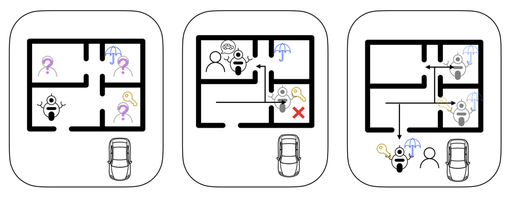
Fig. 1 : A worked example, where the robot must obey the epistemic rule: “ensure the user leaves their home, and has what they need when they leave”, while being physically safe. The robot should be confident that the user has what they need before they leave the house.Left:The robot must first search for the user in the house, who may be in one of three locations. Middle:After finding the user, the robot asks them about what they might need for the day.Right:The robot hears the user is planning to go on a drive to see friends on a rainy day, and then brings them their keys and umbrella.
出典 · CC BY 4.0 · Phillip J. K. Christoffersen, Rachel Ma, Patrick Barragán, Dylan Hadfield-Menell · Deploying Physically and Epistemically Compliant Agents by Distilling Belief-Space Task and Motion Planners · 論文の図を引用 · 元のPDFの2ページ目から図の部分を抽出しています。著者らは、この間隙を埋めるために、計画はシミュレータでオフラインに生成し、その計画の軌道を生の観測に直接作用する方策へ蒸留すると説明しています。ただし、既存の計画模倣の手法は完全観測の領域を前提としていたため、観測と行動の履歴全体に依存する方策では分布シフトがより大きくなります。そのため、本研究の中心的な問いは、履歴ベースの方策をbelief-space計画へ蒸留するときに学習を安定させる2つの変更が実際に効果を持つかどうかです。
Dual Averaging:行動の切り替わり時点に重みを置く損失
従来の計画蒸留の研究は、行動予測に標準の交差エントロピーと行動クローニングを使っていました。この論文の設定では、軌道ごとに高レベル行動の数と低レベル制御の数が大きく異なり、履歴全体に依存する高レベル方策π_Hの予測は自己相関を持ちます。その結果、π_Hは現在の行動を維持する方向に偏り、行動を切り替える予測が不利になります。
Dual Averagingは、この問題を軌道ごとに2つの平均を組み合わせる損失で補正します。全タイムステップに対する平均損失と、計画器が行動を切り替えるタイムステップに対する平均損失をそれぞれ求めたのち、重みαとβで足し合わせます。論文の式は L_dual(τ) = α(L(τ)/|τ|) + β(L(τ[t:a[t]≠a[t−1]]) / |{t : a[t]≠a[t−1]}|) です。分母は行動の切り替え回数なので、切り替えの少ない軌道でも、切り替え時点の損失が過度に薄まらないよう平均を取ります。この損失はπ_Hに適用され、π_Lの制御学習は同じ式の対象ではありません。実験ではα=β=1を使用したと述べられています。
ρ-Optimal Reinforcement:成功した方策rolloutの再利用
既存のフィードバック機構であるTask Exploration Nodeは、違法な高レベル行動を減らすことに合わせられていました。しかし部分観測の問題では、失敗した方策の行動の多くは合法ですが非効率であることが多いです。例えば、部屋をさらに探せるものの、その探索が効果的でない場合です。この研究は、このような最適性の差を直接検出するのではなく、成功した方策rolloutを、同じ初期状態から計画器が作った成功軌道と比べる方法を採ります。
方策rolloutが成功し、その長さが計画の長さのρ倍以下であれば、その方策rolloutを学習データバッファに入れます。そうでなく計画が成功していた場合は、計画の軌道を入れます。ρは1より大きいため、方策がすでに実行できる少し非効率な行動も強化され、方策は学習においてより多くの柔軟性を得ます。この手法は、Task Exploration Nodeの違法行動中心のフィードバックを置き換える単純な代替案として提示されています。
静的探索におけるδ-prior-efficient計画器の完全性
この研究は、手法の設計の根拠としてbelief-space計画器の再計画回数を分析します。定理1は、状態を観測可能な部分S_obsと観測不能な部分S_unobsに分け、どの行動もS_unobsを変えない状況を仮定します。観測モデルは、観測された値がA(s_obs)に属するときだけs_unobsを与え、そうでなければnullを与えると仮定します。このnoiseless設定では、δ-prior-efficient計画器は再計画のたびに、B_0の確率δ以上の未探索候補を除去するか、不確実性を解消しなければなりません。この性質の結果として、不確実性が解消されるまでの再計画回数は最大で⌈1/δ⌉+1であり、漸近的にO(1/δ)です。
系1は、この上界から、noiselessな静的探索においてδ-prior-efficient計画器が有限時間内に終了するため完全だという結論を導きます。系2は、連続事前分布B_0で最尤の観測計画器が常に有効な再計画を作れるなら、δ=1のδ-prior-efficient性質を持つため完全だという結論を導きます。したがって、この結論は静的探索とnoiseless観測という条件付きの結果であり、すべてのbelief-space計画問題に対する一般的な性質ではありません。著者らは、この性質が行動の不可逆性を暗黙に含むと述べており、この点も適用範囲の限界として残しています。
Scavengerでの蒸留プランナーとRLベースラインの比較
実験は、手続き的に生成された多部屋の平面図で、ヒントを探し正しいマーカーに推測するScavengerタスクで行われました。同じタスクで、flat RLとhierarchical RLのベースラインは最大5%の成功率でした。これらのベースラインは、24時間以上の壁時計計算時間と密な報酬を与えられたと論文に明記されています。したがって、この比較は、ベースラインの報酬設計と学習時間を十分に与えた条件での結果です。
3つの方法のうち、ρ=1.1の設定の蒸留プランナーが、視覚ヒントと言語ヒントの両方で最も高い成功率を示しました。アブレーション実験では、フィードバックを外したNo Feedback、比率上限を外したNo Ratio Cap、タスク変更項を外したNo Task-Changeを、同じ壁時計時間の予算で比較しました。No Task-Changeはα=1、β=0で学習されました。論文は、これらのアブレーション変種がベースラインのRLより大幅に強い一方、言語ヒントの解析でより苦戦すると報告しています。この結果は各構成要素を保つ効果を示していますが、すべての変種で同じ大きさの利得が現れるという意味ではありません。
また、すべての方法は単一シードで実行されました。
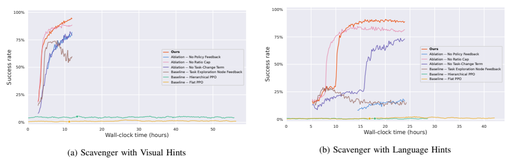
Fig. 3 : Success rates vs. wall-clock time on Scavenger. The dots on the baseline runs refer to the point in baseline runs where as many simulation timesteps are used for training the policies as our method. In all cases, our method attains at least18 timesthe success rate of the baseline RL policies, even while giving the baseline RL policies access to at least 50% more simulator steps for training. Our method attains the highest success rate among the ablations for our feedback mechanism. Note: our method and ablations do not all start at 0 wall-clock time, because there is an initial phase of data generation without policy training for each, longer for the No Feedback ablation since it does not get further policy / planner feedback afterward. The ablations attain much stronger performance than the RL baselines, but start to struggle more with parsing language hints. All methods are run with a single seed.
出典 · CC BY 4.0 · Phillip J. K. Christoffersen, Rachel Ma, Patrick Barragán, Dylan Hadfield-Menell · Deploying Physically and Epistemically Compliant Agents by Distilling Belief-Space Task and Motion Planners · 論文の図を引用 · 元のPDFの7ページ目から図の部分を抽出しています。学習外の指示とより多くの部屋への一般化
この評価は、言語ヒントの方策を、学習時には使わなかった指示と、意図的に曖昧にした指示で、それぞれ50エピソードずつ実行した実験です。学習時に見ていない同じ形式の指示では、元のドメインの94%から92%へとほとんど下がりませんでした。一方、間接的な説明や曖昧な指示では62%でした。したがって、この結果は間接的な説明でも60%を超える成功率があったことを意味し、曖昧な指示全体で高い成功率が保証されるわけではありません。
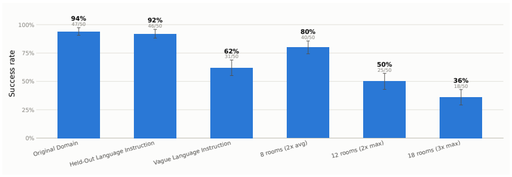
Fig. 4 : Results of the generalization study. The policy from our method, trained in Figure 3b, transfers to unseen language commands, to intentionally vague commands, and to problems with vastly more rooms than was seen in training. This shows that our policy learns to comply with physical and epistemic constraints reliably, even in floorplans and given language hints that were unseen in training. Each success rate is calculated based on 50 episodes, and the error bars are binomial standard errors.
出典 · CC BY 4.0 · Phillip J. K. Christoffersen, Rachel Ma, Patrick Barragán, Dylan Hadfield-Menell · Deploying Physically and Epistemically Compliant Agents by Distilling Belief-Space Task and Motion Planners · 論文の図を引用 · 元のPDFの8ページ目から図の部分を抽出しています。平面図のサイズの一般化では、学習時には3~6部屋を使い、評価では8部屋、12部屋、18部屋を使いました。成功率は8部屋で80%、12部屋で50%、18部屋で36%でした。論文の要旨にある、学習時より多い部屋を持つ平面図で75%を超えるという文は8部屋の結果にのみ当てはまり、12部屋と18部屋の結果はそれより低くなっています。したがって、部屋数が増えるほど成功率が下がる傾向が確認でき、18部屋は学習時の最大値の3倍です。

Fig. 5 : We evaluate transfer from the 3-6 room problems seen in training, to 18 room problems like those shown above, three times the maximum number of rooms seen in training.
出典 · CC BY 4.0 · Phillip J. K. Christoffersen, Rachel Ma, Patrick Barragán, Dylan Hadfield-Menell · Deploying Physically and Epistemically Compliant Agents by Distilling Belief-Space Task and Motion Planners · 論文の図を引用 · 元のPDFの8ページ目から図の部分を抽出しています。適用範囲と残された問い
この方法は、belief-space計画モデルを実際に作成できるという前提に依拠します。著者らは、ロボットの設定で、シミュレータを使って問題をモデル化しやすい場合にはこの前提が妥当だと考えており、ロボット以外の安全制約のような領域への拡張は今後の課題としています。また、理論の結果はnoiseless観測と静的探索を前提としており、この前提を緩めることも残された問いです。
実験面では、すべての方法が単一シードで実行され、主な評価は新しいタスクであるScavengerに限られています。そのため、結果を他のロボットのタスクや実環境にそのまま移すには根拠が不足しています。著者らは、ρ-Optimal Reinforcementとbelief-space計画器の選択が、学習者に実現可能な目標を与えると解釈していますが、この解釈の一般性についても追加の研究が必要です。
論文情報
- 著者
- Phillip J. K. Christoffersen, Rachel Ma, Patrick Barragán, Dylan Hadfield-Menell
- 学会・ジャーナル
- arXiv · プレプリント
- 公開日
- 2026年11月7日
- 登録日
- 2026年11月10日
- 更新日
- 2026年11月7日
- バージョン
- v1
- arXiv
- 2611.10430
- カテゴリ
- cs.RO · cs.AI
- ライセンス
- CC BY 4.0
- 掲載内容
- 論文情報・解説・論文の図
この解説は、Refivuの韓国語解説をAIで翻訳したものです。不正確な翻訳や誤りが含まれる可能性があります。論文と図の利用条件は各出典に従います。
アブストラクト
In this work, we train agents to act under uncertainty according to specified, belief-dependent rules. Deep reinforcement learning (RL) can in theory train agents to follow rules if encoded into well-designed rewards, but in practice, RL fails to perfectly optimize these rewards, leading to ineffective or noncompliant agent behavior. Belief-space planners by construction produce behavior in line with developer specification, but require hand-programming online planners and belief-state estimators, adding significant engineering complexity at scale. We combine the two: we plan offline to generate a dataset of sample trajectories and then distill the plans into a policy that acts on raw observations. We propose two changes to planner distillation that address problems specific to history-based policies: Dual Averaging, a loss that combines per-timestep predictive loss and average loss on task changes, and $ρ$-Optimal Reinforcement, a feedback mechanism that reinforces the policy's own successful rollouts when these are near-optimal. We provide a sufficient condition under which static search problems with noiseless observation models is complete, and show that maximum-likelihood-observation planning implies this condition in static search with continuous beliefs. We create a challenging new domain, Scavenger, where an agent needs to gain information in order to succeed. We evaluate our distilled policy in two versions of Scavenger, one where information is provided visually and one where it is provided as a command in natural language. In either case, the learned policy attains a success rate above 90% in Scavenger, compared with at most 5% for RL. We also find that distilled planners transfer with greater than 60% success to following unseen and intentionally vague commands and greater than 75% success to following floorplans larger than those seen in training.
この論文を引用
Phillip J. K. Christoffersen, Rachel Ma, Patrick Barragán, Dylan Hadfield-Menell (2026). Deploying Physically and Epistemically Compliant Agents by Distilling Belief-Space Task and Motion Planners. arXiv:2611.10430v1. https://arxiv.org/abs/2611.10430v1
BibTeX
@misc{christoffersen2026deploying,
  title = {{Deploying Physically and Epistemically Compliant Agents by Distilling Belief-Space Task and Motion Planners}},
  author = {Phillip J. K. Christoffersen and Rachel Ma and Patrick Barragán and Dylan Hadfield-Menell},
  year = {2026},
  eprint = {2611.10430},
  archivePrefix = {arXiv},
  url = {https://arxiv.org/abs/2611.10430v1}
}