論文解説
Speed-to-Power Dominates Energy Costs for AI Data Centers: Technoeconomic Analysis of Powering AI in the Continental United States
AIデータセンターのエネルギーコストを左右するSpeed-to-Power:米国本土でAIに電力を供給する技術経済分析
- 課題 AIデータセンターは系統連系とガスタービンの供給遅れのため電力構成を素早く決める必要がありますが、既存の比較は単位エネルギーコストに偏っています。
- 手法 建設期間中に使えなかったGPUの計算価値をLCOEに加えた速度補正コストで、太陽光・蓄電、天然ガス、系統連系を比較します。
- 結果 DC結合は、AC結合より平均18%(9¢/kWh)低い生涯エネルギーコストを示しました。速度補正コストで比べると、米国の立地の85%で最も低コストでした。
展開速度が電力コストを変える理由
AIデータセンターは短期間に大規模に建設する必要がありますが、系統連系の待ちとガスタービンの供給遅れが長くなっています。本論文は、電力構成を選ぶ際に単位エネルギーコストだけを見ると、重要な機会費用を見落とすと問題提起しています。そこで、建設期間中に使えなかったGPUの計算価値をコストに加えた速度補正LCOEを中心的な比較基準に据えます。
比較対象は、ACとDCで接続した太陽光と蓄電装置、系統から切り離された天然ガス(ディーゼル予備電源を含む)、そして系統連系です。すべての構成は、同じ負荷と同じ信頼度を満たすように設計されています。
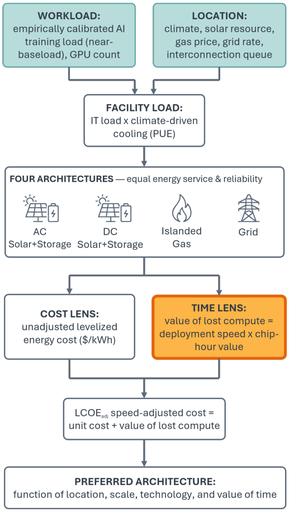
Figure 1 : Analytical framework.For a given quantity of chips, workload (in this research empirically calibrated to AI training) and location (climate, solar resource, gas price, grid rate, and interconnection queue), we build an hourly facility load combining IT demand with climate-driven cooling (PUE). We then size and dispatch three islanded architectures, AC solar+storage, DC solar+storage, and islanded natural gas with diesel backup, and compare them against grid interconnection. Each deliver equivalent energy service at equivalent reliability through an explicitly modeled power-conversion path. Each option is assessed on two axes: its unadjusted levelized cost of energy ($/kWh) and the value of compute forgone during construction (set by deployment speed and chip-hour value). Their sum, a speed-adjusted cost (LCOEadj), determines the preferred option, which varies with location, scale, technology, and the value of time.
出典 · CC BY 4.0 · Alex C. Newkirk, Daniel L. Gerber, Erica R. H. Fuchs, Alex Hubbard, M. Granger Morgan, Arman Shehabi, Sarah J. Smith, Constantine Samaras · Speed-to-Power Dominates Energy Costs for AI Data Centers: Technoeconomic Analysis of Powering AI in the Continental United States · 論文の図を引用 · 元のPDFの5ページ目から図の部分を抽出しています。速度補正コストと設計の方法
各構成のコストは、LCOEに建設中のGPU遊休時間と市場レンタル価格の積として定義される放棄された計算価値(VLC)を加えて求めます。著者らは基準のレンタル価格をH100の時間当たり2.40ドルとし、ハイパースケーラーでは近似値、専門のAI研究所では下限になりうると見ています。計算は、建設期間中のVLCを含むコストの現在価値の総和を、電力量の現在価値の総和で割って行われます。
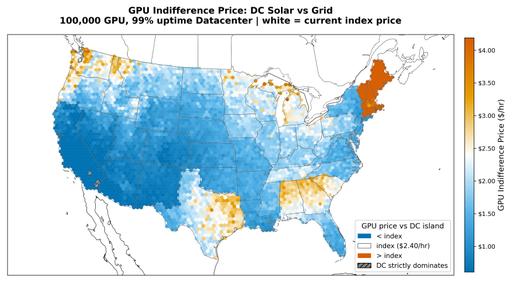
Figure 7 : Value of a chip-hour at which firms would be indifferent between DC-coupled microgrids and grid interconnection.Holding interconnection timelines at baseline (state-specific, 2.5-5 years). Color indicates indifference utility in $/GPU-hour; white contour marks the baseline assumption ($2.40/hr). Blue regions show where DC solar dominates even at low GPU values due to favorable solar resources and/or slow grid interconnection. The median indifference utility is $1.61/hr. Orange/red regions (concentrated in New England and parts of Texas) show where grid remains competitive even at high GPU opportunity costs due to cheap electricity and fast interconnection. Most of continental U.S. lies below $2.40/hr (blue spectrum), indicating DC microgrids are preferable to grid interconnection when valuing deployment speed even at lower GPU value.
出典 · CC BY 4.0 · Alex C. Newkirk, Daniel L. Gerber, Erica R. H. Fuchs, Alex Hubbard, M. Granger Morgan, Arman Shehabi, Sarah J. Smith, Constantine Samaras · Speed-to-Power Dominates Energy Costs for AI Data Centers: Technoeconomic Analysis of Powering AI in the Continental United States · 論文の図を引用 · 元のPDFの16ページ目から図の部分を抽出しています。太陽光と蓄電装置は設計空間を探索して最小LCOEの構成を選び、天然ガスは離散的なタービンモデルと台数の組み合わせを列挙します。電池の劣化はBLAST-Liteで学習したgray-box代理モデルで計算し、最適化の反復にかかる負担を減らしました。この代理モデルは、カレンダー劣化とサイクル劣化を物理ベースの項として扱い、ガウス過程で残差だけを学習します。
速度補正後の結果とガス加速シナリオ
基準の建設期間では、DC結合の太陽光が米国の立地の85%で、速度補正コストが最も低いモデルの選択肢でした。系統連系は、電気料金が安く接続期間が短い立地でのみ優位でした。単位エネルギーコストだけで見るとマイクログリッドの大半は系統に負けていましたが、機会費用を加えると順位が入れ替わりました。
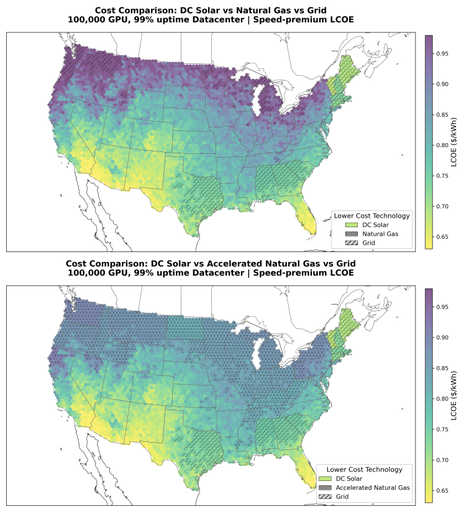
Figure 6 : Minimum speed-premium LCOE for 100,000 GPU facilities across the continental United States.Color indicates LCOE magnitude; hatching shows lowest-LCOE adj technology. Maps vary by natural gas deployment speed assumptions, with the top panel (A) showing the baseline case of 4 year combined turbine delivery and plant construction time, and the bottom panel (B) showing the accelerated 3 year case.(A)Baseline construction timelines: DC solar is the lowestLCOE adj architecture in 85% of locations due to rapid deployment despite higher unadjusted energy costs. Grid interconnection remains preferred in regions (15% of locations) combining poor solar resources, low industrial electricity rates, and abbreviated approval timelines.(B)Accelerated 36-month natural gas timelines: DC solar (solid) is preferred in∼55% of locations. Natural gas (dots) is preferred in∼35% of locations, forming coherent regional deployments in solar-poor areas (upper Midwest, Appalachian Basin, Pacific Northwest). Grid interconnection (diagonal hatching) remains optimal in∼9% of locations. Even under this aggressive scenario, DC solar microgrids remain the most widely preferred option.
出典 · CC BY 4.0 · Alex C. Newkirk, Daniel L. Gerber, Erica R. H. Fuchs, Alex Hubbard, M. Granger Morgan, Arman Shehabi, Sarah J. Smith, Constantine Samaras · Speed-to-Power Dominates Energy Costs for AI Data Centers: Technoeconomic Analysis of Powering AI in the Continental United States · 論文の図を引用 · 元のPDFの15ページ目から図の部分を抽出しています。天然ガスタービンを36か月で完成させる加速シナリオでは、DC太陽光が約55%、天然ガスが約35%、系統が約9%の立地で最も低コストでした。100,000 GPUにおけるDCとACの平均差は約18%、1kWh当たり0.09ドルと報告されています。これらの数値は、著者らの設定と入力データに基づく結果です。
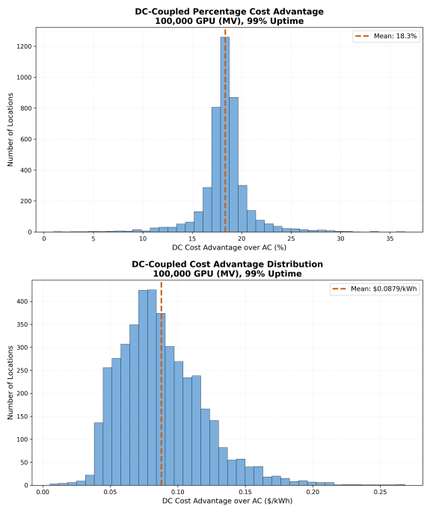
Figure 3 : Cost advantage of DC-coupled systems over AC counterparts for 100,000 GPUs at 99% uptime across all modeled continental U.S. locations.Skew in the absolute distribution reflects variation in sensitivity to solar-to-load and battery-to-load path efficiency by location. Scale of DC advantage generally increases in locations with lower quality solar resources as marginal path efficiencies provide returns for highly overbuilt systems. In regions with substantial and consistent solar resources, both AC and all-DC microgrids can scope more aggressively, shrinking but not eliminating the DC cost advantage.(A)Percentage cost advantage distribution. Mean DC advantage is 18% of total cost of ownership for a given location.(B) Absolute cost advantage distribution. Mean DC advantage is $0.09 / kWh.
出典 · CC BY 4.0 · Alex C. Newkirk, Daniel L. Gerber, Erica R. H. Fuchs, Alex Hubbard, M. Granger Morgan, Arman Shehabi, Sarah J. Smith, Constantine Samaras · Speed-to-Power Dominates Energy Costs for AI Data Centers: Technoeconomic Analysis of Powering AI in the Continental United States · 論文の図を引用 · 元のPDFの11ページ目から図の部分を抽出しています。限界と残された問い
系統コストは、大型負荷によって生じる変圧器や送電の増強費用を除いて計算されているため、系統LCOEの下限として解釈されます。系統連系期間には、供給側の待ち行列の州ごとの中央値を代理指標として使っているため、需要側の手続きとは差がある可能性があります。
著者らは、DC供給網は大規模ではまだ十分に検証されていないと明らかにしています。気象設計にはTMYを使っており、過去の年の平均より中央値で4.5%低く設計されていたことがわかりました。そのため、極端な気象に対する過小設計の可能性が残ります。
論文情報
- 著者
- Alex C. Newkirk, Daniel L. Gerber, Erica R. H. Fuchs, Alex Hubbard, M. Granger Morgan, Arman Shehabi, Sarah J. Smith, Constantine Samaras
- 学会・ジャーナル
- arXiv · プレプリント
- 公開日
- 2026年11月12日
- 登録日
- 2026年11月14日
- 更新日
- 2026年11月12日
- バージョン
- v1
- arXiv
- 2611.17098
- カテゴリ
- cs.AI · eess.SY
- ライセンス
- CC BY 4.0
- 掲載内容
- 論文情報・解説・論文の図
この解説は、Refivuの韓国語解説をAIで翻訳したものです。不正確な翻訳や誤りが含まれる可能性があります。論文と図の利用条件は各出典に従います。
アブストラクト
The rapid growth of artificial intelligence is driving demand for new data centers at large scale and on short deployment timelines. To power them, firms connect to the commercial grid or contract generation directly, but interconnection and gas-turbine delays now incentivize on-site generation. We compare grid-connected and off-grid data center energy infrastructure (AC- and DC-coupled solar-plus-storage, islanded natural gas, and grid interconnection) across the continental U.S. Using an open-source technoeconomic framework built on empirically calibrated AI training loads, climate-driven cooling, stage-by-stage power conversion, and physics-based battery degradation, we model designs providing equivalent energy services. Our central contribution is a speed-adjusted cost of energy that values the compute unlocked by faster construction, making options with different deployment timelines directly comparable on one physically consistent basis. We find DC coupling reduces lifetime energy costs by 18% ($0.09/ kWh) on average versus AC counterparts by eliminating inverters and improving efficiency. Though rarely cheapest on unadjusted energy cost, DC-coupled microgrids' faster deployment makes them the lowest-cost modeled option in 85% of U.S. locations once foregone compute is valued, or 55% under accelerated natural gas timelines. For AI infrastructure, deployment speed rather than unit energy cost determines the economically preferred path to power.
この論文を引用
Alex C. Newkirk, Daniel L. Gerber, Erica R. H. Fuchs, Alex Hubbard, M. Granger Morgan, Arman Shehabi, Sarah J. Smith, Constantine Samaras (2026). Speed-to-Power Dominates Energy Costs for AI Data Centers: Technoeconomic Analysis of Powering AI in the Continental United States. arXiv:2611.17098v1. https://arxiv.org/abs/2611.17098v1
BibTeX
@misc{newkirk2026speed,
  title = {{Speed-to-Power Dominates Energy Costs for AI Data Centers: Technoeconomic Analysis of Powering AI in the Continental United States}},
  author = {Alex C. Newkirk and Daniel L. Gerber and Erica R. H. Fuchs and Alex Hubbard and M. Granger Morgan and Arman Shehabi and Sarah J. Smith and Constantine Samaras},
  year = {2026},
  eprint = {2611.17098},
  archivePrefix = {arXiv},
  url = {https://arxiv.org/abs/2611.17098v1}
}