論文解説
Translating KV Caches Between Hybrid-Attention Language Models: MLA Latents, Linear-Attention States and Sparse-Attention Indexers
ハイブリッドアテンション言語モデル間のKVキャッシュ変換:MLA潜在ベクトル、線形アテンション状態、スパースアテンションインデクサ
- 課題 モデルが会話を引き継ぐ際に、会話全体を読み直すコストを減らすには、ハイブリッドアテンションモデルの異なるキャッシュ要素を変換する方法が必要です。
- 手法 キャッシュ要素ごとに、トークン単位の線形写像、状態コピーと双線形補正、状態の再生、トークンid復元を使い分け、2段階で学習します。
- 結果 Pair Bの状態コピーはnative並みの性能を示しました。Pair Aのreverseは、7つのMLA潜在とトークンidを使うことで、ほとんどの指標がnativeの信頼区間内に収まりました。Pair Aのforwardは、長文脈の想起を回復させるにはトークンidの追加が必要でした。
モデル切り替えとキャッシュ再読のコスト
会話をあるモデルから別のモデルに渡すとき、受け取るモデルは通常、会話全体を読み直す必要があります。テキスト要約で渡せば再読は減りますが、要約から漏れた内容は失われます。KVキャッシュ変換は、ソースモデルのキャッシュを対象モデルの形式に移し、文脈全体を読み直さずに応答を続けられるようにする方法です。既存研究はGQAのトークン単位のK/Vキャッシュを中心に扱ってきました。しかし、最近公開されているモデルは圧縮潜在(MLA)、スパースアテンションのインデクサキー、固定サイズの線形アテンション状態を併用しており、本論文はこれらの要素を変換対象として扱います。
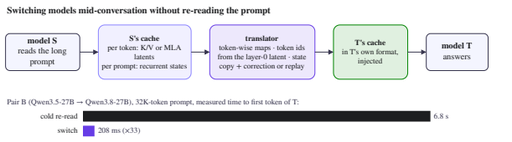
Figure 1 :Switching models mid-conversation without re-reading the prompt. Model S has read the prompt; a translator maps S’s cache (per-token K/V or MLA latents and per-prompt recurrent states) into T’s format, and T answers. Inset: Pair B at 32K tokens, time to T’s first token, cold re-read vs switch (6,823 vs 208ms,×32.8).
出典 · CC BY 4.0 · Povilas Kvedaras, Tomas Rasymas · Translating KV Caches Between Hybrid-Attention Language Models: MLA Latents, Linear-Attention States and Sparse-Attention Indexers · 論文の図を引用 · 元のPDFの4ページ目から図の部分を抽出しています。キャッシュ要素ごとの変換の仕組み
論文では、キャッシュ要素ごとに異なる復元方法を使います。MLA潜在はトークン単位の線形写像で移します。このとき、レイヤー入力ではなく正規化前の値を読み、対象モデルの正規化と回転を経て書き込みます。線形アテンション状態はトークン単位で対応させられないため、ソースの状態が同じ幾何を持つ場合はコピーしたうえでヘッドごとの双線形補正を適用します。ソースに状態がない場合は、予測したトークン単位の入力を対象モデル自身の再帰に通して再生します。再生にかかるコストはトークン数に対してO(n)です。長文脈の想起では、MLAの最初のレイヤーの潜在がトークン自体の関数であるという性質を利用し、トークンidを復元する方法を追加します。
変換器はソースモデルと対象モデルを固定したまま、写像だけを学習します。
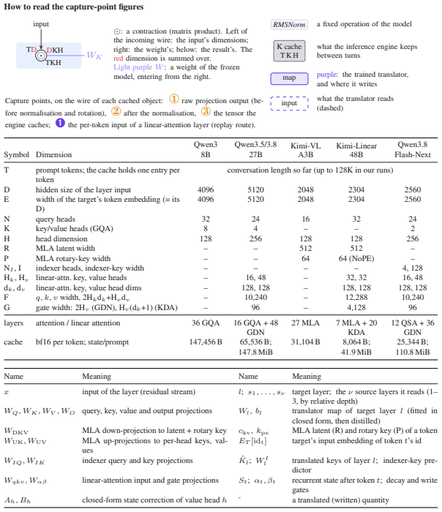
Figure 2 :How to read Figures 3–6, which draw one attention layer of each variant (attention block only) and where the translator reads and writes. Top: visual conven- tions and capture points. Middle: every dimension letter with its value for our five models (cache sizes in bf16, MTP layers excluded; state sizes as measured). Bottom: every named quantity.
出典 · CC BY 4.0 · Povilas Kvedaras, Tomas Rasymas · Translating KV Caches Between Hybrid-Attention Language Models: MLA Latents, Linear-Attention States and Sparse-Attention Indexers · 論文の図を引用 · 元のPDFの11ページ目から図の部分を抽出しています。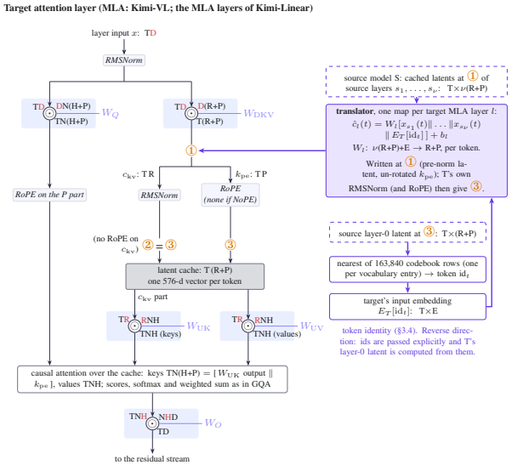
Figure 4 :MLA layer (Kimi-VL; the MLA layers of Kimi-Linear). The engine caches one 576-d vector per token (latentckv and rotary keykpe) and up-projects it at atten- tion time. The translator writes the pre-norm latent and un-rotated rotary key at①; its input is the source latents plus the target’s embedding of each token id, decoded from the source’s layer-0 latent (§3.4).
出典 · CC BY 4.0 · Povilas Kvedaras, Tomas Rasymas · Translating KV Caches Between Hybrid-Attention Language Models: MLA Latents, Linear-Attention States and Sparse-Attention Indexers · 論文の図を引用 · 元のPDFの13ページ目から図の部分を抽出しています。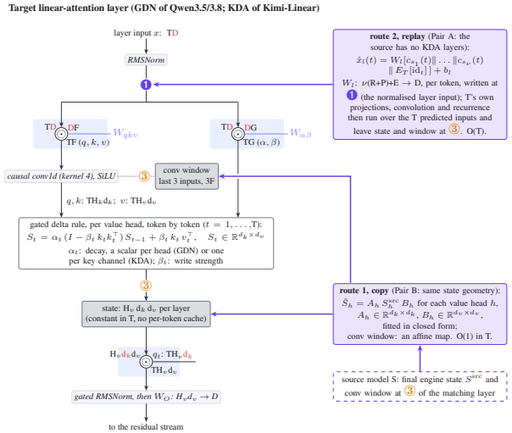
Figure 6 :Linear-attention layer (GDN of Qwen3.5/3.8; KDA of Kimi-Linear). The layer caches only a fixed-size state and a conv window (③). Route 1 (Pair B) copies the source’s state with a closed-form per-head correction, O(1) in the prompt length; route 2 (Pair A, no source state) writes predicted per-token inputs at➊and replays the target’s own projections, convolution and recurrence over them, O(n).
出典 · CC BY 4.0 · Povilas Kvedaras, Tomas Rasymas · Translating KV Caches Between Hybrid-Attention Language Models: MLA Latents, Linear-Attention States and Sparse-Attention Indexers · 論文の図を引用 · 元のPDFの15ページ目から図の部分を抽出しています。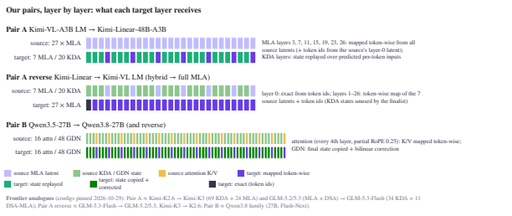
Figure 8 :Every layer of source and target, coloured by what the target layer receives: mapped token-wise, state replayed, state copied, or computed exactly from token ids; with the verified frontier analogues.
出典 · CC BY 4.0 · Povilas Kvedaras, Tomas Rasymas · Translating KV Caches Between Hybrid-Attention Language Models: MLA Latents, Linear-Attention States and Sparse-Attention Indexers · 論文の図を引用 · 元のPDFの19ページ目から図の部分を抽出しています。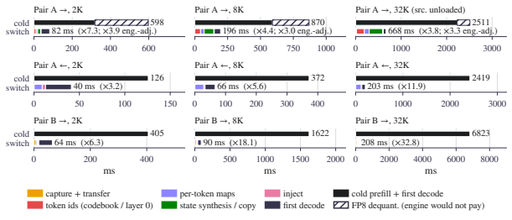
Figure 16 :Where the switch time goes, at 2K, 8K and 32K, against the cold re-read. Pair A forward pays O(n) KDA state synthesis (replay) and codebook token decoding; Pair B copies O(1) GDN states; the reverse direction has no state synthesis.
出典 · CC BY 4.0 · Povilas Kvedaras, Tomas Rasymas · Translating KV Caches Between Hybrid-Attention Language Models: MLA Latents, Linear-Attention States and Sparse-Attention Indexers · 論文の図を引用 · 元のPDFの30ページ目から図の部分を抽出しています。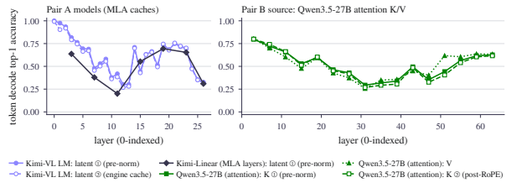
Figure 21 :Top-1 accuracy of decoding the token at each position from one layer’s cached object (linear map + nearest neighbour over the full vocabulary). Early MLA latents and attention keys identify the token.
出典 · CC BY 4.0 · Povilas Kvedaras, Tomas Rasymas · Translating KV Caches Between Hybrid-Attention Language Models: MLA Latents, Linear-Attention States and Sparse-Attention Indexers · 論文の図を引用 · 元のPDFの36ページ目から図の部分を抽出しています。2段階の学習と自己蒸留
Stage 1では、レイヤーごとのトークン写像を最小二乗法の閉形式解で当てはめます。Stage 2では、対象モデルが自身のキャッシュを読んだときの次トークン分布と、変換したキャッシュを読んだときの分布とのKL損失で、これらの写像をファインチューニングします。正解ラベルも第2のモデルも必要とせず、チャットのプレフィックスだけを使います。プレフィックスは8Kトークンに制限されており、この制限はNemotronチャットデータの設定です。
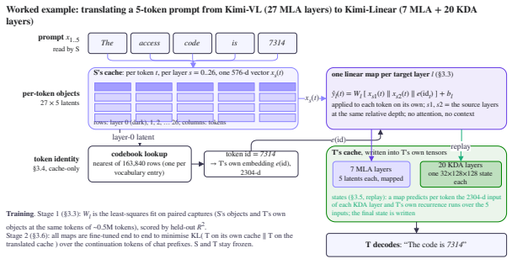
Figure 7 :The translator on a 5-token prompt (Pair A forward). Per-token objects (MLA latents) are mapped layer by layer with a linear map on the concatenation of a few source layers and the target’s embedding of the decoded token id; the per-prompt KDA states are produced by replaying the target’s own recurrence over predicted per- token inputs. Stage 1 fits the maps in closed form; Stage 2 fine-tunes them with a KL loss against the target reading its own cache.
出典 · CC BY 4.0 · Povilas Kvedaras, Tomas Rasymas · Translating KV Caches Between Hybrid-Attention Language Models: MLA Latents, Linear-Attention States and Sparse-Attention Indexers · 論文の図を引用 · 元のPDFの17ページ目から図の部分を抽出しています。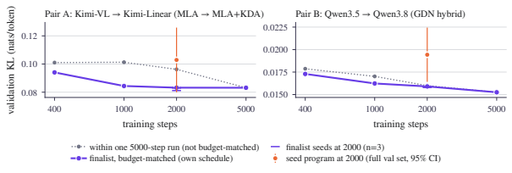
Figure 20 :Validation KL of the finalist against training budget. Solid: budget- matched (each point the end of its own schedule); dotted: checkpoints inside one 5000-step run (warm-up / peak LR, not budget-matched); ticks at 2000: three seeds.
出典 · CC BY 4.0 · Povilas Kvedaras, Tomas Rasymas · Translating KV Caches Between Hybrid-Attention Language Models: MLA Latents, Linear-Attention States and Sparse-Attention Indexers · 論文の図を引用 · 元のPDFの36ページ目から図の部分を抽出しています。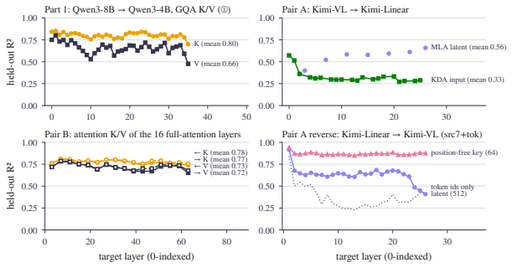
Figure 25 :Held-outR 2 of the closed-form Stage-1 maps per target layer (the share of the target object’s variance the map explains), all pairs and both directions.
出典 · CC BY 4.0 · Povilas Kvedaras, Tomas Rasymas · Translating KV Caches Between Hybrid-Attention Language Models: MLA Latents, Linear-Attention States and Sparse-Attention Indexers · 論文の図を引用 · 元のPDFの48ページ目から図の部分を抽出しています。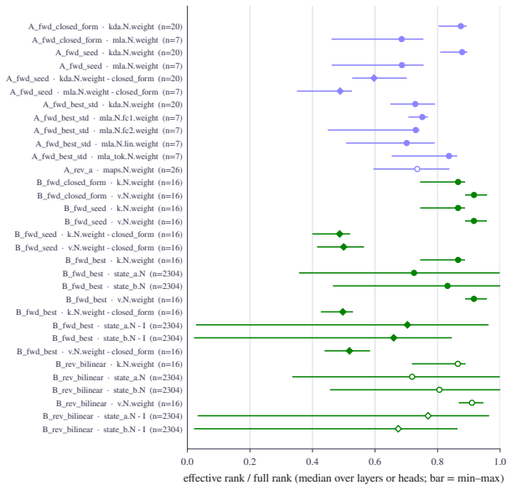
Figure 26 :Effective rank of every map family relative to its full rank, per translator. Diamonds: the trained change relative to the closed-form initialisation (or identity for the bilinear state maps); hollow: reverse direction.
出典 · CC BY 4.0 · Povilas Kvedaras, Tomas Rasymas · Translating KV Caches Between Hybrid-Attention Language Models: MLA Latents, Linear-Attention States and Sparse-Attention Indexers · 論文の図を引用 · 元のPDFの49ページ目から図の部分を抽出しています。ハイブリッドペアの品質と方向による違い
Pair B(Qwen3.5-27BとQwen3.8-27B、同一幾何のGDNハイブリッド)では、状態コピーと双線形補正が、CoQA、ARC、チャット評価において、対象モデル自身のキャッシュと統計的に区別できない性能を示しました。Pair Aのforward(Kimi-VL-A3BからKimi-Linear-48B-A3Bへ)では、トークンidなしではneedleの想起が0.09にとどまりました。トークンidを追加すると、2–32Kでは0.99に、64Kでは0.83から1.00まで回復しました。この想起の向上は、8K学習長の8倍にあたる64Kまで確認されています。一方、Pair Aのforwardはチャット判定で対象モデルのnativeより低い結果でした。
Pair Aのreverse(Kimi-LinearからKimi-VLへ、hybridからfull MLAへ)は、7つのMLA潜在とトークンidを使った単一の写像で、ほとんどのタスク指標がnativeの信頼区間内に収まりました。ただし、この方向の結果は単一シードでの全セットの結果です。
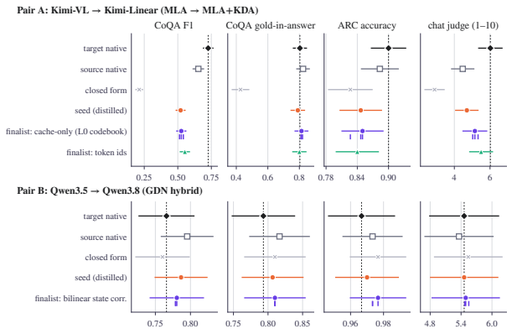
Figure 10 :Full-set quality of every anchor, forward directions (dots, 95% CI = 1.96SE over items; dashed: target native; seed ticks: three seeds). Translated caches reach the target’s level on gold-in-answer and ARC for Pair B and on gold-in-answer for Pair A; Pair A F1 is lower because translated answers are about twice as long.
出典 · CC BY 4.0 · Povilas Kvedaras, Tomas Rasymas · Translating KV Caches Between Hybrid-Attention Language Models: MLA Latents, Linear-Attention States and Sparse-Attention Indexers · 論文の図を引用 · 元のPDFの25ページ目から図の部分を抽出しています。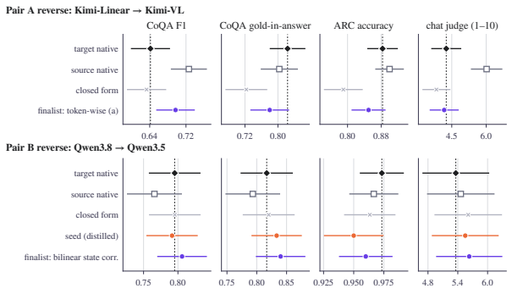
Figure 11 :As Figure 10 for the reverse directions: hybrid→full MLA (Pair A) and Qwen3.8→Qwen3.5 (Pair B).
出典 · CC BY 4.0 · Povilas Kvedaras, Tomas Rasymas · Translating KV Caches Between Hybrid-Attention Language Models: MLA Latents, Linear-Attention States and Sparse-Attention Indexers · 論文の図を引用 · 元のPDFの26ページ目から図の部分を抽出しています。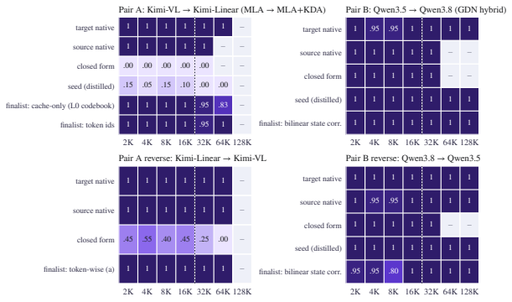
Figure 12 :Needle exact recall by anchor and prompt length (n=20per length at 2– 32K, 12 at 64K/128K). Translators were trained on prompts≤8K. In Pair A forward the seed translator, without token identity, rarely recalls the needle; the finalists that recover token identity recall it at every length, up to 64K, eight times the longest training prompt (8K).
出典 · CC BY 4.0 · Povilas Kvedaras, Tomas Rasymas · Translating KV Caches Between Hybrid-Attention Language Models: MLA Latents, Linear-Attention States and Sparse-Attention Indexers · 論文の図を引用 · 元のPDFの27ページ目から図の部分を抽出しています。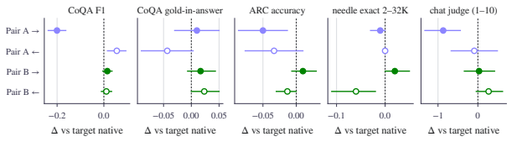
Figure 13 :Finalist minus target native per metric, forward (filled) and reverse (hol- low), paired bootstrap 95% CI.
出典 · CC BY 4.0 · Povilas Kvedaras, Tomas Rasymas · Translating KV Caches Between Hybrid-Attention Language Models: MLA Latents, Linear-Attention States and Sparse-Attention Indexers · 論文の図を引用 · 元のPDFの28ページ目から図の部分を抽出しています。限界と適用範囲
Pair Aのforwardは、8K学習長を超えるエンジンネイティブキャプチャ③で想起が崩壊しました。また、チャット判定と長い回答長でも、対象モデルより低い結果でした。Pair Bの逆方向では、双線形補正の変種がneedleの想起でnativeと有意な差を示し、対象モデルは6件の拒否応答を生成しました。スパースインデクサの実験(Pair C)は、単一シードと400および1000ステップに限られます。300B以上のフラッグシップへの転移は著者らの仮説であり、実験では確立されていません。速度向上の外挿も、計算構造に基づく推定です。
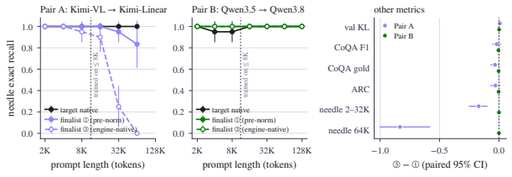
Figure 14 :Needle recall by prompt length for the finalist trained on the pre-norm capture①and on the engine-native cache③. Pair A③falls beyond the 8K training length; Pair B is unaffected. Right:③−①on other metrics (paired 95% CI).
出典 · CC BY 4.0 · Povilas Kvedaras, Tomas Rasymas · Translating KV Caches Between Hybrid-Attention Language Models: MLA Latents, Linear-Attention States and Sparse-Attention Indexers · 論文の図を引用 · 元のPDFの29ページ目から図の部分を抽出しています。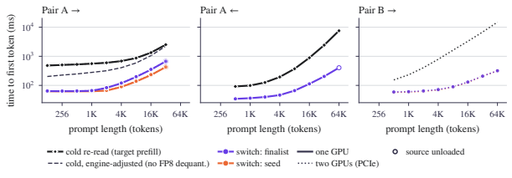
Figure 15 :Time to first token of the target when it re-reads the prompt cold (black) vs when it switches in a translated cache (colours), median of 10, log–log. Dashed grey: cold minus the one-off FP8 dequantisation (Pair A forward only). Solid: one GPU; dotted: two GPUs over PCIe.
出典 · CC BY 4.0 · Povilas Kvedaras, Tomas Rasymas · Translating KV Caches Between Hybrid-Attention Language Models: MLA Latents, Linear-Attention States and Sparse-Attention Indexers · 論文の図を引用 · 元のPDFの30ページ目から図の部分を抽出しています。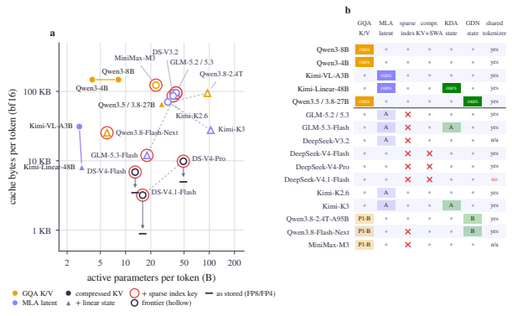
Figure 23 :Our pairs vs frontier models: active parameters vs cache bytes per token (left) and which cache objects each model has (right). Configs pinned by commit on 29 Oct 2026.
出典 · CC BY 4.0 · Povilas Kvedaras, Tomas Rasymas · Translating KV Caches Between Hybrid-Attention Language Models: MLA Latents, Linear-Attention States and Sparse-Attention Indexers · 論文の図を引用 · 元のPDFの38ページ目から図の部分を抽出しています。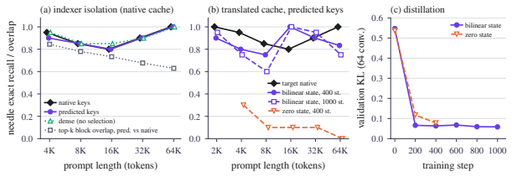
Figure 24 :Pair C (Qwen3.8-27B→Qwen3.8-Flash-Next, QSA indexer), one seed. (a) On the target’s own cache, predicted indexer keys select only 63–84% of the native top-kblocks yet keep needle recall at the native level, as does dense attention. (b) Translated cache decoded with predicted keys: with a bilinear-mapped GDN state recall is near native at 400 and at 1000 steps; with zero state (400 steps) it is not. (c) Validation KL to 1000 steps (bilinear) and 400 (zero state); the bump at 600 follows the learning-rate restart at the resume from step 400.n=20per length at 2–32K, 12 at 64K (zero state: 4–64K only).
出典 · CC BY 4.0 · Povilas Kvedaras, Tomas Rasymas · Translating KV Caches Between Hybrid-Attention Language Models: MLA Latents, Linear-Attention States and Sparse-Attention Indexers · 論文の図を引用 · 元のPDFの39ページ目から図の部分を抽出しています。多ターン切り替えの結果
会話がモデルの間を何度も行き来する場合、セグメント単位の転移では新しい区間だけを一度変換するため、再prefillと同程度の内容品質を保てました。一方、毎回会話全体を変換し直すnaiveな再変換は、変換済みの内容を何度も通すため、5ターン目で崩壊しました。この実験はCoQAの50件の会話と5回の交代ターンで行われ、単一シードです。
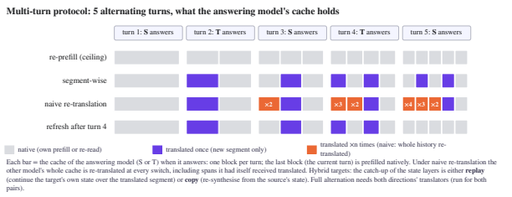
Figure 9 :Multi-turn protocol: the cache each answering model holds over 5 alter- nating turns under re-prefill, segment-wise transfer, naive re-translation and a native refresh after turn 4.
出典 · CC BY 4.0 · Povilas Kvedaras, Tomas Rasymas · Translating KV Caches Between Hybrid-Attention Language Models: MLA Latents, Linear-Attention States and Sparse-Attention Indexers · 論文の図を引用 · 元のPDFの21ページ目から図の部分を抽出しています。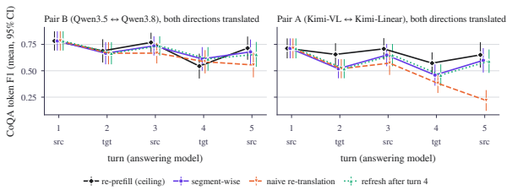
Figure 18 :CoQA F1 per turn over 5 alternating turns, both directions translated (mean, 95% CI over 50 dialogues). Segment-wise transfer stays close to the re-prefill ceiling; naive re-translation degrades by turn 5, mildly on Pair B and to a collapse on Pair A. Refresh after turn 4 equals segment-wise through turn 4 by construction.
出典 · CC BY 4.0 · Povilas Kvedaras, Tomas Rasymas · Translating KV Caches Between Hybrid-Attention Language Models: MLA Latents, Linear-Attention States and Sparse-Attention Indexers · 論文の図を引用 · 元のPDFの33ページ目から図の部分を抽出しています。論文情報
- 著者
- Povilas Kvedaras, Tomas Rasymas
- 学会・ジャーナル
- arXiv · プレプリント
- 公開日
- 2026年11月9日
- 登録日
- 2026年11月10日
- 更新日
- 2026年11月9日
- バージョン
- v1
- arXiv
- 2611.12062
- カテゴリ
- cs.LG · cs.CL
- ライセンス
- CC BY 4.0
- 掲載内容
- 論文情報・解説・論文の図
この解説は、Refivuの韓国語解説をAIで翻訳したものです。不正確な翻訳や誤りが含まれる可能性があります。論文と図の利用条件は各出典に従います。
アブストラクト
A model that takes over another model's conversation must normally re-read the whole history; a text hand-off shortens the re-read only by dropping content. KV-cache translation instead maps the source's cache into the target's own format, so the target continues from the full context without re-reading it. It works for grouped-query attention (GQA), but open-weights frontier models now cache compressed latents (MLA), sparse-attention indexer keys and fixed-size linear-attention states. We replicate KV-Lingo on a GQA pair and then give, for each of these objects, where to capture and inject it and a mechanism that reaches native quality. We study two hybrid pairs at 16-48B scale in both directions, Kimi-VL-A3B - Kimi-Linear-48B (MLA - MLA + Kimi Delta Attention) and Qwen3.5-27B - Qwen3.8-27B (Gated DeltaNet hybrids), plus a sparse-attention target (Qwen3.8-27B - Qwen3.8-Flash-Next). MLA latents translate with token-wise linear maps; recurrent states are copied with a closed-form correction or synthesised by replaying the target's own recurrence. Exact long-range recall needs token identity: decoding token ids from the source's layer-0 MLA latent raises needle recall from 0.09 to 0.99 at 2-32K and to 0.83-1.00 at 64K, eight times the longest training prompt. The hybrid full-MLA direction is within the paired confidence interval of native quality on every task metric, and same-shape GDN hybrids reach the native level in both directions (apart from 6% refusals inherited from the source), with time to first token 18.7 and 46.8 times shorter than a re-read at 64K tokens. Segment-wise multi-turn transfer stays at the re-prefill level; naive re-translation collapses. On the sparse-attention target, predicted indexer keys recall the needle as well as the target's own keys (one seed). We state as a hypothesis how the recipes transfer to 300B+ hybrid flagships.
この論文を引用
Povilas Kvedaras, Tomas Rasymas (2026). Translating KV Caches Between Hybrid-Attention Language Models: MLA Latents, Linear-Attention States and Sparse-Attention Indexers. arXiv:2611.12062v1. https://arxiv.org/abs/2611.12062v1
BibTeX
@misc{kvedaras2026translating,
  title = {{Translating KV Caches Between Hybrid-Attention Language Models: MLA Latents, Linear-Attention States and Sparse-Attention Indexers}},
  author = {Povilas Kvedaras and Tomas Rasymas},
  year = {2026},
  eprint = {2611.12062},
  archivePrefix = {arXiv},
  url = {https://arxiv.org/abs/2611.12062v1}
}