論文解説
DONeRF: Towards Real-Time Rendering of Compact Neural Radiance Fields using Depth Oracle Networks
DONeRF:Depth Oracle Networksによるコンパクトなニューラル放射輝度場のリアルタイムレンダリング
- 課題 NeRFは光線ごとに多くのサンプルでネットワークを評価するため、リアルタイムレンダリングが難しいです。
- 手法 深度オラクルネットワークが光線ごとに1回サンプル位置を予測し、シェーディングネットワークが少数のサンプルで色を積算します。
- 結果 表2の設定では、DONeRFはNeRFと比べて2~4サンプルで同等以上の品質を示し、計算量は48倍から78倍少ないと報告されています。
NeRFのリアルタイムレンダリングのボトルネック
NeRFは光線ごとに多くのサンプルでネットワークを評価するため、リアルタイムレンダリングには大きな計算コストがかかります。論文では、VRヘッドセットの解像度と90 Hzという条件で光線あたり256回のネットワーク評価を想定すると、約37 petaFLOPSが必要だと計算されています。この論文は、シーンの表面付近にだけサンプルを配置すれば光線あたりのサンプル数を大きく減らせるという観察から出発しています。
深度オラクルと局所サンプリングのシェーディングネットワーク
DONeRFは2つのネットワークで構成されます。深度オラクルネットワークは光線ごとに1回評価され、サンプルを置く区間の分類結果を出力します。シェーディングネットワークは、その位置の少数のサンプルから色を積算します。オラクルの分類出力は区間ごとの定数の確率密度として解釈され、累積分布関数を経てサンプル位置に変換されます。学習時は正解の深度から作った分類ターゲットを使い、推論時はフィルタリングを行わず、オラクルの出力だけを使います。
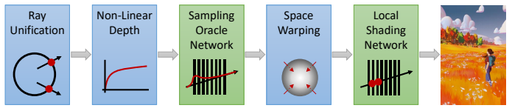
Figure 2 : To enable efficient rendering of large-scale neural representations, DONeRF uses a five stage pipeline: (1) ray descriptions are unified within a view cell, (2) depth is considered in a non-linear space, (3) an oracle network estimates the importance of samples, (4) sample positions are warped towards the view cell, and (5) radiance is generated from the shading MLP with only a few samples along each ray.
出典 · CC BY 4.0 · Thomas Neff, Pascal Stadlbauer, Mathias Parger, Andreas Kurz, Joerg H. Mueller, Chakravarty R. Alla Chaitanya, Anton Kaplanyan, Markus Steinberger · DONeRF: Towards Real-Time Rendering of Compact Neural Radiance Fields using Depth Oracle Networks · 論文の図を引用 · 元のPDFの3ページ目から図の部分を抽出しています。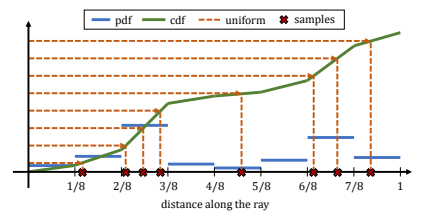
Figure 9 : To place samples along the ray, we treat the classified depth output from the oracle as a piecewise-constant PDF (blue) and translate it into a CDF (green). Sampling the CDF at uniform steps (orange) concentrates samples (red×) around regions with a high classification value.
出典 · CC BY 4.0 · Thomas Neff, Pascal Stadlbauer, Mathias Parger, Andreas Kurz, Joerg H. Mueller, Chakravarty R. Alla Chaitanya, Anton Kaplanyan, Markus Steinberger · DONeRF: Towards Real-Time Rendering of Compact Neural Radiance Fields using Depth Oracle Networks · 論文の図を引用 · 元のPDFの6ページ目から図の部分を抽出しています。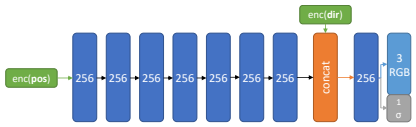
Figure 14 : For evaluation, we use the same MLP architecture for both NeRF and DONeRF: 8 layers with 256 hidden units each, with a single skip connection to forward the encoded directions to the last layer. For the depth oracle network, we do not use a skip connection. The inputs and outputs are described in Section 5.1.
出典 · CC BY 4.0 · Thomas Neff, Pascal Stadlbauer, Mathias Parger, Andreas Kurz, Joerg H. Mueller, Chakravarty R. Alla Chaitanya, Anton Kaplanyan, Markus Steinberger · DONeRF: Towards Real-Time Rendering of Compact Neural Radiance Fields using Depth Oracle Networks · 論文の図を引用 · 元のPDFの13ページ目から図の部分を抽出しています。サンプル配置の方法と対数・ワーピング変換
サンプルの配置の方法は、uniform、対数非線形、log+warp、NDC、局所サンプリングで比較されています。対数非線形は、近い区間にサンプルをより多く集めます。log+warpはこれに加えて、ビューセル中心方向の逆平方根に基づく空間ワーピングを組み合わせ、背景の高周波が位置エンコーディングで弱まるようにします。NDCサンプリングは、すべてのサンプルが平均カメラフレームの前方半球にある場合にだけ適用できます。論文のアブレーション実験の結果では、log+warpはuniformと比べてサンプル数を半分にしても同じ品質が得られると報告されています。
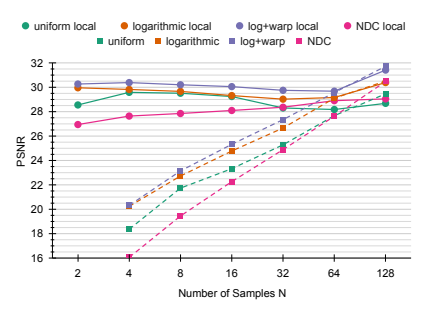
Figure 5 : Average PSNR results for various sample reduction schemes over the sample count N. Uniform sampling roughly in- creases quality by 1.8 dB for each doubling of N. logarithmic in- creases PSNR by1.3 dB and inverse square root warping (log+warp) adds another 0.6 dB on top. Sampling in NDC only manages to sur- pass uniform sampling at 128 samples. When sampling around the ground truth depth ( local), the number of samples hardly affects quality. Still, PSNR roughly increases by0.75 dB with logarithmic and another 0.6 dB with log+warp. Local NDC sampling performs worse than all other local sampling approaches until N = 32.
出典 · CC BY 4.0 · Thomas Neff, Pascal Stadlbauer, Mathias Parger, Andreas Kurz, Joerg H. Mueller, Chakravarty R. Alla Chaitanya, Anton Kaplanyan, Markus Steinberger · DONeRF: Towards Real-Time Rendering of Compact Neural Radiance Fields using Depth Oracle Networks · 論文の図を引用 · 元のPDFの4ページ目から図の部分を抽出しています。分類ターゲットとフィルタリング
オラクルは深度の値を回帰せず、光線上の区間を分類する問題として学習します。最初の表面が属する区間には1、それ以外の区間には0を与えるone-hotのターゲットを、BCE損失で学習します。さらに画像空間と深度軸のフィルタを適用して、不連続部分の周辺のターゲットを滑らかにします。フィルタは学習ターゲットにだけ使われ、推論には使われません。フィルタは偽陽性を増やす代わりに偽陰性を減らす方向に働きます。
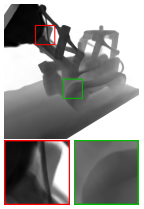
Figure 6 : (a) A depth oracle network with a single depth output smooths depth around discontinuities. (b) As a result, local sampling mixes fore- and background and distorts features. (c) This becomes apparent when compared to the ground truth.
出典 · CC BY 4.0 · Thomas Neff, Pascal Stadlbauer, Mathias Parger, Andreas Kurz, Joerg H. Mueller, Chakravarty R. Alla Chaitanya, Anton Kaplanyan, Markus Steinberger · DONeRF: Towards Real-Time Rendering of Compact Neural Radiance Fields using Depth Oracle Networks · 論文の図を引用 · 元のPDFの5ページ目から図の部分を抽出しています。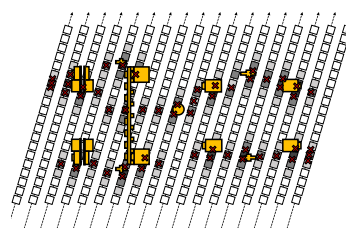
Figure 7 : A horizontal slice through theBulldozer dataset. Filtering the depth classification target (black = 1, white = 0) in both image dimensions and along depth smooths the classification target. An oracle producing such an output still results in high quality sample locations (red×), with additional samples placed in free space. A smooth target is easier to learn as labels vary with lower frequency.
出典 · CC BY 4.0 · Thomas Neff, Pascal Stadlbauer, Mathias Parger, Andreas Kurz, Joerg H. Mueller, Chakravarty R. Alla Chaitanya, Anton Kaplanyan, Markus Steinberger · DONeRF: Towards Real-Time Rendering of Compact Neural Radiance Fields using Depth Oracle Networks · 論文の図を引用 · 元のPDFの5ページ目から図の部分を抽出しています。
Figure 8 : Visualization of the classified depth target for 16 classes along each ray and the largest classes mapped toG, R, B, i.e., a green value indicates a single class with the brightness encoding depth; a gray value means that all classes are at similar depth; and different colors in proximity indicate that classes vary. Small features are smoothed to neighboring pixels with increasing filter sizes (1-5-9).
出典 · CC BY 4.0 · Thomas Neff, Pascal Stadlbauer, Mathias Parger, Andreas Kurz, Joerg H. Mueller, Chakravarty R. Alla Chaitanya, Anton Kaplanyan, Markus Steinberger · DONeRF: Towards Real-Time Rendering of Compact Neural Radiance Fields using Depth Oracle Networks · 論文の図を引用 · 元のPDFの6ページ目から図の部分を抽出しています。品質と計算量の比較
表2の設定では、DONeRFはNeRFと比べて2~4サンプルで同等以上のPSNRを報告しています。論文では、この区間で光線あたりのFLOPが48倍から78倍少ないと報告されています。NSVF、LLFF、NeXとの比較でも、DONeRFは複数のシーンで品質と効率のトレードオフが良いと報告されています。ただし、LLFFは計算量が最も少なく、NeXはレンダリングが速いと報告されているため、DONeRFがすべての指標で最良だという意味ではありません。
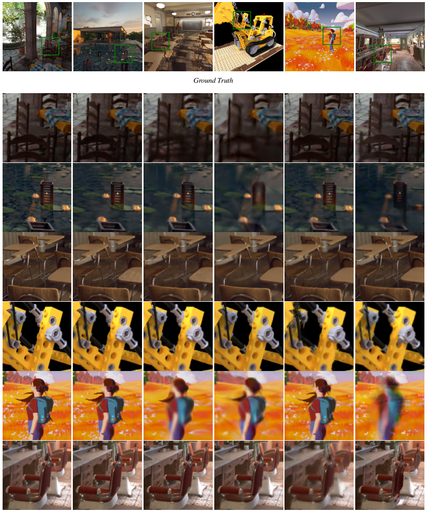
Figure 11 : Even on our challenging dataset, DONeRF achieves higher quality on average than all other methods at only 4 samples per ray. NeRF manages to faithfully reconstruct smaller scenes such as Bulldozer and Barbershop, but struggles with large-scale scenes such as Forest or highly complex geometry such as in Classroom. NSVF shows worse quality on average compared to DONeRF-4 at increased memory requirements and much worse performance. Although LLFF requires significantly more memory, it still struggles to represent fine details accurately, even at a cropped field of view. NeX achieves good quality forSan Miguel, but larger rotations and offsets from its reference pose cause significant artifacts due to its explicit MPI representation.
出典 · CC BY 4.0 · Thomas Neff, Pascal Stadlbauer, Mathias Parger, Andreas Kurz, Joerg H. Mueller, Chakravarty R. Alla Chaitanya, Anton Kaplanyan, Markus Steinberger · DONeRF: Towards Real-Time Rendering of Compact Neural Radiance Fields using Depth Oracle Networks · 論文の図を引用 · 元のPDFの8ページ目から図の部分を抽出しています。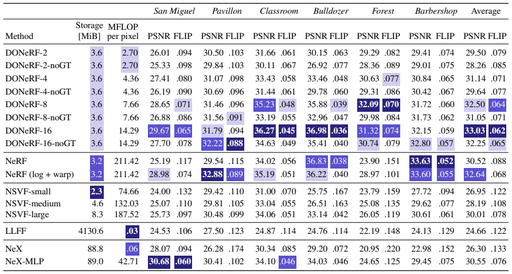
Table 2 : Across all our test scenes, DONeRF shows a significant improvement in quality-speed tradeoff, beating NeRF in most scenes with only 2− 4 samples per ray, resulting in 48× to 78× fewer FLOP per pixel at equal or better quality. Where NSVF struggles to achieve a consistent quality or performance for our tested scenes, especially for larger scenes such asForest, DONeRF performs consistently well across all scales. LLFF is the cheapest to compute, but fails to replicate the quality of the other methods, in addition to requiring storage that scales unfavorably with the amount of training images. Although NeX is also very efficient at rendering, it suffers from artifacts related to the MPI representation when poses differ too much from the reference pose, and requires roughly24× the amount of storage to achieve worse quality than DONeRF across the board. NeX-MLP is able to remedy some of the artifacts at a cost of 9× worse performance compared to DONeRF-4. Finally, using depth maps extracted from a dense NeRF without depending on available ground truth depth, DONeRF-noGT still achieves the best tradeoff between performance, quality and storage overall. Top results in each column are color coded asT op 1, Top 2 and Top 3.
出典 · CC BY 4.0 · Thomas Neff, Pascal Stadlbauer, Mathias Parger, Andreas Kurz, Joerg H. Mueller, Chakravarty R. Alla Chaitanya, Anton Kaplanyan, Markus Steinberger · DONeRF: Towards Real-Time Rendering of Compact Neural Radiance Fields using Depth Oracle Networks · 論文の図を引用 · 元のPDFの9ページ目から図の部分を抽出しています。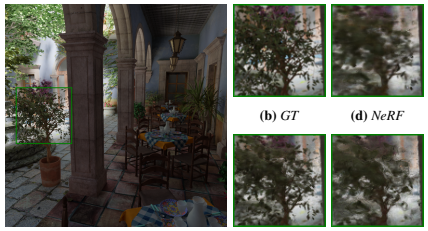
Figure 12 : (a) Example ground truth view of the test set of San Miguel with the corresponding inset (b). (c) DONeRF manages to preserve high-frequency detail around the leaves of the tree at only 4 samples per ray. (d) Although NeRF also preserves the tree faithfully, the edges are blurrier. (e) Even when trained with extracted NeRF depth maps (no GT depth), DONeRF produces slightly sharper results than NeRF.
出典 · CC BY 4.0 · Thomas Neff, Pascal Stadlbauer, Mathias Parger, Andreas Kurz, Joerg H. Mueller, Chakravarty R. Alla Chaitanya, Anton Kaplanyan, Markus Steinberger · DONeRF: Towards Real-Time Rendering of Compact Neural Radiance Fields using Depth Oracle Networks · 論文の図を引用 · 元のPDFの10ページ目から図の部分を抽出しています。限界と適用範囲
論文では、透明な表面と完全反射の鏡は、サンプル数が少ないことと単一の深度推定のため、完全に再現するのが難しいと説明されています。正解の深度を使わず、NeRFから抽出した深度で学習したDONeRF-noGTは、平均で約1 dB低い品質を示します。また、評価は静的なシーンに限られ、動的なシーンは扱っていないと明記されています。
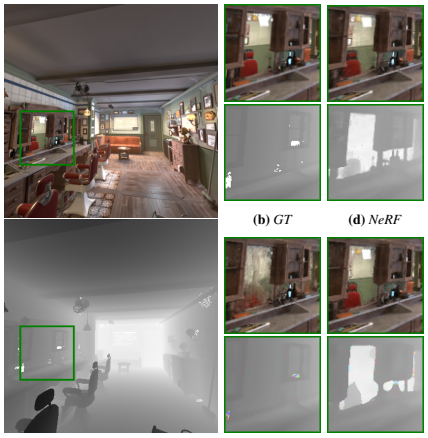
Figure 13 : (a) Example image and ground truth depth from theBar- bershop test set with the corresponding inset (b). (c) The reflective mirrors cannot be accurately represented by just sampling around the mirror’s depth in DONeRF . (d) NeRF places samples behind the mirror, constructing a virtual reflected room. (e) As depth maps extracted from NeRF include the virtual room, DONeRF-4-noGT learns to represent the mirrors with much fewer samples than NeRF.
出典 · CC BY 4.0 · Thomas Neff, Pascal Stadlbauer, Mathias Parger, Andreas Kurz, Joerg H. Mueller, Chakravarty R. Alla Chaitanya, Anton Kaplanyan, Markus Steinberger · DONeRF: Towards Real-Time Rendering of Compact Neural Radiance Fields using Depth Oracle Networks · 論文の図を引用 · 元のPDFの11ページ目から図の部分を抽出しています。論文情報
- 著者
- Thomas Neff, Pascal Stadlbauer, Mathias Parger, Andreas Kurz, Joerg H. Mueller, Chakravarty R. Alla Chaitanya, Anton Kaplanyan, Markus Steinberger
- 学会・ジャーナル
- arXiv · プレプリント
- 公開日
- 2021年3月4日
- 登録日
- 2026年11月6日
- 更新日
- 2021年6月25日
- バージョン
- v4
- arXiv
- 2103.03231
- DOI
- 10.1111/cgf.14340
- カテゴリ
- cs.CV · cs.GR
- ライセンス
- CC BY 4.0
- 掲載内容
- 論文情報・解説・論文の図
この解説は、Refivuの韓国語解説をAIで翻訳したものです。不正確な翻訳や誤りが含まれる可能性があります。論文と図の利用条件は各出典に従います。
アブストラクト
The recent research explosion around implicit neural representations, such as NeRF, shows that there is immense potential for implicitly storing high-quality scene and lighting information in compact neural networks. However, one major limitation preventing the use of NeRF in real-time rendering applications is the prohibitive computational cost of excessive network evaluations along each view ray, requiring dozens of petaFLOPS. In this work, we bring compact neural representations closer to practical rendering of synthetic content in real-time applications, such as games and virtual reality. We show that the number of samples required for each view ray can be significantly reduced when samples are placed around surfaces in the scene without compromising image quality. To this end, we propose a depth oracle network that predicts ray sample locations for each view ray with a single network evaluation. We show that using a classification network around logarithmically discretized and spherically warped depth values is essential to encode surface locations rather than directly estimating depth. The combination of these techniques leads to DONeRF, our compact dual network design with a depth oracle network as its first step and a locally sampled shading network for ray accumulation. With DONeRF, we reduce the inference costs by up to 48x compared to NeRF when conditioning on available ground truth depth information. Compared to concurrent acceleration methods for raymarching-based neural representations, DONeRF does not require additional memory for explicit caching or acceleration structures, and can render interactively (20 frames per second) on a single GPU.
この論文を引用
Thomas Neff, Pascal Stadlbauer, Mathias Parger, Andreas Kurz, Joerg H. Mueller, Chakravarty R. Alla Chaitanya, Anton Kaplanyan, Markus Steinberger (2021). DONeRF: Towards Real-Time Rendering of Compact Neural Radiance Fields using Depth Oracle Networks. arXiv:2103.03231v4. https://doi.org/10.1111/cgf.14340
BibTeX
@article{neff2021donerf,
  title = {{DONeRF: Towards Real-Time Rendering of Compact Neural Radiance Fields using Depth Oracle Networks}},
  author = {Thomas Neff and Pascal Stadlbauer and Mathias Parger and Andreas Kurz and Joerg H. Mueller and Chakravarty R. Alla Chaitanya and Anton Kaplanyan and Markus Steinberger},
  year = {2021},
  eprint = {2103.03231},
  archivePrefix = {arXiv},
  doi = {10.1111/cgf.14340},
  url = {https://arxiv.org/abs/2103.03231v4}
}