論文解説
Q-OIL: Optimistic Exploration in Learning from Human Interventions
Q-OIL:人間の介入から学習する楽観的探索
- 課題 実際の人による介入はロボット学習に役立ちますが、既存の合成ヒューマンモデルは、実際の介入のタイミングや修正行動を十分に再現できていません。
- 手法 介入のタイミングを最近の進捗でモデル化するPAMと、介入ボーナスを探索にだけ使い、タスクのTD目標とは分けるQ-OILを提案します。
- 結果 PAMに基づく評価は、実際のユーザーによるアルゴリズムの順位とρ=1.0の相関を示しました。Q-OILは、シミュレーションと実際のロボットタスクで、ベースラインより高い成功率を報告しています。
実際のユーザー介入とシミュレーション前提の違い
ロボットを実環境に配置すると失敗は避けられず、人の介入はロボットが行動を改善するための有用なフィードバックになります。しかし、実際の人を対象にした実験は時間がかかり費用も大きいため、アルゴリズムの開発には通常、合成ヒューマンモデルが使われます。本論文は、既存の合成モデルが想定していた介入の仕方が、実際の参加者の介入データと合わないと指摘しています。パイロット研究では、8名の参加者が3つのシミュレーション操作タスクを監督しました。その結果、24回の実行と約200k遷移が収集されました。
分析の最初の結果は、介入が瞬間的な行動の最適性ではなく、進捗の停滞に反応して起きることです。既存のMarkovモデルは、現在の状態と行動の最適性だけで介入のタイミングを決めますが、この研究では、直近k段階の価値変化V*(st)-V*(st-k)のほうが介入パターンをよく表すとされています。
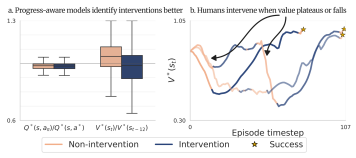
Figure 2 :(a) Progress separates interventions better than instantaneous values. (b) Qualitatively, humans in- tervene when value plateaus or declines.
出典 · CC BY 4.0 · Pranav Teegavarapu, Sriyash Poddar, Rico Qi, Cleah Winston, Krisha Khandelwal, Aykut Onyol, Natasha Jaques, Abhishek Gupta · Q-OIL: Optimistic Exploration in Learning from Human Interventions · 論文の図を引用 · 元のPDFの4ページ目から図の部分を抽出しています。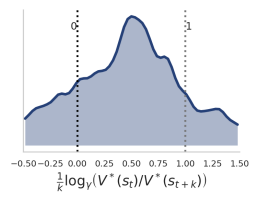
Figure 13 :Human intervention segments often make limited value-based progress.
出典 · CC BY 4.0 · Pranav Teegavarapu, Sriyash Poddar, Rico Qi, Cleah Winston, Krisha Khandelwal, Aykut Onyol, Natasha Jaques, Abhishek Gupta · Q-OIL: Optimistic Exploration in Learning from Human Interventions · 論文の図を引用 · 元のPDFの17ページ目から図の部分を抽出しています。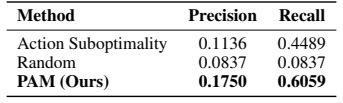
Table 1 : Intervention prediction on held-out human data.
出典 · CC BY 4.0 · Pranav Teegavarapu, Sriyash Poddar, Rico Qi, Cleah Winston, Krisha Khandelwal, Aykut Onyol, Natasha Jaques, Abhishek Gupta · Q-OIL: Optimistic Exploration in Learning from Human Interventions · 論文の図を引用 · 元のPDFの21ページ目から図の部分を抽出しています。進捗ベースの介入モデルと分離されたCritic
研究の中心となる技術的な変更は2つです。1つ目は、介入ゲートgを直近k段階の進捗で定義する、進捗認識モデルPAMに置き換えることです。V*(st)-V*(st-k)がδより小さい場合、介入確率はαで、それ以外の場合はβになります。kとδは、実際の人のデータに対するグリッドサーチで決めました。
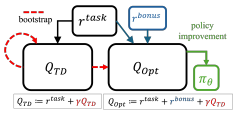
Figure 5 :Overview ofQ-OIL
出典 · CC BY 4.0 · Pranav Teegavarapu, Sriyash Poddar, Rico Qi, Cleah Winston, Krisha Khandelwal, Aykut Onyol, Natasha Jaques, Abhishek Gupta · Q-OIL: Optimistic Exploration in Learning from Human Interventions · 論文の図を引用 · 元のPDFの5ページ目から図の部分を抽出しています。2つ目は、Q-OILが介入遷移に楽観的ボーナスbを加えつつ、Criticを2つに分けることです。タスク報酬だけを使うTD CriticがBellman目標を与え、ボーナスを加えた楽観的Criticが探索と方策改善を担当します。こうすると、ボーナスが介入前の状態へ逆伝播するのを防げます。方策は楽観的Criticを最大化する方向に更新され、介入行動には行動複製の正則化が加えられます。
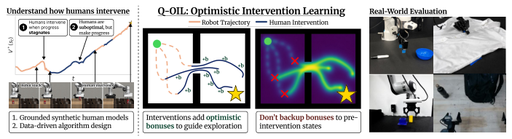
Figure 1 :Overview ofQ-OIL. Real-user data shows that humans intervene when robot progress stalls and provide suboptimal corrections.Q-OILtreats interventions as optimistic exploration bonuses while preventing bonuses from propagating to non-intervention states for faster real-world learning.
出典 · CC BY 4.0 · Pranav Teegavarapu, Sriyash Poddar, Rico Qi, Cleah Winston, Krisha Khandelwal, Aykut Onyol, Natasha Jaques, Abhishek Gupta · Q-OIL: Optimistic Exploration in Learning from Human Interventions · 論文の図を引用 · 元のPDFの2ページ目から図の部分を抽出しています。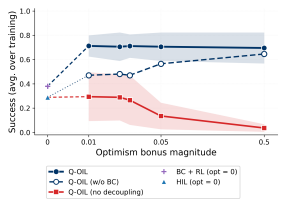
Figure 10 :Q-OILw/o decoupling degrades with higher bonus due to over-optimism.
出典 · CC BY 4.0 · Pranav Teegavarapu, Sriyash Poddar, Rico Qi, Cleah Winston, Krisha Khandelwal, Aykut Onyol, Natasha Jaques, Abhishek Gupta · Q-OIL: Optimistic Exploration in Learning from Human Interventions · 論文の図を引用 · 元のPDFの9ページ目から図の部分を抽出しています。シミュレーションと実際のユーザーの順位比較
PAMは、実際のユーザー評価とアルゴリズムの順位の一致を検証するために使われました。6つの学習アルゴリズムを、PAM、行動非最適性に基づくモデル、ランダムモデルで評価し、実際のユーザーの順位とSpearman相関を比べました。PAMに基づく順位は、実際のユーザーの順位とρ=1.0の相関を示しました。
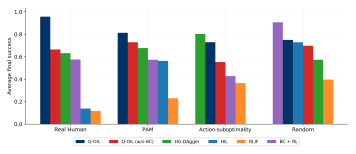
Figure 17 :Rankings of algorithms under real hu- man evaluation and three simulated intervention mod- els, based on final success rate.
出典 · CC BY 4.0 · Pranav Teegavarapu, Sriyash Poddar, Rico Qi, Cleah Winston, Krisha Khandelwal, Aykut Onyol, Natasha Jaques, Abhishek Gupta · Q-OIL: Optimistic Exploration in Learning from Human Interventions · 論文の図を引用 · 元のPDFの21ページ目から図の部分を抽出しています。この結果は、アルゴリズムの順位の一致に関するものであり、絶対的な成功率が同じだという意味ではありません。また、参加者数とタスク数が限られているため、この相関は、対象としたタスクと参加者集団で観察された結果として読むべきです。
シミュレーションと実際のロボットの結果
Robomimicのシミュレーションでは、PAMの介入モデルを使うと、Q-OILはHIL、HG-DAgger、SIRIUS、PVP、RLIF、BC+RLなどのベースラインより少ない相互作用で高い成功率に到達しました。実際のユーザー介入実験では、4名の参加者が2つのタスクで6つの手法を評価しました。
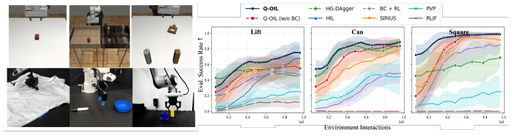
Figure 6 :Left:Evaluation tasks in simulation and on the Franka robot.Right:On Robomimic with the progress-aware human model (PAM),Q-OILimproves success rate and learning efficiency over baselines.
出典 · CC BY 4.0 · Pranav Teegavarapu, Sriyash Poddar, Rico Qi, Cleah Winston, Krisha Khandelwal, Aykut Onyol, Natasha Jaques, Abhishek Gupta · Q-OIL: Optimistic Exploration in Learning from Human Interventions · 論文の図を引用 · 元のPDFの7ページ目から図の部分を抽出しています。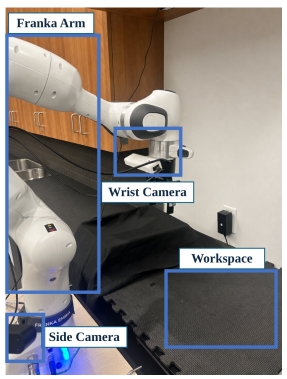
Figure 16 :Real-world robot setup. The policy receives RGB observations from a wrist-mounted camera and, optionally, a side-view camera. The human supervisor monitors the robot during online training and provides interventions using a Space- Mouse.
出典 · CC BY 4.0 · Pranav Teegavarapu, Sriyash Poddar, Rico Qi, Cleah Winston, Krisha Khandelwal, Aykut Onyol, Natasha Jaques, Abhishek Gupta · Q-OIL: Optimistic Exploration in Learning from Human Interventions · 論文の図を引用 · 元のPDFの19ページ目から図の部分を抽出しています。この結果は、対象としたタスクと評価回数に限られます。
適用範囲と残された課題
著者らは、人を対象とした研究が8名のユーザーとシミュレーションタスク24回の実行に限られており、より多様な実際の参加者集団を代表していないと説明しています。また、評価は卓上型の操作タスクに限られ、非定型環境や長いタスクでの介入パターンはまだ確認されていません。
介入ボーナスは、学習中に介入遷移へ重みを付ける仕組みなので、関数近似を通じて周辺の遷移に広がる可能性があります。著者らは、これを意味空間や言語ベースの介入へ拡張することを、今後の課題として挙げています。
論文情報
- 著者
- Pranav Teegavarapu, Sriyash Poddar, Rico Qi, Cleah Winston, Krisha Khandelwal, Aykut Onyol, Natasha Jaques, Abhishek Gupta
- 学会・ジャーナル
- arXiv · プレプリント
- 公開日
- 2026年11月5日
- 登録日
- 2026年11月9日
- 更新日
- 2026年11月5日
- バージョン
- v1
- arXiv
- 2611.08576
- カテゴリ
- cs.RO · cs.AI
- ライセンス
- CC BY 4.0
- 掲載内容
- 論文情報・解説・論文の図
この解説は、Refivuの韓国語解説をAIで翻訳したものです。不正確な翻訳や誤りが含まれる可能性があります。論文と図の利用条件は各出典に従います。
アブストラクト
As robots are deployed in the real world, they will inevitably make mistakes. Human interventions provide valuable feedback for improving their behavior, enabling them to adapt online to new scenarios. However, studying human-in-the-loop robot learning is difficult: real-world experiments are slow and expensive, so most algorithm development relies on simulated human models. We show that common human modeling assumptions do not match how real people intervene in practice. Through analyzing intervention data from human participants, we find that humans tend to intervene when agent progress stalls, and that their corrective actions are often suboptimal. Motivated by these findings, we introduce a progress-based model of human intervention that achieves higher rank correlation with real-user algorithm rankings, enabling realistic algorithm benchmarking and development in simulation. Building on these insights, we propose Q-OIL, a method that adds optimistic bonuses to intervention transitions in reinforcement learning and softly guides exploration toward human corrections. We find that decoupled critics are critical for stability because they prevent the bonuses from backing up to pre-intervention states. As a result, Q-OIL learns more efficiently than competitive baselines, achieving 10-50% higher success in simulation and on real robots, and improving pretrained VLAs on two bimanual manipulation tasks. As we ground both evaluation and algorithms in realistic human behavior, this work provides a practical path toward scalable robot learning from interventions.
この論文を引用
Pranav Teegavarapu, Sriyash Poddar, Rico Qi, Cleah Winston, Krisha Khandelwal, Aykut Onyol, Natasha Jaques, Abhishek Gupta (2026). Q-OIL: Optimistic Exploration in Learning from Human Interventions. arXiv:2611.08576v1. https://arxiv.org/abs/2611.08576v1
BibTeX
@misc{teegavarapu2026optimistic,
  title = {{Q-OIL: Optimistic Exploration in Learning from Human Interventions}},
  author = {Pranav Teegavarapu and Sriyash Poddar and Rico Qi and Cleah Winston and Krisha Khandelwal and Aykut Onyol and Natasha Jaques and Abhishek Gupta},
  year = {2026},
  eprint = {2611.08576},
  archivePrefix = {arXiv},
  url = {https://arxiv.org/abs/2611.08576v1}
}