論文解説
ChainFlow: Few-Step Latent Flow Matching for Speculative Decoding
ChainFlow:Speculative Decodingのための少数ステップ潜在フローマッチング
- 課題 既存の自己回帰ドラフターはドラフト長に応じてコストが増え、並列ドラフターは位置間の依存関係を事後に復元する必要があります。
- 手法 ChainFlowはtarget hidden stateをVAEの潜在空間に圧縮し、直近contextの外挿から出発する少ステップのflowで、未来8位置の潜在状態を一度に予測します。
- 結果 Qwen3.5-4BのEnglish 8ドメインで、ChainFlowの8×4 treeはpooled 1.87×のspeedupを示し、同じ表のEAGLE-3 1.35×やDFlash 1.69×を上回りました。
既存ドラフターの2つの限界
大規模言語モデルの推論は、トークンを1つずつ順番に生成するため遅延が大きくなります。speculative decodingでは、軽量なドラフターが未来のトークンを提案し、targetが1回の並列passで検証することで、この直列性を一部崩します。既存のドラフターは2つの極端な位置にあります。自己回帰ドラフターのEAGLE-3は、各トークンを直前のトークンに条件付けるため高い受理長を得られますが、ドラフト長に比例してコストが増えます。並列ドラフターのDFlashは1回のpassでブロック全体を出力しますが、各位置を検証済みprefixだけで独立に予測するため、ドラフトトークン間の依存関係を事後に復元する必要があります。
論文は、targetの直近のhidden trajectoryから出発して未来の状態へ短く輸送する方法が、この2つの限界を同時に扱えるかを問うています。
潜在空間のflow matchingドラフター
ChainFlowは、targetの最後のhidden stateをVAEで圧縮した潜在空間でflow matchingを行うドラフターです。出発点はガウスノイズではなく、直近2つのcontext latentの線形外挿で決まり、各ドラフト位置iはz(i)0 = zt + i(zt − zt−1)から出発します。学習にはrectified-flowの経路 zs = (1−s)z0 + s z1 を用い、速度網vθが定数速度 z1 − z0 を回帰するようにします。推論時は単一のEuler段階 z ← z + vθ(z, s, c) で未来の潜在状態を予測し、復号された潜在状態を凍結されたlm_headに通して位置ごとの分布を得ます。
ドラフターはcontext latentをcross-attentionのキーと値としてのみ読み取るため、targetの内部表現を読みますが、その中には含まれません。
事後のトークンフィードバックと候補探索
1回のflow passで得られた位置ごとのmarginalは前の位置のサンプルを条件としないため、ChainFlowはflowの後に2つの補正項を適用します。経路ヘッドは末尾p=8個の親トークンのfrozen埋め込みの和を小さなMLPで処理してhidden stateを補正し、Markovヘッドは直前のサンプルトークンに条件付けられたrank-256の低ランク1次遷移バイアスを加えます。この2つの補正は、flowやVAEを再実行せずに位置ごとに評価されます。候補探索では、語彙全体ではなく学習コーパスの62,642トークンのうち共有候補M=8192個だけを再スコアリングし、beam searchでchainまたは8×4 treeを作ります。
tree検証はancestor maskにより、すべてのroot-to-nodeパスを1回のtarget passでスコアリングします。ただし、この検証方式はgreedyデコーディングでのみサポートされています。
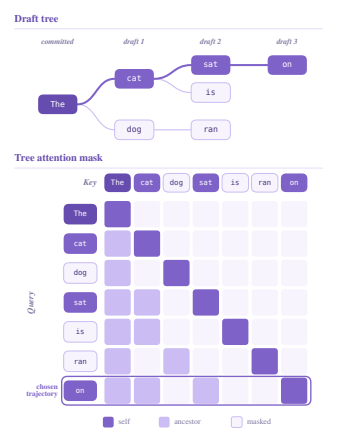
Figure 3 . Tree drafting and attention mask (illustrative). Each draft token attends only to itself and its ancestors, so all branches are verified in one target pass.
出典 · CC BY 4.0 · Selim Aktas, Yusuf Erdem Erdem, Ahmed Zeer, Himmet Toprak Kesgin, Muzaffer Kaan Yuce, Mehmet Fatih Amasyali · ChainFlow: Few-Step Latent Flow Matching for Speculative Decoding · 論文の図を引用 · 元のPDFの5ページ目から図の部分を抽出しています。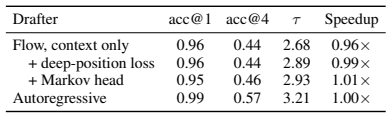
Table 5 . Token feedback. acc@ i: acceptance at draft position i; speedup measured live.
出典 · CC BY 4.0 · Selim Aktas, Yusuf Erdem Erdem, Ahmed Zeer, Himmet Toprak Kesgin, Muzaffer Kaan Yuce, Mehmet Fatih Amasyali · ChainFlow: Few-Step Latent Flow Matching for Speculative Decoding · 論文の図を引用 · 元のPDFの7ページ目から図の部分を抽出しています。学習目的と言語適応
学習では、flow、経路ヘッド、Markovヘッド、VAEをend-to-endで同時に最適化し、全体の損失は flow、hidden、CE、coverage、受理長surrogate、再構成項の重み付き和として構成されます。受理長surrogateは、γ=0.8で重み付けした位置ごとの累積確率項を用いる微分可能な近似です。英語ドラフターはまず45.9Kプロンプトで学習され、その後Turkish、German、Frenchの順に、同じ目的を用いてwarm-start適応されます。必要に応じて、以前の言語のデータの一部をreplayとして混ぜます。
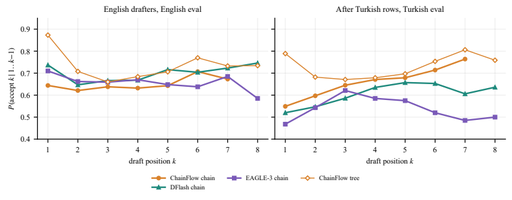
Figure 4 . Conditional acceptance at each draft position, given that all earlier positions were accepted (offline, 4B). Left: English drafters on English. Right: after Turkish adaptation, on Turkish. Chain curves end at position 7; the tree is8×4.
出典 · CC BY 4.0 · Selim Aktas, Yusuf Erdem Erdem, Ahmed Zeer, Himmet Toprak Kesgin, Muzaffer Kaan Yuce, Mehmet Fatih Amasyali · ChainFlow: Few-Step Latent Flow Matching for Speculative Decoding · 論文の図を引用 · 元のPDFの7ページ目から図の部分を抽出しています。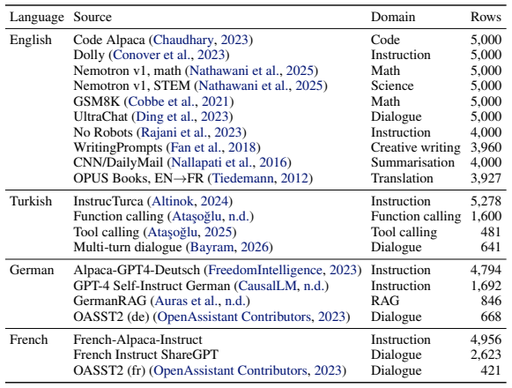
Table 10 . Training sources by language and domain. Drafters are trained on English first, then adapted in sequence to Turkish, German and French without English replay. English totals 45,887 rows (16.6M tokens), while Turkish, German and French 8,000 each. Replay stages add 2,088 Turkish rows (20.7%). Rows are prompts, and training responses are the target’s own greedy continuations.
出典 · CC BY 4.0 · Selim Aktas, Yusuf Erdem Erdem, Ahmed Zeer, Himmet Toprak Kesgin, Muzaffer Kaan Yuce, Mehmet Fatih Amasyali · ChainFlow: Few-Step Latent Flow Matching for Speculative Decoding · 論文の図を引用 · 元のPDFの13ページ目から図の部分を抽出しています。English ドメインの速度比較
Qwen3.5-4Bで、batch 1、NVIDIA B300、vLLM 0.31.0、greedyデコーディングの条件で測定した英語の8ドメインの結果では、ChainFlowの8×4 treeがpooled平均1.87×のspeedupとτ 2.78を報告しています。同じ表では、chainは1.23×、EAGLE-3は1.35×、DFlashは1.69×です。これらの値は、K=3のchainまたはK=4のベースラインという条件のもとでの論文の数値であり、論文本文はChainFlowのtreeが2つのベースラインをすべてのドメインで上回ると報告しています。

Table 1 . English results at Qwen3.5-4B, batch one: acceptance length τ and speedup V over autoregressive decoding by domain and pooled mean. C denotes chain drafting (K=3); T1 and T2 denote 8×4 and 5×7 trees (nodes per depth × depth), respectively, with T1 as our headline configuration. Each drafter has ∼0.52B parameters. EAGLE-3 and DFlash draft K=4 tokens per round. Evaluated on NVIDIA B300 with vLLM 0.31.0 and greedy decoding.
出典 · CC BY 4.0 · Selim Aktas, Yusuf Erdem Erdem, Ahmed Zeer, Himmet Toprak Kesgin, Muzaffer Kaan Yuce, Mehmet Fatih Amasyali · ChainFlow: Few-Step Latent Flow Matching for Speculative Decoding · 論文の図を引用 · 元のPDFの6ページ目から図の部分を抽出しています。モデルサイズと適応結果
targetのサイズを4B、9B、27Bに増やすと、tree受理長は2.66から2.78の範囲にとどまり、flowの積分時間は0.30~0.38 msである一方、自己回帰ステップは3.1から11.2 msへ増加します。27Bでは、pooled treeのspeedupが2.12×で最も高く、Table 4の27B数学ドメインのspeedupは3.23×です。Turkish適応後のドラフターは英語ドラフターより高い速度を示しており、論文では、英語のみで学習したドラフターはTurkishでは4Bと9Bで不利になると報告されています。
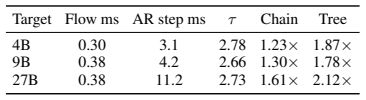
Table 3 . Scaling with target size. Flow and AR latencies are per draft and decoding step (ms), respectively. τ is measured on a fixed8×4tree; chain usesK= 3.
出典 · CC BY 4.0 · Selim Aktas, Yusuf Erdem Erdem, Ahmed Zeer, Himmet Toprak Kesgin, Muzaffer Kaan Yuce, Mehmet Fatih Amasyali · ChainFlow: Few-Step Latent Flow Matching for Speculative Decoding · 論文の図を引用 · 元のPDFの6ページ目から図の部分を抽出しています。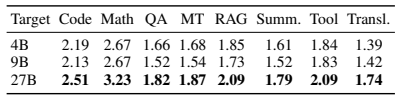
Table 4 . Per-domain tree speedup (8×4 ) by target size in English.
出典 · CC BY 4.0 · Selim Aktas, Yusuf Erdem Erdem, Ahmed Zeer, Himmet Toprak Kesgin, Muzaffer Kaan Yuce, Mehmet Fatih Amasyali · ChainFlow: Few-Step Latent Flow Matching for Speculative Decoding · 論文の図を引用 · 元のPDFの7ページ目から図の部分を抽出しています。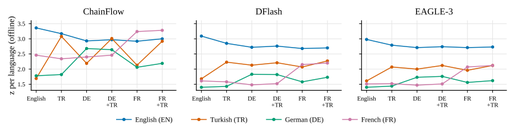
Figure 5 . Effect of language adaptation on offline decoding speedup (z) for ChainFlow (tree mode), DFlash, and EAGLE-3. Adapting to new languages improves their decoding speedups, with ChainFlow achieving the largest gains, while English performance declines slightly across all three methods.
出典 · CC BY 4.0 · Selim Aktas, Yusuf Erdem Erdem, Ahmed Zeer, Himmet Toprak Kesgin, Muzaffer Kaan Yuce, Mehmet Fatih Amasyali · ChainFlow: Few-Step Latent Flow Matching for Speculative Decoding · 論文の図を引用 · 元のPDFの8ページ目から図の部分を抽出しています。構成要素のアブレーション実験と設計上の選択
ドラフター設計の実験は、Qwen3.5-0.8BターゲットとGSM8Kを基準に行われました。トークンフィードバックの実験では、contextのみを使うflowのacc@4は0.44、Markovヘッドを加えた場合は0.46、自己回帰ドラフターは0.57でした。専門家数を2から4に増やしても、検証受理の期待値はすでに到達していたプラトーを超えませんでした。ソース初期化の実験では、ノイズ開始は90%プラトーに約57エポックが必要で、外挿開始は約20エポックでした。4Bでは、Euler段階N=1の推論がサービス設定として使われました。木構造の実験では、4Bターゲットで8×4が最も速い構成で、5×7は最も低いτと処理量を示しました。
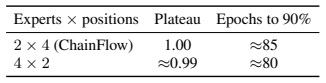
Table 6 . Splitting the draft block across experts. Plateau: validation expected acceptance relative to2×4. Values are approximate.
出典 · CC BY 4.0 · Selim Aktas, Yusuf Erdem Erdem, Ahmed Zeer, Himmet Toprak Kesgin, Muzaffer Kaan Yuce, Mehmet Fatih Amasyali · ChainFlow: Few-Step Latent Flow Matching for Speculative Decoding · 論文の図を引用 · 元のPDFの8ページ目から図の部分を抽出しています。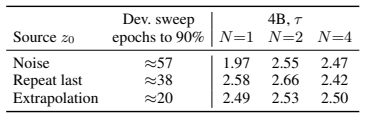
Table 7 . Source distribution. Left: training epochs to 90% of the validation plateau. Right: inference-time Euler steps for 4B drafters trained atN= 2(offline, English chain).
出典 · CC BY 4.0 · Selim Aktas, Yusuf Erdem Erdem, Ahmed Zeer, Himmet Toprak Kesgin, Muzaffer Kaan Yuce, Mehmet Fatih Amasyali · ChainFlow: Few-Step Latent Flow Matching for Speculative Decoding · 論文の図を引用 · 元のPDFの8ページ目から図の部分を抽出しています。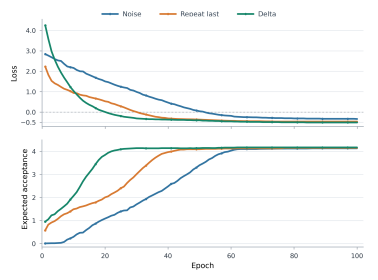
Figure 6 . Training loss (top) and validation expected acceptance (bottom) across epochs for three initializations: noise, last-latent repetition, and trajectory extrapolation (Delta).
出典 · CC BY 4.0 · Selim Aktas, Yusuf Erdem Erdem, Ahmed Zeer, Himmet Toprak Kesgin, Muzaffer Kaan Yuce, Mehmet Fatih Amasyali · ChainFlow: Few-Step Latent Flow Matching for Speculative Decoding · 論文の図を引用 · 元のPDFの8ページ目から図の部分を抽出しています。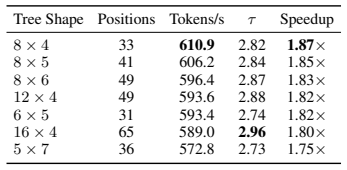
Table 8 . Tree shape (Wb ×D : nodes kept per depth × depth) at Qwen3.5-4B, batch one, eight English domains. Positions: tokens verified per round, including the committed token. Speedup is relative to plain decoding (327 tokens/s). The headline 8×4 tree is best.
出典 · CC BY 4.0 · Selim Aktas, Yusuf Erdem Erdem, Ahmed Zeer, Himmet Toprak Kesgin, Muzaffer Kaan Yuce, Mehmet Fatih Amasyali · ChainFlow: Few-Step Latent Flow Matching for Speculative Decoding · 論文の図を引用 · 元のPDFの9ページ目から図の部分を抽出しています。並行性と適用範囲の限界
同時リクエスト数が増えると、ChainFlowの利得は小さくなります。すべての実験はQwen3.5ターゲットで行われたため、他のモデル系列への転移は確認されていません。tree検証にはpatchedエンジンとgreedyデコーディングが必要で、B300での実行では4~13%のプロンプトが通常のgreedyデコーディングとは異なる出力を生成しました。著者らは、この差をbatched verificationにおけるfp16のnear-tieとして解釈しており、この結果はbit-wiseな同一性を示すものではないと説明しています。
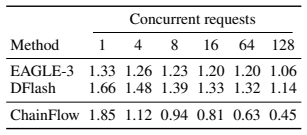
Table 9 . Speedup under concurrency at Qwen3.5-4B: output tokens per second relative to autoregressive decoding at the same number of concurrent requests.
出典 · CC BY 4.0 · Selim Aktas, Yusuf Erdem Erdem, Ahmed Zeer, Himmet Toprak Kesgin, Muzaffer Kaan Yuce, Mehmet Fatih Amasyali · ChainFlow: Few-Step Latent Flow Matching for Speculative Decoding · 論文の図を引用 · 元のPDFの9ページ目から図の部分を抽出しています。論文情報
- 著者
- Selim Aktas, Yusuf Erdem Erdem, Ahmed Zeer, Himmet Toprak Kesgin, Muzaffer Kaan Yuce, Mehmet Fatih Amasyali
- 学会・ジャーナル
- arXiv · プレプリント
- 公開日
- 2026年11月5日
- 登録日
- 2026年11月9日
- 更新日
- 2026年11月5日
- バージョン
- v1
- arXiv
- 2611.08669
- カテゴリ
- cs.AI · cs.CL
- ライセンス
- CC BY 4.0
- 掲載内容
- 論文情報・解説・論文の図
この解説は、Refivuの韓国語解説をAIで翻訳したものです。不正確な翻訳や誤りが含まれる可能性があります。論文と図の利用条件は各出典に従います。
アブストラクト
Speculative decoding has become a standard way to accelerate LLM inference: a lightweight drafter proposes tokens that the target verifies in one parallel pass. Existing drafters face trade-offs that limits their speedups: autoregressive drafters generate tokens one at a time, so drafting cost grows with draft length, while diffusion drafters generate tokens in parallel but predict each position independently, ignoring inter-token dependencies. We introduce ChainFlow, a new speculative decoding paradigm and the first flow-matching drafter conditioned on the target's hidden states. ChainFlow treats drafting as a short transport over hidden states, needing one or two flow steps instead of the many denoising steps of generation from noise. A variational autoencoder compresses these states so drafting cost barely grows with target size, lightweight feedback heads restore inter-token dependencies, and tree drafting raises acceptance. On Qwen3.5 models, at matched drafter size and training data, ChainFlow outperforms EAGLE-3 and DFlash in vLLM by 39% and 11%, respectively. These gains further widen as drafters are adapted to new languages sequentially. Our ablations cover drafter design and concurrent serving, and we open-source our code and drafter models.
この論文を引用
Selim Aktas, Yusuf Erdem Erdem, Ahmed Zeer, Himmet Toprak Kesgin, Muzaffer Kaan Yuce, Mehmet Fatih Amasyali (2026). ChainFlow: Few-Step Latent Flow Matching for Speculative Decoding. arXiv:2611.08669v1. https://arxiv.org/abs/2611.08669v1
BibTeX
@misc{aktas2026chainflow,
  title = {{ChainFlow: Few-Step Latent Flow Matching for Speculative Decoding}},
  author = {Selim Aktas and Yusuf Erdem Erdem and Ahmed Zeer and Himmet Toprak Kesgin and Muzaffer Kaan Yuce and Mehmet Fatih Amasyali},
  year = {2026},
  eprint = {2611.08669},
  archivePrefix = {arXiv},
  url = {https://arxiv.org/abs/2611.08669v1}
}