論文解説
Open-fMIND: A Large-Scale Open-Access fMRI Corpus for Pretraining Brain Foundation Models
Open-fMIND:Brain Foundation Modelの事前学習に向けた大規模公開fMRIコーパス
- 課題 公開されているOpenNeuroのfMRIデータは小規模で種類もまちまちであり、前処理もされていないため、大規模な事前学習用コーパスには使いにくいです。
- 手法 fMRIPrepで前処理したあと52個のアトラスでパーセレーションし、デノイジングなしのquasirawとデノイジング済みのpreprocの2版を作成します。
- 結果 Open-fMINDで事前学習したBrain-SemantoksはHCP-YAでの性別AUROCが0.945で、UK Biobankのモデルと同じ値を記録しました。
公開fMRIデータを事前学習に使う際の障壁
fMRIの基盤モデルを事前学習するには、大量の標準化されたデータが必要です。最大の標準的なリソースであるHCP、UK Biobank、ABCDは、データ利用協定によりアクセスが制限されており、取得プロトコルも少数に偏っています。一方、OpenNeuroには数千個の公開データセットがありますが、どれも小規模で構成がばらばらであり、大半は前処理されていません。このロングテールのデータを1つの事前学習コーパスにまとめるには、数百件の研究を同じ方法でダウンロードし、前処理し、デノイジングする必要があり、この作業がこれまで大規模な活用を妨げてきました。著者らはこの問題に対処するためにOpen-fMINDを公開しており、今回のリリースには322件のOpenNeuro研究、11,379名の被験者、45,731個の機能的runが含まれています。
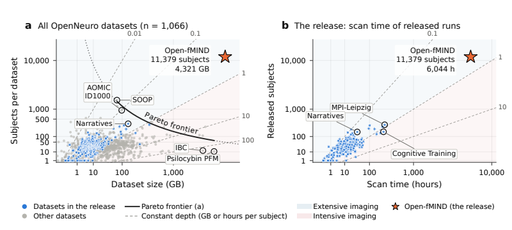
Figure 1 :Open-fMIND pools many small datasets into a corpus larger than any single one of them.(a) The 1,066 OpenNeuro MRI datasets, by size and number of subjects. Blue points are datasets with released runs in Open-fMIND, grey points the others. Dashed lines mark constant size per subject, and the black line is the Pareto frontier (no dataset has both more subjects and more data). The star is the release itself: its 11,379 subjects and the size of its files (4,321 GB, both versions and all atlases). (b) Scan time against subjects for the released datasets, restricted to released subjects and runs.
出典 · CC BY 4.0 · Carlo Alberto Barbano, Giovanni Marraffini, Demian Wassermann · Open-fMIND: A Large-Scale Open-Access fMRI Corpus for Pretraining Brain Foundation Models · 論文の図を引用 · 元のPDFの2ページ目から図の部分を抽出しています。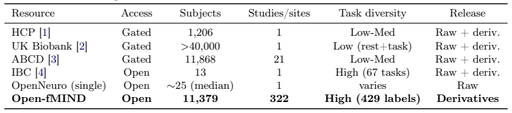
Table 1 : Comparison with existing resources. Subject counts for HCP are from the S1200 release, for UK Biobank are participants with fMRI, for ABCD are from Release 5.1, and for IBC are the participants of the cumulative dataset up to the fifth release.
出典 · CC BY 4.0 · Carlo Alberto Barbano, Giovanni Marraffini, Demian Wassermann · Open-fMIND: A Large-Scale Open-Access fMRI Corpus for Pretraining Brain Foundation Models · 論文の図を引用 · 元のPDFの2ページ目から図の部分を抽出しています。fMRIPrepによる前処理から2版の作成まで
パイプラインは、OpenNeuroからBIDSデータを検査し、fMRIPrepでヘッドモーション補正、解剖学的画像との位置合わせ、MNI152NLin2009cAsymテンプレートへのリサンプリングを行うところから始まります。続いて、各runを52個のアトラスでパーセレーションします。ハードなパーセレーションにはlabels maskerを、重なり合う確率的アトラスにはmaps maskerを使い、確率的アトラスを勝者総取りの割り当てに変換しないようにしています。こうして得られた時系列にデノイジングを行わないものがquasirawの版です。preprocの版では、これに加えて26個のfMRIPrep confounds回帰、FDが0.5 mmを超えるボリュームのscrubbing、線形デトレンドと0.01–0.1 Hzのバンドパスフィルタ、ROIごとの単位分散による標準化を1段階で適用します。
これらの処理は時間に対して線形なので、パーセレーション後の信号をデノイジングすることは、パーセレーション前のボクセルデータに同じ処理をすることと同じだと著者らは説明しています。どちらの版にも、runとアトラスごとのPearson連結行列が含まれています。
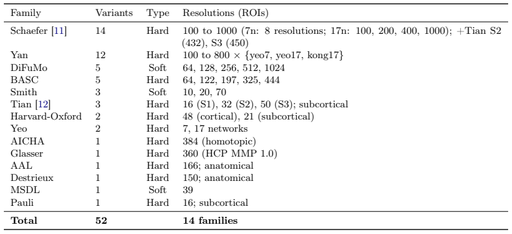
Table 2 : Atlas inventory, grouped by parcellation family. “Hard” atlases assign each voxel to exactly one parcel; “soft” atlases are probabilistic and spatially overlapping. ROI counts are those of the released sidecars (ROILabels).
出典 · CC BY 4.0 · Carlo Alberto Barbano, Giovanni Marraffini, Demian Wassermann · Open-fMIND: A Large-Scale Open-Access fMRI Corpus for Pretraining Brain Foundation Models · 論文の図を引用 · 元のPDFの4ページ目から図の部分を抽出しています。残差モーションと連結性の品質確認
Technical Validationでは、ラベルを使わずに連結行列の品質を確認します。残差モーションはエッジごとのQC-FCで測定しました。被験者1人につき1つのrunを使い、すべてのエッジで結合強度と平均FDの相関を求めたうえで、その分布が0付近にあり、ROI間距離に依存しないかを見ます。その結果、QC-FCの中央値は+0.033で、エッジの74.5%がFDRで有意でした。著者らは、この傾きはモーションアーティファクトの古典的な信号だと解釈しており、絶対値としては小さいと述べています。したがって、公開される行列には小さいものの統計的に明確な残差モーションの信号が残っていると整理されます。
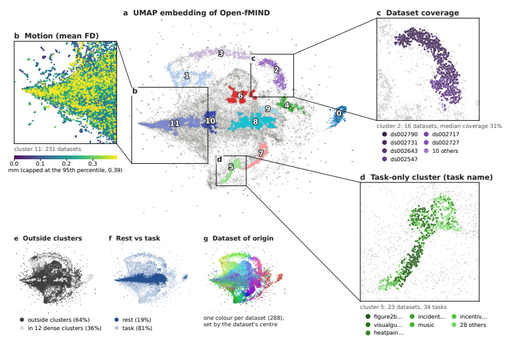
Figure 2 :Runs form regions in connectivity space that differ in motion, dataset of origin and task.(a) UMAP (15 neighbors, minimum distance 0.1) of the Schaefer-400 connectivity vectors of 44,241 preprocessed runs from 288 datasets; datasets with fewer than 5 subjects are left out (32 datasets, 63 subjects, 778 runs). The 12 dense clusters found by HDBSCAN (minimum cluster size 500, minimum samples 50, leaf selection; 36% of runs) are colored and numbered, and the other runs are grey. Boxes mark the clusters enlarged in (b-d), each of which maximizes one criterion. (b) Motion: the cluster with the highest median mean FD (cluster 11, 231 datasets; 0.165 mm against 0.124 mm over all runs), colored by mean FD capped at the 95th percentile. (c) Dataset coverage: the cluster with the highest median dataset coverage (cluster 2, 16 datasets, 31%), colored by dataset. (d) Task-only cluster: the cluster with the lowest share of rest runs (cluster 5, no rest runs, 23 datasets, 34 task names), colored by task name. In (c) and (d), runs of other clusters inside the box are grey, and legends name the six most frequent groups. (e) The 64% of runs outside any dense cluster. (f) Rest (19%) and task (81%) runs. (g) All runs colored by dataset. Each dataset has its own color, set by the median position of its runs in the plot (hue by x, lightness by y), so datasets with nearby centers have similar colors. Axes are arbitrary.
出典 · CC BY 4.0 · Carlo Alberto Barbano, Giovanni Marraffini, Demian Wassermann · Open-fMIND: A Large-Scale Open-Access fMRI Corpus for Pretraining Brain Foundation Models · 論文の図を引用 · 元のPDFの6ページ目から図の部分を抽出しています。Brain-Semantoksの事前学習の比較
Open-fMINDでBrain-Semantoksを事前学習したエンコーダを、UK Biobankで事前学習された公開チェックポイントやランダム初期化と同じ下流タスクでの評価で比較しました。事前学習では、Schaefer-400のpreproc時系列を160ボリュームのウィンドウに分け、著者らの実装とハイパーパラメータを用いて100 epochにわたって行い、epoch-50のチェックポイントを評価しました。HCP-YAでは、Open-fMINDのモデルの性別AUROCは0.945で、UK Biobankのモデルと同じでした。認知との相関は0.415対0.409でした。ランダム初期化ではそれぞれ0.877と0.380でした。
ABIDEとADHD-200では、Open-fMINDのモデルはABIDEの診断でUK Biobankより約1ポイント低く、性別では約3ポイント低い結果でした。ABIDEの年齢では5ポイント高い結果でした。各エンコーダは事前学習を1回だけ実行して得たもので、誤差バーは交差検証の再標本化のみを反映しているため、小さな差は慎重に解釈する必要があります。この実験のエンコーダは凍結されたバックボーンで、その上に課題ごとに線形またはカーネルによるリードアウトを学習させています。
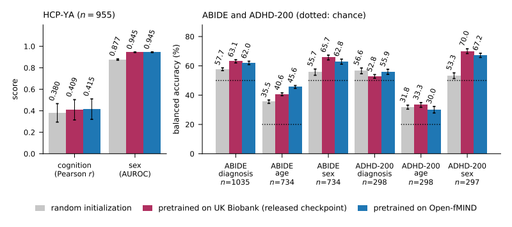
Figure 4 :A model pretrained on Open-fMIND reaches accuracy close to that of a model pretrained on UK Biobank.Frozen Brain-Semantoks encoders with a linear or kernel readout on HCP-YA, ABIDE and ADHD-200. Bars are means and error bars standard deviations over cross-validation folds (200 for HCP cognition) or repetitions (20 for HCP sex, 10 for ABIDE and ADHD-200). Accuracies are balanced accuracies, age is predicted as one of 5 classes of equal size, and dotted lines mark chance (50% for two classes, 20% for five).
出典 · CC BY 4.0 · Carlo Alberto Barbano, Giovanni Marraffini, Demian Wassermann · Open-fMIND: A Large-Scale Open-Access fMRI Corpus for Pretraining Brain Foundation Models · 論文の図を引用 · 元のPDFの10ページ目から図の部分を抽出しています。公開範囲と残差モーションの制約
Open-fMINDはパーセレーションされたROI時系列のみを公開するため、ボクセルレベルの詳細な空間解析は対象外です。ただし、パイプラインを使えばfMRIPrepの出力から別のアトラスを作り直すことができます。モーションの基準はあえて緩くしてあり、QC-FCで見られた残差モーションの信号も残っているため、より厳しい基準が必要な利用者は、qc.tsvのrunごとのモーション指標でフィルタリングする必要があります。さらに、サイトやスキャナーの効果があるため、データセットの出所による差が存在します。年齢と性別の分布は、元の研究の構成に従っています。
論文情報
- 著者
- Carlo Alberto Barbano, Giovanni Marraffini, Demian Wassermann
- 学会・ジャーナル
- arXiv · プレプリント
- 公開日
- 2026年11月16日
- 登録日
- 2026年11月18日
- 更新日
- 2026年11月16日
- バージョン
- v1
- arXiv
- 2611.21215
- カテゴリ
- cs.LG · q-bio.NC
- ライセンス
- CC BY 4.0
- 掲載内容
- 論文情報・解説・論文の図
この解説は、Refivuの韓国語解説をAIで翻訳したものです。不正確な翻訳や誤りが含まれる可能性があります。論文と図の利用条件は各出典に従います。
アブストラクト
Self-supervised pretraining has transformed language and vision, but its application to functional MRI (fMRI) is constrained by data access. The largest standardized fMRI resources are governed by data use agreements and dominated by a small number of acquisition protocols, while the thousands of openly licensed datasets on OpenNeuro are individually small, heterogeneously organized, and unprocessed. We present the first release of Open-fMIND, a uniformly preprocessed, openly accessible corpus of parcellated fMRI timeseries from 322 OpenNeuro studies, comprising 11,379 subjects and 45,731 functional runs. Each run is preprocessed with fMRIPrep and parcellated under 52 atlases spanning 14 families, yielding a massive 2.4 million timeseries. Timeseries are released either denoised with our default pipeline (preproc) or as the fMRIPrep output with its confound files (quasiraw), with functional connectivity matrices, per-run provenance and motion metadata. Open-fMIND is intended as a pretraining resource for self-supervised brain representation learning. Pretraining on it yields downstream performance comparable to that obtained with UK Biobank.
この論文を引用
Carlo Alberto Barbano, Giovanni Marraffini, Demian Wassermann (2026). Open-fMIND: A Large-Scale Open-Access fMRI Corpus for Pretraining Brain Foundation Models. arXiv:2611.21215v1. https://arxiv.org/abs/2611.21215v1
BibTeX
@misc{barbano2026open,
  title = {{Open-fMIND: A Large-Scale Open-Access fMRI Corpus for Pretraining Brain Foundation Models}},
  author = {Carlo Alberto Barbano and Giovanni Marraffini and Demian Wassermann},
  year = {2026},
  eprint = {2611.21215},
  archivePrefix = {arXiv},
  url = {https://arxiv.org/abs/2611.21215v1}
}