論文解説
Interpretable and Explainable Machine Learning for Materials Science and Chemistry
材料科学と化学のための解釈可能で説明可能な機械学習
- 課題 課題:材料科学と化学の機械学習では、予測性能に加えてモデルを理解し、科学的な知見を得られることが求められます。 手法:この論文は、解釈可能性と説明可能性の手法を整理しています。
- 手法 課題:論文は解釈可能性、完全性、正確性の間にあるトレードオフを定義しています。 手法:内在的な解釈と外在的な解釈、SHAP、深層学習における顕著性とアテンションなどの手法を、材料科学の事例とともに説明しています。
- 結果 課題:SHAP分析は、ペロブスカイト太陽電池のキャッピング層の事例で、上位の極性表面積とH-bond donorを劣化開始時間を予測する主要な特徴量として報告しています。 結果:この2つの特徴量が、予測に大きく寄与していたとされています。
科学的機械学習で解釈可能性が必要な理由
材料科学と化学の機械学習は、予測性能を超えて科学的な知見を与えられる必要があります。論文では、モデルの予測と内部の動作を人が理解できる水準で説明できれば、モデルの限界を見つけ、予測への信頼を高め、科学的発見につながる相関を明らかにできると強調されています。この論文は、こうした解釈可能性と説明可能性の手法を、材料科学と化学の事例に合わせて整理しています。
論文では、解釈可能性を、モデルが説明を提供し、人が動作を理解できる性質としています。説明可能性は、解釈可能性に完全性を加えた概念とされています。完全性とは、説明が実際のモデルの動作をどれだけ正確に反映しているかを指します。科学的な応用では、これに物理的・化学的な観点からの正確性という3つ目の観点が加わります。
解釈の分類と説明の範囲
論文では、解釈をモデル自体を調べる内在的解釈と、入力に対するモデルの反応を調べる外在的解釈に分けています。内在的解釈は構造に依存するため特定のアルゴリズムに限られ、主に大域的な説明を与えます。線形回帰はその代表例です。外在的解釈はモデルに依存しないか、帰納バイアスを利用することが多く、入力を変えて確かめる方法で局所的な説明を与える場合が多いです。
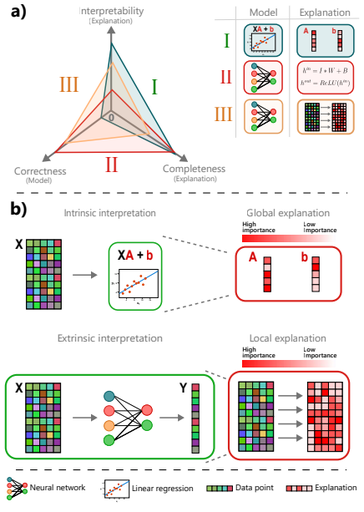
FIG. 1 . Key concepts a) Any explanation of a machine learning model has some inherent trade-offs to it. In partic- ular, any explanation should balance completeness, i.e. how well the given explanation approximates the operating mech- anisms of the actual model and interpretability, i.e. how well can a human subject understand the given explanation. In models that approximate real-world phenomena, we argue that a third dimension exists: correctness i.e. how correct a given explanation from the physical or chemical points of view. In the text, we explain the various trade-offs in more detail in examples I, II and III. b) Illustration of local/global explanations and intrinsic/extrinsic interpretability. In I) a linear model is a intrinsic interpretable model. By construc- tion, the vector coefficients A and b can be interpreted di- rectly, as represented by the color scale. In the same way, a linear model can be explained globally as both A and b are applied to all inputs X and have constant contributions for each input. II) A neural network requires extrinsic expla- nations. Due to its non-linear nature, interpretations of the model require observing the inputs along with the outputs. In the same way, a neural network model is better explained using local explanations: each input interacts in a different way with the model to generate specific outputs.
出典 · CC BY 4.0 · Felipe Oviedo, Juan Lavista Ferres, Tonio Buonassisi, Keith Butler · Interpretable and Explainable Machine Learning for Materials Science and Chemistry · 論文の図を引用 · 元のPDFの2ページ目から図の部分を抽出しています。論文は、深層学習モデルは数百万個の学習パラメータと非線形変換を使うため、構造を直接見るだけでは動作を理解しにくいと説明しています。そのため、深層学習の解釈は外在的な方法から得られます。論文では、従来のモデルで使われてきた外在的な方法の多くも、深層学習に適用できるとも付け加えられています。
SHAP解釈とペロブスカイト・キャッピング層の事例
SHAP値は、モデルの出力を局所線形の説明モデルで近似し、各特徴量が出力に与える局所的な効果を係数で表す方法です。論文では、これらの係数を合計すると大域的な特徴量寄与を得られると説明されています。
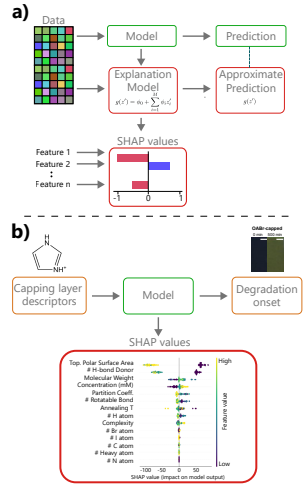
FIG. 2 . Interpretability with SHAP values (a) SHAP values are a generalization of various black-box explainability methods. SHAP values work by approximating the output of a model with a local linear explanation model. The coef- ficients of this explanation model quantify the local effect of each feature on the output. The coefficients can be aggre- gated to get global feature contributions. (b) Case study of SHAP analysis in material science [23]. A model is built to relate the physio-chemical descriptors of a capping layer of lead halide perovskite solar cells. Then, a machine learning model is trained to predict the onset time of degradation of the solar cells under ambient conditions. SHAP analysis al- lows to identify the dominant descriptors in the model, shown in the figures as a distribution of local SHAP values. Top po- lar surface area and H-bond donor have the most significant impact the output’s prediction and are demonstrated to have dominant importance by additional experimentation.
出典 · CC BY 4.0 · Felipe Oviedo, Juan Lavista Ferres, Tonio Buonassisi, Keith Butler · Interpretable and Explainable Machine Learning for Materials Science and Chemistry · 論文の図を引用 · 元のPDFの5ページ目から図の部分を抽出しています。論文の事例では、研究者らがハロゲン化鉛ペロブスカイト太陽電池のキャップ層の物理化学的記述子を入力とし、大気条件での劣化開始時間を予測する機械学習モデルを学習しました。その後、SHAP分析によりモデルの支配的な記述子を調べたところ、上位の極性表面積とH-bond donorが予測に最も大きく影響していることがわかりました。論文では、この2つの特徴量の重要性が追加実験でも確認されたと報告されています。
what-if分析の限界
部分依存プロットは、ある特徴量を変えたときに出力がどう変わるかを、他の特徴量の効果を周辺化して示します。論文は、この方法では交絡関係を見落とす可能性があると指摘しています。たとえば、平均原子量が大きくなるにつれて、密度の高い物質では誘電応答が大きくなり、多孔質の物質では小さくなる場合、この2つの効果は部分依存プロットで打ち消し合うことがあります。
個別条件付き期待値プロットは部分依存プロットに近いものですが、こうした相互作用を示せるように設計されています。論文では、SHAP分析にも限界があると説明されています。サンプリングの過程で相関のある特徴量の非現実的な組み合わせが生じることがあり、また特徴量間の因果の向きを表さないためです。
解釈可能性と因果性の違い
論文は、解釈可能性は因果性と同じものではないと説明しています。機械学習モデルが物理現象をおおまかに近似していても、予測変数の影響力を示すにとどまり、それ自体では因果的な説明にはなりません。そのため著者らは、物理的な知見を得るには、解釈手法を後続の実験や明示的な因果モデリングで補う必要があると主張しています。
この観点から、機械学習の解釈は科学的な仮説を立て、モデルの予測を理解するための有用なツールとして位置づけられています。生成された仮説には、別途の確認が必要です。
論文情報
- 著者
- Felipe Oviedo, Juan Lavista Ferres, Tonio Buonassisi, Keith Butler
- 学会・ジャーナル
- arXiv · プレプリント
- 公開日
- 2021年11月1日
- 登録日
- 2026年11月6日
- 更新日
- 2021年11月3日
- バージョン
- v2
- arXiv
- 2111.01037
- DOI
- 10.1021/accountsmr.1c00244
- カテゴリ
- cond-mat.mtrl-sci · cs.LG
- ライセンス
- CC BY 4.0
- 掲載内容
- 論文情報・解説・論文の図
この解説は、Refivuの韓国語解説をAIで翻訳したものです。不正確な翻訳や誤りが含まれる可能性があります。論文と図の利用条件は各出典に従います。
アブストラクト
While the uptake of data-driven approaches for materials science and chemistry is at an exciting, early stage, to realise the true potential of machine learning models for successful scientific discovery, they must have qualities beyond purely predictive power. The predictions and inner workings of models should provide a certain degree of explainability by human experts, permitting the identification of potential model issues or limitations, building trust on model predictions and unveiling unexpected correlations that may lead to scientific insights. In this work, we summarize applications of interpretability and explainability techniques for materials science and chemistry and discuss how these techniques can improve the outcome of scientific studies. We discuss various challenges for interpretable machine learning in materials science and, more broadly, in scientific settings. In particular, we emphasize the risks of inferring causation or reaching generalization by purely interpreting machine learning models and the need of uncertainty estimates for model explanations. Finally, we showcase a number of exciting developments in other fields that could benefit interpretability in material science and chemistry problems.
この論文を引用
Felipe Oviedo, Juan Lavista Ferres, Tonio Buonassisi, Keith Butler (2021). Interpretable and Explainable Machine Learning for Materials Science and Chemistry. arXiv:2111.01037v2. https://doi.org/10.1021/accountsmr.1c00244
BibTeX
@article{oviedo2021interpretable,
  title = {{Interpretable and Explainable Machine Learning for Materials Science and Chemistry}},
  author = {Felipe Oviedo and Juan Lavista Ferres and Tonio Buonassisi and Keith Butler},
  year = {2021},
  eprint = {2111.01037},
  archivePrefix = {arXiv},
  doi = {10.1021/accountsmr.1c00244},
  url = {https://arxiv.org/abs/2111.01037v2}
}