論文解説
Unreasonable Confidence from Simulator Misspecification: Directional Robustness on the SPEED+ Sim-to-Real Benchmark
根拠のない確信:SPEED+ Sim-to-Realベンチマークにおける方向性の頑健性
- 課題 合成画像で学習した姿勢推定器は、実際の軌道画像で回転誤差が大きく増えますが、その誤差は不確実性指標では検出できません。
- 手法 ResNet-50による直接回帰の推定器を合成画像だけで学習し、バックボーンの凍結の有無と光度拡張の有無を2×2で変えて、2つの実ドメインで評価します。
- 結果 レイヤー4を学習すると合成回転誤差は0.32 radまで下がり、その利得の63–83%が実ドメインに移りました。
合成学習と実画像の間にある差
宇宙機の姿勢推定モデルは、実際の軌道画像をほとんど得られないため、シミュレータが生成した合成画像で学習します。本論文は、SPEED+ベンチマークにおいて、合成画像と実際のモックアップ画像(lightbox、sunlamp)の差がどこから生じるのかを問いかけています。著者らは、シミュレータの誤差は幾何ではなく放射測定(radiometric)の側にあると考えています。合成画像には、反射ハイライト、強い影、センサーの飽和が欠けているという説明です。著者らは、この差によってモデルが誤ったときに、不確実性指標も信頼できなくなるかどうかを併せて確認しようとしています。
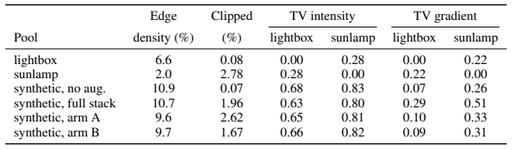
Table 8 : Pooled image statistics and total-variation distance to each real domain.
出典 · CC BY 4.0 · Nikolay Dolgov · Unreasonable Confidence from Simulator Misspecification: Directional Robustness on the SPEED+ Sim-to-Real Benchmark · 論文の図を引用 · 元のPDFの8ページ目から図の部分を抽出しています。単純な直接回帰の推定器と2×2の設計
推定器は、ImageNetで事前学習したResNet-50に2層のMLPヘッドを付けた、直接姿勢回帰モデルです。バックボーンのプーリング特徴量2048次元をヘッドが受け取り、並進と単位クォータニオンを出力します。損失は、並進のMSEと、クォータニオンの内積に基づく項をλ=1で足し合わせた形です。クォータニオンの符号の曖昧さを避けるため、内積の二乗を使っています。実験は、バックボーンを凍結した場合とレイヤー4を学習した場合、そして光度拡張を入れる場合と入れない場合を組み合わせた2×2の設計で行いました。学習には合成画像のみを使い、チェックポイントは合成検証データの回転誤差で選びます。
回転誤差とskill指標
評価には、正規化された並進誤差ETと測地線回転誤差ERを用います。公式のSPEED+スコアSは両者の単純な和です。回転誤差にはランダム推測のベースラインが必要なため、一様分布を仮定すると E[θ]=π/2+2/π≈2.207 rad を chance level とします。skillは2.207からERを引いた値で、同じ生の誤差でも、chance からどれだけ離れているかを示します。付録の定数姿勢ベースラインは、SPEED+の姿勢が完全には一様でないため、この値が最大で0.031 rad程度ずれうることを示しています。
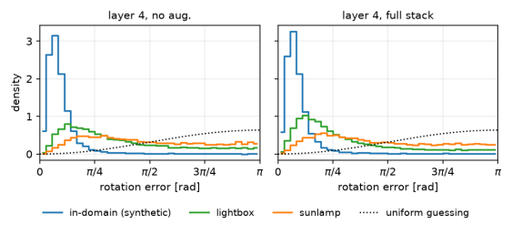
Figure 3 : Rotation-error densities on each domain for the layer-4 arms, pooled over three seeds, against the density uniform guessing gives,(1−cosθ)/π(dotted).
出典 · CC BY 4.0 · Nikolay Dolgov · Unreasonable Confidence from Simulator Misspecification: Directional Robustness on the SPEED+ Sim-to-Real Benchmark · 論文の図を引用 · 元のPDFの9ページ目から図の部分を抽出しています。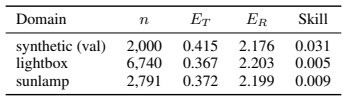
Table 15 : A constant pose fitted on the training split, evaluated on each test domain. ET range- normalised,E R in radians. Skill is2.207−E R. Reported for the Karcher-refined estimate.
出典 · CC BY 4.0 · Nikolay Dolgov · Unreasonable Confidence from Simulator Misspecification: Directional Robustness on the SPEED+ Sim-to-Real Benchmark · 論文の図を引用 · 元のPDFの17ページ目から図の部分を抽出しています。合成での改善が実画像へ移る仕組み
一方、レイヤー4を学習すると、合成誤差は1.03から0.32 radに下がり、その追加の利得の63–83%がlightboxとsunlampに移りました。lightboxは1.76から1.17 radに、sunlampは1.99から1.53 radに下がりました。著者らは、利得の大きさよりも、どのような仕組みで得られた利得なのかが重要だと解釈しています。
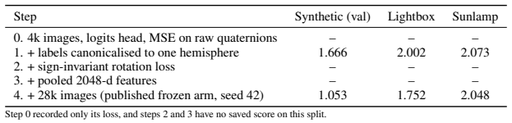
Table 4 : Main results: mean ± s.d. over seeds {42, 43, 44}. ET range-normalised, ER in rad (chance level 2.207). Checkpoints are picked by best synthetic validationE R.
出典 · CC BY 4.0 · Nikolay Dolgov · Unreasonable Confidence from Simulator Misspecification: Directional Robustness on the SPEED+ Sim-to-Real Benchmark · 論文の図を引用 · 元のPDFの5ページ目から図の部分を抽出しています。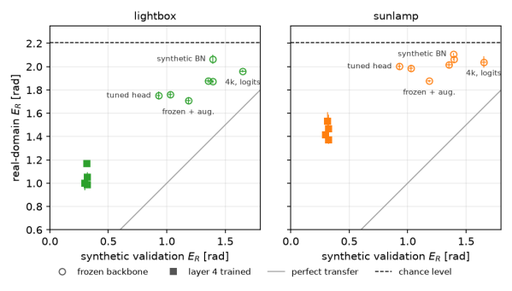
Figure 1 : Synthetic against real rotation error for every configuration: frozen-backbone heads (open circles) and layer-4 arms (squares), mean ± s.d. over seeds. The grey line marks perfect transfer and the dashed line chance.
出典 · CC BY 4.0 · Nikolay Dolgov · Unreasonable Confidence from Simulator Misspecification: Directional Robustness on the SPEED+ Sim-to-Real Benchmark · 論文の図を引用 · 元のPDFの6ページ目から図の部分を抽出しています。光度拡張の効果は学習対象のバックボーンで変わります
拡張スタックは、明るさ・コントラストのジッター、ガンマ、グレアブロブ、ブラー、ノイズ、ランダム消去を確率的に適用します。バックボーンを凍結した場合は効果の向きが逆転し、sunlampがすべてのシードで改善しました。
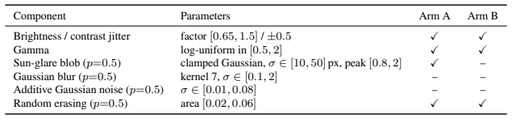
Table 2 : The photometric stack, in order. Stochastic components apply with p=0.5. Arm A drops blur and noise, and arm B also drops the glare blob.
出典 · CC BY 4.0 · Nikolay Dolgov · Unreasonable Confidence from Simulator Misspecification: Directional Robustness on the SPEED+ Sim-to-Real Benchmark · 論文の図を引用 · 元のPDFの4ページ目から図の部分を抽出しています。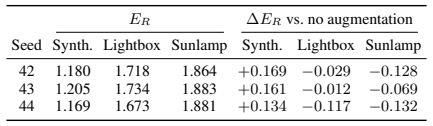
Table 6 : Frozen backbone with augmentation, ER (rad) per seed and paired difference from the head-only retrain without augmentation (same seed).
出典 · CC BY 4.0 · Nikolay Dolgov · Unreasonable Confidence from Simulator Misspecification: Directional Robustness on the SPEED+ Sim-to-Real Benchmark · 論文の図を引用 · 元のPDFの7ページ目から図の部分を抽出しています。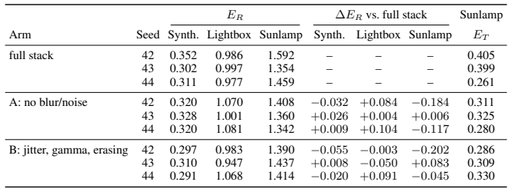
Table 7 : Augmentation ablation, ER (rad) per seed and paired difference from the published full stack (layer 4, same seed). Last column: sunlampE T .
出典 · CC BY 4.0 · Nikolay Dolgov · Unreasonable Confidence from Simulator Misspecification: Directional Robustness on the SPEED+ Sim-to-Real Benchmark · 論文の図を引用 · 元のPDFの7ページ目から図の部分を抽出しています。合成で較正した領域が実画像で崩れる理由
分割コンフォーマル領域は、合成データ1,000枚で90%の名目レベルに較正しました。合成ドメインではカバレッジはほぼ名目レベルを維持しましたが、sunlampではレイヤー4・拡張なしの設定の回転カバレッジが9–13%にとどまりました。著者らは、これを較正の前提である交換可能性が合成と実画像の間で崩れたためだと解釈しています。このカバレッジはmarginalな保証であり、距離区間ごとに見ると、較正は条件付きでは保たれないことも確認したと述べています。AdaBNでBatchNormの統計量を実ドメインで再推定すると、誤差は減りますが、回転カバレッジは最大40%、sunlampでは最大20%程度にとどまりました。
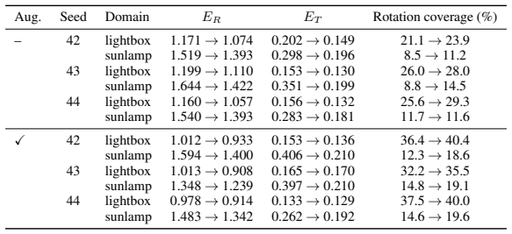
Table 9 : AdaBN on the held-out half of each real domain: unadapted → adapted. Coverage is of the 90% synthetic-calibrated rotation cone.
出典 · CC BY 4.0 · Nikolay Dolgov · Unreasonable Confidence from Simulator Misspecification: Directional Robustness on the SPEED+ Sim-to-Real Benchmark · 論文の図を引用 · 元のPDFの9ページ目から図の部分を抽出しています。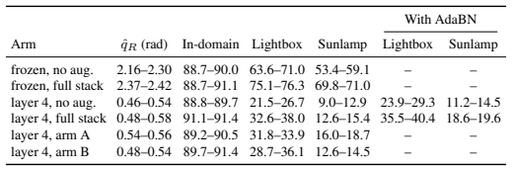
Table 10 : Rotation coverage (%) of the 90% synthetic-calibrated cone, range over three seeds. AdaBN columns: after re-estimating layer 4’s BatchNorm statistics on the other half of each real domain.
出典 · CC BY 4.0 · Nikolay Dolgov · Unreasonable Confidence from Simulator Misspecification: Directional Robustness on the SPEED+ Sim-to-Real Benchmark · 論文の図を引用 · 元のPDFの10ページ目から図の部分を抽出しています。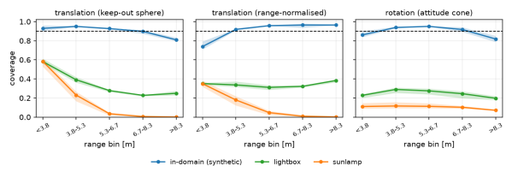
Figure 5 : Coverage of the marginal 90% region within each range bin (quintiles of the calibration split’s range) for the layer-4 arm without augmentation: mean over three seeds, range shaded. Dashed: nominal.
出典 · CC BY 4.0 · Nikolay Dolgov · Unreasonable Confidence from Simulator Misspecification: Directional Robustness on the SPEED+ Sim-to-Real Benchmark · 論文の図を引用 · 元のPDFの11ページ目から図の部分を抽出しています。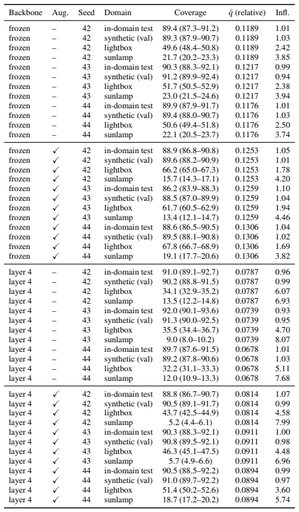
Table 13 : Conformal coverage at nominal 90%, translation scored with the range-normalised error ET .
出典 · CC BY 4.0 · Nikolay Dolgov · Unreasonable Confidence from Simulator Misspecification: Directional Robustness on the SPEED+ Sim-to-Real Benchmark · 論文の図を引用 · 元のPDFの16ページ目から図の部分を抽出しています。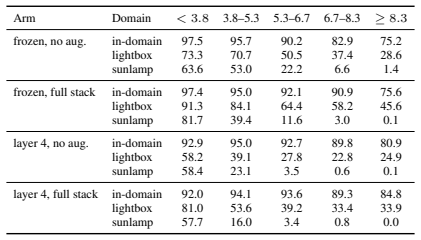
Table 17 : Coverage (%) of the marginal 90% region by range bin (m), translation, metres, as the mean over the seeds of each arm. Bins are quintiles of the calibration split’s range.
出典 · CC BY 4.0 · Nikolay Dolgov · Unreasonable Confidence from Simulator Misspecification: Directional Robustness on the SPEED+ Sim-to-Real Benchmark · 論文の図を引用 · 元のPDFの20ページ目から図の部分を抽出しています。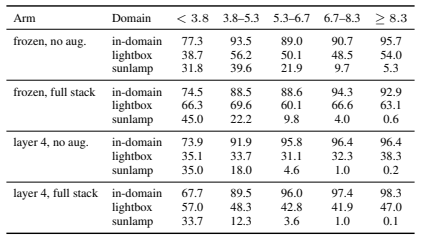
Table 18 : Coverage (%) of the marginal 90% region by range bin (m), translation, range-normalised, as the mean over the seeds of each arm. Bins are quintiles of the calibration split’s range.
出典 · CC BY 4.0 · Nikolay Dolgov · Unreasonable Confidence from Simulator Misspecification: Directional Robustness on the SPEED+ Sim-to-Real Benchmark · 論文の図を引用 · 元のPDFの20ページ目から図の部分を抽出しています。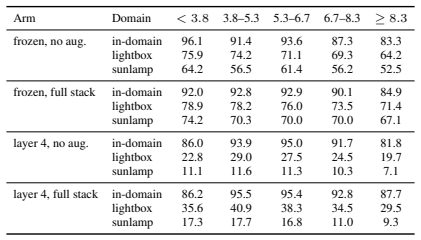
Table 19 : Coverage (%) of the marginal 90% region by range bin (m), rotation, as the mean over the seeds of each arm. Bins are quintiles of the calibration split’s range.
出典 · CC BY 4.0 · Nikolay Dolgov · Unreasonable Confidence from Simulator Misspecification: Directional Robustness on the SPEED+ Sim-to-Real Benchmark · 論文の図を引用 · 元のPDFの20ページ目から図の部分を抽出しています。限界と今後の課題
実験は、単純な推定器1つ、ベンチマーク1つ、320×512の解像度に限られています。実ドメインの誤差は約1 rad程度であるため、実運用向けの航法器というより診断の基準線です。sunlampのテストセットは2,791枚で、3つのシードでは0.1 rad程度の効果を区別しにくいです。一部の除去実験と再実験は、別のハードウェアで行われました。著者らは、特定の物体マスキングの統計や完全なファインチューニングによる結果は確認していないと述べています。重み付きコンフォーマル予測は、ドメインの密度比が重ならないため、まだ適用しにくいと記しています。
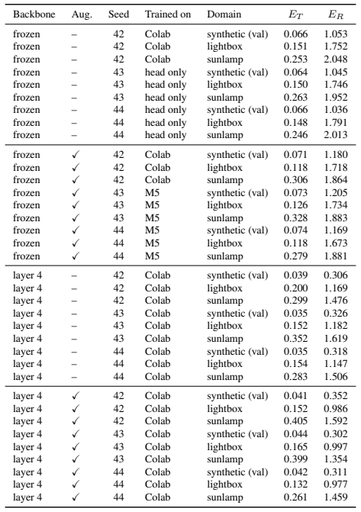
Table 11 : Per-seed results behind Table 4. ET range-normalised, ER in rad (chance level 2.207). Head only: the head retrained on cached frozen features.
出典 · CC BY 4.0 · Nikolay Dolgov · Unreasonable Confidence from Simulator Misspecification: Directional Robustness on the SPEED+ Sim-to-Real Benchmark · 論文の図を引用 · 元のPDFの14ページ目から図の部分を抽出しています。論文情報
- 著者
- Nikolay Dolgov
- 学会・ジャーナル
- arXiv · プレプリント
- 公開日
- 2026年11月15日
- 登録日
- 2026年11月17日
- 更新日
- 2026年11月15日
- バージョン
- v1
- arXiv
- 2611.20321
- カテゴリ
- cs.CV · cs.AI · cs.LG
- ライセンス
- CC BY 4.0
- 掲載内容
- 論文情報・解説・論文の図
この解説は、Refivuの韓国語解説をAIで翻訳したものです。不正確な翻訳や誤りが含まれる可能性があります。論文と図の利用条件は各出典に従います。
アブストラクト
Vision-based navigation systems for orbit must be trained almost entirely on synthetic imagery, because real labelled images of a given spacecraft in flight rarely exist. Benchmarks like SPEED+ are built for that situation: the training set comes from a simulator, and the test sets are real images of a satellite mockup under two kinds of lighting. That simulator approximates how light reflects off mylar and aluminium, and like every scientific simulator it is misspecified. Its error is radiometric, since it misses the specular highlights, hard shadows and sensor saturation common in real images. We probe the resulting synthetic-to-real gap, the central risk for such systems, with a deliberately simple monocular pose estimator. In a 2x2 study of backbone adaptation and photometric augmentation, trained on synthetic images and tested on both real hardware-in-the-loop domains, we find three things. (1) The model does not know it is failing: regions conformally calibrated to 90% on synthetic data cover only 9-15% of rotation errors on sunlamp and 21-38% on lightbox, so a wrong pose carries the confidence of a correct one. (2) Transfer is asymmetric: scaling data and features improved synthetic rotation error from 1.65 to 1.03 rad but moved the harshly lit sunlamp domain by only 0.05 rad, under twice its seed s.d., whereas adapting the backbone's last stage carried 63-83% of its extra synthetic gain to both real domains. (3) Once the backbone adapts, augmentation helps only in the direction it models: our photometric stack improved the diffusely lit lightbox domain from 1.17 to 0.99 rad on every seed but moved sunlamp no more than seed-to-seed variation, while with the backbone frozen it helped sunlamp more. Every post-review experiment was pre-registered, and the code, per-image predictions and pre-registration record are at https://github.com/lokindoo/spacecraft-pose-estimation.
この論文を引用
Nikolay Dolgov (2026). Unreasonable Confidence from Simulator Misspecification: Directional Robustness on the SPEED+ Sim-to-Real Benchmark. arXiv:2611.20321v1. https://arxiv.org/abs/2611.20321v1
BibTeX
@misc{dolgov2026unreasonable,
  title = {{Unreasonable Confidence from Simulator Misspecification: Directional Robustness on the SPEED+ Sim-to-Real Benchmark}},
  author = {Nikolay Dolgov},
  year = {2026},
  eprint = {2611.20321},
  archivePrefix = {arXiv},
  url = {https://arxiv.org/abs/2611.20321v1}
}