論文解説
Beyond Row-Level Prediction: Evaluating and Learning Composition for Reusable Table Representations
行単位予測を超えて:再利用可能なテーブル表現のための構成の評価と学習
- 課題 表単位の埋め込みは、行単位の予測では品質を十分に測ることが難しいです。
- 手法 表の埋め込みを局所状態と合成規則に分け、凍結したConTextTab上でSCDMにより合成ヘッドだけを学習します。
行単位予測で表埋め込みを評価する限界
表は、スキーマ、セルの値、行と列の構造にわたって内容が広がっています。検索、重複除去、データキュレーションといった作業では、表ごとに再利用可能な埋め込みベクトルが1つ必要です。しかし既存の表表現手法は、主に行単位の予測や教師あり学習の下流タスクで評価されており、表単位の埋め込みの品質を直接測ることはできません。この論文は、表単位の埋め込みを部分ビュー一貫性、ラベル粒度別の識別力、良性の摂動に対する頑健性、効率性の4つの基準で直接評価するベンチマークを提案します。以降の節では、固定プーリングで作った埋め込みの弱点が、エンコーダの状態によるものか合成規則によるものかを切り分けて見ていきます。
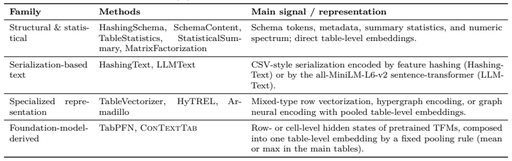
Table 1 : Benchmark summary. Part (A) lists the families of table representation methods compared under the shared observation interface, and part (B) lists the desiderata, main metrics, and corresponding evaluation targets. Full details are provided in Appendix A.1 and Appendix A.2.
出典 · CC BY 4.0 · Ali Younes, Saeed Ghoorchian, Maximilian Schambach, Georgia Chalvatzaki, Johannes Höhne · Beyond Row-Level Prediction: Evaluating and Learning Composition for Reusable Table Representations · 論文の図を引用 · 元のPDFの5ページ目から図の部分を抽出しています。局所状態と合成規則の分離
この論文は、表単位の埋め込みを、エンコーダが作る局所状態の集合H(T)と、その集合を1つのベクトルに変換する合成規則Cの組み合わせとして捉えています。固定プーリングの実験では、Cは平均、最大値、合計、最小値、標準偏差のプーリングのような、パラメータを持たない規則です。2つの表埋め込みの比較は、すべての手法でコサイン類似度に統一しました。2段階目では、TFMエンコーダのConTextTabを凍結し、合成規則だけを学習可能なヘッドに置き換えます。ヘッドは元の表を見ず、凍結されたセル状態だけを受け取るため、基準は同じ状態に対する固定プーリングになります。
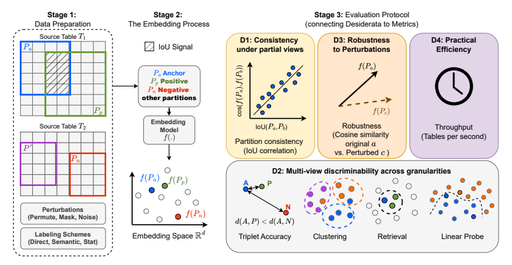
Figure 1 : The evaluation pipeline. Stage 1 samples partitions from source tables and attaches labeling schemes and perturbations. Stage 2 maps each partition to a single table-level embedding, either directly or by composing local encoder states with a fixed or learned compositional rule. Stage 3 measures the four desiderata through concrete metrics, so lightweight baselines and foundation-model-derived representations are compared under the same observation interface. or supervised downstream tasks (Hollmann et al., 2025; Spinaci et al., 2025; Hoppe et al., 2025). Naturally, these evaluations show how well a model predicts, not how good its table-level embedding is.
出典 · CC BY 4.0 · Ali Younes, Saeed Ghoorchian, Maximilian Schambach, Georgia Chalvatzaki, Johannes Höhne · Beyond Row-Level Prediction: Evaluating and Learning Composition for Reusable Table Representations · 論文の図を引用 · 元のPDFの2ページ目から図の部分を抽出しています。SCDM損失による合成ヘッドの学習
SCDMは、埋め込みの類似度の分布を、パーティション間のIoUで定めた目標分布に合わせる損失です。目標分布Tは、同じ元の表から得られた候補に対して、アンカーとのIoUを合計で割った値です。局所の支持集合では同じ表の候補を、大域の支持集合ではバッチ全体を用いて正規化した確率分布P_localとP_globalを使います。全体の損失は L = α D_KL(T||P_local) + (1−α) D_KL(T||P_global) です。ここでαは、同じ表の中での細かな包含構造と、表どうしの識別のバランスを調整します。学習は実際の表でのみ行われ、学習時のパーティション方針は評価時の方針と異なります。
各ヘッドを3つのシードで学習させ、そのうえで検証スコアが最も高いチェックポイントを選びます。
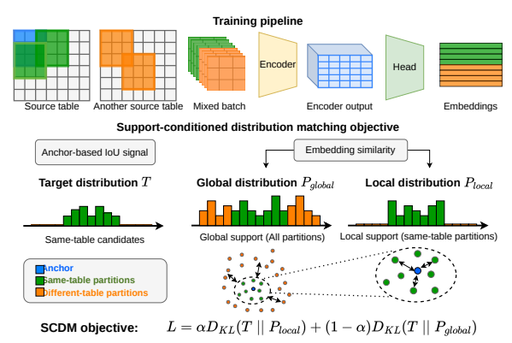
Figure 4 : Learning table-level composition on top of frozenConTextTab. At the top, partitions sampled from one source table and from other source tables are collated into mixed batches, encoded by the frozen backbone, and aggregated by a trainable representation head into table embeddings. At the bottom, support- conditioned distribution matching defines a target distributionT from anchor-based overlap and matches it with local and global similarity distributions induced by the learned embeddings.
出典 · CC BY 4.0 · Ali Younes, Saeed Ghoorchian, Maximilian Schambach, Georgia Chalvatzaki, Johannes Höhne · Beyond Row-Level Prediction: Evaluating and Learning Composition for Reusable Table Representations · 論文の図を引用 · 元のPDFの9ページ目から図の部分を抽出しています。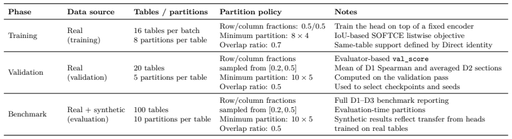
Table 25 : Training, validation, and final benchmark protocols for learned representation heads.
出典 · CC BY 4.0 · Ali Younes, Saeed Ghoorchian, Maximilian Schambach, Georgia Chalvatzaki, Johannes Höhne · Beyond Row-Level Prediction: Evaluating and Learning Composition for Reusable Table Representations · 論文の図を引用 · 元のPDFの31ページ目から図の部分を抽出しています。固定プーリング埋め込みのベンチマーク性能
固定プーリングで作ったTabPFNとConTextTabの埋め込みは、合成データでのD1 Spearman相関が−0.17から0.04の間にとどまりました。同じ条件のHashingTextとHashingSchemaは、0.54から0.59を記録しています。5つのプーリング規則を同じ単一の順伝播の状態に適用しても結論は変わらず、平均と合計はコサインベースの指標で同じ値になりました。著者らは、この弱点は特定のプーリング規則だけの問題ではなく、固定された集約方式に由来すると解釈しています。
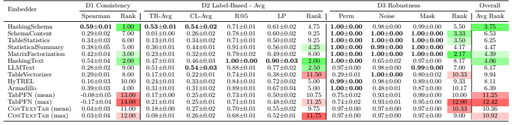
Table 2 : Evaluation Results for Synthetic data (mean±95% CI over 10 seeds).
出典 · CC BY 4.0 · Ali Younes, Saeed Ghoorchian, Maximilian Schambach, Georgia Chalvatzaki, Johannes Höhne · Beyond Row-Level Prediction: Evaluating and Learning Composition for Reusable Table Representations · 論文の図を引用 · 元のPDFの7ページ目から図の部分を抽出しています。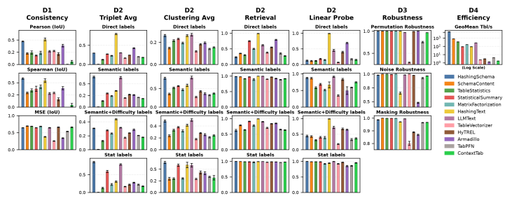
Figure 2 : Metric summary for Synthetic data across the benchmark dimensions.
出典 · CC BY 4.0 · Ali Younes, Saeed Ghoorchian, Maximilian Schambach, Georgia Chalvatzaki, Johannes Höhne · Beyond Row-Level Prediction: Evaluating and Learning Composition for Reusable Table Representations · 論文の図を引用 · 元のPDFの7ページ目から図の部分を抽出しています。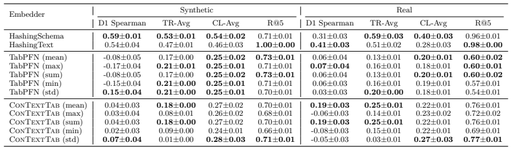
Table 4 : Five parameter-free pooling rules applied to the same TabPFN andConTextTabstates (Ap- pendix A.7), with the two strongest fingerprints for reference (mean± 95% CI over 10 seeds). Mean and max rows match Tables 2 and 3. Bold marks the best value per column within each group.
出典 · CC BY 4.0 · Ali Younes, Saeed Ghoorchian, Maximilian Schambach, Georgia Chalvatzaki, Johannes Höhne · Beyond Row-Level Prediction: Evaluating and Learning Composition for Reusable Table Representations · 論文の図を引用 · 元のPDFの8ページ目から図の部分を抽出しています。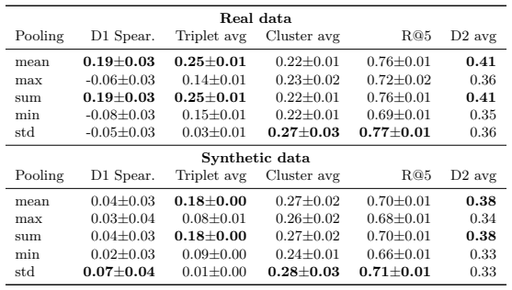
Table 14 :ConTextTabunder all non-learned poolings (mean± 95% CI over 10 seeds). D2 avg averages the triplet, clustering, and retrieval columns as displayed. Best value per column inbold.
出典 · CC BY 4.0 · Ali Younes, Saeed Ghoorchian, Maximilian Schambach, Georgia Chalvatzaki, Johannes Höhne · Beyond Row-Level Prediction: Evaluating and Learning Composition for Reusable Table Representations · 論文の図を引用 · 元のPDFの26ページ目から図の部分を抽出しています。学習されたヘッドの改善幅
例外はα=1のAttentionで、D1が0.17、トリプレット順位が0.24となり、プーリングの基準を上回ることはできませんでした。この改善は、エンコーダが変わらないという条件で得られたものです。また実データでは、改善幅は合成データより小さくなりました。
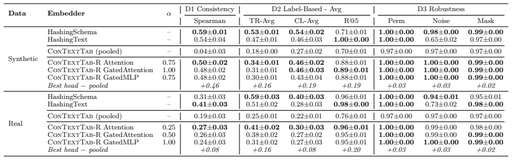
Table 5 : Learned compositional rules on frozenConTextTabstates, compared with fixed pooling of the same states and with the two strongest fingerprints (mean± 95% CI over 10 seeds). Each head is the validation-selected checkpoint at theα with the lowest D1–D3 average rank (allα in Appendix A.10). Bold marks the best value per column within each group; italic rows give the best head’s gain over pooling.
出典 · CC BY 4.0 · Ali Younes, Saeed Ghoorchian, Maximilian Schambach, Georgia Chalvatzaki, Johannes Höhne · Beyond Row-Level Prediction: Evaluating and Learning Composition for Reusable Table Representations · 論文の図を引用 · 元のPDFの11ページ目から図の部分を抽出しています。上位表検索による検証
下流の検証として、親の表を検索するタスクを設けました。クエリはサンプリングされたパーティションで、候補コーパスは100個の元の表です。指標はRecall@1、Recall@5、Recall@10、MRRです。ただし、SCDMは検索指標で学習したわけではないものの、包含のような表の信号を用いるため、この部分は独立した検証ではなく一貫性の確認として読むべきです。
代表的な設定と残る問い
この論文の固定プーリングの結果は、TabPFNとConTextTabの2つのモデルに関するものです。他のTFMは、より良い埋め込みも悪い埋め込みも出す可能性があります。学習実験では1つのバックボーンだけを使い、合成規則が唯一学習される構成要素になるようにしました。検索タスクは100個の表からなる閉じたコーパスで行ったため、オープンな検索や複数表の推論は対象外です。学習されたヘッドの信頼区間は、学習の実行間のばらつきではなく評価時のサンプリングを反映しており、ラベルの種類ごとに利得が一様に現れるかは分析していません。特に、実データで学習したヘッドが最良の基準との間に残す差の原因が、バックボーン、ヘッドの容量、目的関数、学習と評価のパーティションの違いのどれなのかは、この実験では区別できません。
論文情報
- 著者
- Ali Younes, Saeed Ghoorchian, Maximilian Schambach, Georgia Chalvatzaki, Johannes Höhne
- 学会・ジャーナル
- arXiv · プレプリント
- 公開日
- 2026年11月10日
- 登録日
- 2026年11月13日
- 更新日
- 2026年11月10日
- バージョン
- v1
- arXiv
- 2611.14697
- カテゴリ
- cs.LG
- ライセンス
- CC BY 4.0
- 掲載内容
- 論文情報・解説・論文の図
この解説は、Refivuの韓国語解説をAIで翻訳したものです。不正確な翻訳や誤りが含まれる可能性があります。論文と図の利用条件は各出典に従います。
アブストラクト
Tables are compositional, with content spread across a schema, cell values, rows, and columns. Large-scale operations such as retrieval, overlap estimation, deduplication, and data curation need these local signals composed into one reusable embedding vector per table. Table representation methods, however, are mostly evaluated through row-level prediction or supervised downstream tasks, which do not measure table-level embedding quality directly. We introduce a benchmark that evaluates table-level embeddings through four desiderata: consistency under partial views, discriminability across label granularities, robustness to benign perturbations, and efficiency. Across twelve methods on synthetic and real corpora, lightweight schema- and text-based fingerprints are among the strongest. The sharpest contrast comes from two tabular foundation models, TabPFN and ConTextTab: although both are strong row-level predictors, their states, composed by mean, max, or three further parameter-free pooling rules, trail the strongest fingerprints. We therefore ask whether the gap lies in the encoder or in the compositional rule. Keeping ConTextTab frozen, we learn only the compositional rule over its cell states, using support-conditioned distribution matching (SCDM), a self-supervised loss we propose that matches the distribution of embedding similarities to the distribution of partition overlaps within and across tables. Across all fifteen head configurations, the learned rule raises the Spearman correlation between embedding similarity and partial-view overlap from 0.04 to 0.43-0.50 on synthetic data and improves triplet ranking, clustering, and retrieval, with smaller but systematic gains on real data. A downstream parent-table retrieval task confirms these findings. How local states are composed, and with what objective, substantially affects the quality of table-level embeddings.
この論文を引用
Ali Younes, Saeed Ghoorchian, Maximilian Schambach, Georgia Chalvatzaki, Johannes Höhne (2026). Beyond Row-Level Prediction: Evaluating and Learning Composition for Reusable Table Representations. arXiv:2611.14697v1. https://arxiv.org/abs/2611.14697v1
BibTeX
@misc{younes2026beyond,
  title = {{Beyond Row-Level Prediction: Evaluating and Learning Composition for Reusable Table Representations}},
  author = {Ali Younes and Saeed Ghoorchian and Maximilian Schambach and Georgia Chalvatzaki and Johannes Höhne},
  year = {2026},
  eprint = {2611.14697},
  archivePrefix = {arXiv},
  url = {https://arxiv.org/abs/2611.14697v1}
}